
AUTO-120 · Lesson 5 of 12 · 21 min
Camshafts, timing belts and timing chains
On Tuesday Simone books the Lindqvists' minivan for a morning appointment. Erik Lindqvist has heard a rattle for a couple of seconds when the van starts on cold mornings, and now the check engine light is on. Marty pulls the codes, notes a crankshaft-to-camshaft correlation code for bank 1, and tells Simone the van will need a proper diagnosis that afternoon. Then he turns to Kiran. “Before you help me with that van, you need to know how a timing drive works and how it fails. The training engine has a belt. The van has chains. Learn both.”
The camshaft must turn at exactly half the speed of the crankshaft, in a fixed relationship to it, for the engine to run. This lesson describes camshafts and the three ways of driving them, gears, chains and belts, how timing marks are used to set the relationship, why belts must be replaced on schedule, and how chains wear and stretch. The diagnosis of the Lindqvists' van comes together in the capstone, Lesson 12.
The camshaft
A camshaft is a cast iron or steel shaft, or on many modern engines a steel tube with lobes pressed onto it, carrying one lobe for every valve it operates. It turns in bearings, either in the block on a pushrod engine or in caps on top of the head on an overhead camshaft engine, and it is lubricated by oil from the engine's galleries. A thrust surface controls its end play. On many engines the camshaft also drives other parts: a high-pressure fuel pump for direct injection from an extra lobe, a vacuum pump for the brakes, or on older engines the distributor and oil pump.
Because each cylinder's valves open once in every two crankshaft revolutions, the camshaft turns once for every two crankshaft turns. A cam sprocket therefore has twice as many teeth as the crankshaft sprocket it is linked to, or the drive includes a gear that halves the speed. One degree of camshaft rotation equals two degrees of crankshaft rotation, which matters when a scan tool reports camshaft angles and when a chain or belt is one tooth out.
Camshaft lobes and their followers wear if the engine's oil is wrong or neglected, especially on engines with flat tappets, where the lobe slides on the follower rather than rolling. A worn lobe opens its valve less, the cylinder breathes poorly, and the engine may misfire or lose power. Worn lobes can be measured with a micrometer across the nose and the base circle, or with a dial indicator on the follower while the engine is turned by hand, and compared with the specified lift.
Three ways to drive a camshaft
Gear drives connect the crankshaft and camshaft with a pair of meshed gears. They are very durable and are used in many diesel and heavy-duty engines, and in some older pushrod engines. Their drawback is noise and cost.
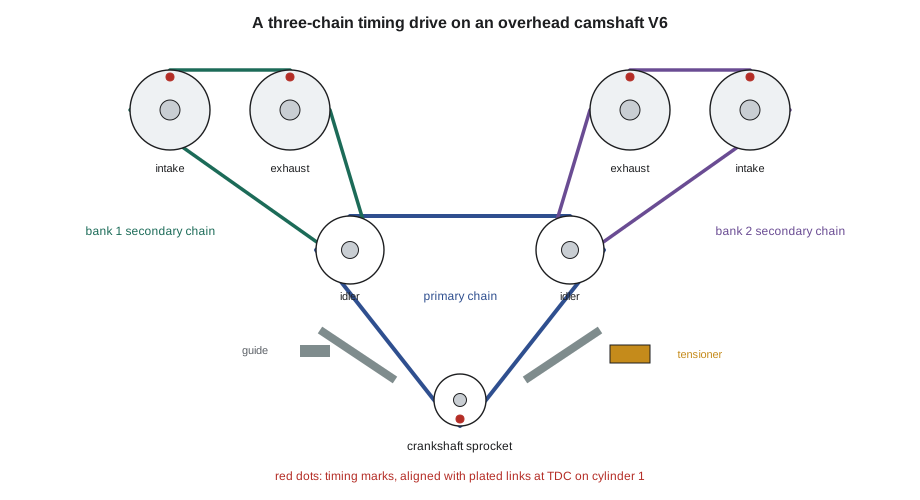
Timing chains are the most common drive on engines built today. A roller chain is like a bicycle chain; a silent chain, or inverted-tooth chain, is made of stacked toothed plates and runs more quietly. The chain runs on sprockets, and plastic-faced guides keep it from whipping, while a tensioner presses a shoe against the slack side to take up the slack. Most tensioners are hydraulic: engine oil pressure pushes a plunger out, and a ratchet stops it from retracting too far when the engine is off. On a pushrod engine like Gord's V8, a single short chain links the crankshaft to the camshaft in the block. On an overhead camshaft V6 like the Lindqvists', a primary chain drives the camshafts on both banks, often through an idler sprocket that drives shorter secondary chains, so the engine may have three chains, three or more guides and three tensioners.
Timing belts are toothed belts of rubber reinforced with glass or aramid cords. They are quiet, light and cheap, and they need no lubrication, so they run outside the engine behind a plastic cover. A tensioner, often automatic with a spring and damper, keeps the belt tight, and one or more idler pulleys guide it. On many engines the belt also drives the water pump. A belt's cords and teeth deteriorate with age, heat, oil contamination and the number of revolutions it has made, so it is replaced at the distance or time in the maintenance schedule, whichever comes first, even if it looks good.
| Drive | Where it is used | Service | Typical failure |
|---|---|---|---|
| Gears | Diesels, heavy-duty and older pushrod engines | Normally lasts the life of the engine | Worn or chipped teeth, noise |
| Chain | Most modern gasoline engines | No scheduled replacement; depends on clean oil | Stretch, worn guides, weak tensioner: rattle and correlation codes |
| Belt | Many older and some current engines | Replace at scheduled distance or age | Cracked or stripped teeth, breakage, often with no warning |
Timing marks and setting the timing
When a timing drive is replaced, the camshafts and crankshaft must be put back in their correct relationship. Manufacturers provide marks to do this: dots, lines or notches on the sprockets that align with marks on the block, head or bearing caps, or with coloured or plated links on the chain. The service information shows exactly where each mark must be with the engine at a specified position, usually TDC on the compression stroke of cylinder 1.
Some modern engines have no keyways or marks on their camshaft sprockets, because the sprockets are clamped to the camshafts by friction alone. On these, special locking tools hold the camshafts in position, a pin or plug holds the crankshaft at TDC, and the sprocket bolts are tightened with the tools installed. Trying to time such an engine by eye will almost certainly put it out by a few degrees, and the control module will set a correlation code. Ridgeline buys or rents the locking tools for each engine family it works on.
After any timing work, the crankshaft is turned by hand, slowly and in its normal direction, through at least two full turns, and the marks are checked again. If the engine stops turning because a valve has touched a piston, the technician stops immediately. The marks must line up exactly; an error of one tooth is never acceptable. Many timing chains have their coloured links spaced so that the marks line up with them only once every many revolutions, so after the first check the technician uses the sprocket marks, not the chain links.
# How far out is the timing if a chain or belt is one tooth off?
cam_sprocket_teeth = 42      # sprocket on the camshaft
crank_sprocket_teeth = 21    # sprocket on the crankshaft (half as many: the cam turns at half speed)
cam_deg_per_tooth = 360 / cam_sprocket_teeth
crank_deg_per_tooth = 2 * cam_deg_per_tooth
print(f"speed ratio {cam_sprocket_teeth / crank_sprocket_teeth:.0f} : 1")
print(f"one tooth = {cam_deg_per_tooth:.2f} camshaft degrees = {crank_deg_per_tooth:.2f} crankshaft degrees")
for teeth in (1, 2, 3):
print(f"{teeth} tooth/teeth off: valve events {teeth * crank_deg_per_tooth:5.1f} crank degrees early or late")speed ratio 2 : 1 one tooth = 8.57 camshaft degrees = 17.14 crankshaft degrees 1 tooth/teeth off: valve events 17.1 crank degrees early or late 2 tooth/teeth off: valve events 34.3 crank degrees early or late 3 tooth/teeth off: valve events 51.4 crank degrees early or late
One tooth on a typical sprocket moves the valve events by about seventeen crankshaft degrees, far more than the control module's correlation limit of a few degrees, and enough on an interference engine to let a valve touch a piston. A chain that has stretched, by contrast, retards the camshaft gradually, a fraction of a degree at a time, which is why the control module watches the cam angle continuously.
Timing belt service
A timing belt job on an overhead camshaft engine is one of the most common major services a general shop does. On an interference engine like the training engine, a belt that breaks while the engine runs bends valves, so the scheduled replacement is a serious recommendation, not an upsell. The service usually includes the belt, its tensioner and idler pulleys, which wear at the same rate, and, if the water pump is driven by the belt, the water pump as well, because a pump that leaks or seizes later would mean doing the whole job again. Camshaft and crankshaft front seals are inspected and replaced if they are seeping, since oil destroys belts.
# Is the timing belt due? (training engine schedule: whichever comes first, illustrative)
interval_distance, interval_years = 160_000, 8
installed_at, installed_year = 96_400, 2017      # odometer km and year at the last belt change
odometer, year = 171_900, 2026
used = odometer - installed_at
age = year - installed_year
print(f"belt has run {used:,} km ({used / interval_distance * 100:.0f} % of the distance interval)")
print(f"belt is {age} years old ({age / interval_years * 100:.0f} % of the time interval)")
due = used >= interval_distance or age >= interval_years
print("replace the belt now" if due else f"due in {min(interval_distance - used, (interval_years - age) * 16_000):,} km at current use, or by {installed_year + interval_years}")belt has run 75,500 km (47 % of the distance interval) belt is 9 years old (112 % of the time interval) replace the belt now
The calculation shows why age matters as much as distance. A vehicle that is driven little may never reach the distance interval, but its belt's rubber still hardens and cracks with time. Cold winters and hot summers in Calgary are hard on rubber, so Marty's view is that the time limit should be taken seriously.
The procedure varies by engine, but the steps are similar. Disconnect the battery if the service information calls for it, remove the accessory drive belt and the covers, turn the engine to TDC on cylinder 1 and check the marks, install any locking tools, release the tensioner and remove the belt. Replace the tensioner, idlers, pump and seals as planned, fit the new belt in the direction the manufacturer specifies, with the slack on the tensioner side, and set the tensioner. Turn the engine two full turns by hand and recheck every mark and the tension before refitting the covers.
Timing chain wear
A chain does not stretch in the way a rubber band does. Its pins and the holes in its links wear, so each link gets slightly longer, and over a long chain the small wear in each link adds up. As the chain lengthens, the tensioner extends to take up the slack, until it reaches the end of its travel. The guides wear grooves where the chain runs on them. The camshafts, being pulled by a longer chain, fall slightly behind the crankshaft: their timing retards.
The most common cause of early chain wear is oil. Dirty oil carries soot and abrasive particles that wear the pins, and oil that is low or of the wrong specification may not reach the chain and tensioner properly. Engines whose oil changes have been stretched far beyond the schedule, or which have run low, show chain wear at much lower distances than engines that were serviced on time. Some engine families also have known chain or guide problems, and manufacturers publish technical service bulletins describing updated parts.
Signs of a worn chain include a rattle for a second or two at a cold start, before oil pressure pushes the tensioner out; a steady whine or slap from the front of the engine; and correlation codes, set when the control module finds that the camshaft position sensors report the camshafts out of their expected position relative to the crankshaft. Scan tools can display how many degrees each camshaft is from its expected position, which lets a technician see whether one bank or both are affected. Lesson 6 explains these readings, which also depend on the variable valve timing system.
# Measuring chain elongation on the bench (illustrative method and limit)
pitch = 8.00                 # nominal pitch of one link, mm
links_measured = 16
nominal_length = pitch * links_measured
measured_length = 129.3         # measured over 16 links under light tension, mm
elongation = (measured_length - nominal_length) / nominal_length * 100
limit = 0.8                     # percent, an example limit; use the manufacturer's figure
print(f"nominal over {links_measured} links {nominal_length:.1f} mm, measured {measured_length:.1f} mm")
print(f"elongation {elongation:.2f} % against a limit of {limit} %:", "replace the chain" if elongation > limit else "within limit")nominal over 16 links 128.0 mm, measured 129.3 mm elongation 1.02 % against a limit of 0.8 %: replace the chain
When a chain is replaced, its guides, tensioners and usually its sprockets are replaced with it, because a new chain on worn sprockets wears quickly, and the parts are sold as a kit for most engines. The repair also includes an oil change with the correct oil, and a conversation with the customer about why the chain wore. On engines that need the cylinder heads or the engine removed to reach the chains, the labour can be many hours, so accurate diagnosis before any parts are ordered is essential.
Worked problem
Belt or chain?
A customer asks why her old car needed a timing belt every 100,000 kilometres but her new one has no timing belt interval at all. What should Kiran tell her?
Show solution
- Her new car most likely has a timing chain, which runs inside the engine in oil and has no scheduled replacement.
- A chain's life depends on the oil: changing it on schedule with the correct specification is what keeps the chain healthy.
- If she ever hears a rattle at a cold start or the check engine light comes on, the chain and tensioner should be checked.
- Her old car's belt was replaced on schedule because rubber deteriorates with distance and age, and a broken belt on an interference engine bends valves.
Answer: Chains last as long as the oil is cared for; belts must be replaced on schedule.
Common mistakes
MistakeTurning an engine by the camshaft bolt.
InsteadTurn it by the crankshaft bolt in its normal direction.
MistakeTiming a keyless camshaft by eye.
InsteadUse the manufacturer's locking tools.
MistakeReplacing only the belt on a belt job.
InsteadReplace the tensioner and idlers, and the water pump if it is belt driven.
MistakeLining up the coloured chain links after turning the engine.
InsteadCheck the sprocket marks; the coloured links line up only occasionally.
MistakeReplacing a stretched chain without asking about oil changes.
InsteadFind and explain the cause, usually neglected or incorrect oil.
Summary and key terms
- The camshaft turns at half crankshaft speed; one cam degree equals two crank degrees.
- Cams are driven by gears, chains or belts; chains have guides and hydraulic tensioners.
- Timing marks or locking tools set the cam-to-crank relationship; turn the engine two turns and recheck.
- One tooth out moves the valve events by many degrees; a stretched chain retards the cams gradually.
- Belts are replaced at the scheduled distance or age, with tensioners, idlers and often the water pump.
- Chain wear is mostly caused by poor oil and shows as cold-start rattle and correlation codes.
- Timing chain
- A chain inside the engine that drives the camshafts from the crankshaft.
- Timing belt
- A toothed rubber belt that drives the camshafts from outside the engine.
- Tensioner
- A device that takes up slack in a chain or belt.
- Chain guide
- A plastic-faced rail that steadies a chain.
- Timing marks
- Marks that show the correct relationship of the camshafts to the crankshaft.
- Correlation code
- A trouble code set when the camshaft position does not agree with the crankshaft position.
Practice problems
Work each problem on paper first, then reveal the answer to check.
How many crankshaft degrees is one tooth on a 40-tooth cam sprocket?
Show answer
360 / 40 = 9 cam degrees = 18 crank degrees.
Why is a timing belt replaced by age as well as distance?
Show answer
Rubber hardens and cracks with time even if the vehicle is little used.
What usually causes early chain wear?
Show answer
Dirty, low or incorrect engine oil.
Why are guides and tensioners replaced with a chain?
Show answer
They wear with the chain, and a new chain on worn parts fails early.
Lesson quiz · 5 questions
Score 60% or more to complete this lesson.
Create a free account to save your progress, take quizzes and earn a certificate.