
AUTO-120 · Lesson 12 of 12 · 22 min
Capstone: diagnosing and repairing a timing chain fault
The Lindqvists' minivan has been waiting since Lesson 5. Erik Lindqvist's complaint has not changed: on cold mornings the engine rattles for about two seconds after it starts, and the check engine light has been on for a week. Marty pulled one code when the van first came in, a crankshaft-to-camshaft correlation code for bank 1, and the van went home with a recommendation for a full diagnosis. Now it is back, and Marty has decided that Kiran will run the job from write-up to delivery, with him checking each stage. “Every lesson in this course is in this one job,” he says. “Show me.”
This capstone follows the diagnosis and repair of a timing chain fault on a transverse 3.6 litre V6 with dual overhead camshafts and variable valve timing on all four camshafts. It brings together the four-stroke cycle and firing order, engine construction and identification, valve timing, chain drives, variable valve timing, oil, measurement, sealing and fasteners, and diagnosis. Each section names the lesson it draws on.
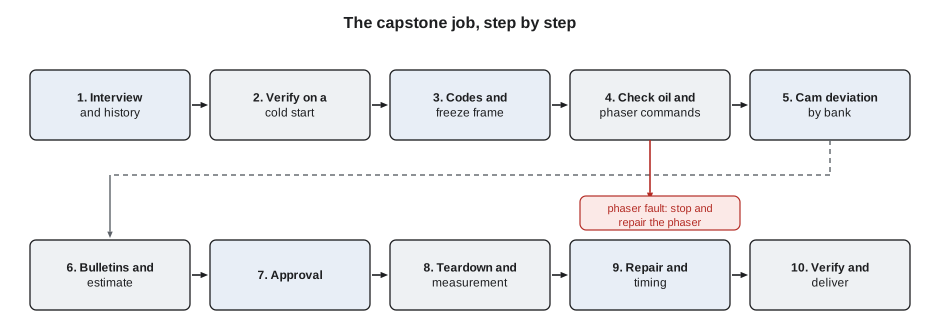
Step 1: interview and history (Lessons 2 and 8)
Kiran starts at the counter with Erik, using the open questions she learned in AUTO-110. When does the rattle happen? Only on the first start of the day, and worse when it is cold. How long has it been happening? About three months, getting a little longer. Has anything changed? The van went to a quick-lube shop twice last year while Ridgeline was booked up. Kiran asks for those invoices. One shows an oil change at an interval far beyond the schedule, and the other shows a 5W-30 oil, where the van's oil filler cap and owner's manual specify 0W-20 meeting the manufacturer's specification.
Kiran also identifies the engine properly from the VIN, as Lesson 2 taught, and checks Ridgeline's records. The van is at 151,200 km. Ridgeline replaced its front brakes and a sway bar link a year ago, and noted a weak battery, which has since been replaced. The repair order's concern line reads, in Erik's words: “Rattle from engine for 2 seconds after cold start. Check engine light on.”
Step 2: verify the concern (Lessons 1 and 10)
The van stays overnight, outside, so the engine is fully cold in the morning. Kiran starts it with the hood open and her phone recording, while Marty listens at the front of the engine with a stethoscope. The rattle is there: a dry chattering from the timing cover, loudest on the bank 1 side, lasting just under two seconds and then stopping as the oil pressure comes up. It does not return when the engine is revved warm. On the bank 1 side of this engine, Kiran notes, is the timing cover end of the cylinders numbered 1, 3 and 5, so she will be careful to use the manufacturer's bank names rather than front and rear.
Step 3: codes, freeze frame and scan data (Lessons 5 and 6)
The scan tool shows one stored code, the bank 1 crankshaft-camshaft correlation code, with freeze-frame data showing it set on a cold start at idle. There are no misfire codes. This engine's control module reports the position of each of the four camshafts relative to the crankshaft as a deviation in degrees from its learned position, with the phasers at their parked, locked positions at idle.
# Camshaft-to-crankshaft deviation at warm idle, phasers parked (crankshaft degrees; negative = retarded)
deviation = {"bank 1 intake": -8.6, "bank 1 exhaust": -8.1, "bank 2 intake": -2.3, "bank 2 exhaust": -1.9}
limit = 6.0          # example: the module sets the correlation code beyond this
for cam, d in deviation.items():
    print(f"{cam:<15} {d:5.1f}  {'beyond limit' if abs(d) > limit else 'within limit'}")
b1 = [deviation["bank 1 intake"], deviation["bank 1 exhaust"]]
b2 = [deviation["bank 2 intake"], deviation["bank 2 exhaust"]]
if max(b1) < -limit and max(abs(x) for x in b2) <= limit:
    print("both bank 1 cams retarded by the same amount: the bank 1 secondary chain, guide or tensioner is the likely cause")
elif all(d < -limit for d in b1 + b2):
    print("all cams retarded alike: suspect the primary chain")
else:
    print("one cam only: suspect that cam's phaser or oil control valve")
print(f"bank 2 is also retarded about {-sum(b2) / 2:.1f} degrees: some primary chain wear is likely too")bank 1 intake -8.6 beyond limit bank 1 exhaust -8.1 beyond limit bank 2 intake -2.3 within limit bank 2 exhaust -1.9 within limit both bank 1 cams retarded by the same amount: the bank 1 secondary chain, guide or tensioner is the likely cause bank 2 is also retarded about 2.1 degrees: some primary chain wear is likely too
The pattern is the key. If only one camshaft were out, a sticking phaser or oil control valve would be the first suspect, because each phaser moves its own camshaft. Both camshafts on bank 1 are retarded by almost the same amount, and both are driven by the bank 1 secondary chain, so that chain, or its tensioner or guide, is the most likely cause. Bank 2 is retarded slightly too, which suggests that the primary chain, which drives both banks, has also worn somewhat. The deviation of about eight crankshaft degrees is about half a tooth's worth on a typical sprocket, as Lesson 5 calculated, which fits gradual wear and not a jumped tooth.
Step 4: rule out oil and the phasers (Lessons 6 and 8)
Before anyone recommends a timing chain job, the simpler causes must be ruled out. Kiran checks the oil: the level is at the full mark, but the oil on the dipstick is dark, and the van is near its next change. She uses the scan tool to command each phaser in turn at 2,000 rpm and watches the actual angle follow the desired angle. All four phasers move promptly and settle on their commands, which tells her the oil control valves and phasers work. A phaser problem would have changed the plan; this result keeps it on the chain.
Kiran also checks the service information for bulletins on the engine family. A bulletin describes updated timing chain tensioners and guides for this family and lists the correlation codes and cold-start rattle as symptoms; it also stresses the correct oil specification and change interval. Bulletins do not prove a diagnosis on their own, but this one matches the evidence, and its parts list goes into the estimate.
Step 5: estimate and approval (AUTO-110, Lesson 6)
The timing chains on this engine are behind the front cover, and reaching them on a transverse V6 in a minivan takes many hours: the accessory drive, upper intake, valve covers, front cover and other parts must come off. Simone and Kiran build the estimate from the labour guide, the parts kit the bulletin specifies, and the gaskets, seals and fluids the job needs. The estimate includes an inspection step: once the front cover is off, Kiran will measure and photograph the chains, guides and tensioners, and Simone will call Erik before reassembly if anything unexpected is found.
# Estimate for the Lindqvists' timing chain repair (illustrative figures)
labour_hours = 11.8
rate = 165
parts = {"timing chain kit: 3 chains, guides, tensioners, idler sprockets": 486.00,
         "front cover gasket set, valve cover and intake gaskets, crankshaft front seal": 214.00,
         "sealant, coolant and oil with filter (0W-20 meeting the manufacturer's specification)": 118.00}
shop_supplies = 8.00
labour = labour_hours * rate
parts_total = sum(parts.values())
subtotal = labour + parts_total + shop_supplies
tax = subtotal * 0.05
total = subtotal + tax
print(f"labour {labour_hours} h at {rate}/h: {labour:,.2f}")
for name, cost in parts.items():
    print(f"  {cost:8.2f}  {name}")
print(f"parts {parts_total:,.2f} + shop supplies {shop_supplies:.2f} + tax {tax:,.2f} = {total:,.2f} CAD")
print(f"approval also covers up to 10 % more ({total * 1.10:,.2f}) only if Erik is phoned first")labour 11.8 h at 165/h: 1,947.00
486.00 timing chain kit: 3 chains, guides, tensioners, idler sprockets
214.00 front cover gasket set, valve cover and intake gaskets, crankshaft front seal
118.00 sealant, coolant and oil with filter (0W-20 meeting the manufacturer's specification)
parts 818.00 + shop supplies 8.00 + tax 138.65 = 2,911.65 CAD
approval also covers up to 10 % more (3,202.82) only if Erik is phoned firstSimone explains the estimate to Erik by phone and sends it to him to approve in writing, as Ridgeline does for every job and as Alberta's consumer protection rules expect of a repair business. She is honest about the alternative: the van can be driven for now, but the chain will keep stretching, the correlation code will stay on, and if a tensioner or guide fails, the chain can jump and, on this interference engine, bend valves. Erik approves the repair.
Step 6: teardown and measurement (Lessons 5 and 7)
Kiran disconnects the battery, drains the coolant into a clean container for recycling, and removes parts in the order the service information gives, bagging and labelling bolts by location, because the front cover bolts are of several lengths. She turns the engine to TDC on cylinder 1's compression stroke, confirming it with the camshaft marks and not just the crankshaft pulley, as Lesson 1 taught, before the front cover comes off.
With the cover off, the evidence is plain. The bank 1 secondary tensioner's plunger is extended almost to the end of its travel. Its guide has a deep groove worn by the chain, and the primary chain's tensioner is extended further than the new one in the kit. Kiran removes the chains and measures their elongation on the bench, using the method from Lesson 5, against the figures in the bulletin.
# Chain elongation measured on the bench over 16 links (illustrative pitch and limit)
pitch, links = 8.00, 16
nominal = pitch * links
limit = 0.8                  # percent; use the manufacturer's figure
chains = {"bank 1 secondary": 129.6, "bank 2 secondary": 128.9, "primary": 129.1}
for name, measured in chains.items():
    e = (measured - nominal) / nominal * 100
print(f"{name:<17} {measured:.1f} mm: {e:.2f} % {'replace' if e > limit else 'within limit'}")bank 1 secondary 129.6 mm: 1.25 % replace bank 2 secondary 128.9 mm: 0.70 % within limit primary 129.1 mm: 0.86 % replace
The bank 1 secondary chain is well beyond its limit and the primary chain is past it too, while the bank 2 secondary chain is still just within. All three are replaced, as the kit and the bulletin require, because a new chain running with worn chains and sprockets will not last. Kiran photographs the tensioner, the guide groove and the measurements for the customer's file. The findings match the estimate, so no extra approval is needed.
Step 7: repair and timing (Lessons 5, 11 and 4)
Kiran installs the new parts following the service information's sequence. The camshaft sprockets on this engine are positioned by the phasers' marks, and the service information shows each mark's position relative to the plated links on the new chains with the engine at TDC on cylinder 1. She installs the camshaft holding tools the procedure calls for, so the camshafts cannot move while the chains are fitted, fits the primary chain, idler sprockets and secondary chains, and then the guides and tensioners, removing each tensioner's locking pin last so it pushes out against the chain. Bolts are tightened to the torque and angle specified, and the phaser bolts, which are the special oil control bolts on this engine, are tightened with the camshafts held by their flats, never by the chain.
With the holding tools removed, she turns the crankshaft slowly by hand, in its normal direction, through two full revolutions, feeling for any interference, and checks every mark against the service information. She checks them a third time after Marty does his own check. Then the front cover goes on with a fresh bead of the specified sealant at the joints the procedure shows, a new crankshaft front seal, and the bolts tightened in sequence; the gasket surfaces were cleaned with plastic scrapers and chemical remover, as Lesson 11 taught, with the oil pan opening covered so nothing fell in. The rest of the engine goes back together, with new valve cover and intake gaskets.
Before starting, Kiran changes the oil and filter with oil of the correct viscosity and specification, refills and bleeds the cooling system, and primes the engine by cranking with the fuel disabled until oil pressure shows, so the new tensioners are pressurized before the first start.
Step 8: verify the repair (Lessons 6 and 10)
The engine starts quietly. Kiran clears the code and, as the service information requires after timing work on this engine, uses the scan tool to perform the crankshaft position variation relearn, which teaches the module the exact position of the new parts. Then she checks the camshaft deviations again at warm idle and road tests the van, commanding each phaser and watching it follow.
# Camshaft deviation before and after the repair (crankshaft degrees at warm idle)
before = {"bank 1 intake": -8.6, "bank 1 exhaust": -8.1, "bank 2 intake": -2.3, "bank 2 exhaust": -1.9}
after  = {"bank 1 intake": -0.4, "bank 1 exhaust": 0.3, "bank 2 intake": -0.2, "bank 2 exhaust": 0.1}
for cam in before:
    print(f"{cam:<15} before {before[cam]:5.1f}  after {after[cam]:5.1f}")
worst = max(abs(v) for v in after.values())
print(f"largest deviation after repair: {worst:.1f} degrees -> timing correct")bank 1 intake before -8.6 after -0.4 bank 1 exhaust before -8.1 after 0.3 bank 2 intake before -2.3 after -0.2 bank 2 exhaust before -1.9 after 0.1 largest deviation after repair: 0.4 degrees -> timing correct
The next morning, after the van has stood outside all night, Kiran starts it cold with Erik's recording on her phone for comparison. There is no rattle. The check engine light stays off, and the code has not returned. Marty checks the work and signs off the quality check.
Step 9: the repair order and delivery (AUTO-110 and Lesson 8)
Kiran writes the repair order's cause and correction in the plain, complete style Marty expects. The cause records what was tested and found: cold-start rattle verified at the timing cover; bank 1 correlation code; bank 1 camshafts retarded about eight degrees and bank 2 about two; phasers responding normally; bank 1 secondary chain and the primary chain stretched beyond limit, bank 1 tensioner near the end of its travel and its guide grooved. The correction lists the timing kit and seals installed, the oil and coolant used, the relearn performed, and the verified results.
When Erik picks up the van, Simone and Kiran go through the invoice and show him the photographs of the worn parts. Kiran explains the likely cause plainly and without blame: chain wear is accelerated by long oil change intervals and by oil that does not meet the engine's specification, and both had happened. She recommends that the van's oil be changed at the interval in the maintenance schedule, using the specified oil, and that it come back to Ridgeline or to any shop that will use the right oil. She also notes the next scheduled services due on the van. Erik leaves with the old parts in a box, because he asked to see them.
Worked problem
Why not just replace the bank 1 chain?
Erik asks whether it would have been cheaper to replace only the bank 1 secondary chain, since it was the worst. How should Kiran answer?
Show solution
- Most of the labour is in removing and refitting the front of the engine, which is the same whether one chain or three are replaced.
- The primary chain was also beyond its limit, and bank 2 was close; a new chain running with worn ones and worn sprockets wears out quickly.
- The manufacturer's bulletin specifies the complete kit with updated tensioners and guides.
- Doing it once, completely, avoids paying most of the labour again within a short time.
Answer: Replacing the whole drive costs little more in parts, nothing more in labour, and lasts.
Common mistakes
MistakeRecommending a chain job from a code alone.
InsteadVerify the noise, read all four cam deviations, and rule out oil and phasers first.
MistakeAssuming the pulley mark shows TDC compression.
InsteadConfirm with the camshaft marks.
MistakeHolding a camshaft by the chain while tightening its bolt.
InsteadHold it by its flats or with the holding tool.
MistakeSkipping the crankshaft position relearn.
InsteadPerform any relearn the service information requires after timing work.
MistakeDelivering without explaining the cause.
InsteadExplain the oil-related cause and how to prevent a repeat.
Summary and key terms
- Interview the customer and collect the service history; identify the engine from the VIN.
- Verify the concern under the conditions described; listen at the timing cover.
- Read every camshaft's deviation: one cam suggests a phaser, one bank suggests a secondary chain, all four suggest the primary chain.
- Rule out oil and phasers before recommending disassembly; check bulletins.
- Estimate, get written approval and call before exceeding it; measure and photograph the worn parts.
- Time the engine with the marks and tools, turn it twice by hand, prime it, relearn, verify and explain the cause.
- Correlation deviation
- The difference between a camshaft’s position and its learned position relative to the crankshaft.
- Secondary chain
- A chain driven from an idler sprocket that drives one bank’s camshafts.
- Primary chain
- The chain driven by the crankshaft that drives the idler sprockets or camshafts.
- Camshaft holding tool
- A tool that locks the camshafts in position during timing work.
- Crankshaft position relearn
- A scan tool procedure that teaches the engine control module the exact position of the crankshaft target wheel.
- Quality check
- A final inspection of the work by a second technician before delivery.
Practice problems
Work each problem on paper first, then reveal the answer to check.
All four camshafts read about 7 degrees retarded. What is the most likely cause?
Show answer
Primary chain wear.
Only the bank 2 intake camshaft is out of limit, and its phaser does not follow commands. What next?
Show answer
Check that phaser's oil control valve, screen and the oil, and the phaser itself.
Why is the van primed before its first start after the repair?
Show answer
So the new tensioners and bearings have oil pressure before the engine runs.
What two oil-related factors likely caused the chain wear?
Show answer
An oil change interval far beyond the schedule and an oil that did not meet the specification.
Lesson quiz · 5 questions
Score 60% or more to complete this lesson.
Create a free account to save your progress, take quizzes and earn a certificate.