
AUTO-120 · Lesson 1 of 12 · 23 min
How a four-stroke engine works
Kiran Dhaliwal has been at Ridgeline Auto Service for four months. She can now do an oil service, a tire swap and a multi-point inspection without anyone checking every step, and Marty Kowalchuk has decided it is time she learned what happens inside the engines she has been servicing. On a Monday morning he rolls an engine stand into bay 5. On it sits a 2.0 litre four-cylinder engine from a car that was written off after a collision, which Ridgeline keeps for training. The cylinder head is off, the oil pan is off, and the pistons can be seen from above and below.
“Everything you do on this engine for the next few weeks you will do for real on a customer's car later,” Marty says. “Measure it, take it apart, put it back together. But first you need to know what it does.” He turns the crankshaft slowly with a breaker bar on the front bolt, and Kiran watches two pistons rise while the other two fall.
This lesson explains the basic job of a piston engine: turning the chemical energy in fuel into the rotation that drives the wheels. It covers the main moving parts, the four strokes of the cycle, why an engine needs two crankshaft turns to complete one cycle, how the cylinders take turns firing, and the variations used in hybrid and diesel engines. Every later lesson in this course, from valve trains to diagnosis, builds on this one.
From fuel to rotation
A gasoline engine is a heat engine. It burns a mixture of fuel and air inside a closed space, the combustion chamber, and the hot gas pushes on a piston. The piston is connected by a connecting rod to the crankshaft, and the offset journal on the crankshaft, the crankpin, turns the piston's straight-line motion into rotation, the same way a cyclist's legs turn the pedals. Because the burning happens inside the engine itself, it is called an internal combustion engine.
Only part of the fuel's energy becomes useful work at the crankshaft. In a typical modern gasoline engine about a third of it does, at best, and less at light loads. The rest leaves as heat in the exhaust gas, as heat carried away by the coolant and oil, and as friction. That is why an engine needs a cooling system and a lubrication system, which Lessons 8 and 9 cover, and why small improvements in friction or combustion are worth so much to manufacturers.
| Part | What it does |
|---|---|
| Cylinder block | The main casting; contains the cylinders and supports the crankshaft |
| Piston and rings | Moves up and down in the cylinder; the rings seal the gap to the cylinder wall |
| Connecting rod | Links the piston to the crankshaft |
| Crankshaft | Turns the up-and-down motion into rotation; carries the flywheel or flexplate |
| Cylinder head | Closes the top of the cylinder; holds the valves, ports and spark plugs |
| Valves | Open to let the mixture in and the exhaust out, and close to seal the chamber |
| Camshaft | Opens the valves at the right moments; turns at half crankshaft speed |
| Timing chain or belt | Keeps the camshaft in step with the crankshaft |
Top dead centre, bottom dead centre and the stroke
As the crankshaft turns, the piston moves between two end points. At top dead centre, or TDC, the piston is at the top of its travel and the space above it is smallest. At bottom dead centre, BDC, it is at the bottom and the space above it is largest. The distance between them is the stroke, and it equals twice the crankpin's offset from the crankshaft's centre, the crank throw. The diameter of the cylinder is the bore. Lesson 3 uses bore and stroke to calculate an engine's displacement.
Kiran notices that the piston slows almost to a stop near TDC and BDC and moves fastest about halfway between them. Marty explains that this is why a piston's speed is quoted as an average, the mean piston speed, and why the top piston ring wears the cylinder most at the very top of the stroke, where the piston stops and reverses with full combustion pressure behind it. She will measure that wear on the training engine in Lesson 7.
The four strokes
Almost every car and light truck engine works on the four-stroke cycle, also called the Otto cycle after Nikolaus Otto, whose engine of 1876 first used it successfully. One complete cycle takes four strokes of the piston, which is two turns of the crankshaft, or 720 degrees.
- Intake stroke. The piston moves down from TDC to BDC with the intake valve open. The falling piston lowers the pressure in the cylinder, and the higher atmospheric pressure outside pushes air, or air and fuel, in through the intake port.
- Compression stroke. Both valves are closed and the piston moves up, squeezing the mixture into the small space of the combustion chamber. Compressing the mixture raises its pressure and temperature, which makes it burn faster and lets the expanding gas do more work.
- Power stroke. Near the top of the compression stroke the spark plug fires. The burning mixture's pressure rises sharply and drives the piston down. This is the only stroke that delivers work to the crankshaft; the others take work from it.
- Exhaust stroke. Near the bottom of the power stroke the exhaust valve opens. The piston moves up and pushes the burned gas out through the exhaust port, and the cycle begins again.
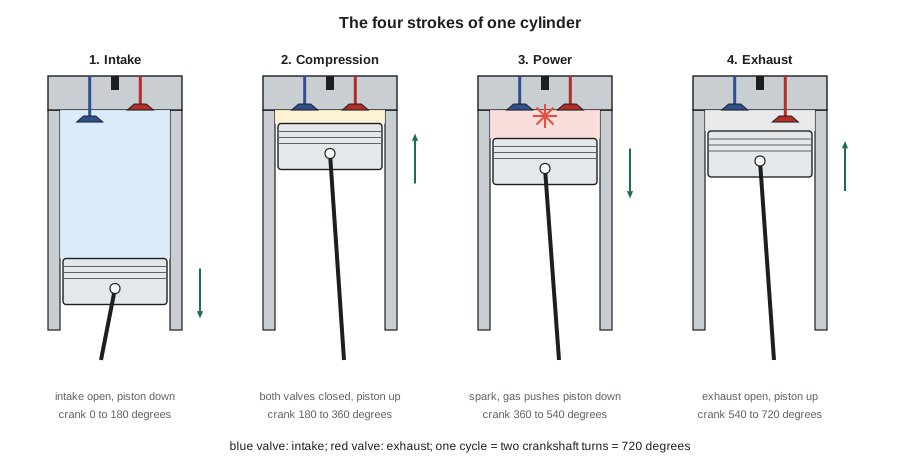
In a real engine the valves do not open and close exactly at TDC and BDC. The intake valve opens a little before TDC and closes well after BDC, so the moving air keeps filling the cylinder even as the piston starts back up. The exhaust valve opens before BDC to let the pressure blow down, and closes after TDC. For a short time near TDC at the end of the exhaust stroke both valves are slightly open; this is called valve overlap. The camshaft's shape sets these timings, and variable valve timing, in Lesson 6, changes them while the engine runs.
The spark also comes before TDC. The mixture takes a few thousandths of a second to burn, so the engine control module fires the plug early enough that the peak pressure arrives just after TDC, when it can push the piston down most effectively. The amount of spark advance increases with engine speed and falls with load. Ignition is covered in AUTO-230; in this course it is enough to know that the spark, the valves and the piston all have to be in step, and that the timing chain or belt is what keeps the camshaft and crankshaft in step.
Firing order and firing interval
An engine with several cylinders arranges their power strokes so that they are spread evenly over the 720 degrees of the cycle. In a four-cylinder engine, a power stroke starts every 180 degrees of crankshaft rotation; in a V6, every 120 degrees; in a V8, every 90 degrees. The sequence in which the cylinders fire is the firing order, and it is cast into the intake manifold or printed in the service information. A common four-cylinder firing order is 1-3-4-2. Gord Haney's 5.3 litre V8 fires 1-8-7-2-6-5-4-3, the order used by this family of General Motors V8 engines.
Cylinder numbering is set by the manufacturer and must always be checked. On many V engines the odd-numbered cylinders are on one bank and the even-numbered ones on the other; on others the cylinders on one bank are numbered 1 to 3 and on the other 4 to 6. A technician who tests or replaces parts on the wrong cylinder because of a guess wastes the customer's money, so Marty's rule from AUTO-110 applies: look it up.
In this formula, theta is the crankshaft angle between power strokes and n is the number of cylinders. The more cylinders an engine has, the more often a power stroke occurs and the smoother it runs.
# Firing interval and how long each stroke lasts at a given engine speed
for name, cylinders in [("four-cylinder", 4), ("V6", 6), ("V8", 8)]:
    interval = 720 / cylinders
    print(f"{name:<14} power stroke every {interval:5.1f} degrees")
print()
for rpm in (700, 2000, 6000):
    rev_per_s = rpm / 60
    ms_per_stroke = 1000 / rev_per_s / 2          # one stroke is half a revolution
    power_per_s_v8 = rev_per_s / 2 * 8            # each cylinder fires once every 2 revolutions
print(f"{rpm:>5} rpm: one stroke takes {ms_per_stroke:5.1f} ms; a V8 makes {power_per_s_v8:4.0f} power strokes per second")four-cylinder power stroke every 180.0 degrees V6 power stroke every 120.0 degrees V8 power stroke every 90.0 degrees 700 rpm: one stroke takes 42.9 ms; a V8 makes 47 power strokes per second 2000 rpm: one stroke takes 15.0 ms; a V8 makes 133 power strokes per second 6000 rpm: one stroke takes 5.0 ms; a V8 makes 400 power strokes per second
At 6,000 rpm each stroke lasts five thousandths of a second, which is why the intake air must be helped by the timing of the valves and why the parts inside an engine must be balanced and lubricated so carefully. At idle, a V8 still makes nearly fifty power strokes every second.
Following one cylinder through the cycle
Marty asks Kiran to find TDC on cylinder 1 of the training engine. She puts a long screwdriver gently on the top of the piston, turns the crankshaft clockwise by hand until the screwdriver rises to its highest point, and checks that the timing mark on the crankshaft pulley lines up with the zero mark on the front cover. Then he asks her which stroke cylinder 1 is on. She cannot tell, because the head is off and there are no valves.
“That's the point,” he says. “The crankshaft passes TDC twice in each cycle, once at the end of compression and once at the end of exhaust. The crank looks the same both times. Only the camshaft knows which one it is.” On an assembled engine, TDC on the compression stroke is the position where both valves of that cylinder are closed and their rockers are loose; on the exhaust stroke, the valves are rocking, with the exhaust closing and the intake just opening. Finding TDC compression on cylinder 1 is the starting point for setting valve lash, for timing a camshaft and for many timing-chain jobs, and she will do it again in Lessons 4, 5 and 12.
Worked problem
Which stroke is cylinder 4 on?
On a four-cylinder engine with firing order 1-3-4-2, cylinder 1 is at TDC on the compression stroke. What is cylinder 4 doing?
Show solution
- In a four-cylinder engine the pistons move in pairs: 1 and 4 are at the top together, and 2 and 3 are at the bottom.
- Cylinder 1 is at the end of compression, about to fire.
- Cylinder 4 is at the same height, so it is at TDC too, but it is 360 degrees away in the cycle.
- 360 degrees after the end of compression is the end of the exhaust stroke, so cylinder 4 is at TDC on exhaust, in valve overlap.
- Next in the firing order after 1 is 3, which is at BDC finishing its intake stroke.
Answer: Cylinder 4 is at TDC at the end of its exhaust stroke, with both valves slightly open.
What makes the engine run: air, fuel, compression and spark
A gasoline engine needs four things in each cylinder: enough air, the right amount of fuel mixed with it, compression, and a spark at the right time. Technicians use this list as a starting point when an engine will not start or a cylinder does not fire. A cylinder that has fuel and spark but cannot hold compression, because a valve is bent, a ring is broken or a head gasket has failed, will not fire properly. A cylinder whose valves do not open, because a camshaft lobe is worn or a lifter has collapsed, cannot breathe and will not fire either. Lesson 10 shows how compression, leak-down and vacuum tests tell these faults apart.
The amount of air an engine takes in sets how much fuel it can burn and therefore how much power it can make. Opening the throttle lets more air in. A turbocharger or supercharger pushes air in above atmospheric pressure. At high altitude, where the air is thinner, a naturally aspirated engine takes in less air and makes less power. Calgary sits at about 1,045 m above sea level, and Lesson 3 calculates how much power an engine loses there.
Two strokes, diesels and hybrid engines
Some small engines, such as those in chainsaws, outboard motors and older snowmobiles, use a two-stroke cycle, which completes intake, compression, power and exhaust in one crankshaft turn by using ports in the cylinder wall instead of valves. They are light and powerful for their size but use more fuel and produce more emissions, and are no longer used in cars.
Diesel engines also use the four-stroke cycle, but they have no spark plugs. They compress air alone to a much higher ratio, roughly 15 to 20 to one compared with 9 to 12 to one in a gasoline engine, and the air becomes hot enough to ignite the fuel when it is injected near the top of the compression stroke. This is called compression ignition. Diesels are more efficient, especially under load, and are used in heavy pickups, many vans and nearly all large trucks.
Ines Moreau's hybrid hatchback uses a gasoline engine that runs on the Atkinson cycle, a version of the four-stroke cycle in which the intake valve stays open well into the compression stroke. Some of the mixture is pushed back into the intake, so the effective compression stroke is shorter than the expansion stroke. The engine makes less power for its size but uses its fuel more efficiently, and the hybrid's electric motor supplies the extra power when it is needed. The engine also stops and starts many times on every trip, which affects how it is lubricated and cooled. Dr. Amara Singh's electric car has no engine at all, and Kiran will meet its electric drive in AUTO-410.
Rotation, direction and turning an engine by hand
Most engines turn clockwise when seen from the front, the timing chain end. Service procedures that ask a technician to turn the engine by hand assume this direction, and turning an engine backwards can let a timing chain tensioner retract or a belt jump a tooth. The crankshaft is turned with a socket on the front bolt, never by the camshaft sprockets, and always slowly, so that if something stops it, such as a valve touching a piston, the technician feels it before damage is done.
Before turning an engine by hand in a vehicle, Kiran learns to disable the ignition and fuel, for example by removing the fuel pump relay or the ignition fuse as the service information directs, so the engine cannot start if someone turns the key. It is also easier to turn an engine with the spark plugs removed, because the cylinders are no longer compressing air.
Common mistakes
MistakeAssuming TDC is always TDC on the compression stroke.
InsteadCheck the valves or the camshaft position; the crankshaft passes TDC twice each cycle.
MistakeGuessing the cylinder numbering on a V engine.
InsteadFind the numbering and firing order in the service information.
MistakeTurning an engine backwards or by the camshaft bolt.
InsteadTurn it slowly in its normal direction with the crankshaft bolt.
MistakeThinking the spark occurs exactly at TDC.
InsteadThe spark is advanced so peak pressure arrives just after TDC.
MistakeForgetting that a diesel has no spark plugs.
InsteadA diesel ignites its fuel by the heat of compression.
Summary and key terms
- A four-stroke engine completes intake, compression, power and exhaust in two crankshaft turns, 720 degrees.
- Only the power stroke delivers work; the flywheel and the other cylinders carry the engine through the other strokes.
- The firing interval is 720 degrees divided by the number of cylinders.
- The crankshaft passes TDC twice in each cycle; the camshaft tells which stroke a cylinder is on.
- Each cylinder needs air, fuel, compression and spark at the right time.
- Diesels use compression ignition; many hybrids use the Atkinson cycle for efficiency.
- Top dead centre (TDC)
- The piston position at the top of its travel, where the volume above it is smallest.
- Bottom dead centre (BDC)
- The piston position at the bottom of its travel.
- Stroke
- The distance the piston travels from TDC to BDC; twice the crank throw.
- Bore
- The diameter of the cylinder.
- Valve overlap
- The period near TDC when the exhaust and intake valves are both slightly open.
- Firing order
- The sequence in which the cylinders fire.
- Atkinson cycle
- A four-stroke cycle with a late-closing intake valve that gives a shorter effective compression stroke.
Practice problems
Work each problem on paper first, then reveal the answer to check.
How many degrees of crankshaft rotation does one four-stroke cycle take?
Show answer
720 degrees, two revolutions.
What is the firing interval of a V6?
Show answer
720 / 6 = 120 degrees.
Name the only stroke that delivers work to the crankshaft.
Show answer
The power stroke.
How can you tell TDC compression from TDC exhaust on an assembled engine?
Show answer
On compression both valves are closed and the rockers are loose; on exhaust the valves are in overlap.
Why is the spark fired before TDC?
Show answer
The mixture takes time to burn, so the spark is advanced to put the peak pressure just after TDC.
Lesson quiz · 5 questions
Score 60% or more to complete this lesson.
Create a free account to save your progress, take quizzes and earn a certificate.