
ARCH-510 · Lesson 8 of 12 · 21 min
Thermal comfort
The eighth seminar begins with a vote. Holm sets the seminar room's thermostat to 23 °C (73 °F), waits twenty minutes, and asks each student to rate how they feel on a scale from cold to hot. Wren, in a sweater, votes neutral; Joon-ho, who cycled in, votes slightly warm; Ingrid, sitting by the cold window, votes slightly cool; Callum votes neutral but says the air feels stuffy. 'Four people, one room, one temperature, four different answers,' Holm says. 'Comfort is not a temperature. It is a state of mind that depends on the air, the surfaces, the air movement, the humidity, what you are wearing, what you are doing, and what you expect. Today we look at how simulation predicts it.'
The six factors
Thermal comfort depends on four environmental factors and two personal ones. The environmental factors are air temperature, mean radiant temperature (the average temperature of the surfaces a person exchanges radiant heat with, weighted by how much of the view each occupies), air speed and humidity. The personal factors are metabolic rate, measured in met units, where 1 met is a person seated quietly, and clothing insulation, measured in clo, where 1 clo is roughly a business suit. A simulation can calculate the environmental factors; the personal factors must be assumed, and their ranges should be tested like any other uncertain input.
Mean radiant temperature is the factor architects control most directly and most often forget. A person near a large cold window loses heat by radiation to the glass even if the air is at a comfortable temperature, which is why Ingrid felt cool. Operative temperature, roughly the average of air and mean radiant temperature in still air, combines the two into one number and is what most comfort criteria use.
Fanger's heat balance model
In 1970 the Danish engineer Ole Fanger published a model that predicts the average thermal sensation of a large group of people from the six factors. It is based on the body's heat balance: a person is comfortable when the heat produced by metabolism equals the heat lost by convection, radiation, evaporation and breathing, with skin temperature and sweating at levels typical of comfort. The model gives the predicted mean vote (PMV) on a seven-point scale from −3 (cold) through 0 (neutral) to +3 (hot), and the predicted percentage dissatisfied (PPD), the share of people expected to vote outside the central three points. Even at a PMV of zero, about 5 in 100 people are dissatisfied: no condition pleases everyone.
The model is codified in ISO 7730 and in ASHRAE Standard 55, the North American comfort standard, which was updated as ASHRAE 55-2023. It is most reliable in air-conditioned buildings where conditions are steady and people's clothing and activity are known. The students implement the ISO 7730 algorithm and test three conditions in the hub's reading room.
# Two ways to judge comfort: Fanger's PMV/PPD (ISO 7730) and the adaptive model of ASHRAE 55
import math
def pmv(ta, tr, vel, rh, met, clo):
    pa = rh * 10 * math.exp(16.6536 - 4030.183 / (ta + 235))
    icl = 0.155 * clo; m = met * 58.15; w = 0.0; mw = m - w
    fcl = 1.05 + 0.645 * icl if icl > 0.078 else 1.0 + 1.29 * icl
    hcf = 12.1 * math.sqrt(vel); taa = ta + 273; tra = tr + 273
    tcla = taa + (35.5 - ta) / (3.5 * icl + 0.1)
    p1 = icl * fcl; p2 = p1 * 3.96; p3 = p1 * 100; p4 = p1 * taa
    p5 = 308.7 - 0.028 * mw + p2 * (tra / 100) ** 4
    xn = tcla / 100; xf = xn
    for _ in range(150):
        xf = (xf + xn) / 2
        hcn = 2.38 * abs(100 * xf - taa) ** 0.25
        hc = max(hcf, hcn)
        xn = (p5 + p4 * hc - p2 * xf ** 4) / (100 + p3 * hc)
        if abs(xn - xf) < 1.5e-5:
            break
    tcl = 100 * xn - 273
    hl1 = 3.05e-3 * (5733 - 6.99 * mw - pa); hl2 = 0.42 * (mw - 58.15) if mw > 58.15 else 0.0
    hl3 = 1.7e-5 * m * (5867 - pa); hl4 = 0.0014 * m * (34 - ta)
    hl5 = 3.96 * fcl * (xn ** 4 - (tra / 100) ** 4); hl6 = fcl * hc * (tcl - ta)
    ts = 0.303 * math.exp(-0.036 * m) + 0.028
    v = ts * (mw - hl1 - hl2 - hl3 - hl4 - hl5 - hl6)
    return v, 100 - 95 * math.exp(-0.03353 * v ** 4 - 0.2179 * v ** 2)
def show(t):
    return f"{t * 1 + 0:.1f} C"
for label, ta, tr, clo in (("winter, sweater", 21.0, 19.5, 1.0), ("winter, cold window nearby", 21.0, 16.5, 1.0),
                           ("summer, light clothing", 25.5, 25.5, 0.5)):
    v, ppd = pmv(ta, tr, 0.1, 40, 1.2, clo)
    print(f"{label:28s} air {show(ta)}, radiant {show(tr)}: PMV {v:+.2f}, PPD {ppd:.0f} in 100")
# adaptive model for the reading room running free in a July heat spell
prevailing = 22.0   # prevailing mean outdoor temperature, C
t_comf = 0.31 * prevailing + 17.8
print(f"adaptive neutral temperature {show(t_comf)}; 80 in 100 accept {show(t_comf - 3.5)} to {show(t_comf + 3.5)}")
ops = [24.5 + 3.8 * math.sin(2 * math.pi * (h - 9) / 24) + 0.12 * (h // 24) for h in range(7 * 24)]
occupied = [t for h, t in enumerate(ops) if 9 <= h % 24 < 21]
over = sum(1 for t in occupied if t > t_comf + 3.5)
print(f"occupied hours above the 80 band in the week: {over} of {len(occupied)}")winter, sweater air 21.0 C, radiant 19.5 C: PMV -0.33, PPD 7 in 100 winter, cold window nearby air 21.0 C, radiant 16.5 C: PMV -0.62, PPD 13 in 100 summer, light clothing air 25.5 C, radiant 25.5 C: PMV +0.16, PPD 6 in 100 adaptive neutral temperature 24.6 C; 80 in 100 accept 21.1 C to 28.1 C occupied hours above the 80 band in the week: 29 of 84
With air at 21 °C and surfaces at 19.5 °C, a reader in a sweater has a PMV of −0.33, slightly cool but within the common comfort range of −0.5 to +0.5, with 7 in 100 dissatisfied. Next to a cold window, with a mean radiant temperature of 16.5 °C, the PMV falls to −0.62 and dissatisfaction nearly doubles, although the air temperature has not changed. In summer, light clothing at 25.5 °C gives a PMV of +0.16. Holm points to the second result: the hub's triple glazing, which keeps the inner pane warmer, is a comfort measure as well as an energy measure. A model that reports only air temperature would never show it.
The adaptive model
In the 1990s field studies of buildings around the world found that people in naturally ventilated buildings, who could open windows and adjust their clothing, were comfortable over a much wider range of temperatures than Fanger's model predicted, and that their preferred temperature followed the outdoor climate of recent days. Richard de Dear and Gail Brager used these data to develop the adaptive comfort model, adopted in ASHRAE 55 in 2004 and, in a similar form, in the European standard EN 16798-1. It applies to occupant-controlled, naturally conditioned spaces without mechanical cooling, where people are engaged in near-sedentary activities.
In the ASHRAE version, the neutral operative temperature depends on the prevailing mean outdoor air temperature, a running average of recent days. Bands around it define the conditions that 80 or 90 in 100 occupants find acceptable.
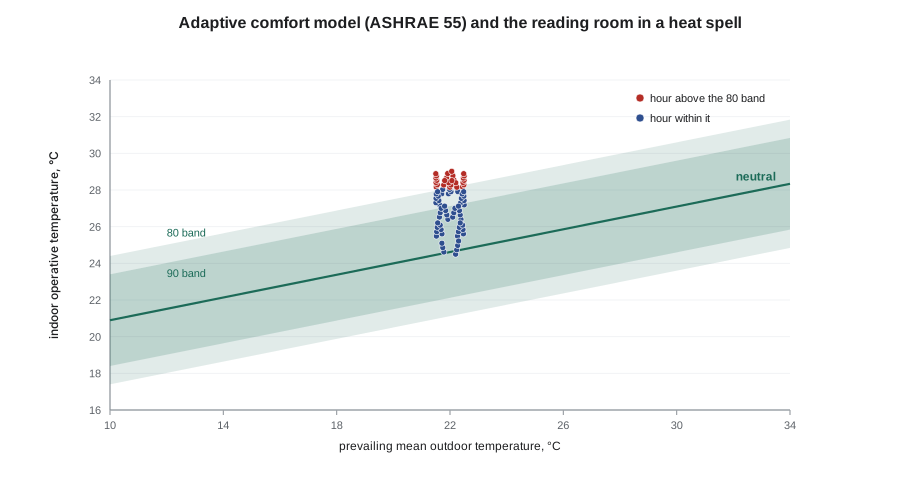
The second part of the students' program applies the adaptive model to the reading room during a July heat spell, with the room running free on natural ventilation. With a prevailing mean outdoor temperature of 22 °C, the neutral temperature is about 24.6 °C, and 80 in 100 people accept operative temperatures from about 21.1 to 28.1 °C. In the simulated week, 29 of the 84 occupied hours lie above the upper limit. Without mechanical cooling, the reading room would be too warm for about a third of the opening hours in that week. As a neighbourhood cool room in a heat wave, it needs more: either the ceiling fans and night ventilation the strategy assumes, modelled properly, or mechanical cooling from the heat pumps for the worst days.
Air movement
Air movement cools people by convection and evaporation, and in warm conditions it extends the acceptable range considerably. ASHRAE 55 allows higher operative temperatures when occupants have control of elevated air speed, such as ceiling fans; in the adaptive model, an air speed of about 0.9 m/s (180 ft/min) raises the upper limit by about 1.8 °C (3.2 °F), and more at higher speeds. A ceiling fan uses a few tens of watts; the cooling it saves may be worth many times that. Modelling it requires knowing the air speed at occupants, which simple energy models do not calculate. Comfort tools such as the CBE Thermal Comfort Tool, developed at the University of California, Berkeley, apply the standard's elevated air speed method to given conditions.
In cold weather the reverse applies: unwanted air movement, a draft, causes local discomfort. Cold air falling down a tall window is a classic cause. The students recall the hub's tall reading room windows and the radiant floor along them that was meant to counter the downdraft.
Local discomfort
Even when the whole body is in balance, parts of it may be uncomfortable. ASHRAE 55 and ISO 7730 set limits on four kinds of local discomfort: radiant asymmetry, such as a cold window on one side or a hot ceiling above; drafts; vertical air temperature difference between head and ankles; and floor surface temperature that is too warm or too cold. These matter in the hub. The daycare's radiant floor must stay below about 29 °C (84 °F) at its surface, because children sit and lie on it; the reading room's tall windows create radiant asymmetry for readers next to them; the hall's stratification can leave ankles cold and heads warm.
Overheating criteria
Comfort criteria are often turned into overheating criteria for design: limits on the number or share of hours above a threshold. Practice varies. Some codes and programs use a fixed limit, such as no more than a set number of occupied hours above 26 °C (79 °F); others use the adaptive bands; the British CIBSE TM59 method for dwellings combines adaptive criteria for living rooms with a fixed night-time limit for bedrooms. Some governments have begun to set limits for housing: British Columbia and the cities of Toronto and Vancouver have introduced requirements or guidance that limit indoor temperatures in new dwellings, a response to the deaths in the 2021 heat dome. For vulnerable occupants, such as seniors and young children, the health threshold may be lower than the comfort threshold.
Ingrid applies one such check to Greenway Homes, the students' second-year housing project, with a 2050s heat-wave week. The top-floor south apartments exceed the adaptive upper limit for many evening hours, and their bedrooms stay above 26 °C (79 °F) all night. The model shows why: the windows can be opened only a little for child safety, the corridors are single-loaded on the north so there is no cross-ventilation path, and the dark roof heats the top floor. Exterior blinds, a light roof and transom openings to the corridor bring the bedrooms below the limit in all but the hottest night.
Worked problem
Choosing a comfort criterion for the hub
The hub has three kinds of space: the daycare, which is mechanically heated and cooled; the reading room, which runs free with natural ventilation and fans for most of the summer; and the hall, which is mechanically ventilated and cooled for events. Wren must choose comfort criteria for each. What should she choose?
Show solution
- Daycare: Fanger's model, PMV within −0.5 to +0.5, with metabolic rates and clothing suitable for active children and napping, plus limits on floor surface temperature and drafts at floor level.
- Reading room in summer: the adaptive model, 80 band, with credit for ceiling fans; and a fixed health limit for its use as a cool room in a heat wave.
- Reading room in winter: Fanger's model, with a check on radiant asymmetry next to the windows.
- Hall: Fanger's model during events, with high metabolic rates for dancing and exercise, and a check on vertical temperature difference.
- Report each criterion, its source and the assumed clothing and activity.
Answer: Different spaces and seasons need different models: Fanger where conditions are controlled, adaptive where occupants control windows and fans, and local discomfort checks where cold surfaces, floors or tall spaces matter.
Exercise 8: comfort in a free-running room
Each student simulates one naturally ventilated room in their project for a typical summer and a future heat wave.
- Report hourly operative temperature during occupied hours.
- Plot the results against the adaptive bands.
- Count hours above the 80 upper limit and identify their causes.
- Test at least two passive measures and one with fans.
Self-critique checklist
- Have I used operative, not air, temperature?
- Is the adaptive model applicable to this space?
- Have I assumed realistic clothing and activity, and tested their ranges?
- Have I considered local discomfort?
Common mistakes
MistakeJudging comfort by air temperature alone.
InsteadUse operative temperature, which includes radiant effects.
MistakeApplying the adaptive model to a mechanically cooled space.
InsteadUse it only for occupant-controlled, naturally conditioned spaces.
MistakeAssuming one clothing and activity level for all users.
InsteadAssume values that suit each user group and test their range.
MistakeIgnoring air movement.
InsteadCredit fans in warm weather and check drafts in cold weather.
MistakeUsing comfort limits for vulnerable occupants.
InsteadApply lower health thresholds for seniors and young children.
Summary and key terms
- Comfort depends on air temperature, mean radiant temperature, air speed, humidity, metabolic rate and clothing.
- Fanger's PMV and PPD, in ISO 7730 and ASHRAE 55, predict average sensation in steady, controlled conditions; even at neutral, about 5 in 100 are dissatisfied.
- The adaptive model relates acceptable temperatures in naturally conditioned spaces to the prevailing outdoor temperature.
- Air movement extends the warm limit; drafts, radiant asymmetry, vertical gradients and floor temperatures cause local discomfort.
- Overheating criteria differ between standards and should reflect the vulnerability of the occupants.
- Mean radiant temperature
- The average temperature of surrounding surfaces, weighted by their view from the person.
- Operative temperature
- A combination of air and mean radiant temperature used in comfort criteria.
- PMV
- Predicted mean vote on a seven-point thermal sensation scale.
- PPD
- Predicted share of people dissatisfied with the thermal environment.
- Met
- Unit of metabolic rate; 1 met is a person seated quietly.
- Clo
- Unit of clothing insulation; 1 clo is roughly a business suit.
- Adaptive model
- Comfort model for naturally conditioned spaces linking acceptable temperatures to outdoor conditions.
- Radiant asymmetry
- Discomfort caused by a large difference in radiant temperature between two sides of a person.
Practice problems
Work each problem on paper first, then reveal the answer to check.
Air is at 22 °C and the mean radiant temperature is 18 °C in still air. What is the approximate operative temperature?
Show answer
(22 + 18) ÷ 2 = 20 °C.
What is the adaptive neutral temperature when the prevailing mean outdoor temperature is 16 °C?
Show answer
0.31 × 16 + 17.8 = 22.8 °C.
Why did the cold window lower the reader's PMV although the air temperature stayed the same?
Show answer
The window lowered the mean radiant temperature, so the reader lost more heat by radiation.
When is the adaptive model not applicable?
Show answer
In spaces with mechanical cooling, where occupants cannot open windows, or for activities well above sedentary.
Why are overheating limits for a seniors' residence often lower than ordinary comfort limits?
Show answer
Older people regulate body temperature less effectively and are more vulnerable to heat illness, so health thresholds are lower.
Lesson quiz · 5 questions
Score 60% or more to complete this lesson.
Create a free account to save your progress, take quizzes and earn a certificate.