
ARCH-250 · Lesson 8 of 12 · 21 min
Room acoustics
Abernathy has arranged for the eighth week's class to meet in the gymnasium of an old school down the street, a tall box of painted concrete block with a wooden floor and a steel deck roof. She stands at one end and reads a paragraph aloud at a normal speaking volume. At the far end, the students can hear that she is speaking but cannot follow a word: each syllable smears into the next in a long, booming tail. Then she claps once, sharply, and the clap rattles back and forth between the parallel walls like a stick dragged along a fence. 'This room hosts the neighbourhood's town halls, its seniors' exercise classes and its school concerts,' she says. 'It is useless for all of them. The community hall you are designing will be used for the same things. By the end of today you will be able to predict how it will sound before anyone builds it, and you will know what to do about it.' She introduces Claire Beaulieu, the acoustician who advised on the hub the previous term, who will teach this lesson and the next.
What sound is
Sound is a pressure wave travelling through air, or through any material, as tiny, rapid fluctuations in pressure. Its frequency, measured in hertz, is the number of fluctuations per second, which the ear hears as pitch; human hearing spans roughly 20 to 20,000 hertz, and speech carries most of its meaning between about 250 and 4,000 hertz. Sound travels through air at about 343 metres per second, so its wavelength, the speed divided by the frequency, ranges from about 17 m at 20 hertz to 17 mm at 20,000 hertz. This range matters in design: low-frequency sound has wavelengths as long as a room and bends around obstacles, while high-frequency sound behaves almost like light, travelling in straight lines and reflecting off surfaces.
The strength of sound is measured in decibels, a logarithmic scale that matches the huge range of pressures the ear can detect. A quiet library is about 35 decibels, normal conversation about 60, a busy street about 75, a shouting crowd about 90 and a rock concert about 110. Because the scale is logarithmic, decibels do not add like ordinary numbers: two equal sources together are only 3 decibels louder than one. An increase of about 10 decibels is heard as roughly twice as loud. Outdoors, away from reflecting surfaces, sound from a small source falls by about 6 decibels each time the distance doubles.
Direct sound, reflections and reverberation
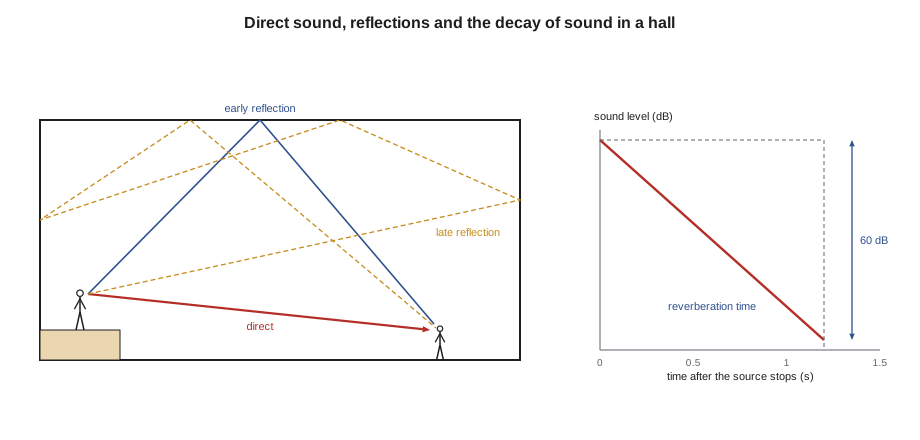
In a room, a listener hears the sound directly from the source first, then a series of reflections from the floor, walls and ceiling, then a dense mass of later reflections that gradually decays as the sound is absorbed at each bounce. Early reflections, arriving within about a twentieth of a second of the direct sound, reinforce it and help intelligibility; the brain fuses them with the direct sound. Later reflections that arrive more than about a tenth of a second after it, and are strong enough to be heard separately, are echoes. The decaying tail of later reflections is reverberation. A little reverberation gives warmth and fullness to music and helps a speaker's voice carry; too much smears speech into an unintelligible blur, as in the old gymnasium.
Reverberation is measured by the reverberation time: the time it takes for sound to decay by 60 decibels, to about a millionth of its original intensity, after the source stops. It depends on the volume of the room, since sound travels further between bounces in a larger room, and on the total absorption of its surfaces and contents.
Absorption and Sabine's equation
Every surface absorbs part of the sound that strikes it and reflects the rest. The sound absorption coefficient, α, is the fraction absorbed, from nearly 0 for hard, smooth materials such as concrete, glass and plaster, to nearly 1 for thick, porous materials such as mineral wool panels with a fabric face. Coefficients vary with frequency: porous absorbers are effective at middle and high frequencies but weak at low frequencies unless they are thick or mounted with an air space behind them, while thin panels and membranes absorb mainly low frequencies. The noise reduction coefficient, NRC, is the average of a material's coefficients at 250, 500, 1,000 and 2,000 hertz, a convenient single number for comparing products.
The total absorption of a room is the sum, over all its surfaces, of each area multiplied by its coefficient, plus the absorption of people and furniture. The unit of absorption is the sabin, named after Wallace Clement Sabine, the Harvard physicist who in the 1890s studied the reverberation of a lecture hall on the campus by moving seat cushions in and out of it at night and timing the decay of an organ pipe with a stopwatch. His equation, published in 1900, is still the first tool of room acoustics.
Sabine's equation is accurate when the absorption is low and evenly distributed. In rooms with a lot of absorption, the Eyring equation, which treats the decay as a series of reflections each losing a fraction of the sound, gives better results.
| Material | Absorption coefficient at 500 Hz |
|---|---|
| Painted concrete block or concrete | about 0.02 to 0.06 |
| Gypsum board on studs | about 0.05 to 0.10 |
| Glass window | about 0.05 to 0.15 |
| Wood floor | about 0.10 |
| Wood slats over mineral wool | about 0.5 to 0.8 |
| Acoustic ceiling tile | about 0.6 to 0.9 |
| Fabric-wrapped mineral wool panel, 50 mm | about 0.8 to 1.0 |
| Audience seated in upholstered chairs | about 0.8 |
How long should a room ring?
The right reverberation time depends on the use. Speech needs a short time so that each syllable is heard clearly: about 0.4 to 0.6 seconds in a classroom or meeting room, which is the target of the American standard for classroom acoustics and of guidance in many other countries, and somewhat longer in a large lecture hall. Music needs longer times: about 1.2 to 1.6 seconds for chamber music and 1.8 to 2.2 seconds for orchestral music in a concert hall, and longer still for organ and choral music in a church. A multipurpose hall, used for speech, sport and amateur music, is a compromise, usually aiming at about 1.0 to 1.3 seconds when full, with adjustable absorption such as curtains or panels if both speech and music matter. Gymnasiums and swimming pools are noisy by nature, with many people shouting, and need as much absorption as their hard, robust surfaces allow.
# Reverberation time of the community hall at 500 Hz: Sabine and Eyring
import math
L, W, H = 30, 20, 7                       # hall size (m)
V = L * W * H
k = 0.161                                       # 0.161 in SI, 0.049 in imperial units
def rt(surfaces, people=0, per_person=0.45):
    S = sum(a for a, _ in surfaces)
    A = sum(a * alpha for a, alpha in surfaces) + people * per_person
    sabine = k * V / A
    eyring = k * V / (-S * math.log(1 - A / S))
    return sabine, eyring
floor, ceiling = L * W, L * W
walls = 2 * (L + W) * H
bare = [(floor, 0.10), (ceiling, 0.05), (walls * 0.8, 0.05), (walls * 0.2, 0.10)]   # wood floor, deck, block, glass
treated = [(floor, 0.10), (ceiling, 0.80), (walls * 0.4, 0.05), (walls * 0.4, 0.70), (walls * 0.2, 0.10)]
print(f"Hall volume {V:,.0f} m3")
for name, s, people in (("hard, empty", bare, 0), ("hard, 200 people", bare, 200),
                        ("treated, empty", treated, 0), ("treated, 200 people", treated, 200)):
    sab, eyr = rt(s, people)
print(f"{name:20s} Sabine {sab:4.1f} s Eyring {eyr:4.1f} s")Hall volume 4,200 m3 hard, empty Sabine 5.1 s Eyring 4.9 s hard, 200 people Sabine 3.0 s Eyring 2.9 s treated, empty Sabine 0.9 s Eyring 0.7 s treated, 200 people Sabine 0.8 s Eyring 0.6 s
Built with hard surfaces only, like the old gymnasium, the hall would ring for several seconds when empty, and still far too long when full. With an absorptive ceiling and absorptive panels on part of the walls, the reverberation time falls to just under one second, suitable for meetings and community events, and the audience brings it down further. The two equations agree when the room is hard and diverge as the absorption increases, with Eyring giving the shorter, more realistic time. Because people absorb so much sound, a hall must be designed to sound acceptable both full and nearly empty; upholstered seats, which absorb almost as much as the people who sit in them, help keep the difference small.
Shape: echoes, flutter and focusing
The amount of absorption sets the reverberation time, but the shape of a room decides where reflections go. Parallel hard walls produce flutter echo, the rattle heard when Abernathy clapped, as sound bounces repeatedly between them. Concave surfaces, such as domes, curved rear walls and barrel vaults, focus sound into hot spots and leave dead spots elsewhere. Long distances between the source and a hard rear wall produce discrete echoes. Remedies include splaying or tilting one of a pair of parallel walls by a few degrees, breaking up surfaces with diffusing elements such as irregular slats, shelves or deep coffers, which scatter sound in many directions, and placing absorption on rear walls. Reflectors over a stage and the front of a hall, angled to send early reflections to the audience, help a speaker's voice reach the back without amplification.
Diffusion is as important as absorption in a good room. A hall in which all the absorption is on the ceiling and all the walls are flat and hard may have the right reverberation time but still suffer from flutter between the walls. The timber trusses and slatted wall panels the students proposed for the hub's hall help on both counts: the slats over mineral wool absorb, and the irregular trusses scatter the remaining sound.
Background noise and speech
Speech intelligibility depends on the ratio of the speaker's voice to the background noise as well as on reverberation. Noise from ventilation systems, traffic and neighbouring rooms masks speech, and children, older people, people with hearing loss and people listening in a second language are especially affected. Background noise is described by noise criteria curves, such as NC or RC ratings, which set limits in each frequency band; a classroom or library is typically designed for about NC 25 to 30, and a hall for about NC 30 to 35. The speech transmission index, STI, combines the effects of reverberation and noise into one number from 0 to 1, with values above about 0.6 rated good. In rooms used by people with hearing aids, assistive listening systems, such as hearing loops, are often required by accessibility standards.
Open and active rooms raise a particular problem: in a daycare playroom, a cafeteria or a busy commons, people raise their voices to be heard over each other, which raises the noise, which makes them raise their voices further. Adequate absorption breaks this cycle and makes such rooms far less tiring for staff and children.
Worked problem
Fixing the old gymnasium
The old school gymnasium is 30 × 18 m and 7 m high, of painted concrete block with a wood floor and a bare steel deck. Its reverberation time at 500 hertz is about 5 seconds when empty. The neighbourhood association has a small budget. What should it do?
Show solution
- Add absorption where it is most effective and safe from balls: the underside of the roof deck, with perforated acoustic deck or hung mineral wool baffles covering most of the ceiling.
- Treat the upper part of one long wall and one end wall with impact-resistant slatted panels over mineral wool, to stop flutter between the parallel walls.
- Leave the lower walls hard and durable, since they take impact from balls and people.
- Recalculate: ceiling absorption alone brings the time down to about 1.3 seconds; adding the wall panels brings it to about 1.0 second, good enough for meetings and classes.
Answer: Ceiling absorption out of reach and wall panels above the impact zone transform the gymnasium for speech, within a modest budget.
Exercise 8: an acoustic design
This exercise takes about one week.
- Choose the hub's hall and one other room, such as the reading room or a daycare playroom, and set target reverberation times for their main uses.
- Calculate their reverberation times at 500 hertz with your current finishes, empty and full.
- Select and place absorbing and diffusing finishes to meet the targets, and recalculate.
- Draw a section and plan of the hall showing the paths of early reflections from the stage and identify any risk of echo or flutter.
- Set background noise targets for both rooms and list the noise sources that could exceed them.
Common mistakes
MistakeTreating acoustics as decoration added at the end.
InsteadSet targets early and shape the room and its finishes to meet them.
MistakePlacing all the absorption on the ceiling of a room with parallel hard walls.
InsteadBreak up or treat at least one wall of each parallel pair.
MistakeDesigning for a full room only.
InsteadCheck the reverberation time empty and full; use upholstered seating.
MistakeUsing thin absorbers for low-frequency problems.
InsteadUse thick porous absorbers, air spaces or panel absorbers for low frequencies.
MistakeIgnoring background noise.
InsteadSet noise criteria and coordinate quiet ventilation and good sound isolation.
Summary and key terms
- Sound is a pressure wave; frequency is heard as pitch and level is measured in decibels on a logarithmic scale.
- Listeners hear direct sound, early reflections and reverberation; early reflections help, late ones and long reverberation harm speech.
- Sabine's and Eyring's equations predict reverberation time from room volume and total absorption.
- Speech needs short reverberation times, music longer ones; multipurpose halls compromise and may use adjustable absorption.
- Room shape controls echoes, flutter and focusing; diffusion and absorption work together.
- Background noise and reverberation together determine speech intelligibility.
- Frequency
- The number of pressure fluctuations per second, measured in hertz.
- Decibel
- A logarithmic unit of sound level.
- Reverberation time
- The time for sound to decay by 60 decibels after the source stops.
- Absorption coefficient
- The fraction of incident sound energy absorbed by a surface.
- Sabin
- A unit of sound absorption equal to one unit of area of a perfect absorber.
- Flutter echo
- A rapid series of echoes between parallel reflecting surfaces.
- Diffusion
- The scattering of sound in many directions by irregular surfaces.
Practice problems
Work each problem on paper first, then reveal the answer to check.
Two machines each produce 70 decibels. What is their combined level?
Show answer
About 73 decibels.
A room of 500 m³ has 80 m² sabins of absorption. What is its Sabine reverberation time?
Show answer
0.161 × 500 / 80 ≈ 1.0 s.
Why are early reflections helpful for speech?
Show answer
The brain fuses them with the direct sound, making the voice louder and clearer.
How can flutter echo between two parallel walls be cured?
Show answer
Splay or tilt one wall, add diffusing elements, or treat one wall with absorption.
Why should a hall be checked both empty and full?
Show answer
People absorb a great deal of sound, so the reverberation time changes greatly with the audience.
Lesson quiz · 5 questions
Score 60% or more to complete this lesson.
Create a free account to save your progress, take quizzes and earn a certificate.