
ARCH-250 · Lesson 7 of 12 · 21 min
Electric lighting
At five o'clock on a December afternoon, Abernathy takes the students to two libraries a few blocks apart. The first, refitted ten years ago, is lit by rows of bright ceiling panels that give an even, shadowless glare from end to end; the floor, the shelves and the people all look the same, and the windows, now black, reflect the panels back like mirrors. The second, an old branch recently renovated, has warm light washing its shelves and walls, pools of light on the reading tables from low lamps, a soft glow on its vaulted ceiling and almost no visible light source anywhere. Its light meter readings on the tables are about the same as the first library's. 'Same lux,' says Abernathy. 'One feels like an airport and the other like a living room. Lighting design is not about putting enough light on the floor. It is about deciding what people should see, and how the room should feel when the sun has gone, which in this city is by half past four for two months a year.'
Light sources
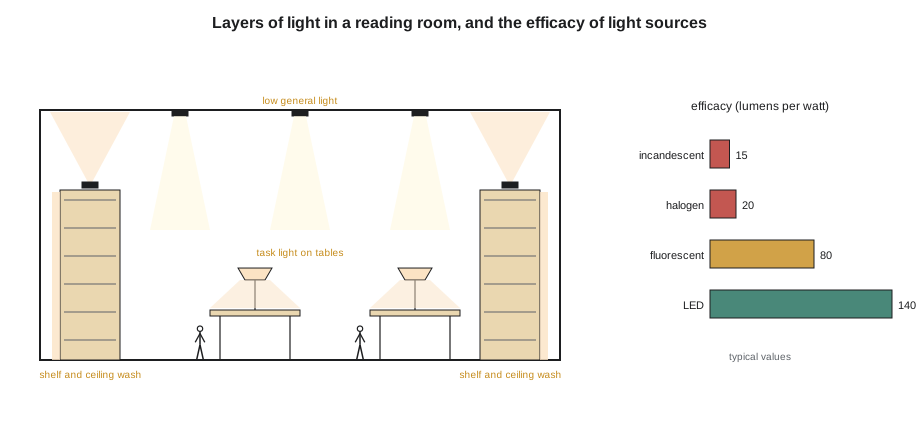
The efficiency of a light source is described by its luminous efficacy, the light it produces for each watt of electricity, in lumens per watt. The incandescent lamp, which lit buildings for a century, produced about 15 lumens per watt and turned most of its energy into heat. Fluorescent lamps raised this to between about 60 and 100. Light-emitting diodes, or LEDs, now produce well over 100 lumens per watt in typical architectural luminaires and keep improving; they have replaced almost every other source in new buildings. LEDs are small, dimmable, long-lived and controllable, but their quality varies widely, and cheap products can flicker, shift in tint as they age or render colours poorly.
| Source | Typical efficacy | Notes |
|---|---|---|
| Incandescent | about 15 lm/W | Warm, excellent colour rendering, short life; largely phased out |
| Halogen | about 20 lm/W | A brighter incandescent; also being phased out |
| Fluorescent | about 60 to 100 lm/W | Contains mercury; once standard in offices and schools |
| LED | about 100 to 200 lm/W | Now the default; quality depends on the product and its driver |
Two other properties describe the quality of light. Correlated colour temperature, measured in kelvins, describes how warm or cool white light appears: about 2,700 K is the warm light of a traditional lamp, 3,000 to 3,500 K a neutral white often used in homes, libraries and restaurants, and 4,000 to 5,000 K a cool white common in offices and schools. The colour rendering index, CRI, measures how faithfully a source reveals the colours of objects compared with a reference, on a scale up to 100; 80 is the usual minimum for interiors and 90 or more is preferred where faces, food, art or materials matter. A newer method, published as IES TM-30, gives a fuller picture of colour quality, and designers increasingly ask for it.
Layers of light
Lighting designers think in layers. Ambient light provides general illumination so that people can move about safely and see the space. Task light provides higher levels where detailed work happens: on a reading table, a kitchen counter or a reception desk. Accent light picks out objects, such as books on a shelf, a painting, a stage or a sign. Light on vertical surfaces, walls and shelves, makes a room feel bright and open even when the light on the floor is modest, because people judge brightness mostly by what they see at eye level. Decorative luminaires add sparkle and character. And the light in a room must also connect to the light of the spaces around it, so that people's eyes are not forced to adapt suddenly as they move from a bright corridor into a dim hall.
The second library in the December visit used every layer. Its shelves were washed with light from concealed fixtures, its tables lit by lamps, its ceiling lit from above the shelves, and its general light kept low. The first used one layer for everything, at the same level everywhere, and lit the floor more than anything people actually looked at.
How much light
The Illuminating Engineering Society publishes recommended illuminances for different tasks and spaces, adjusted for the age of the occupants and the importance of the task. Typical recommendations are in the order of 300 to 500 lux for reading and desk work, 100 to 200 lux for corridors, lobbies and stacks, 500 lux or more for a gymnasium used for sport, and higher values for detailed or demanding tasks. Older people need considerably more light than young people for the same task, because the lens of the eye yellows and the pupil shrinks with age. Uniformity matters too: a ratio of the minimum to the average illuminance across a working area of about 0.6 or more avoids patches that are too dim.
The lumen method is a quick way to estimate how many luminaires a room needs for a target average illuminance. It divides the light needed on the working plane by the useful light each luminaire delivers there, after allowing for the light absorbed by the room's surfaces, captured by the utilization factor, and the loss of output as the luminaires age and gather dirt, captured by the maintenance factor.
# Lumen method and lighting power for the hub reading room
area = 280                    # floor area (m2)
target = 400                  # average illuminance on the tables (lux)
lumens = 4000                 # output of one LED luminaire
watts = 30                    # input power of one luminaire
uf, mf = 0.6, 0.85            # utilization and maintenance factors for a pale room
n = target * area / (lumens * uf * mf)
count = int(-(-n // 1))       # round up
lpd = count * watts / area
print(f"Luminaires needed: {n:.1f}, so {count}; efficacy {lumens / watts:.0f} lm/W")
print(f"Lighting power density: {lpd:.2f} W/m2")
print(f"With fluorescent fittings of 60 lm/W for the same light: {count * lumens / 60 / area:.2f} W/m2")
# Layered alternative: low general light plus table lamps and shelf lighting
general = target * 0.4 * area / (lumens * uf * mf) * watts
tables, lamp_w = 20, 10
shelves = 60                 # length of shelving to wash with light (m)
shelf_w = 6                # watts per unit length of linear LED
layered = general + tables * lamp_w + shelves * shelf_w
print(f"Layered scheme: general {general:.0f} W + tables {tables * lamp_w} W + shelves {shelves * shelf_w:.0f} W = {layered:.0f} W")
print(f"Layered lighting power density: {layered / area:.2f} W/m2")Luminaires needed: 54.9, so 55; efficacy 133 lm/W Lighting power density: 5.89 W/m2 With fluorescent fittings of 60 lm/W for the same light: 13.10 W/m2 Layered scheme: general 659 W + tables 200 W + shelves 360 W = 1219 W Layered lighting power density: 4.35 W/m2
The uniform scheme meets the target with a power density well within current code limits, thanks to the efficacy of LEDs; with fluorescent fittings, the same light would take about twice the power. The layered scheme uses less power and spends it differently: less on the floor, more on the tables and the shelves, where people look. It will feel brighter and more inviting, and it allows the general light to be dimmed or switched off in zones that are not in use.
Glare from luminaires
Bright luminaires in the field of view cause discomfort glare, just as bright windows do. The unified glare rating, UGR, used in many standards, estimates it from the brightness of the luminaires, their size and position, and the brightness of the background; lower is better, and about 19 is a common limit for offices and classrooms. Practical measures are simple: choose luminaires with shielding or diffusers that hide the bright LEDs, avoid exposed points of light at eye level, light the ceiling and walls so that the contrast with the luminaires is lower, and keep reflections off screens and glossy tables. At night, windows become dark mirrors; luminaires placed so that their reflections do not appear in the glass from the main seating positions make a room far more pleasant.
Controls and daylight
Controls save as much energy as efficient lamps. Occupancy sensors switch lights on when people enter and off when they leave; vacancy sensors require people to switch lights on but switch them off automatically, which saves more. Daylight-responsive controls, sometimes called daylight harvesting, use photosensors to dim the lights in zones near windows and under clerestories when there is enough daylight. Scheduling switches lights off after hours, and task tuning sets the maximum output of each zone to what is actually needed. Energy codes in both countries require many of these controls in new buildings.
Daylight controls work only if the lighting zones follow the daylight: rows of luminaires parallel to the windows, each on its own circuit, so that the row nearest the glass can dim first. In the reading room, with its south windows and north clerestory, the zones are the south band, the clerestory band and the middle.
# Daylight dimming in the reading room: lighting energy over a year of daytime hours
target = 400                        # lux on the tables
hours = 3000                        # occupied daytime hours per year
outdoor = [(3000, 600), (8000, 900), (15000, 900), (30000, 600)]   # outdoor overcast-sky illuminance (lux) and hours
zones = {"south band": (5.0, 1500), "middle": (1.2, 1500), "clerestory band": (4.0, 1200)}   # daylight factor, installed watts
for name, (df, watts) in zones.items():
    used = 0.0
    for e_out, h in outdoor:
        daylight = e_out * df / 100
        need = max(0.0, target - daylight) / target          # share of electric light still needed
        used += watts * max(need, 0.1 if need > 0 else 0) * h / 1000   # dimmed fittings keep a small minimum
    full = watts * hours / 1000
print(f"{name:16s} {full:6,.0f} kWh without dimming, {used:6,.0f} kWh with dimming ({100 * (1 - used / full):.0f} of 100 saved)")south band 4,500 kWh without dimming, 562 kWh with dimming (88 of 100 saved) middle 4,500 kWh without dimming, 2,678 kWh with dimming (40 of 100 saved) clerestory band 3,600 kWh without dimming, 720 kWh with dimming (80 of 100 saved)
Near the windows and under the clerestory, daylight dimming saves most of the lighting energy over the year; in the middle of the room it saves well under half. The savings are only realized if the sensors are placed and calibrated well, which is why commissioning, the testing and adjustment of systems after they are installed, is essential. Badly set daylight controls that dim the lights while people still need them are soon disabled by unhappy occupants.
Light, health and the night
Light affects the body's daily rhythm as well as vision. Light rich in blue wavelengths, as in daylight and cool white LEDs, suppresses the hormone melatonin and promotes alertness, while warm, dim light in the evening allows it to rise. This has led to tunable lighting that shifts from cool and bright in the morning to warm and dim in the evening, used in some schools, hospitals and seniors' homes. The science is still developing, and the clearest advice is simple: plenty of daylight during the day, especially in the morning, and warmer, dimmer light in the evening.
Outdoor lighting needs as much care. Light that spills upward and sideways from badly shielded fixtures wastes energy, causes glare for drivers and pedestrians, disturbs neighbours and wildlife, and brightens the night sky so that stars disappear. Dark-sky guidance asks for fully shielded fixtures that send no light above the horizontal, warm sources of about 3,000 K or less, lighting only where and when it is needed, and controls that dim or switch off late at night. For the community hub, beside a greenway used by wildlife and overlooked by homes, these are part of the brief.
Worked problem
Lighting the hall for many uses
The community hall hosts volleyball, suppers, dances, meetings, concerts and elections. Callum's first scheme uses a single grid of high-output LED fixtures giving 500 lux everywhere. What would a better scheme look like?
Show solution
- Keep the sports lighting, with fixtures protected against balls and arranged so that players looking up are not dazzled; put it on its own circuit.
- Add a second, warmer layer for social events: wall washers on the long walls and uplights onto the timber trusses, dimmable to a low level.
- Provide a separate stage lighting circuit with outlets for portable fixtures.
- Group the controls into scenes, sport, supper, meeting, performance and cleaning, on a simple panel by the door, with an occupancy sensor to switch off forgotten lights.
- Make sure emergency lighting covers every exit route whatever scene is selected.
Answer: Layers and scenes let one hall serve many uses well, at lower energy than running sports lighting for every event.
Exercise 7: a lighting design
This exercise takes about one week.
- Choose two rooms of the hub with different uses and draw reflected ceiling plans showing the layers of light.
- Calculate the number of luminaires by the lumen method and the lighting power density for each room.
- Define the lighting zones and controls, including daylight dimming where it applies.
- Draw a night section showing how the room will look when it is dark outside, including reflections in the windows.
- Specify the correlated colour temperature, colour rendering and glare limits for each room and justify them.
Common mistakes
MistakeLighting the floor evenly and leaving the walls dark.
InsteadLight vertical surfaces and tasks; keep general light modest.
MistakeChoosing luminaires by price and output alone.
InsteadCheck colour rendering, flicker, glare and the quality of the driver.
MistakeDaylight controls on zones that cut across the daylight.
InsteadArrange lighting zones parallel to the windows and clerestories.
MistakeCool, bright light everywhere at night.
InsteadUse warmer, dimmer light in the evening and in homes.
MistakeUnshielded outdoor fixtures.
InsteadUse fully shielded, warm fixtures and switch them off when not needed.
Summary and key terms
- LEDs, at well over 100 lumens per watt, have replaced most other sources; their quality varies with the product.
- Correlated colour temperature and colour rendering describe the quality of white light.
- Good lighting uses layers: ambient, task, accent and light on vertical surfaces.
- The lumen method estimates the number of luminaires for a target illuminance.
- Occupancy and daylight controls save as much energy as efficient sources, if they are zoned and commissioned well.
- Daylight by day and warm, dim light at night support health; outdoor lighting should be shielded and warm.
- Luminous efficacy
- The light produced per watt of electricity, in lumens per watt.
- CCT
- Correlated colour temperature: the warmth or coolness of white light, in kelvins.
- CRI
- Colour rendering index: a measure of how faithfully a light source reveals the colours of objects.
- Lumen method
- A calculation of the number of luminaires needed for a target average illuminance.
- Lighting power density
- Installed lighting power divided by floor area.
- Daylight harvesting
- Dimming electric lights automatically in response to available daylight.
- Unified glare rating
- An index of discomfort glare from luminaires.
Practice problems
Work each problem on paper first, then reveal the answer to check.
A luminaire uses 25 W and produces 3,000 lumens. What is its efficacy?
Show answer
120 lumens per watt.
How many luminaires of 4,000 lumens are needed for 300 lux on 100 m² with a utilization factor of 0.6 and a maintenance factor of 0.8?
Show answer
300 × 100 / (4,000 × 0.6 × 0.8) ≈ 15.6, so 16.
Why do older people need more light?
Show answer
The lens of the eye yellows and the pupil shrinks with age, so less light reaches the retina.
What is the difference between an occupancy sensor and a vacancy sensor?
Show answer
An occupancy sensor switches lights on and off automatically; a vacancy sensor only switches them off, so people must switch them on.
Name two features of dark-sky outdoor lighting.
Show answer
Fully shielded fixtures that send no light upward, and warm sources of about 3,000 K or less.
Lesson quiz · 5 questions
Score 60% or more to complete this lesson.
Create a free account to save your progress, take quizzes and earn a certificate.