
AI-440 · Lesson 7 of 12 · 24 min
Liability for AI harms
When an AI system causes harm, by giving wrong advice, making a defective decision, misidentifying a person, defaming someone, or failing in a physical product, who pays? Liability law answers this question, usually by applying long-established doctrines of negligence, product liability, misrepresentation, defamation and contract to new facts. Liability matters not only for compensating victims but also for incentives: the prospect of liability encourages developers and deployers to invest in safety. This lesson covers negligence and the standard of care for AI, product liability and its application to software, liability for statements made by AI systems, professional responsibility, liability across the AI value chain, contractual allocation, insurance, and how organizations can estimate and reduce their exposure.
Negligence
Negligence is the general basis of liability for careless conduct. A claimant must show that the defendant owed a duty of care, breached the standard of care expected of a reasonable person (or organization or professional) in the circumstances, and caused harm that was reasonably foreseeable. For AI, key questions include:
- Duty: developers and deployers who put AI systems into use affecting others will usually owe duties to people foreseeably affected.
- Standard of care: what would a reasonable developer or deployer have done? Courts consider industry practice, standards (Lesson 10), regulatory requirements, the foreseeability and severity of harm, and the cost of precautions. Failing to test a system adequately, ignoring known failure modes, deploying without monitoring, or using a system outside its intended purpose may all be evidence of breach.
- Causation: claimants must show that the AI's failure caused the harm, which can be hard when decisions involve both AI and human judgement, or when the system is opaque. Documentation and logs are often decisive.
Compliance with regulations and standards does not guarantee that a defendant was not negligent, but it is strong evidence of reasonable care, and non-compliance is strong evidence of breach. This gives practical legal value to the governance practices covered in this course.
Product liability
Product liability concerns harm caused by defective products, classified as manufacturing defects, design defects and failures to warn.
In Canada outside Quebec, product liability is based on negligence: manufacturers and sellers must take reasonable care in design, manufacture and warnings, and are not strictly liable. Quebec's Civil Code imposes extra-contractual liability on manufacturers and distributors for safety defects, with limited defences, which is closer to strict liability. Whether standalone software or AI services are "products" is unsettled, but AI embedded in physical products such as vehicles, medical devices and machinery is clearly covered.
The European Union has moved furthest. Its revised Product Liability Directive (2024), which applies to products placed on the market from December 2026, explicitly includes software and AI systems as products, covers defects arising from updates or the lack of them, and eases the claimant's burden of proof through disclosure obligations and presumptions of defect and causation where technical complexity makes proof excessively difficult. A separate proposed AI Liability Directive was withdrawn in 2025.
Liability for what AI systems say
Organizations are generally responsible for statements made by AI systems they deploy, just as for statements on their websites or by their employees. In Moffatt v. Air Canada (2024), the British Columbia Civil Resolution Tribunal held the airline liable for negligent misrepresentation after its website chatbot gave a customer incorrect information about bereavement fares; the tribunal rejected the argument that the chatbot was a separate entity responsible for its own actions. The case is widely cited in both Canada and the United States as a warning: deploying a chatbot does not shift responsibility for its answers to the customer or the vendor.
AI outputs can also defame people by generating false statements of fact. Claims have been brought against AI developers for invented accusations against real people. In one United States case, Walters v. OpenAI, a Georgia court granted summary judgment to the developer in 2025, finding among other things that no reasonable reader would have taken the output as fact given the warnings and context, and that the plaintiff could not show damages or fault; the law in this area is still developing. In the United States, Section 230 of the Communications Decency Act protects online services from liability for content provided by others, but whether it protects AI-generated content, which the service itself creates, is doubtful and unresolved.
Professional responsibility
Professionals who use AI remain responsible for their work. Lawyers in both countries have been sanctioned or ordered to pay costs for filing documents citing cases invented by AI tools, as in Mata v. Avianca in New York (2023) and Zhang v. Chen in British Columbia (2024). Law societies, medical colleges and engineering regulators have issued guidance requiring practitioners to understand AI tools' limitations, verify outputs, protect client confidentiality, and in some cases disclose AI use. For engineers, codes of ethics require competence and protection of public safety, which extends to verifying AI-assisted designs and calculations.
Liability across the value chain
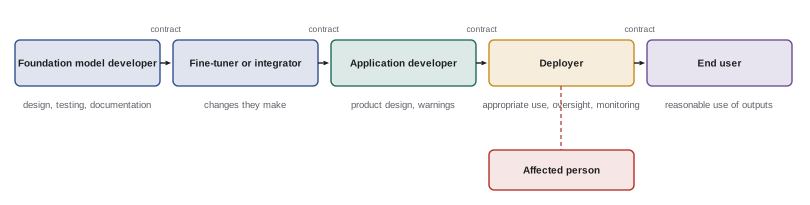
AI systems involve many parties: foundation model developers, fine-tuners, application developers, integrators, deployers and users. When harm occurs, liability may fall on several of them, depending on who controlled the relevant decisions:
- Developers are responsible for design choices, testing, documentation of limitations and warnings.
- Deployers are responsible for choosing appropriate systems, using them as intended, providing human oversight, monitoring, and acting on known problems.
- Integrators and modifiers may take on developer responsibilities for changes they make.
- Users are responsible for using outputs reasonably.
Regulations such as the EU AI Act define these responsibilities explicitly (Lesson 3), and contracts allocate them among the parties, though contracts cannot usually exclude liability to third parties such as injured members of the public.
Contracts and limitation of liability
Between businesses, contracts allocate AI risks through warranties (promises about performance or compliance), disclaimers (excluding implied warranties such as fitness for purpose), indemnities (promises to defend and compensate for third-party claims, such as IP infringement or data breaches), and limitations of liability (caps on damages, often at fees paid, and exclusions of indirect damages). Standard terms for AI services often disclaim accuracy and place responsibility for verifying outputs on the customer. Consumer contracts are subject to consumer protection laws that may limit such disclaimers. Lesson 11 discusses negotiating AI contracts.
Insurance
Organizations transfer some AI liability risk through insurance: professional liability (errors and omissions) for service providers, technology errors and omissions for software providers, cyber insurance for data breaches and security incidents, general liability for bodily injury and property damage, and directors and officers coverage for governance failures. Insurers are adapting: some are adding exclusions for AI-related losses or asking detailed questions about AI governance, while specialized policies covering AI performance failures have appeared. Strong governance practices can improve insurability and terms.
Estimating exposure
Expected liability can be estimated, roughly, as the number of uses multiplied by the probability of a harmful failure, the probability that it leads to a claim, and the cost per claim. Such estimates are uncertain but help prioritize controls.
import numpy as np
# Expected annual liability exposure from a customer-facing chatbot that sometimes gives wrong answers
rng = np.random.default_rng(7)
conversations = 2_000_000
error_rate = 0.004                 # share of conversations with a materially wrong answer
reliance_rate = 0.05               # share of wrong answers that a customer relies on to their detriment
claims_rate = 0.10                 # share of those that lead to a complaint or claim
cost_per_claim = (500, 2_000, 25_000)   # low, typical, severe, dollars (triangular)
def simulate(err, years=20_000):
    claims = rng.binomial(conversations, err * reliance_rate * claims_rate, years)
    costs = np.array([rng.triangular(*cost_per_claim, k).sum() for k in claims])
    return claims.mean(), costs.mean(), np.percentile(costs, 95)
for label, err in [("current error rate 0.4 %", error_rate), ("after grounding and review 0.1 %", 0.001)]:
    n, mean, p95 = simulate(err)
print(f"{label:34s} claims per year {n:6.0f}, expected cost {mean / 1e6:5.2f} M, P95 {p95 / 1e6:5.2f} M")current error rate 0.4 % claims per year 40, expected cost 0.37 M, P95 0.48 M after grounding and review 0.1 % claims per year 10, expected cost 0.09 M, P95 0.15 M
At a 0.4 % rate of materially wrong answers, two million conversations produce about 40 claims a year and an expected cost of about 0.37 million dollars, with a 95th percentile of about 0.48 million. Grounding answers in verified company policies and adding review for high-stakes topics, cutting the error rate to 0.1 %, reduces expected cost to about 0.09 million. The direct claims are modest here, but the estimate omits regulatory penalties, reputational harm and the possibility of a single severe incident; the main value of the exercise is in showing which parameters matter and how much reducing errors is worth.
Worked problem
A chatbot gives wrong refund information
An online retailer's AI chatbot tells a customer that a product can be returned within 90 days for a full refund, but the actual policy is 30 days. The customer returns it on day 60 and is refused. What are the retailer's legal position and the lessons?
Show solution
- Responsibility: the retailer deployed the chatbot and is responsible for its statements, as in Moffatt v. Air Canada; the customer reasonably relied on information from the retailer's official channel.
- Likely outcome: the retailer is likely to have to honour the refund or compensate the customer under misrepresentation or consumer protection law.
- Vendor: the retailer's recourse against the chatbot vendor depends on its contract, which probably disclaims accuracy.
- Lessons: ground the chatbot in the authoritative policy documents, test it on policy questions, add clear escalation to humans for refunds and exceptions, monitor conversations, and correct errors promptly.
Answer: The retailer should honour the stated terms in this case and fix the system. Deployers cannot disclaim responsibility for their chatbots' answers to customers, so accuracy controls on policy-related answers are essential.
Reducing liability exposure in practice
The practical measures that reduce liability are the same governance practices covered throughout this course: testing systems against their intended uses, documenting limitations and warnings, keeping humans responsible for high-stakes decisions, monitoring performance and acting on problems, responding promptly and fairly when errors occur, and allocating responsibilities clearly in contracts. Records of these measures are also the evidence needed to show reasonable care if a claim arises.
Common mistakes
MistakeAssuming a chatbot's statements are not the company's.
InsteadTreat chatbot answers as company statements and control their accuracy.
MistakeRelying on vendor disclaimers to avoid liability to customers.
InsteadAssume responsibility to third parties and allocate risk with vendors by contract.
MistakeUsing AI outputs in professional work without verification.
InsteadVerify outputs; professionals remain responsible.
MistakeIgnoring logs and documentation until a claim arises.
InsteadKeep records that show reasonable care and support causation analysis.
MistakeAssuming insurance automatically covers AI losses.
InsteadCheck policies for AI exclusions and coverage gaps.
Summary and key terms
- Negligence requires duty, breach of the standard of care, causation and harm; standards and regulations inform the standard of care.
- Canadian product liability is negligence-based outside Quebec, where manufacturers face near-strict liability.
- The EU's revised Product Liability Directive covers software and AI from December 2026.
- Deployers are responsible for their AI systems' statements, as Moffatt v. Air Canada showed.
- Professionals must verify AI outputs; sanctions for fabricated citations illustrate the risk.
- Liability can fall on several parties along the value chain; contracts allocate risk between businesses.
- Insurance and exposure estimates support risk management.
- Negligence
- Liability for failing to take reasonable care that causes foreseeable harm.
- Standard of care
- The level of care expected of a reasonable person in the circumstances.
- Strict liability
- Liability without proof of fault.
- Design defect
- A flaw in a product's design making it unreasonably dangerous.
- Failure to warn
- Inadequate warnings about a product's risks or limitations.
- Negligent misrepresentation
- A careless false statement relied on to the claimant's detriment.
- Defamation
- A false statement of fact harming someone's reputation.
- Indemnity
- A promise to compensate another party for specified losses or claims.
- Limitation of liability
- A contractual cap or exclusion of damages.
- Section 230
- A US law shielding online services from liability for third-party content.
Practice problems
Work each problem on paper first, then reveal the answer to check.
Name the elements of negligence.
Show answer
Duty of care, breach of the standard of care, causation and damage.
How does compliance with standards affect negligence claims?
Show answer
It is strong evidence of reasonable care, though not conclusive.
How does Quebec product liability differ from the rest of Canada?
Show answer
Quebec imposes liability for safety defects with limited defences, close to strict liability.
What does the revised EU Product Liability Directive change for AI?
Show answer
It treats software and AI as products and eases the burden of proof.
What did Moffatt v. Air Canada decide?
Show answer
The airline was liable for its chatbot's incorrect information.
What happened in Mata v. Avianca and Zhang v. Chen?
Show answer
Lawyers faced sanctions or costs for citing AI-invented cases.
From the output, what is the expected annual cost at a 0.4 % error rate?
Show answer
About 0.37 million dollars.
From the output, what does reducing the error rate to 0.1 % achieve?
Show answer
Expected cost falls to about 0.09 million dollars.
Name three contract tools for allocating AI risk.
Show answer
Warranties, disclaimers, indemnities, limitations of liability.
Why is Section 230 protection for AI outputs doubtful?
Show answer
The service itself generates the content rather than a third party.
Lesson quiz · 5 questions
Score 60% or more to complete this lesson.
Create a free account to save your progress, take quizzes and earn a certificate.