
AI-440 · Lesson 2 of 12 · 24 min
AI law and policy in Canada
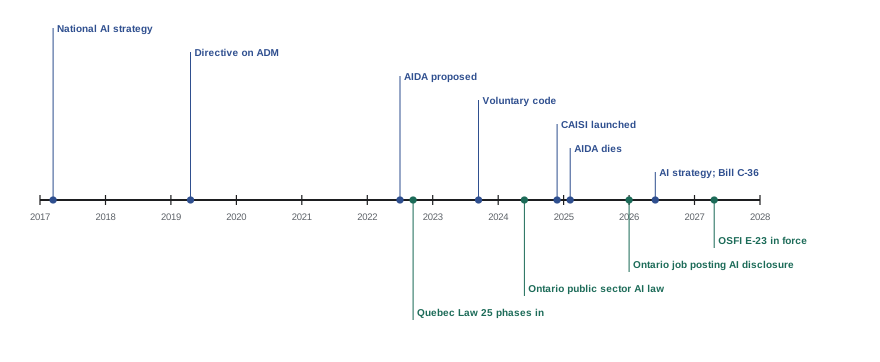
Canada was among the first countries to adopt a national AI strategy, in 2017, and its researchers helped create modern deep learning. Its approach to regulating AI has nonetheless been cautious and is still evolving. There is no AI-specific federal statute in force: the proposed Artificial Intelligence and Data Act died in January 2025, and the federal government has since emphasized adoption, investment and trust, with new privacy and online harms legislation as the main vehicles for protecting the public. This lesson explains the federal landscape, the rules governing government's own use of AI, provincial laws, the regulators that apply existing law to AI, and how organizations should navigate this evolving framework.
Federal legislation and policy
The Artificial Intelligence and Data Act (AIDA), introduced in 2022 as part of Bill C-27, would have regulated "high-impact" AI systems with requirements for risk assessment, mitigation, monitoring and transparency, enforced by an AI and Data Commissioner. It was criticized for leaving key definitions to future regulations and for limited consultation, and it died on the order paper when Parliament was prorogued in January 2025, along with the privacy reforms in the same bill. In May 2025, the federal government appointed Canada's first Minister of Artificial Intelligence and Digital Innovation, signalling a focus on adoption and economic benefit. A renewed national AI strategy announced in June 2026 emphasized trust, workforce support, sovereign compute infrastructure, support for Canadian AI companies and international coordination. Rather than reintroducing a broad AI act, the government introduced Bill C-36, the Protecting Privacy and Consumer Data Act, in June 2026 (Lesson 4), and announced a separate online harms bill, describing these as the legal foundations for trust in AI. As of late 2026, Bill C-36 was before Parliament.
Government use of AI
The federal Directive on Automated Decision-Making, issued by the Treasury Board in 2019 and updated since, governs federal institutions' use of automated systems to make or support administrative decisions about people. It requires an Algorithmic Impact Assessment (AIA), a published questionnaire whose score assigns an impact level from I (little impact) to IV (very high impact), with escalating requirements: notice to affected people, peer review, quality assurance and testing for bias, human intervention in final decisions at higher levels, explanations of decisions, recourse, and publication of the assessment. The government has also issued guidance on federal use of generative AI. Several provinces govern public sector AI too: Ontario's Strengthening Cyber Security and Building Trust in the Public Sector Act, 2024 enables requirements for public sector entities to disclose AI use, manage risks and ensure accountability.
Impact assessments of this kind are a model for any organization: a structured questionnaire about the decision, the people affected, the data and the degree of automation produces a score, mitigation measures reduce it, and the resulting level determines the required safeguards.
# An algorithmic impact assessment: questionnaire answers produce a raw risk score,
# mitigation measures reduce it, and the result maps to an impact level with required safeguards.
risk_answers = {  # question: points
    "decision affects rights, benefits or liberty": 8,
    "fully automated without human review": 6,
    "uses personal information": 4,
    "affects vulnerable groups": 5,
    "model is complex or opaque": 3,
    "decision hard to reverse": 4,
    "large number of people affected": 3,
}
mitigations = {"human review of all adverse decisions": 5, "documented testing for bias": 3,
               "plain-language explanation to affected people": 2, "recourse and appeal process": 3}
raw = sum(risk_answers.values())
max_raw = 40
mitigated = raw - sum(mitigations.values())
share = mitigated / max_raw
level = 1 + sum(share > t for t in (0.25, 0.50, 0.75))
safeguards = {1: "basic notice", 2: "notice, peer review, documentation",
              3: "plus human review of decisions, bias testing, explanation", 4: "plus independent review and senior approval"}
print(f"raw risk score {raw} of {max_raw}; after mitigation {mitigated} ({share:.0%})")
print(f"impact level {level}: {safeguards[level]}")
for drop in ["human review of all adverse decisions"]:
    m2 = raw - (sum(mitigations.values()) - mitigations[drop])
print(f"without {drop}: score {m2} ({m2 / max_raw:.0%}), level {1 + sum(m2 / max_raw > t for t in (0.25, 0.50, 0.75))}")raw risk score 33 of 40; after mitigation 20 (50%) impact level 2: notice, peer review, documentation without human review of all adverse decisions: score 25 (62%), level 3
The system starts with a high raw risk score because it affects rights and is fully automated, but documented mitigations, including human review of adverse decisions, bias testing, explanations and an appeal process, bring it down to level 2. Removing human review alone pushes it to level 3, triggering stronger requirements. Assessments like this encourage designers to build mitigations in, and make the reasoning behind deployment decisions visible to reviewers and the public.
Existing law applied to AI
In the absence of an AI statute, existing laws and regulators carry most of the load:
- Privacy: the Personal Information Protection and Electronic Documents Act (PIPEDA) and provincial private-sector laws, enforced by the Office of the Privacy Commissioner and provincial commissioners, who have investigated facial recognition (Clearview AI) and issued guidance on generative AI (Lesson 4).
- Human rights: the Canadian Human Rights Act and provincial human rights codes prohibit discrimination in employment, services and housing, whether by people or algorithms (Lesson 5).
- Competition and consumer protection: the Competition Bureau has studied AI and algorithmic pricing and applies the Competition Act's rules on deceptive marketing, including false claims about AI.
- Sector regulators: OSFI (financial institutions), Health Canada (medical devices), Transport Canada and others regulate AI within their domains (Lesson 9).
- Standards and voluntary codes: the Voluntary Code of Conduct on the Responsible Development and Management of Advanced Generative AI Systems (2023), signed by many companies, and standards from the Standards Council of Canada and the Digital Governance Standards Institute.
Provincial and state laws
Provinces have acted in several areas. Quebec's Law 25, which modernized its private-sector privacy law with obligations phased in from 2022 to 2024, requires organizations that make decisions based exclusively on automated processing of personal information to inform the person and, on request, explain the information and factors used and allow them to submit observations to a person who can review the decision. Ontario requires employers with 25 or more employees to disclose in publicly advertised job postings whether AI is used to screen, assess or select applicants, from January 1, 2026, under its Working for Workers legislation, and has public sector AI rules. Other provinces regulate AI indirectly through privacy, employment and consumer laws. Because Canada lacks a federal AI statute, organizations operating across provinces must follow the strictest applicable rules, often Quebec's.
Canadian organizations that also operate in the United States or the European Union face those jurisdictions' rules as well, and in practice many Canadian companies align their AI governance with the EU AI Act and with US state laws to serve those markets.
The national framework question
Canada's debate is less about federal-provincial preemption than about whether a dedicated AI law is needed at all. Supporters of an AI act argue that privacy and human rights laws do not cover risks such as unsafe autonomous systems, and that Canada risks falling behind trading partners; others argue that existing laws, sector regulators and standards are sufficient and that premature regulation would hamper adoption. The constitutional division of powers also matters: the federal government regulates trade and commerce, criminal law and federally regulated industries, while provinces regulate property and civil rights, employment in most sectors, health and education, so comprehensive AI regulation would likely require both levels of government.
Navigating an evolving framework
In an environment where rules are changing and sometimes contested, organizations can take several practical steps:
- Track developments systematically: assign responsibility for monitoring legislation, regulatory guidance, enforcement actions and court decisions in each jurisdiction of operation.
- Build on principles that persist across regimes: inventories, risk assessment, documentation, testing, human oversight and notice are required or encouraged almost everywhere, so investments in them remain useful as specific rules change.
- Comply with the strictest applicable rule where feasible, rather than maintaining many variants.
- Pay close attention to government customers and regulated sectors, where rules are often more detailed and enforced through procurement and supervision.
- Engage in consultations: governments in both countries regularly seek input on AI policy, and practitioners can contribute technical expertise.
Worked problem
Applying Quebec's automated decision rule
A Montreal-based online lender approves or declines small loans automatically, without human involvement, based on applicants' financial data. What must it do under Quebec's Law 25?
Show solution
- Determine whether decisions are based exclusively on automated processing of personal information: yes, no human reviews them.
- Inform each applicant, at or before the time of the decision, that the decision was made by automated processing.
- On request, explain the personal information used, the reasons and principal factors that led to the decision, and the right to correct the information.
- Allow the applicant to submit observations to a staff member who can review the decision.
Answer: The lender must give notice of automated decision-making, explanations of the information and principal factors on request, correction rights, and a route to human review. Designing explanation and review capabilities into the system from the start makes compliance straightforward; retrofitting them is harder.
Who regulates what: a practical map
For any AI deployment, it helps to identify the regulators whose existing mandates reach it. A useful exercise is to list, for each system, the regulator of personal information (a privacy commissioner or consumer protection agency), the regulator of discrimination (a human rights commission or civil rights enforcement agency), the regulator of advertising and consumer claims, any sector regulator (banking, insurance, health, transport, telecommunications, securities), and any government customer whose procurement rules apply. Each has its own powers, guidance and enforcement priorities, and their publications on AI are among the best indicators of what they will expect. Where several regulators share jurisdiction, as with a bank's AI hiring tool, the organization must satisfy all of them, and coordinated guidance from regulators is increasingly common.
Because AI policy is evolving quickly, organizations also benefit from tracking signals beyond formal law: government consultations and strategy documents, statements by ministers and agency heads, enforcement actions in neighbouring jurisdictions, and standards development. These often show the direction of future requirements years before they become binding.
Common mistakes
MistakeAssuming AI is unregulated in Canada because AIDA died.
InsteadApply privacy, human rights, competition and sector laws, and Quebec's automated decision rules.
MistakeIgnoring provincial differences.
InsteadComply with the strictest provincial rules, often Quebec's.
MistakeTreating impact assessments as paperwork.
InsteadUse them to design mitigations such as human review and explanations.
MistakeBuilding separate compliance for every rule change.
InsteadInvest in durable practices: inventory, assessment, documentation, testing, oversight.
MistakeNot tracking legislative and enforcement developments.
InsteadAssign responsibility for monitoring each jurisdiction.
Summary and key terms
- Canada has no AI statute in force; AIDA died in 2025 and Bill C-36 (privacy) was introduced in June 2026.
- The 2026 AI strategy emphasizes trust, workforce, sovereign compute and adoption.
- The Directive on Automated Decision-Making requires algorithmic impact assessments with four levels.
- Privacy, human rights, competition and sector regulators apply existing law to AI.
- Quebec's Law 25 regulates exclusively automated decisions; Ontario requires AI disclosure in job postings.
- The division of powers means comprehensive AI law would involve both levels of government.
- Durable practices such as inventories, assessments, documentation and oversight remain useful as rules change.
- Government directive
- A binding instruction to government departments or agencies, such as a Treasury Board directive or an executive order.
- Algorithmic impact assessment
- A structured assessment of an automated system's risks and required safeguards.
- Impact level
- A category determining the safeguards for an automated decision system.
- High-impact AI
- AI whose outputs are a principal basis for decisions with significant effects.
- Preemption
- Displacement of lower-level law by higher-level law.
- Automated decision
- A decision made by automated processing, with or without human involvement.
- Voluntary code
- A non-binding commitment by organizations to practices.
- Chief AI officer
- An official responsible for an organization's AI governance.
- Division of powers
- The allocation of legislative authority between levels of government.
- Recourse
- A route for affected people to challenge a decision.
Practice problems
Work each problem on paper first, then reveal the answer to check.
What happened to AIDA?
Show answer
It died when Parliament was prorogued in January 2025.
What does Bill C-36 propose?
Show answer
Modernized private-sector privacy law with stronger consent, deletion rights, children's protections, explanations of automated decisions and a new enforcement commission.
How many impact levels does the federal AIA use?
Show answer
Four, from I to IV.
From the output, what impact level results after mitigation?
Show answer
Level 2.
From the output, what happens without human review?
Show answer
The score rises to 62 % and the level to 3.
Which regulator investigated Clearview AI?
Show answer
The Office of the Privacy Commissioner (with provincial commissioners).
What does Quebec's Law 25 require for exclusively automated decisions?
Show answer
Notice, explanation of information and factors on request, correction, and the chance to submit observations for review.
What must Ontario job postings disclose from 2026?
Show answer
Whether AI is used to screen, assess or select applicants.
Name three durable governance practices.
Show answer
Inventory, impact assessment, documentation, testing, human oversight, notice.
Why comply with the strictest applicable rule?
Show answer
It avoids maintaining many variants and gaps as rules change.
Lesson quiz · 5 questions
Score 60% or more to complete this lesson.
Create a free account to save your progress, take quizzes and earn a certificate.