
AI-440 · Lesson 10 of 12 · 24 min
Standards, management systems and audits
Laws state what must be achieved; standards describe how. As AI regulation has grown, so has a body of technical and management standards that define terminology, risk management processes, impact assessments, documentation, testing and organizational management systems for AI. Standards give organizations a structured way to build governance, give regulators and courts a benchmark for reasonable practice, and in some regimes provide a presumption of conformity with the law. Audits and certifications verify that organizations and systems meet them. This lesson covers the main AI standards and frameworks, the structure of an AI management system, the NIST AI Risk Management Framework, documentation practices, the varieties of AI audit, audit evidence and sampling, and how to prepare for an audit.
The standards landscape
International standards for AI are developed mainly by ISO/IEC JTC 1/SC 42, a joint committee of the International Organization for Standardization and the International Electrotechnical Commission. Key standards include:
- ISO/IEC 22989 (AI concepts and terminology) and ISO/IEC 23053 (framework for machine learning systems).
- ISO/IEC 23894 (guidance on AI risk management, building on ISO 31000).
- ISO/IEC 42001 (2023): requirements for an AI management system, certifiable by accredited bodies.
- ISO/IEC 42005 (2025): guidance on AI system impact assessment, and ISO/IEC 42006 (2025): requirements for bodies auditing and certifying AI management systems.
- Standards on bias (ISO/IEC TR 24027), robustness, data quality (ISO/IEC 5259 series) and AI system life cycle processes.
Other sources include the IEEE 7000 series on ethical design, sector standards (for example on medical device software and automotive functional safety, ISO 26262 and ISO 21448), and European harmonized standards being developed by CEN-CENELEC to support the EU AI Act, whose delays contributed to the 2026 postponement of high-risk obligations (Lesson 3).
In Canada, the Standards Council of Canada coordinates national participation in international standards and convened the AI and Data Standardization Collaborative, and the Digital Governance Standards Institute publishes national standards such as CAN/DGSI 101 on ethical design and use of automated decision systems. Canadian organizations commonly adopt ISO/IEC 42001 and the NIST framework.
AI management systems: ISO/IEC 42001
ISO/IEC 42001 follows the structure common to ISO management system standards (such as ISO 9001 for quality and ISO/IEC 27001 for information security), so organizations can integrate it with existing systems. Its requirements cover:
- Context: understanding the organization, its stakeholders and the scope of the AI management system.
- Leadership: top management commitment, an AI policy, and assigned roles and responsibilities.
- Planning: AI risk assessment and treatment, AI system impact assessment, and AI objectives.
- Support: resources, competence, awareness, communication and documented information.
- Operation: operational planning and control, including the AI system life cycle, data, and third-party relationships.
- Performance evaluation: monitoring, internal audit and management review.
- Improvement: nonconformity, corrective action and continual improvement.
An annex lists reference controls, from policies and internal organization to resources, impact assessment, life cycle processes, data management, information for interested parties, responsible use and third-party relationships, which organizations select and justify in a statement of applicability. Certification by an accredited body provides external assurance, increasingly requested by customers and partners.
The NIST AI Risk Management Framework
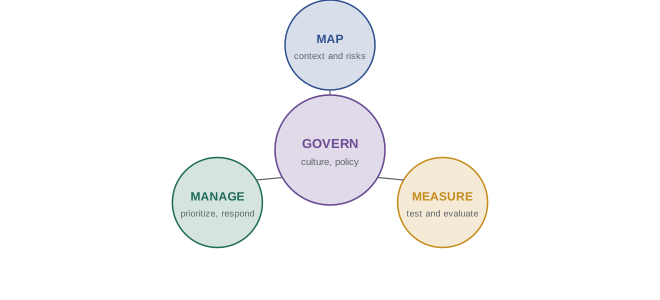
The NIST AI Risk Management Framework (AI RMF 1.0, January 2023) is a voluntary framework widely used in the United States and internationally. It describes characteristics of trustworthy AI (valid and reliable, safe, secure and resilient, accountable and transparent, explainable and interpretable, privacy-enhanced, and fair with harmful bias managed) and organizes risk management into four functions:
- Govern: cultivate a culture of risk management, with policies, accountability, workforce diversity and third-party management.
- Map: establish the context, intended purposes, stakeholders, and the potential impacts and risks of each AI system.
- Measure: analyse, assess and track risks with quantitative and qualitative methods, including testing, evaluation, verification and validation.
- Manage: prioritize and act on risks, respond to incidents, and communicate.
A companion playbook suggests actions for each subcategory, and profiles adapt the framework to particular contexts, including a Generative AI Profile (NIST AI 600-1, 2024) that addresses risks such as confabulation, information integrity, harmful content, data privacy, intellectual property and value chain dependencies.
Documentation
Standards and laws converge on documentation as the backbone of accountability. Common artefacts include:
- Model cards: short documents describing a model's intended use, performance across conditions and groups, limitations and ethical considerations.
- Datasheets for datasets: the motivation, composition, collection process, preprocessing, uses and maintenance of training data.
- System cards: documentation of a deployed AI system, including its components, safeguards and evaluation results, often published for frontier models (AI-430).
- Technical documentation required by regulations, such as under the EU AI Act.
- Impact assessments (algorithmic, privacy, fundamental rights).
- Logs of testing, approvals, changes, monitoring results and incidents.
Documentation serves several audiences: developers and maintainers, deployers who need to use the system correctly, auditors and regulators, and affected people. Good documentation is written as the system is developed, versioned with it, and kept accurate as it changes.
Varieties of AI audit
The word audit is used for several different activities:
- Internal audit: an organization's own audit function, independent of the teams being audited, assesses whether AI governance processes are designed and operating effectively.
- Management system certification: an accredited certification body audits conformity with ISO/IEC 42001.
- Bias or algorithmic audits: an independent party tests a system's outcomes for disparate impact or other harms, as required by New York City for automated employment decision tools (Lesson 5).
- Conformity assessment: under the EU AI Act, providers of high-risk systems assess conformity, in some cases through notified bodies (Lesson 3).
- Technical audits and red teaming: specialists probe a system's security, robustness and safety (AI-430).
- Regulatory examinations: supervisors such as banking regulators examine model risk management.
Audits differ in scope (process, system or outcome), independence, criteria, and the level of assurance they provide, from limited review to reasonable assurance. Users of audit reports should understand which kind they are reading: a certified management system does not guarantee that every AI system is fair or accurate, and a bias audit of one tool says nothing about governance elsewhere.
Audit evidence and sampling
Auditors gather evidence by inspecting documents, interviewing people, observing processes, re-performing controls and testing outcomes. Because it is rarely practical to test every model, decision or record, they use sampling. In attribute sampling, the auditor chooses a sample size large enough to conclude, with stated confidence, that the rate of control failures in the population is below a tolerable rate, provided the sample contains no more than a specified number of failures.
import math
# Audit sampling: how many records must an auditor test to be 95 percent confident that the
# control failure rate is below a tolerable rate, if zero or one failures are found?
def sample_size(tolerable, confidence=0.95, allowed_failures=0):
    n = 1
    while True:
        p_pass = sum(math.comb(n, k) * tolerable ** k * (1 - tolerable) ** (n - k) for k in range(allowed_failures + 1))
        if p_pass <= 1 - confidence:
            return n
        n += 1
for tol in (0.10, 0.05, 0.02):
    print(f"tolerable failure rate {tol:4.0%}: sample {sample_size(tol):4d} with zero failures, "
f"{sample_size(tol, allowed_failures=1):4d} if one failure is allowed")tolerable failure rate 10%: sample 29 with zero failures, 46 if one failure is allowed tolerable failure rate 5%: sample 59 with zero failures, 93 if one failure is allowed tolerable failure rate 2%: sample 149 with zero failures, 236 if one failure is allowed
To conclude with 95 % confidence that fewer than 10 % of, say, model approvals lack required documentation, an auditor must test 29 approvals and find none deficient, or 46 if one deficiency is allowed. For a 2 % tolerable rate, 149 or 236 items are needed. The numbers depend little on the size of the population, which is why sampling is efficient. Organizations preparing for audits can apply the same logic in their own quality checks: testing a modest random sample regularly gives meaningful assurance that controls are working.
Preparing for an audit
Organizations that perform well in AI audits share common practices:
- An up-to-date AI inventory with risk tiers and owners (Lesson 1).
- Policies and procedures that match what teams actually do.
- Evidence generated as a by-product of work: approvals recorded in workflow tools, test results stored with models, monitoring dashboards with history.
- Clear ownership of each control and a contact for each system.
- Prior internal reviews that have found and fixed problems, with records of corrective actions.
- Honest disclosure of known gaps with remediation plans; auditors and regulators respond better to identified and managed weaknesses than to surprises.
Worked problem
Planning ISO/IEC 42001 certification
A software company that sells AI-based document processing to banks has been asked by customers for ISO/IEC 42001 certification. It already holds ISO/IEC 27001. How should it plan?
Show solution
- Scope: define the AI management system scope, for example the development and operation of its document processing products.
- Gap analysis: compare current practices against 42001 clauses and Annex A controls, reusing 27001 elements such as document control, internal audit and management review.
- Build: write an AI policy, assign roles, implement AI risk and impact assessment procedures, data management and life cycle controls, and supplier controls for model providers.
- Operate: run the system for several months, generating records: assessments, approvals, monitoring, incidents, training.
- Verify: conduct an internal audit and management review, fix nonconformities.
- Certify: engage an accredited certification body for the two-stage certification audit.
Answer: Building on the existing ISO/IEC 27001 system makes 42001 certification achievable in months rather than years. The key is operating the system long enough to produce real evidence before the certification audit.
Choosing among frameworks
Organizations often ask whether to adopt ISO/IEC 42001, the NIST AI RMF or both. The two are complementary: the NIST framework offers detailed, flexible guidance on identifying and managing AI risks, while ISO/IEC 42001 provides a certifiable management system structure that customers and partners can verify. Many organizations use the NIST framework and its profiles to shape their risk practices, and ISO/IEC 42001 to organize and certify the program, mapping between them with published crosswalks. Sector standards and regulatory requirements are then layered on top. Whichever is chosen, the value lies in consistent practice and evidence, not in the label.
Finally, standards evolve: new parts and revisions appear regularly, and harmonized standards for the EU AI Act will create specific presumptions of conformity when published. Assigning someone to track relevant standards and to update internal practices keeps the program current.
Common mistakes
MistakeTreating standards as checklists to copy.
InsteadAdapt them to the organization's context and risks.
MistakeAssuming ISO/IEC 42001 certification proves every AI system is fair.
InsteadUnderstand that it certifies a management system, not each system's outcomes.
MistakeWriting documentation after the fact.
InsteadCreate and version documentation during development.
MistakeTesting too few items to draw conclusions.
InsteadUse sampling plans that support the desired confidence.
MistakeHiding known gaps from auditors.
InsteadDisclose gaps with remediation plans.
Summary and key terms
- ISO/IEC JTC 1/SC 42 standards cover terminology, risk management, management systems, impact assessment and more.
- ISO/IEC 42001 specifies a certifiable AI management system integrated with other ISO systems.
- The NIST AI RMF organizes risk management into Govern, Map, Measure and Manage, with a generative AI profile.
- Model cards, datasheets, system cards, technical files and impact assessments document AI systems.
- Audits range from internal audit and certification to bias audits, conformity assessment, red teaming and regulatory exams.
- Attribute sampling gives stated confidence about control failure rates with modest samples.
- Audit readiness depends on inventories, real evidence, ownership and honest gap management.
- ISO/IEC 42001
- The international standard for AI management systems.
- Statement of applicability
- A document listing selected controls and justifications.
- NIST AI RMF
- A voluntary US framework for AI risk management.
- Model card
- A short document describing a model's use, performance and limits.
- Datasheet for datasets
- Documentation of a dataset's origin, composition and use.
- Conformity assessment
- A process to verify that a system meets requirements.
- Bias audit
- An independent test of a system's outcomes for disparate impact.
- Attribute sampling
- Sampling to estimate the rate of a control failure.
- Tolerable rate
- The maximum acceptable failure rate in an audit.
- Nonconformity
- Failure to meet a requirement of a standard.
Practice problems
Work each problem on paper first, then reveal the answer to check.
Which committee develops international AI standards?
Show answer
ISO/IEC JTC 1/SC 42.
What does ISO/IEC 42001 specify?
Show answer
Requirements for an AI management system.
Name the four NIST AI RMF functions.
Show answer
Govern, Map, Measure, Manage.
What risks does the NIST Generative AI Profile address?
Show answer
Confabulation, information integrity, harmful content, privacy, IP, value chain.
What does a model card contain?
Show answer
Intended use, performance across conditions and groups, limitations and ethical considerations.
Why does a certified management system not guarantee fair outcomes?
Show answer
It certifies processes, not each system's results.
From the output, what sample is needed for a 5 % tolerable rate with zero failures?
Show answer
59.
Why does sample size depend little on population size?
Show answer
Confidence depends on the sample and tolerable rate, not the population, for large populations.
Name three audit readiness practices.
Show answer
Inventory, matching policies, evidence from workflow, ownership, prior internal reviews, honest gap disclosure.
Why build on ISO/IEC 27001 for 42001?
Show answer
They share management system structure and processes.
Lesson quiz · 5 questions
Score 60% or more to complete this lesson.
Create a free account to save your progress, take quizzes and earn a certificate.