
AI-440 · Lesson 5 of 12 · 24 min
Automated decisions, discrimination and human rights
When AI systems help decide who is hired, who receives credit, who is approved for housing or insurance, or who is flagged for investigation, they engage some of the most important protections in law: the right to equal treatment without discrimination, and, for governments, the rights to procedural fairness and equality guaranteed by constitutions. Algorithms can discriminate without anyone intending them to, by learning patterns from biased historical data or using proxies for protected characteristics. This lesson explains how algorithmic discrimination arises, the legal concepts of direct and adverse effect discrimination, the frameworks that apply in employment, credit, housing and services, how adverse impact is measured, the obligations of explanation and accommodation, human oversight and its limits, and how organizations can manage these risks.
How algorithms discriminate
Algorithmic discrimination usually arises from data and design choices rather than intent:
- Historical bias: a model trained on past hiring decisions learns the preferences, including biases, of past decision-makers. A widely reported case involved an experimental recruiting tool that learned to downgrade resumes containing words associated with women, because past hires in technical roles were mostly men.
- Proxies: even without protected attributes as inputs, models can use correlated features such as postal code, school, name, employment gaps or purchasing patterns that act as proxies for race, sex, age or disability.
- Representation: groups underrepresented in training data may experience higher error rates, as studies of facial recognition showed for darker-skinned women.
- Measurement: the target variable may itself be biased, such as using arrests as a proxy for crime, or health spending as a proxy for health need (a well-known study found a widely used health algorithm underestimated the needs of Black patients for this reason).
- Feedback loops: decisions influence future data, for example policing directed by predictions generates more data in the same areas.
- Accessibility: AI interviews or tests may disadvantage people with disabilities, such as speech or vision impairments, if accommodations are not provided.
Legal concepts of discrimination
Anti-discrimination law recognizes two broad forms:
- Direct discrimination (disparate treatment): treating someone less favourably because of a protected characteristic, for example a model that uses sex or age as an input to reject applicants, or a rule deliberately targeting a group.
- Adverse effect discrimination (disparate impact): a neutral-seeming rule or practice that disproportionately disadvantages a protected group, which is unlawful unless justified. Most algorithmic discrimination falls into this category.
In Canada, the Canadian Human Rights Act (for federally regulated employers and service providers) and provincial human rights codes prohibit discrimination in employment, services, housing and contracts on grounds such as race, national or ethnic origin, colour, religion, age, sex, sexual orientation, gender identity or expression, marital and family status, and disability. Canadian law does not require intent: a practice with an adverse effect on a protected group is discriminatory unless the respondent shows it is a bona fide requirement, rationally connected to a legitimate purpose, adopted in good faith, and reasonably necessary, with accommodation to the point of undue hardship (the test from the Supreme Court of Canada's Meiorin decision, 1999). For governments, section 15 of the Canadian Charter of Rights and Freedoms guarantees equality, and administrative law requires procedural fairness in decisions affecting individuals, including the right to reasons in many cases. Human rights commissions in Ontario and elsewhere have issued guidance on AI and human rights.
Measuring adverse impact
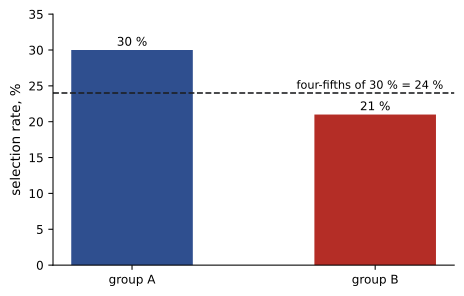
A common screening measure in employment is the selection rate ratio, used in the four-fifths (80 %) rule of thumb from the US Uniform Guidelines on Employee Selection Procedures (1978): if a group's selection rate is less than 80 % of the highest group's rate, this is generally regarded as evidence of adverse impact. The rule is a guide, not a legal standard in Canada and not conclusive in the United States, where statistical significance and practical significance are both considered. Similar analysis applies to credit approvals, pricing and other decisions.
import numpy as np
# Adverse impact in a hiring screen: selection rates by group and the four-fifths rule
applicants = {"group A": 1200, "group B": 800}
selected = {"group A": 360, "group B": 168}
rates = {g: selected[g] / applicants[g] for g in applicants}
best = max(rates.values())
for g, r in rates.items():
    ratio = r / best
    flag = "below four-fifths" if ratio < 0.8 else "ok"
    print(f"{g}: selection rate {r:.1%}, impact ratio {ratio:.2f} ({flag})")
# Is the difference statistically significant? Two-proportion z test
p1, p2 = rates["group A"], rates["group B"]
n1, n2 = applicants["group A"], applicants["group B"]
p = (selected["group A"] + selected["group B"]) / (n1 + n2)
z = (p1 - p2) / np.sqrt(p * (1 - p) * (1 / n1 + 1 / n2))
print(f"difference {p1 - p2:.1%}, z = {z:.2f}")
# With small samples the same rates may not be significant
z_small = (p1 - p2) / np.sqrt(p * (1 - p) * (1 / 60 + 1 / 40))
print(f"same rates with 60 and 40 applicants: z = {z_small:.2f}")group A: selection rate 30.0%, impact ratio 1.00 (ok) group B: selection rate 21.0%, impact ratio 0.70 (below four-fifths) difference 9.0%, z = 4.47 same rates with 60 and 40 applicants: z = 1.00
Group B is selected at 21 % against 30 % for group A, an impact ratio of 0.70, below four-fifths, and with 2,000 applicants the difference is highly significant (z about 4.5). With only 100 applicants, the same rates would not be statistically significant (z about 1.0), which is why small samples need careful interpretation and why ongoing monitoring across larger volumes is important. Finding adverse impact is not the end of the analysis: the organization must examine why it arises, whether the criteria are job-related and necessary, and whether less discriminatory alternatives exist, such as removing proxy features or adjusting thresholds.
Explanation and reasons
Laws increasingly require explanations of automated decisions. In the United States, the Equal Credit Opportunity Act requires lenders to give applicants specific reasons for adverse credit decisions, which means the model must support accurate identification of the principal factors, not generic statements. Quebec's Law 25, the EU AI Act and GDPR, and several US state laws give rights to information about the main factors in automated decisions. Government decision-makers must generally give reasons that allow people to understand and challenge decisions. Explanations should be accurate (faithful to the model, AI-430), meaningful to the recipient, and actionable where possible, indicating what could change the outcome. Technical explanation methods such as feature attribution help, but must be validated, and complex models may need simpler surrogate or inherently interpretable models for high-stakes decisions.
Accommodation and accessibility
Employers and service providers have a duty to accommodate people with disabilities, and other protected characteristics such as religion, to the point of undue hardship. AI-driven processes, such as automated video interviews, timed online assessments, voice systems and chatbots, can create barriers for people with visual, hearing, speech, motor, cognitive or mental health disabilities. Organizations should inform applicants about AI tools, offer alternative formats or human assessment on request, test tools for accessibility, and ensure that accommodation requests are not screened out by the system. Accessibility laws, such as the Accessible Canada Act and provincial laws, and the ADA in the United States, reinforce these obligations.
Human oversight and its limits
Many frameworks require human oversight of automated decisions, and keeping a human in the loop is often presented as the safeguard against algorithmic harm. But oversight is only meaningful if the human has the authority, time, information and competence to disagree with the system. Research shows automation bias: people tend to accept system recommendations, especially under time pressure, and may defer even when the recommendation is wrong. Rubber-stamp review of hundreds of decisions per hour does not satisfy the purpose of oversight and may not satisfy the law. Effective oversight design includes clear criteria for when to override, information about the system's confidence and limitations, manageable workloads, monitoring of override rates, and training. Legal rules that apply only to decisions made solely by automated means can sometimes be avoided by nominal human involvement, which regulators increasingly scrutinize.
Managing discrimination risk
An organization deploying AI in consequential decisions should:
- Assess impact before deployment: identify protected groups, available data to test outcomes (collecting demographic data for testing where lawful and with safeguards), and potential proxies.
- Test for adverse impact and error rate differences across groups, on representative data.
- Investigate and mitigate: remove or constrain proxy features, rebalance data, adjust thresholds, or choose different models; document the analysis of alternatives.
- Validate job-relatedness or business necessity: show that criteria predict the outcome that matters.
- Provide notice, explanations, accommodation and human review.
- Monitor in production for drift in outcomes across groups, and re-audit regularly, independently where required.
- Require vendors to provide testing evidence and cooperate with audits (Lesson 11).
Fairness metrics and mitigation techniques are covered in depth in AI-460. Technical fairness and legal compliance overlap but are not identical: the right metric depends on the legal context and the decision.
Worked problem
Responding to an adverse impact finding
An internal audit finds that an AI tool used to shortlist applicants for warehouse supervisor roles selects women at 65 % of the rate for men. What should the employer do?
Show solution
- Pause or add human review of rejected applicants while investigating, to limit ongoing harm.
- Investigate causes: examine features and their effects; for example, the model may weight continuous employment heavily, disadvantaging people with caregiving gaps, or use prior job titles that reflect historical segregation.
- Assess job-relatedness: do those features actually predict supervisor performance? Validate against performance data.
- Mitigate: remove or reduce weight on non-predictive proxy features, retrain, and test again for impact and predictive validity.
- Document the analysis, including alternatives considered, and inform the vendor if it supplied the tool, requiring its cooperation.
- Monitor going forward and review whether affected past applicants should be reconsidered.
Answer: An impact ratio of 0.65 is strong evidence of adverse impact. The employer must find the cause, justify or remove the criteria, adopt less discriminatory alternatives, and keep monitoring. Ignoring the finding, or relying on the vendor's assurances, would expose it to liability under human rights or civil rights law.
Organizations should also remember that discrimination law protects people throughout the employment relationship, not only in hiring: AI used for scheduling, performance evaluation, promotion, pay and termination decisions raises the same issues and deserves the same testing and oversight.
Common mistakes
MistakeAssuming removing protected attributes prevents discrimination.
InsteadTest outcomes and look for proxy features.
MistakeTreating the four-fifths rule as a safe harbour.
InsteadConsider statistical and practical significance and justification.
MistakeRelying on nominal human review.
InsteadDesign oversight with authority, information, time and monitoring of overrides.
MistakeIgnoring accessibility of AI-driven processes.
InsteadOffer alternatives and accommodation, and test accessibility.
MistakeAccepting vendor bias claims without evidence.
InsteadRequire testing data, audits and cooperation in contracts.
Summary and key terms
- Algorithms discriminate through historical bias, proxies, representation, measurement and feedback loops.
- Direct discrimination treats people differently by protected characteristic; adverse effect discrimination disadvantages groups through neutral practices.
- Canadian human rights law needs no intent; respondents must justify adverse effects under the Meiorin test and accommodate.
- The four-fifths rule screens for adverse impact but is not conclusive; sample size matters.
- Explanation obligations require accurate, meaningful reasons for automated decisions.
- Accommodation and accessibility apply to AI-driven processes.
- Human oversight must be meaningful to counter automation bias.
- Direct discrimination
- Less favourable treatment because of a protected characteristic.
- Adverse effect discrimination
- A neutral practice that disproportionately disadvantages a protected group.
- Disparate impact
- The US term for adverse effect discrimination.
- Proxy variable
- A feature correlated with a protected characteristic.
- Four-fifths rule
- A selection rate below 80 % of the highest group's rate suggests adverse impact.
- Bona fide requirement
- A justified requirement that may excuse adverse effects.
- Duty to accommodate
- The obligation to adjust practices for protected needs up to undue hardship.
- Adverse action notice
- A required statement of reasons for denying credit.
- Automation bias
- The tendency to over-rely on automated recommendations.
- Less discriminatory alternative
- A practice meeting the same goal with less adverse impact.
Practice problems
Work each problem on paper first, then reveal the answer to check.
Name three ways algorithms can discriminate without intent.
Show answer
Historical bias, proxies, unrepresentative data, biased targets, feedback loops, inaccessible processes.
What is adverse effect discrimination?
Show answer
A neutral practice that disproportionately disadvantages a protected group.
Which decision set the Canadian test for justifying adverse effects?
Show answer
Meiorin (Supreme Court of Canada, 1999).
From the output, what is group B's impact ratio?
Show answer
0.70.
From the output, why is the small-sample result different?
Show answer
With 100 applicants the same difference is not statistically significant (z about 1.0).
Selection rates are 40 % and 34 %. Is the lower group below four-fifths?
Show answer
No: 34 ÷ 40 = 0.85.
What must explanations of automated decisions be?
Show answer
Accurate, meaningful and, where possible, actionable.
Name an accessibility barrier in AI hiring and a remedy.
Show answer
Timed or video assessments for people with disabilities; offer alternative formats or human assessment.
What is automation bias?
Show answer
Over-reliance on automated recommendations.
Name three steps to manage discrimination risk.
Show answer
Pre-deployment testing, proxy investigation, mitigation, validation, notice and review, monitoring, vendor evidence.
Lesson quiz · 5 questions
Score 60% or more to complete this lesson.
Create a free account to save your progress, take quizzes and earn a certificate.