
AERO-330 · Lesson 7 of 12 · 23 min
Longitudinal modes: short period and phugoid
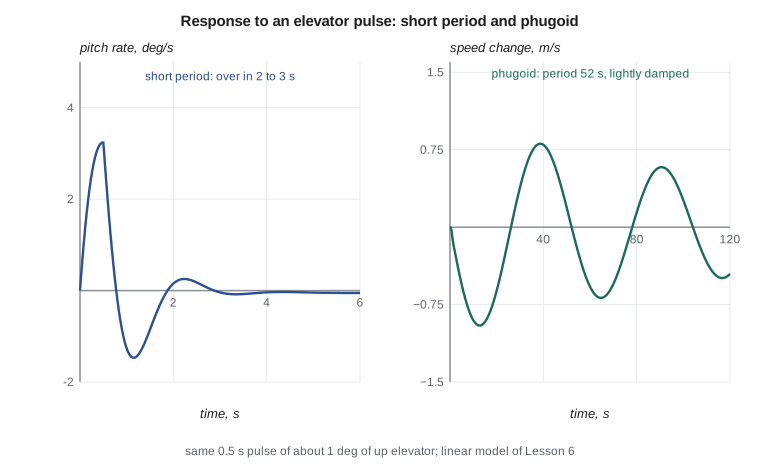
In the engineering simulator, Sam trims the Tern Block 2 in cruise, gives the control column a sharp tug and lets go. For two or three seconds the nose bobs once and settles. Then, much more slowly, something else happens: over the next minute the aircraft gently climbs, slows, dives, speeds up and climbs again, a long rolling motion that a passenger reading a newspaper would never notice but that an autopilot designer cannot ignore. Those are the two longitudinal modes found in Lesson 6: the short period and the phugoid. This lesson explains the physics of each, derives simple approximations that capture them, and shows how the CG position changes them.
The short-period mode
The short period is a rapid pitching oscillation about the CG in which the angle of attack and pitch rate change while the speed stays almost constant. Its physics is that of a mass on a spring with a damper. The spring is the pitch stiffness: an increase in angle of attack produces a nose-down moment proportional to \(C_{m_\alpha}\). The damper is the pitch damping: as the aircraft pitches, the tail moves up or down through the air, changing its angle of attack and producing a moment opposing the pitch rate, the derivative \(C_{m_q}\), with a further contribution from the downwash lag \(C_{m_{\dot\alpha}}\). Lift also helps damp the mode, because a rise in angle of attack raises lift, which curves the flight path and reduces the angle of attack again.
Holding speed constant and dropping the speed equation leaves a second-order system in \(w\) and \(q\), whose characteristic equation gives the short-period approximation:
The first term reads: frequency squared equals pitch stiffness plus a lift-damping product. Since \(M_w u_0 = M_\alpha\) is proportional to \(C_{m_\alpha}\) and dynamic pressure, the short-period frequency rises with static margin and with speed. The damping comes from three terms of similar size for the Tern: tail damping, downwash lag and lift. Unlike the frequency, the damping term does not grow with static margin, so a more stable aircraft has a higher frequency and a lower damping ratio.
The phugoid
The phugoid is the slow exchange of kinetic and potential energy at nearly constant angle of attack. If the aircraft is disturbed so that it flies slightly faster than trim, its lift exceeds its weight and it climbs. Climbing, it slows; slower, its lift falls below its weight, and it descends, speeding up again. The cycle repeats. Lanchester described this mode in 1908, imagining a glider whose angle of attack stays fixed and whose drag is negligible, and found a remarkably simple result:
The period depends only on speed: about 0.45 seconds per metre per second of airspeed. The damping comes from drag, which takes energy out of the exchange, and is therefore inversely proportional to the lift-to-drag ratio. An efficient aircraft, with a high lift-to-drag ratio, has a lightly damped phugoid. Gliders and modern airliners can have phugoid damping ratios of a few hundredths, and in some conditions the phugoid is mildly unstable without anyone being alarmed, because its time scale is long enough for a pilot to correct without noticing.
# Short-period and phugoid modes of the Tern Block 2: compare the two-degree-of-freedom
# approximations with the full fourth-order eigenvalues, then vary the CG.
import math
def charpoly(A):
    """Coefficients of det(sI - A), highest power first (Faddeev-LeVerrier)."""
    n = len(A); M = [[0.0] * n for _ in range(n)]; c = [1.0]
    I = [[1.0 if i == j else 0.0 for j in range(n)] for i in range(n)]
    for k in range(1, n + 1):
        AM = [[sum(A[i][l] * M[l][j] for l in range(n)) for j in range(n)] for i in range(n)]
        M = [[AM[i][j] + c[-1] * I[i][j] for j in range(n)] for i in range(n)]
        AM = [[sum(A[i][l] * M[l][j] for l in range(n)) for j in range(n)] for i in range(n)]
        c.append(-sum(AM[i][i] for i in range(n)) / k)
    return c

def roots(c, it=500):
    """All roots of a polynomial by the Durand-Kerner iteration."""
    n = len(c) - 1; a = [x / c[0] for x in c]
    z = [complex(0.4, 0.9) ** k for k in range(n)]
    for _ in range(it):
        new = []
        for i in range(n):
            p = sum(a[k] * z[i] ** (n - k) for k in range(n + 1))
            d = 1
            for j in range(n):
                if j != i: d *= (z[i] - z[j])
            new.append(z[i] - p / d)
        z = new
    return sorted(z, key=lambda r: -abs(r))

def describe(s):
    import math
    if abs(s.imag) < 1e-6:
        t = -1 / s.real if s.real < 0 else 1 / s.real
        kind = 'time constant' if s.real < 0 else 'doubles every'
        val = t if s.real < 0 else math.log(2) / s.real
        return f"real root {s.real:+.4f}: {kind} {val:.2f} s"
    wn = abs(s); z = -s.real / wn
    return f"pair {s.real:+.4f} +/- {abs(s.imag):.4f}j: wn {wn:.3f} rad/s, zeta {z:.3f}, period {2*math.pi/abs(s.imag):.1f} s"

m, Iyy, S, c, g, rho, u0 = 6500.0, 27000.0, 28.0, 1.73, 9.81, 0.909, 105.0
QS = 0.5 * rho * u0 ** 2 * S
CL = m * g / QS; CD = 0.028 + 0.039 * CL ** 2; CLa = 5.6; CDa = 2 * 0.039 * CL * CLa
Cmq, Cmad = -20.0, -6.0
def model(Cma):
    Xu = -2 * CD * QS / (m * u0); Xw = (CL - CDa) * QS / (m * u0)
    Zu = -2 * CL * QS / (m * u0); Zw = -(CLa + CD) * QS / (m * u0)
    Mw = Cma * QS * c / (Iyy * u0); Mwd = Cmad * (c / (2 * u0)) * QS * c / (Iyy * u0)
    Mq = Cmq * (c / (2 * u0)) * QS * c / Iyy
    A = [[Xu, Xw, 0, -g], [Zu, Zw, u0, 0], [Mwd * Zu, Mw + Mwd * Zw, Mq + Mwd * u0, 0], [0, 0, 1, 0]]
    return A, Xu, Zw, Mw, Mwd, Mq
def wz(s): return abs(s), -s.real / abs(s)
A, Xu, Zw, Mw, Mwd, Mq = model(-1.00)
full = [s for s in roots(charpoly(A)) if s.imag > 0]
# short period approximation (constant speed): s^2 - (Mq + Mwd u0 + Zw) s + (Zw Mq - Mw u0) = 0
wn_sp = math.sqrt(Zw * Mq - Mw * u0); z_sp = -(Mq + Mwd * u0 + Zw) / (2 * wn_sp)
# Lanchester phugoid (constant angle of attack, no drag): wn = sqrt(2) g/u0; zeta from Xu
wn_ph = math.sqrt(2) * g / u0; z_ph = -Xu / (2 * wn_ph)
print("mode           full model              approximation")
w1, z1 = wz(full[0]); w2, z2 = wz(full[1])
print(f"short period   wn {w1:.3f}, zeta {z1:.3f}     wn {wn_sp:.3f}, zeta {z_sp:.3f}")
print(f"phugoid        wn {w2:.4f}, zeta {z2:.3f}    wn {wn_ph:.4f}, zeta {z_ph:.3f}")
print(f"phugoid period {2*math.pi/full[1].imag:.1f} s (Lanchester {2*math.pi/wn_ph:.1f} s = pi sqrt(2) u0/g)")
print("\nCm_alpha   static margin   short period wn, zeta     phugoid period, zeta")
for Cma in (-1.40, -1.00, -0.60, -0.30, -0.10):
    A = model(Cma)[0]; r = [s for s in roots(charpoly(A)) if s.imag > 1e-6]
    sp = max(r, key=abs) if r else None
    ph = min(r, key=abs) if len(r) > 1 else None
    txt = f"{abs(sp):.2f}, {wz(sp)[1]:.2f}" if sp is not None else "two real roots"
    txt2 = f"{2*math.pi/ph.imag:5.1f} s, {wz(ph)[1]:.3f}" if ph is not None else "no oscillation"
print(f" {Cma:+.2f} {-Cma/5.6:5.3f} {txt:20s} {txt2}")mode full model approximation short period wn 3.272, zeta 0.472 wn 3.272, zeta 0.471 phugoid wn 0.1211, zeta 0.052 wn 0.1321, zeta 0.056 phugoid period 52.0 s (Lanchester 47.6 s = pi sqrt(2) u0/g) Cm_alpha static margin short period wn, zeta phugoid period, zeta -1.40 0.250 3.78, 0.41 50.8 s, 0.053 -1.00 0.179 3.27, 0.47 52.0 s, 0.052 -0.60 0.107 2.67, 0.58 54.7 s, 0.053 -0.30 0.054 2.10, 0.73 61.0 s, 0.060 -0.10 0.018 1.62, 0.95 81.5 s, 0.105
The short-period approximation is excellent: 3.272 rad/s and a damping ratio of 0.471 against 3.272 and 0.472 from the full model. That reflects how well separated the two modes are; the speed hardly changes in the first few seconds. The Lanchester approximation is cruder. It predicts a 47.6 second period against the true 52.0, about 9 percent short, because it ignores the change of lift with speed caused by compressibility and thrust, and the coupling with pitch. It is still the quickest way to estimate the period at the start of a design. The damping, 0.056 against 0.052, is close.
The second table shows what the CG does. As the static margin falls from 25 percent to 2 percent, the short-period frequency drops from 3.78 to 1.62 rad/s and its damping ratio climbs from 0.41 to 0.95. At very small margins the two short-period roots move toward the real axis and eventually split into two real roots, one of which would become unstable at a negative margin. The phugoid barely notices until the margin is small; then its period lengthens and its damping changes, a sign that the two modes are beginning to couple. That coupling at small margins is one reason why aircraft designed for relaxed stability need a flight control system that keeps the modes apart.
What the modes mean to the pilot
The short period is the mode the pilot feels in every manoeuvre. Its frequency sets how quickly the aircraft responds to a control input and its damping sets whether the response overshoots. Too slow and the aircraft feels sluggish; too fast and it feels twitchy; too lightly damped and it bobs after every input, inviting a pilot-induced oscillation. Lesson 9 turns those impressions into handling-qualities criteria. The phugoid matters less to the pilot, who corrects it unconsciously, but much more to the autopilot designer and to a pilot who has trimmed carelessly: an aircraft out of trim by a few knots will slowly porpoise if left alone.
Configuration and flight condition change both modes. At the approach speed of 52 m/s , with flaps down, the short period is slower because dynamic pressure is a quarter of its cruise value, and the phugoid period is shorter because it scales with speed. At high altitude, where the air density is low, aerodynamic damping falls relative to inertia, so the short-period damping ratio drops: this is why high-altitude aircraft often carry a pitch damper. Lesson 9 checks the Tern at both cruise and approach.
| Mode | Typical period | Variables involved | Governed by |
|---|---|---|---|
| Short period | 1 to 5 s | angle of attack and pitch rate | Cm-alpha, Cm-q, lift slope |
| Phugoid | 20 to 100 s | speed and height (pitch attitude) | speed, lift-to-drag ratio |
Worked problem
Lanchester estimate
Estimate the phugoid period and damping ratio for an aircraft flying at 140 m/s with a lift-to-drag ratio of 16.
Show solution
- \(T = \pi\sqrt 2 \times 140/9.81 = 63.4\) s.
- \(\zeta = (1/\sqrt 2)(1/16) = 0.044\).
Answer: A cleaner aircraft with a lift-to-drag ratio of 20 would have a damping ratio of only 0.035.
Worked problem
Short-period approximation
An aircraft has \(Z_w = -1.2\) per s, \(M_q + M_{\dot w}u_0 = -2.1\) per s, \(M_q = -1.6\) per s and \(M_\alpha = -9.0\) per s². Estimate the short-period frequency and damping ratio.
Show solution
- \(\omega_n^2 = Z_w M_q - M_\alpha = (-1.2)(-1.6) + 9.0 = 10.92\), so \(\omega_n = 3.30\) rad/s.
- \(2\zeta\omega_n = 2.1 + 1.2 = 3.3\), so \(\zeta = 3.3/6.60 = 0.50\).
Answer: This is a typical level 1 short period for a transport-category aircraft in cruise.
Common mistakes
MistakeThinking the phugoid involves large angle of attack changes.
InsteadIt is an energy exchange at nearly constant angle of attack.
MistakeExpecting more static margin to increase short-period damping ratio.
InsteadIt raises the frequency; the damping ratio usually falls.
MistakeTreating a lightly damped phugoid as dangerous in itself.
InsteadIts period is long enough for pilots and autopilots to correct easily.
MistakeUsing cruise mode values for the approach.
InsteadSpeed, density and configuration change both modes; analyse each condition.
Summary and key terms
- The longitudinal motion of a conventional aircraft splits into two modes.
- The short period is a fast, usually well-damped pitching oscillation at nearly constant speed, governed by pitch stiffness, pitch damping and lift; its two-degree-of-freedom approximation is accurate.
- The phugoid is a slow, lightly damped exchange of speed and height at nearly constant angle of attack, with a period roughly proportional to speed and damping inversely proportional to lift-to-drag ratio.
- Reducing the static margin lowers the short-period frequency, raises its damping ratio and eventually couples the modes.
- Short-period mode
- A rapid pitching oscillation at nearly constant speed.
- Phugoid
- A slow oscillation exchanging speed and height at nearly constant angle of attack.
- Pitch damping
- Cm_q, the moment opposing pitch rate, mostly from the tail.
- Lanchester approximation
- The phugoid estimate ω_n = √2 g/u_0 for constant angle of attack and negligible drag.
- Mode separation
- The large ratio of short-period to phugoid frequency that allows separate approximations.
- Pilot-induced oscillation
- An unwanted oscillation caused by the pilot fighting the aircraft response.
Practice problems
Work each problem on paper first, then reveal the answer to check.
What two quantities set the short-period frequency?
Show answer
Pitch stiffness (M_α) and the product of lift and pitch damping (Z_w M_q).
Estimate the phugoid period at 70 m/s.
Show answer
π√2 × 70/9.81 = 31.7 s.
Why is phugoid damping low for efficient aircraft?
Show answer
It is proportional to drag over lift.
In the program, at what static margin does the short-period damping ratio approach 1?
Show answer
Near 2 percent.
Why does short-period damping ratio fall at high altitude?
Show answer
Aerodynamic damping drops with density while inertia does not.
Which mode does the pilot feel in every manoeuvre?
Show answer
The short period.
Lesson quiz · 5 questions
Score 60% or more to complete this lesson.
Create a free account to save your progress, take quizzes and earn a certificate.