
ACCT-421 · Lesson 9 of 12 · 27 min
Strategic capital investment and capital cost allowance tax shields
Capital investment decisions commit large sums for many years and are hard to reverse. They shape what an organization can do long after the managers who made them have moved on. FIN-201 covered the mechanics of capital budgeting: estimating cash flows, discounting them at the cost of capital, and applying net present value (NPV), internal rate of return (IRR) and payback. This lesson takes those mechanics as given and focuses on the management accounting questions around them: how capital investment connects to strategy, how taxes and inflation affect the analysis, how to handle sensitivity and qualitative factors, and how the process itself can be designed to produce good decisions. The example is Northgate's proposed robotic welding cell for the Farm Systems plant.
Capital investment and strategy
Capital spending is where strategy becomes concrete. A company that says its strategy is to compete on reliability and service but spends its capital budget on capacity for low-margin products is not following its strategy, whatever its documents say. For that reason, many organizations classify capital proposals by their strategic purpose, such as maintaining existing capacity, meeting regulatory or safety requirements, reducing cost, expanding capacity, or entering new markets, and allocate the budget across categories before ranking individual projects. That prevents small cost-saving projects with easily quantified returns from crowding out strategic investments whose benefits are harder to measure.
Northgate's 2027 capital budget is 9.0 million dollars, set by the board to keep debt unchanged. Proposals total 12.9 million. They include the robotic welding cell, a second paint booth to relieve the bottleneck from lessons 4 and 5, an upgrade to the enterprise resource planning system, the GrainSense launch, a dealer ordering portal and automated warehouse racking. This lesson analyses the welding cell in detail; lesson 10 deals with the problem of choosing among projects when capital is limited.
The welding cell proposal
Welding is a skilled job, and Northgate has struggled to recruit welders for its second shift. The proposal is for a cell of two welding robots with fixtures and safety guarding, costing 4.2 million dollars installed. The cell would replace manual welding of auger flighting and conveyor frames on both shifts. The engineering team estimates annual savings of 950,000 dollars in wages and benefits, 150,000 dollars in scrap and rework from more consistent welds, and from the second year, 300,000 dollars of contribution from extra capacity. Against these, maintenance, programming and consumables would cost 240,000 dollars a year. The cell is expected to last eight years and to have a resale value of 400,000 dollars at the end. Savings are expected to rise with inflation at 2.5 per cent a year.
Northgate's after-tax cost of capital, used as its hurdle rate, is 10 per cent in nominal terms. Its combined federal and Manitoba corporate tax rate is 27 per cent, the general rate of 15 per cent federally plus 12 per cent in Manitoba. Although privately held, Northgate has taxable capital well above the level at which the small business deduction is fully phased out, so it pays the general rate on all its income.
Taxes and capital investment
Taxes affect capital projects in two ways. First, operating cash flows such as savings are taxed, so after-tax savings are pre-tax savings multiplied by one minus the tax rate. Second, the cost of the asset is deducted for tax over time through tax depreciation, which reduces tax payable. The reduction in tax from these deductions is called the tax shield. Its value depends on how quickly the deductions can be claimed, because a deduction claimed earlier is worth more in present value terms. Tax rules for depreciation differ sharply between Canada and the United States, and both countries have recently changed them to encourage investment.
In Canada, tax depreciation is called capital cost allowance (CCA). Assets are grouped into classes, each with a prescribed rate, and CCA is generally claimed on a declining balance basis on the undepreciated capital cost (UCC) of the class. Normally, the half-year rule allows only half the usual CCA in the year an asset is acquired. Manufacturing and processing machinery acquired after 2015 and before 2026 falls in Class 53 at 50 per cent, and such machinery acquired after 2025 would ordinarily fall in Class 43 at 30 per cent. However, measures from the November 2025 federal budget, enacted by Bill C-15, reinstated immediate expensing, a 100 per cent first-year deduction without the half-year rule, for eligible manufacturing and processing machinery and equipment acquired after 2024 and available for use before 2030, with reduced first-year rates for property that becomes available for use from 2030 to 2033. The welding cell, to be installed in 2027, qualifies.
Grace models the cell under both the immediate expensing rule that applies and the regular Class 43 rule that would apply without the incentive, to show the incentive's value. She assumes that cash flows occur at the end of each year, that the first CCA claim is in the first year of operation, and that when the cell is sold no other assets remain in the class, so that any difference between the sale price and the remaining UCC is recaptured or deducted as a terminal loss.
# Robotic welding cell: after-tax NPV with capital cost allowance (invented data, dollars).
# Tax rate 27% (federal 15% + Manitoba 12% general rate); after-tax discount rate 10%.
cost, life, salvage, T, k = 4.2e6, 8, 0.4e6, 0.27, 0.10
SCALE = 1.0
def pretax_saving(t):
    s = 0.95e6 + 0.15e6 - 0.24e6 + (0.30e6 if t >= 2 else 0)   # wages + scrap - upkeep + capacity
    return SCALE * s * 1.025 ** (t - 1)                         # 2.5% a year inflation

def cca_schedule(method):
    ucc, out = cost, []
    for t in range(1, life + 1):
        if method == 'immediate':                 # 100% first-year deduction, no half-year rule
            claim = ucc if t == 1 else 0.0
        else:                                     # Class 43, 30% declining balance, half-year rule
            claim = ucc * 0.30 * (0.5 if t == 1 else 1.0)
        ucc -= claim; out.append(claim)
    return out, ucc

def evaluate(method):
    claims, ucc_end = cca_schedule(method)
    flows = [-cost]
    for t in range(1, life + 1):
        cf = pretax_saving(t) * (1 - T) + claims[t - 1] * T
        if t == life:   # sale of the cell; assume no other assets remain in the class
            cf += salvage + (ucc_end - salvage) * T   # terminal loss (+) or recapture (-)
        flows.append(cf)
    npv = sum(f / (1 + k) ** t for t, f in enumerate(flows))
    shield = sum(c * T / (1 + k) ** t for t, c in enumerate(claims, 1))
    lo, hi = 0.0, 1.0
    for _ in range(60):                            # IRR by bisection
        mid = (lo + hi) / 2
        if sum(f / (1 + mid) ** t for t, f in enumerate(flows)) > 0: lo = mid
        else: hi = mid
    cum, disc_payback = 0.0, None
    for t, f in enumerate(flows):
        cum += f / (1 + k) ** t
        if cum >= 0 and disc_payback is None: disc_payback = t
    return npv, lo, shield, disc_payback

for method, label in [('immediate', 'Immediate expensing (M&P property, available before 2030)'),
                      ('class43', 'Regular Class 43, 30% with half-year rule')]:
    npv, irr, shield, dp = evaluate(method)
    print(label)
    print(f"  PV of CCA tax shield {shield:12,.0f}   NPV {npv:12,.0f}   IRR {irr:.1%}   "
          f"discounted payback year {dp}")
SCALE = 0.75
npv, irr, shield, dp = evaluate('immediate')
print(f"If savings are 25% lower (first method): NPV {npv:12,.0f} IRR {irr:.1%}")Immediate expensing (M&P property, available before 2030) PV of CCA tax shield 1,030,909 NPV 1,641,158 IRR 20.9% discounted payback year 6 Regular Class 43, 30% with half-year rule PV of CCA tax shield 784,067 NPV 1,431,348 IRR 18.3% discounted payback year 6 If savings are 25% lower (first method): NPV 472,651 IRR 13.3%
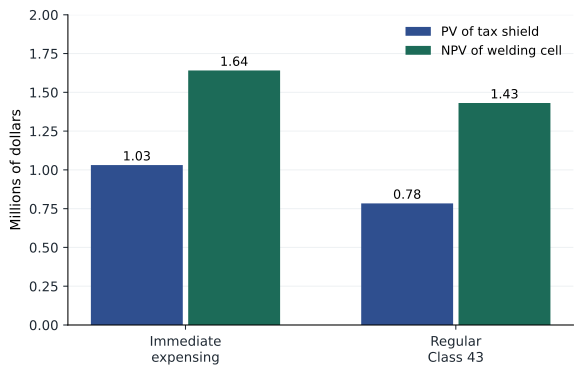
Under immediate expensing, the present value of the CCA tax shield is about 1.03 million, and the cell has an NPV of about 1.64 million and an IRR of about 21 per cent, well above the 10 per cent hurdle rate. Under the regular Class 43 rule, the tax shield would be worth about 0.78 million and the NPV about 1.43 million. The incentive adds about 0.21 million of value by bringing deductions forward. The project is attractive under either rule, so the tax incentive is not decisive here, but for marginal projects it can be.
The last line tests the most uncertain assumption. If the savings turned out 25 per cent lower than estimated, perhaps because the robots took longer to program for Northgate's many product variants, the NPV would fall to under 0.5 million and the IRR to about 13 per cent. The project would still be worth doing, but with a much smaller margin for error. This kind of test is more useful to decision makers than a single NPV figure, and lesson 11 extends it to simulation.
For quick estimates under declining balance CCA, a closed-form formula gives the present value of the tax shield from an asset that stays in a continuing pool. With capital cost C, CCA rate d, tax rate T, discount rate k, salvage value S and life n, and the half-year rule, the formula is shown below. It is useful for checking spreadsheet models and appears in many Canadian finance texts. It assumes the pool continues indefinitely after the asset is sold, which is a different assumption from the closed-class treatment in Grace's program, so the two approaches give slightly different answers.
Inflation
Inflation affects capital budgeting through consistency. Cash flows and discount rates must be stated on the same basis. A nominal discount rate, which includes expected inflation, must be applied to nominal cash flows, which include expected price increases. A real discount rate must be applied to real cash flows in today's prices. Mixing them, typically by discounting cash flows in today's prices at a nominal rate, understates NPV and biases decisions against long-lived projects. The relationship between nominal and real rates is (1 + nominal) = (1 + real) × (1 + inflation).
Tax shields are an exception to the usual expectation that cash flows rise with inflation. Tax depreciation is based on historical cost and does not increase with prices, so in real terms its value falls as inflation rises. For this reason, it is usually easiest to work in nominal terms throughout, as Grace's program does, growing savings at the expected inflation rate and discounting at the nominal cost of capital.
Worked problem
Real and nominal rates
Northgate's nominal hurdle rate is 10% and expected inflation is 2.5%. What is the equivalent real rate?
Show solution
- Use (1 + nominal) = (1 + real) × (1 + inflation).
- 1.10 = (1 + real) × 1.025.
- 1 + real = 1.10 ÷ 1.025 = 1.0732.
Answer: About 7.3 per cent. Discounting real cash flows at 10% would understate the project's value.
Beyond the numbers
The welding cell's NPV captures savings that can be measured, but several important considerations do not appear in it. On the positive side, the cell reduces Northgate's dependence on scarce skilled welders, improves weld consistency, which supports the reliability objective, and reduces exposure to welding fumes, a recognized occupational health hazard. On the negative side, it adds complexity and reliance on robot programming skills, it reduces flexibility for one-off custom work, and it affects the people whose jobs change. Northgate plans to retrain several of its welders as robot operators and programmers and to redeploy others to custom fabrication, rather than to lay anyone off, which the board regards as important for the plant's culture and its standing in the community.
Environmental, social and governance considerations increasingly enter capital decisions directly. Some companies apply an internal carbon price to projects that change emissions, to test how the investment would perform if carbon costs rose. Others include climate-related physical risks, such as flooding or extreme heat, in the analysis of long-lived assets. Lesson 12 and ACCT-321 discuss sustainability reporting; for capital budgeting, the point is that such factors can often be quantified at least approximately, and that leaving them out is itself a judgment about their value, usually an implicit judgment that they are worth zero.
The capital investment process
Good capital decisions depend on a sound process as well as sound analysis. A typical process moves through stages: identifying opportunities, developing proposals, screening them against strategic fit and minimum criteria, detailed evaluation, approval at a level that depends on size, implementation, and post-investment review. Each stage has known failure modes. Proposals tend to be written by people who want the project approved, which leads to optimistic estimates. Approval thresholds can encourage managers to split large projects into smaller pieces that fall below the threshold. And once a project is approved, the incentive to report honestly on its performance weakens.
| Stage | Purpose | Common problem | Safeguard |
|---|---|---|---|
| Identification | Generate ideas linked to strategy | Only incremental ideas surface | Strategic reviews; challenge from outside the unit |
| Proposal | Develop the case | Optimistic estimates | Standard templates; independent review of assumptions |
| Screening | Filter against strategy and minimum criteria | Good strategic projects rejected on payback | Allocate budget by category before ranking |
| Evaluation | Detailed financial and risk analysis | Single-point estimates | Sensitivity, scenarios, simulation |
| Approval | Decide at the right level | Projects split to avoid thresholds | Review related projects together |
| Implementation | Deliver on time and budget | Scope creep | Change control; contingency held centrally |
| Post-investment review | Compare outcomes with forecasts and learn | Not done, or done defensively | Routine audits of a sample of projects |
Lesson 10 returns to post-investment reviews and to the problem of allocating a limited budget across competing projects.
Common mistakes
MistakeDiscounting cash flows in today's prices at a nominal rate.
InsteadUse nominal cash flows with a nominal rate, or real cash flows with a real rate.
MistakeTreating tax depreciation as rising with inflation.
InsteadBase it on historical cost; its real value falls as inflation rises.
MistakeUsing accounting depreciation instead of tax depreciation for the tax shield.
InsteadApply the tax rules for the jurisdiction, including incentives such as immediate expensing or bonus depreciation.
MistakePresenting one NPV without testing key assumptions.
InsteadShow how NPV changes if the most uncertain estimates are wrong.
MistakeIgnoring effects on people, flexibility and the environment.
InsteadIdentify qualitative factors explicitly and quantify them where possible.
MistakeLetting payback screen out strategic projects.
InsteadAllocate budget by strategic category before ranking projects within categories.
Summary and key terms
- Capital investment is where strategy becomes concrete; budgets are often allocated by strategic category.
- After-tax cash flows include taxed savings and the tax shield from tax depreciation.
- In Canada, Bill C-15 reinstated immediate expensing for eligible manufacturing and processing equipment available for use before 2030.
- The welding cell's NPV is about 1.64 million with immediate expensing and 1.43 million under regular Class 43 CCA.
- If savings are 25% lower, the NPV falls below 0.5 million: the project is robust but not by a wide margin.
- Nominal cash flows must be discounted at nominal rates; tax shields do not rise with inflation.
- Qualitative and ESG factors, including effects on employees, should be identified and quantified where possible.
- A disciplined capital process with independent review and post-investment audits counters optimism.
- Capital cost allowance (CCA)
- Tax depreciation under the Income Tax Act, claimed by class at prescribed rates.
- Undepreciated capital cost (UCC)
- The remaining tax value of a CCA class.
- Immediate expensing
- A 100% first-year tax deduction for the cost of eligible property.
- Recapture
- Income that arises when proceeds of disposal exceed the UCC of a class.
- Hurdle rate
- The minimum required rate of return for a capital project, often the cost of capital.
- Tax shield
- The reduction in tax from a tax-deductible expense such as tax depreciation.
- Nominal discount rate
- A discount rate that includes expected inflation.
- Real discount rate
- A discount rate that excludes inflation.
- Internal carbon price
- A price per tonne of emissions that a company applies to its own decisions.
- Post-investment review
- A comparison of a project's actual results with its forecasts, made after implementation.
Practice problems
Work each problem on paper first, then reveal the answer to check.
Why do many organizations allocate capital budgets by category?
Show answer
So that strategic projects with hard-to-measure benefits are not crowded out by small cost-saving projects.
What is the welding cell's IRR with the accelerated tax rule?
Show answer
About 21%.
How much value does immediate expensing add compared with regular Class 43 CCA?
Show answer
About 0.21 million.
What happens to NPV if savings are 25% lower?
Show answer
It falls to under 0.5 million, still positive.
Change the hurdle rate in the program to 14%. Is the project still acceptable?
Show answer
Yes, the NPV remains positive at 14% with the accelerated rule, since the IRR is about 21%.
What real rate corresponds to a 10% nominal rate with 2.5% inflation?
Show answer
About 7.3%.
Why should tax shields not be increased for inflation?
Show answer
Tax depreciation is based on historical cost.
Name two qualitative benefits of the welding cell.
Show answer
Less dependence on scarce welders, more consistent welds and less exposure to welding fumes.
Why might a manager split a large project into smaller proposals?
Show answer
To keep each below an approval threshold.
What is the purpose of a post-investment review?
Show answer
To compare outcomes with forecasts, improve future estimates and hold proposers accountable.
Lesson quiz · 5 questions
Score 60% or more to complete this lesson.
Create a free account to save your progress, take quizzes and earn a certificate.