
ACCT-421 · Lesson 10 of 12 · 28 min
Capital rationing, real options and post-investment review
Lesson 9 evaluated one project on its own. In practice, organizations choose among many projects with a limited budget, and the projects they choose have features that a standard NPV calculation can miss, especially the flexibility to expand, delay or abandon as conditions change. This lesson covers three topics that complete the treatment of capital investment: capital rationing, real options and post-investment review. Northgate's 2027 capital budget of 9.0 million dollars, against proposals of 12.9 million, provides the setting.
Why capital is rationed
In finance theory, a company should accept every project with a positive NPV, raising whatever capital is needed, because each such project adds value. In practice, almost every organization limits capital spending. Hard capital rationing arises when external capital is unavailable or available only on very unfavourable terms, which can happen to small firms, firms in financial difficulty or firms in industries that lenders currently avoid. Soft capital rationing is self-imposed: management or the board sets a capital budget below what positive-NPV projects would require.
Soft rationing has several defensible motives. It may reflect a policy on borrowing, as Northgate's board has decided not to increase debt. It may reflect limited management capacity to carry out many projects at once, which is a real constraint even if money is not. It may be a deliberate response to the optimism of project proposals: if forecasts are systematically too high, rationing forces a higher bar. And it may reflect a desire to avoid diluting existing owners. The management accountant's job is to make sure the limited budget is spent on the projects that add the most value, and to show the board the value forgone by the limit, so that the limit itself can be reconsidered.
Choosing projects under a budget limit
When capital is rationed in a single period and projects are divisible, so that part of a project can be undertaken for a proportional share of its cost and NPV, the best approach is to rank projects by the profitability index (PI), the present value of future cash flows divided by the initial investment, or equivalently one plus NPV divided by investment. Projects are then accepted in descending order of PI until the budget is used. This maximizes NPV per dollar of capital, which is what matters when capital is the scarce resource, just as contribution per paint hour mattered in lesson 4.
Most capital projects are not divisible. Northgate cannot buy two-thirds of a welding cell. With indivisible projects, ranking by PI can leave part of the budget unused and can miss a better combination. The correct approach is to find the combination of whole projects with the highest total NPV that fits within the budget, which is an integer programming problem. For a handful of projects, every combination can be tested; for more, optimization software is used, as lesson 5 described.
# Capital rationing: choose projects for a 9.0 million capital budget (invented data, millions).
from itertools import combinations
budget = 9.0
projects = {   # name: (outlay, NPV)
    'A Robotic welding cell':   (4.2, 1.60),
    'B Second paint booth':     (2.6, 1.35),
    'C ERP upgrade':            (1.8, 0.42),
    'D GrainSense launch':      (1.9, 0.62),
    'E Dealer ordering portal': (0.9, 0.30),
    'F Automated racking':      (1.5, 0.38),
}
print(f"{'project':26s} {'outlay':>6s} {'NPV':>5s} {'PI':>5s}")
for n, (c, v) in sorted(projects.items(), key=lambda kv: -(kv[1][1] / kv[1][0])):
    print(f"{n:26s} {c:6.1f} {v:5.2f} {1 + v / c:5.2f}")
# rule 1: take projects in order of profitability index until money runs out
spent, npv, chosen = 0.0, 0.0, []
for n, (c, v) in sorted(projects.items(), key=lambda kv: -(kv[1][1] / kv[1][0])):
    if spent + c <= budget:
        spent += c; npv += v; chosen.append(n[0])
print(f"PI ranking picks {chosen}: spends {spent:.1f}, NPV {npv:.2f}, unused {budget - spent:.1f}")
# rule 2: test every combination (projects are indivisible)
best = max((sum(projects[n][1] for n in combo), combo)
           for r in range(1, len(projects) + 1) for combo in combinations(projects, r)
           if sum(projects[n][0] for n in combo) <= budget)
print(f"Best combination {[n[0] for n in best[1]]}: spends "
f"{sum(projects[n][0] for n in best[1]):.1f}, NPV {best[0]:.2f}")project outlay NPV PI B Second paint booth 2.6 1.35 1.52 A Robotic welding cell 4.2 1.60 1.38 E Dealer ordering portal 0.9 0.30 1.33 D GrainSense launch 1.9 0.62 1.33 F Automated racking 1.5 0.38 1.25 C ERP upgrade 1.8 0.42 1.23 PI ranking picks ['B', 'A', 'E']: spends 7.7, NPV 3.25, unused 1.3 Best combination ['A', 'B', 'D']: spends 8.7, NPV 3.57
Ranking by PI selects the paint booth, the welding cell and the dealer portal, spending 7.7 million and producing NPV of 3.25 million. The remaining 1.3 million is too little for any of the remaining projects. Testing every combination finds a better answer: the welding cell, the paint booth and the GrainSense launch, spending 8.7 million and producing NPV of 3.57 million. The difference of 0.32 million comes from using the budget more fully. The PI ranking is not wrong, but it is a heuristic that works best when projects are small relative to the budget.
| Project | Outlay (millions) | NPV (millions) | PI | Strategic category |
|---|---|---|---|---|
| A Robotic welding cell | 4.2 | 1.60 | 1.38 | Cost reduction and capacity |
| B Second paint booth | 2.6 | 1.35 | 1.52 | Capacity at the constraint |
| C ERP upgrade | 1.8 | 0.42 | 1.23 | Infrastructure |
| D GrainSense launch | 1.9 | 0.62 | 1.33 | New product and strategy |
| E Dealer ordering portal | 0.9 | 0.30 | 1.33 | Customer and cost to serve |
| F Automated racking | 1.5 | 0.38 | 1.25 | Working capital and cost |
Several refinements matter in practice. If capital is rationed in more than one period, a project's later cash flows may help fund other projects, and the problem must be solved over several periods with linear or integer programming. Some projects are mutually exclusive, such as two alternative layouts for the same space, and the combination must include at most one of them. Some depend on others: the dealer portal is more valuable if the ERP upgrade is done first. And strategic considerations may justify a project with a lower NPV. The team notes that the best combination omits the dealer portal and ERP upgrade, and that the portal is part of the plan to reduce the cost of serving small dealers identified in lesson 2. With the budget fixed, they propose to defer the portal to 2028 rather than drop it.
Worked problem
The cost of the capital limit
All six projects have positive NPVs totalling 4.67 million. What does the 9.0 million budget cost Northgate in forgone NPV, compared with funding every project?
Show solution
- Total NPV of all projects: 1.60 + 1.35 + 0.42 + 0.62 + 0.30 + 0.38 = 4.67 million.
- NPV of the best combination within the budget: 3.57 million.
- Forgone NPV: 4.67 − 3.57 = 1.10 million, for 4.2 million of capital not spent (12.9 − 8.7).
Answer: About 1.1 million of NPV, if the estimates are reliable. The board can weigh this against its reasons for limiting debt.
What NPV misses: flexibility
A standard NPV calculation treats a project as a fixed commitment: invest now, receive the forecast cash flows, end. Real projects are rarely like that. Managers can respond to events. They can expand a project if it succeeds, delay it until uncertainty is resolved, change how it operates, or abandon it if it fails. These choices are called real options, by analogy with financial options, which give the right but not the obligation to buy or sell an asset at a set price. Like a financial option, a real option has value because it lets the holder benefit from good outcomes while limiting exposure to bad ones.
| Real option | What it allows | Northgate example |
|---|---|---|
| Option to expand | Invest more if the project succeeds | Extend GrainSense into a full monitoring product line |
| Option to delay | Wait for more information before investing | Market test before the GrainSense launch, lesson 6 |
| Option to abandon | Exit and recover salvage value if the project fails | Sell the welding robots if demand collapses |
| Option to switch | Change inputs, outputs or processes | Program the welding cell for new product families |
| Staging option | Invest in phases, deciding at each stage | Roll out the dealer portal region by region |
Ignoring real options biases decisions against projects with significant flexibility, particularly strategic projects whose main value lies in the opportunities they create. A small first investment in a new technology may have a negative NPV on its own forecast cash flows but be worth making because it opens the door to larger, more valuable investments if the technology proves successful.
Valuing an option to expand
Real options can be valued with the same methods as financial options. The binomial model is the most intuitive. It assumes that over each period, the value of the underlying project either rises by a factor u or falls by a factor d. Option values are calculated at the end and worked back to the present using risk-neutral probabilities, which are chosen so that the expected return on the project equals the risk-free rate. This avoids having to estimate a risk-adjusted discount rate for the option, which would be very difficult because the option's risk changes with the project's value.
GrainSense offers an option to expand. If the kit succeeds, Northgate could invest 5.5 million in two years to extend it into a full product line, adding monitoring of conveyors and augers, a subscription data service and integration with dealers' service systems. Based on current forecasts, the expansion's future cash flows are worth 5.0 million today. If Northgate committed now to expanding in two years, the NPV would be slightly negative. But Northgate need not commit: it can decide in two years, when it knows how GrainSense has performed.
# Real option: the right, not the obligation, to expand GrainSense into a full product line in two years.
# Binomial model with risk-neutral probabilities (invented data, millions of dollars).
V0 = 5.0            # present value today of the expansion's future cash flows
X = 5.5             # investment needed to expand, paid in year 2
u, d, rf = 1.40, 1 / 1.40, 0.04
p = (1 + rf - d) / (u - d)                   # risk-neutral probability of an up move
print(f"Risk-neutral probability of an up move: {p:.3f}")
static = V0 - X / (1 + rf) ** 2               # commit today to expanding in year 2 regardless
print(f"NPV if Northgate commits now: {static:6.2f}")
value = 0.0
for ups in range(3):                           # outcomes after two periods: 2, 1 or 0 up moves
    V = V0 * u ** ups * d ** (2 - ups)
    payoff = max(V - X, 0)                     # expand only if it pays
    prob = {2: p * p, 1: 2 * p * (1 - p), 0: (1 - p) ** 2}[ups]
    value += prob * payoff
    print(f"  {ups} up moves: project worth {V:5.2f}  expand? {'yes' if V > X else 'no '}  "
          f"payoff {payoff:5.2f}  probability {prob:.3f}")
option = value / (1 + rf) ** 2
print(f"Value of the option to expand: {option:5.2f}")
print(f"Value of flexibility over committing now: {option - static:5.2f}")Risk-neutral probability of an up move: 0.475 NPV if Northgate commits now: -0.09 0 up moves: project worth 2.55 expand? no payoff 0.00 probability 0.276 1 up moves: project worth 5.00 expand? no payoff 0.00 probability 0.499 2 up moves: project worth 9.80 expand? yes payoff 4.30 probability 0.226 Value of the option to expand: 0.90 Value of flexibility over committing now: 0.98
The binomial model, with the expansion's value rising by 40 per cent or falling by about 29 per cent each year and a risk-free rate of 4 per cent, gives a risk-neutral probability of 0.475 for an up move. After two years, the expansion would be worth 9.80 million if both years go well, 5.00 million if one goes well and one badly, and 2.55 million if both go badly. Northgate would expand only in the first case, earning 4.30 million. Discounting the expected payoff at the risk-free rate gives an option value of 0.90 million. The flexibility to wait and decide is worth about 0.98 million more than a commitment made today.
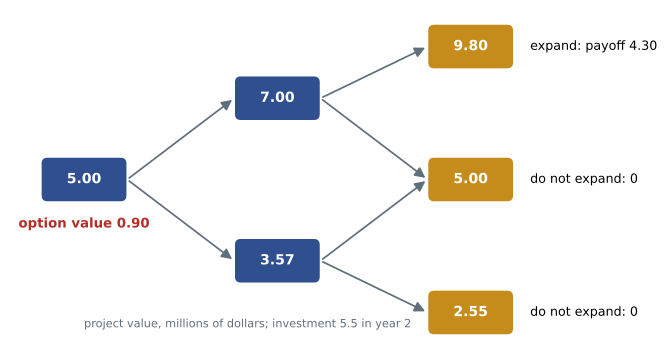
This value belongs in the GrainSense launch decision. Lesson 8 estimated the launch NPV at about 0.62 million on its own cash flows. Including the option to expand, the launch is worth about 1.5 million, which strengthens the case for including it in the 2027 capital budget, as the best combination in this lesson does.
Limits of real options analysis
Real options analysis is valuable as a way of thinking even when precise valuation is not possible. Its main contribution is to make managers ask what flexibility a project contains, how it can be increased, for example by investing in stages or by choosing equipment that can be adapted, and how it should be used. The numbers themselves need care. The volatility of a real project's value is hard to estimate, unlike a traded share's. The underlying project is not traded, so the assumptions behind risk-neutral valuation hold only approximately. Options may be shared with competitors, who can also expand into the market, which reduces their value. And the analysis assumes managers will exercise options rationally, while in practice organizations are often slow to abandon failing projects, as the sunk cost bias in lesson 3 suggests. For these reasons, many companies treat real option values as supporting evidence rather than as a precise addition to NPV.
Post-investment review
A post-investment review, also called a post-completion audit, compares a project's actual costs and benefits with those forecast when it was approved. Its purposes are to improve future forecasting by revealing systematic errors, to encourage realistic proposals by making proposers aware that their forecasts will be checked, to identify problems in projects that are still running so that corrective action can be taken, and to support decisions about abandoning projects that are not working.
Reviews have costs and risks. Separating a project's effects from everything else that changed can be hard, especially for strategic or infrastructure projects. If reviews are used mainly to assign blame, managers become reluctant to propose risky projects and become skilled at writing defensive forecasts. Good practice reviews a sample of projects, focuses on learning, and compares outcomes with the full distribution of forecast outcomes rather than a single number.
Northgate's last major project, a laser cutting machine installed in 2023, provides an example. Its proposal forecast annual savings of 620,000 dollars. The review in 2026 found actual savings of 480,000 dollars, about 23 per cent lower, because the machine took longer than expected to program for small batches and scrap savings were smaller. The review recommended that future automation proposals include a learning period with reduced savings in the first year and a sensitivity case with savings 25 per cent below the engineering estimate. That recommendation is why the welding cell analysis in lesson 9 includes exactly that test. Reviews like this one, applied over many projects, are the organization's own reference class for the forecasting methods discussed in lesson 6.
Common mistakes
MistakeRanking indivisible projects by PI and stopping when the next one does not fit.
InsteadTest combinations of whole projects, or use integer programming, to use the budget fully.
MistakeAccepting the capital limit as given.
InsteadShow the board the NPV forgone so that it can weigh the limit against its reasons.
MistakeTreating a project as a fixed commitment.
InsteadIdentify options to expand, delay, abandon or switch, and consider their value.
MistakeAdding a precise real option value to NPV without discussing its assumptions.
InsteadPresent option values as supporting evidence and explain the volatility and other assumptions.
MistakeUsing post-investment reviews to assign blame.
InsteadUse them to learn and to improve forecasting, reviewing a sample of projects routinely.
Summary and key terms
- Hard rationing comes from external limits; soft rationing is self-imposed, often to limit debt or counter optimism.
- For divisible projects, rank by profitability index; for indivisible projects, find the best combination.
- Northgate's best combination within 9.0 million is the welding cell, paint booth and GrainSense, with NPV of 3.57 million.
- Ranking by PI alone gives 3.25 million and leaves 1.3 million unused.
- Real options to expand, delay, abandon, switch and stage add value that standard NPV misses.
- The option to expand GrainSense is worth about 0.90 million using a two-step binomial model.
- Real option values depend on assumptions about volatility and rational exercise and are best treated as supporting evidence.
- Post-investment reviews improve forecasting; Northgate's laser cutter review led to a 25% sensitivity test on automation savings.
- Hard capital rationing
- A limit on capital imposed by lenders or markets.
- Soft capital rationing
- A limit on capital imposed by the organization itself.
- Profitability index (PI)
- Present value of future cash flows divided by initial investment.
- Divisible project
- A project that can be undertaken in part for a proportional share of its cost and NPV.
- Real option
- A right, but not an obligation, to take an action such as expanding or abandoning a project in future.
- Binomial model
- An option valuation model in which the underlying value moves up or down by set factors each period.
- Risk-neutral probability
- A probability chosen so that expected returns equal the risk-free rate, used to value options.
- Post-investment review
- A comparison of a project's actual results with the forecasts used to approve it.
Practice problems
Work each problem on paper first, then reveal the answer to check.
Give two reasons for soft capital rationing.
Show answer
A policy not to increase debt and limited management capacity, among others.
What is the PI of the second paint booth?
Show answer
1.52: 1 + 1.35/2.6.
Why does ranking by PI give a worse answer than testing combinations here?
Show answer
The projects are indivisible, and the PI ranking leaves 1.3 million unused.
Change the budget in the program to 10.5 million. Which combination is best?
Show answer
A, B, C and D, spending the full 10.5 million with NPV of 3.99 million.
How much NPV does the 9.0 million limit forgo?
Show answer
About 1.1 million compared with funding all six projects.
Name three types of real option.
Show answer
Options to expand, delay and abandon, among others.
What is the risk-neutral probability in the GrainSense expansion model?
Show answer
About 0.475.
Why would Northgate expand only after two up moves?
Show answer
Only then does the project's value, 9.80 million, exceed the 5.5 million cost.
Change u to 1.25 in the program. What happens to the option value, and why?
Show answer
It falls, because lower volatility reduces the chance of a large upside.
What did the laser cutter review find, and what changed as a result?
Show answer
Savings were 23% below forecast; automation proposals now include a learning period and a 25% downside test.
Lesson quiz · 5 questions
Score 60% or more to complete this lesson.
Create a free account to save your progress, take quizzes and earn a certificate.