
VIS-410 · Lesson 8 of 12 · 27 min
Grants, residencies and public funding
Grants and residencies can give photographers time, money and space to make work that clients would never commission: long-term documentary projects, experimental series, books and exhibitions. Writing successful applications is a professional skill that combines a clear idea, strong work samples, a realistic budget and a credible timeline. The funding landscape differs sharply between Canada, where public arts councils fund individual artists directly, and the United States, where individual artists rely more on private foundations, state agencies and fiscal sponsors. This lesson covers both, how to build a grant budget and how to plan applications months ahead.
Why apply for grants and residencies
Grants pay for creation, research, production and professional development that would otherwise be unaffordable. Residencies offer time and space away from daily pressures, sometimes with housing, a stipend, equipment or access to a community. Both bring recognition: a peer-reviewed grant or a selective residency on your CV signals to curators and other funders that your work has been judged serious by your peers. Even unsuccessful applications sharpen your project and your writing, and many funders give feedback.
How juries decide
Most arts funding is decided by peer assessment: a jury of practicing artists and arts professionals scores applications against published criteria. Criteria usually include artistic merit, the strength and feasibility of the project, its impact on your practice or community, and sometimes equity priorities. Juries often read dozens of applications in a session, so clarity matters. Read the program guidelines and criteria closely, answer every question directly and make sure your work samples clearly support your project description.
- Artistic merit: are the work samples strong and is the idea original and well developed?
- Feasibility: is the plan realistic in time, budget and access, and does the artist have the skills to complete it?
- Impact: how will the project develop the artist's practice, reach audiences or benefit a community?
- Alignment: does the project fit the program's purpose and eligibility rules?
Public funding in Canada and the United States
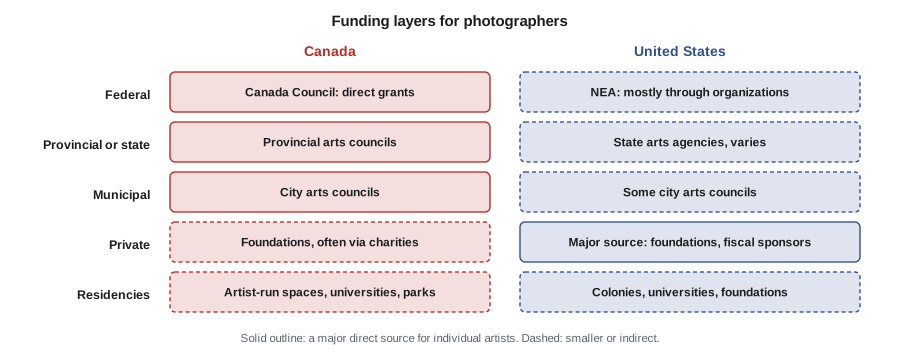
In Canada, public arts councils at the federal, provincial and municipal levels fund individual artists through peer-assessed grants. The Canada Council for the Arts is the main federal funder. Its Explore and Create program includes an Artistic Creation component for individual artists, groups and organizations, offering grants of up to $75,000 per application with rolling intake, so you can apply at any time before your project begins; results usually take several months. Applicants must meet the Council's definition of a professional artist, which generally requires a track record of public presentation and peer recognition. Provincial councils such as the Ontario Arts Council, the BC Arts Council, the Alberta Foundation for the Arts and the Conseil des arts et des lettres du Québec (CALQ), and municipal councils in cities such as Toronto, Montréal, Vancouver and Calgary, offer further programs for creation, travel, exhibition and professional development. Program names, amounts and deadlines change, so check each funder's current guidelines.
In the United States, the National Endowment for the Arts (NEA) makes few grants to individual artists; since the mid-1990s its individual grants have been limited mainly to creative writing and translation fellowships and a small number of honorific awards, so visual artists usually reach NEA money indirectly through organizations that receive project grants. State arts agencies, regional arts organizations and some city arts councils offer individual artist fellowships, though availability varies widely from state to state. Private foundations are a major source: examples include the John Simon Guggenheim Memorial Foundation fellowships and Creative Capital awards, alongside many smaller regional and photography-specific funds. Programs and amounts change, so check each funder's current guidelines.
Fiscal sponsorship
Because many US foundations and government programs can fund only tax-exempt organizations, individual artists often work through a fiscal sponsor: a non-profit organization that accepts grants and tax-deductible donations on behalf of the artist's project, keeps an administrative fee (often in the range of 5 to 10 percent) and passes the rest to the project. Fiscal sponsorship lets artists apply to more funders and accept deductible donations, but the sponsor has legal responsibility for how the money is used, so expect agreements, reporting and oversight.
Building a grant budget
A grant budget is not a wish list; it is a realistic plan that shows the jury you understand what the project costs. Most funders publish eligible and ineligible expenses. Typical eligible costs for a photography project include artist's fees for your own time, assistants and collaborators, travel and accommodation, equipment rental, materials, printing and framing, editing or design, and documentation. Many funders do not cover capital equipment purchases, debt or work already completed. Show revenues as well as expenses: other grants applied for, in-kind contributions, sales or fees.
| Expense | Calculation | Amount ($) |
|---|---|---|
| Artist fee | 16 weeks at 800 a week | 12,800 |
| Assistant | 10 days at 250 a day | 2,500 |
| Travel | 4 trips at 650 | 2,600 |
| Accommodation | 20 nights at 140 | 2,800 |
| Equipment rental | Lighting and lenses, 15 days at 60 | 900 |
| Work prints and proofs | Lump sum | 600 |
| Exhibition prints | 15 prints at 180 | 2,700 |
| Total expenses | 24,900 |
Worked problem
How much should you request?
Using the budget above, the photographer has secured a $3,000 municipal grant and a $1,500 in-kind contribution of studio space from an artist-run center (shown as both an expense and a revenue). She expects $2,400 in exhibition fees. The program's maximum is $25,000. How much should she request, and is it within the limit?
Show solution
- Add the in-kind studio to both sides: expenses become \( 24{,}900 + 1{,}500 = 26{,}400 \) dollars.
- Other revenue: \( 3{,}000 + 1{,}500 + 2{,}400 = 6{,}900 \) dollars.
- Request: \( 26{,}400 - 6{,}900 = 19{,}500 \) dollars.
Answer: She should request $19,500, well within the $25,000 limit, and the balanced budget shows the jury a realistic, partly funded project.
Pay yourself. Many arts councils expect artists to budget fees for their own time, and an application that pays everyone except the artist can look unrealistic. Use reasonable rates and explain them; some funders publish guidance on artist fees, and the CARFAC-RAAV schedule (lesson 7) is a useful Canadian reference.
Writing the application
Strong applications are concrete. Describe what you will make, where, with whom, how, by when and why it matters now, in plain language. Avoid jargon and grand claims; show your thinking through specific detail. Explain how this project builds on your previous work and what it will make possible next. Choose work samples that show you can complete the proposed project, and caption them clearly. Ask someone outside your field to read the description: if they cannot explain your project back to you, rewrite it.
- Project description: a clear summary in the first paragraph, then context, method, timeline and outcomes.
- Work samples: follow the image count and format exactly, and put the most relevant images first.
- Budget: balanced, specific and matched to the description.
- Timeline: realistic dates, including time for permissions, travel and production.
- Support material: letters of support or confirmation from partners, galleries or communities, when the program asks for them.
Residencies
Residencies range from short stays in shared studios to fully funded months abroad with housing, a stipend and production support. Some charge fees; others pay artists. Read the terms carefully: what is provided, what is expected (talks, exhibitions, workshops, donated work), who owns work made during the residency and who covers travel and materials. Photography-specific residencies may offer darkrooms, digital labs, print studios or access to archives. In Canada, artist-run centers, universities, national parks and northern communities host residencies; in the United States, artist colonies, universities, foundations and national parks offer many options. International residencies can often be combined with travel grants.
Worked problem
Planning a residency application timeline
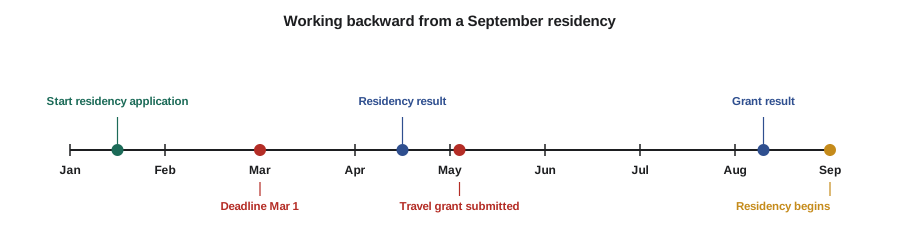
A residency abroad has an application deadline of March 1 for stays beginning in September. You also want a travel grant that requires applications at least 4 months before travel and takes about 3 months to announce results. Working backward, when should you start preparing, and when must you apply for the travel grant?
Show solution
- Travel begins in September, so the travel grant application must be in by early May at the latest (4 months before), with results expected around August.
- Residency results usually come about 6 to 10 weeks after the deadline, so expect an answer by mid-April, before the travel grant deadline.
- Allow at least 6 weeks to prepare a strong residency application: start by mid-January.
- Prepare the travel grant application in April, using the residency acceptance as a support document.
Answer: Start the residency application by mid-January, submit by March 1, and submit the travel grant by early May once the residency result is known.
Reporting, taxes and records
Receiving a grant brings obligations. Most funders require a final report describing what you did, how the money was spent and what came of it; failing to report can make you ineligible for future funding. Keep receipts and records for every expense. Grants are generally taxable income in both Canada and the United States, though how they are treated depends on your situation and the type of grant; set aside part of each grant for tax and ask an accountant (lesson 11 covers basic tax habits). Credit funders as they require in exhibitions, books and publicity.
Coping with rejection
Most applications are unsuccessful. Competitive programs often fund well under a quarter of applicants, and strong projects are rejected for reasons that have nothing to do with quality: limited budgets, a jury's mix of priorities, or many excellent applications in the same round. Treat rejection as part of the process. Ask for feedback where funders offer it, revise and apply again, and keep a schedule of deadlines so that you always have applications in progress.
Letters of support and partners
Some programs ask for letters from partners such as galleries, publishers, community organizations or the people you plan to photograph. A strong letter is specific: it confirms what the partner will provide, such as exhibition dates, access or in-kind support, and explains why the project matters to them. Ask partners early, give them a short summary of the project and the deadline, and thank them whatever the result. For projects involving communities, including Indigenous communities, letters can also show that the people affected have been consulted and support the work.
Common mistakes
MistakeApplying with a vague project and a list of hopes
InsteadDescribe a concrete project with clear methods, outcomes, timeline and budget.
MistakeLeaving your own fee out of the budget
InsteadBudget a reasonable artist fee for your time, following funder guidance.
MistakeIgnoring eligibility rules and image limits
InsteadRead guidelines closely and follow every requirement exactly.
MistakeStarting applications a few days before the deadline
InsteadPlan months ahead, working backward from deadlines and project dates.
MistakeForgetting final reports and tax obligations
InsteadKeep receipts, submit reports on time and set aside money for tax.
Summary and key terms
- Grants and residencies give time, money and recognition for work clients would not commission.
- Peer juries score artistic merit, feasibility, impact and alignment with the program.
- Canada's federal, provincial and municipal arts councils fund individual artists directly; the Canada Council's Artistic Creation component offers up to $75,000 with rolling intake.
- In the US, individual visual artists rely more on state agencies, private foundations and fiscal sponsors, since the NEA rarely funds them directly.
- A realistic, balanced budget includes an artist fee and shows other revenue.
- Plan linked applications by working backward from deadlines and project dates.
- Report on time, keep records, set aside tax and keep applying despite rejections.
- Peer assessment
- Evaluation of applications by a jury of practicing artists and arts professionals
- Artistic merit
- The quality and originality of the work and ideas in an application
- Feasibility
- Whether a project can realistically be completed with the proposed time, budget and skills
- Rolling intake
- A program that accepts applications at any time rather than by fixed deadlines
- Fiscal sponsor
- A non-profit organization that receives funds on behalf of an artist's project
- In-kind contribution
- A non-cash contribution such as donated space or equipment, valued in a budget
- Artist fee
- A payment for the artist's own time and work, included in a project budget
- Residency
- A program offering artists time, space and sometimes support to make work
- Final report
- A document required by funders describing completed activities and spending
- Work samples
- Images or other material submitted to show the quality of an applicant's work
Practice problems
Work each problem on paper first, then reveal the answer to check.
Name four criteria juries commonly use.
Show answer
Artistic merit, feasibility, impact and alignment with the program.
What is the maximum for the Canada Council's Artistic Creation component, and how does intake work?
Show answer
Up to $75,000 per application, with rolling intake before the project begins.
Why do many US artists use fiscal sponsors?
Show answer
Many funders can give only to tax-exempt organizations, and sponsors also allow tax-deductible donations.
Expenses are $18,000 and other revenue is $4,500. How much should you request?
Show answer
\( 18{,}000 - 4{,}500 = 13{,}500 \) dollars.
How should an in-kind contribution appear in a budget?
Show answer
As both an expense and a revenue, at a reasonable value.
A fiscal sponsor charges 7 % on a $20,000 grant. How much reaches the project?
Show answer
\( 20{,}000 \times 0.93 = 18{,}600 \) dollars.
Why include an artist fee in a budget?
Show answer
Many funders expect artists to be paid for their time, and leaving it out looks unrealistic.
A residency starts in October and its travel grant needs applications 5 months before travel. When is the latest travel grant submission?
Show answer
Early May.
What obligations come with a grant?
Show answer
A final report, records of spending, crediting the funder and tax on the income.
What should you do after a rejection?
Show answer
Ask for feedback, revise and reapply, and keep other applications in progress.
Lesson quiz · 5 questions
Score 60% or more to complete this lesson.
Create a free account to save your progress, take quizzes and earn a certificate.