
VIS-410 · Lesson 5 of 12 · 29 min
Social media and newsletters as professional tools
Social media and email newsletters can bring your work to clients, curators and collectors who would never find your website on their own. They can also consume enormous amounts of time with little professional return. This lesson treats them as tools in a professional practice rather than as ends in themselves: choosing channels that reach your actual audience, posting at a sustainable rhythm, measuring what matters, building an email list you own and following the law on commercial email. The Influencer courses (CRE-101 to CRE-499) cover content creation as a business in depth; here the goal is narrower: using these channels to support a photography practice.
Platforms versus owned channels
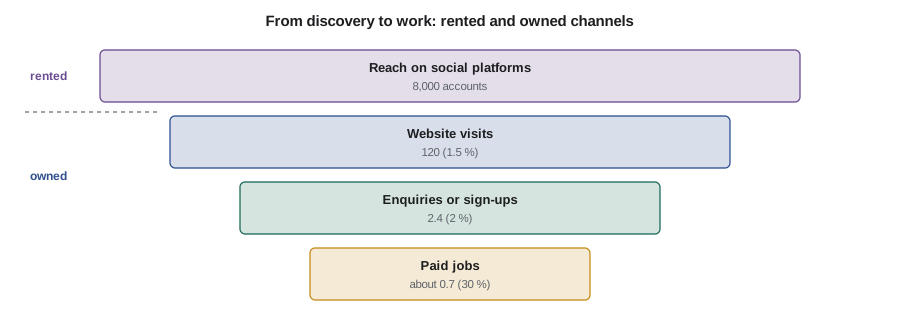
It helps to separate rented channels from owned ones. Social media platforms are rented: you build an audience on land someone else controls, and changes to their algorithms, policies or business can shrink your reach overnight. Your website and your email list are owned: you control them, you can move them, and the people on your list chose to hear from you. A sound strategy uses social platforms to be discovered and to stay visible, and moves interested people toward channels you own.
Choosing channels by audience
The right platforms depend on who hires or supports you, not on where photographers spend the most time. A commercial photographer whose clients are marketing managers and art directors may get more work from a professional networking site and a well-targeted newsletter than from a large following of other photographers. A wedding photographer's clients may find them through image-led social platforms and search. Fine art photographers often rely on image-led platforms to reach curators, editors and collectors, combined with a newsletter announcing exhibitions and print releases.
| Goal | Useful channels | What to post |
|---|---|---|
| Commercial commissions | Professional networking site, image-led platform, newsletter to clients | Finished work with credits, behind the scenes, client results |
| Weddings and portraits | Image-led platform, search listings, reviews | Recent sessions (with consent), client stories, availability |
| Exhibitions and collectors | Image-led platform, newsletter, art community sites | New series, exhibition news, print releases, process |
| Editorial and documentary | Image-led platform, professional networking site, newsletter to editors | Published stories with links, pitches in progress |
Platform names, features and audiences change quickly; at the time of writing (October 2026) several image-led and professional platforms dominate, and short video is favored by many algorithms. Check where your specific clients actually spend time by asking them and by looking at where your enquiries come from.
A sustainable posting rhythm
Consistency matters more than volume. Posting several times a week for a month and then disappearing for three months is less effective than a steady, manageable rhythm. Build a simple content plan that reuses work you are already making: a finished job becomes a carousel of selected images, a short behind-the-scenes clip, a client quote and a newsletter story.
Worked problem
Planning a posting cadence you can keep
A freelance photographer has about 3 hours a week for social media and newsletters. A considered image post takes about 30 minutes to prepare and caption, a short behind-the-scenes video about 60 minutes, and a monthly newsletter about 3 hours. What weekly rhythm fits, averaged over a month of 4 weeks?
Show solution
- Monthly time available: \( 3 \times 4 = 12 \) hours.
- Newsletter: 3 hours a month, leaving 9 hours.
- One short video a week: \( 4 \times 1 = 4 \) hours, leaving 5 hours.
- Image posts: \( 5 / 0.5 = 10 \) posts a month, or about 2 or 3 a week.
Answer: About two or three image posts and one short video a week, plus one monthly newsletter, fits the 3-hour budget.
Track your actual times for a month; most people underestimate captioning, replying to comments and editing.
Measuring what matters
Platforms offer many metrics; few of them predict work. Followers and likes are vanity metrics unless the followers include people who hire you. More useful measures include profile visits, clicks to your website, direct messages and email sign-ups from social media, and, ultimately, enquiries and paid work you can trace to a channel. Ask every new client how they found you and record the answer.
Worked problem
From reach to enquiries
A photographer's posts reach about 8,000 accounts a month. About 1.5 percent of those visit the website, and about 2 percent of website visitors from social media send an enquiry. How many enquiries per month should she expect, and how many paid jobs if she converts 30 percent of enquiries?
Show solution
- Website visits: \( 8{,}000 \times 0.015 = 120 \).
- Enquiries: \( 120 \times 0.02 = 2.4 \), about 2 or 3 a month.
- Paid jobs: \( 2.4 \times 0.30 \approx 0.7 \), roughly one job every one to two months.
Answer: About 2.4 enquiries a month and roughly 0.7 paid jobs. Improving the website conversion or targeting the right audience may matter more than chasing reach.
These rates are illustrative; your numbers will differ by specialty and audience. The point of the calculation is to see which step limits your results. If many people visit your website but few enquire, improve the site and contact path; if few people visit, improve targeting or calls to action.
Newsletters: the list you own
An email newsletter reaches people who chose to hear from you, in an inbox rather than a feed. For many photographers, a newsletter sent monthly or quarterly to past clients, prospects, editors, curators and collectors produces more work per hour than social media. Keep it short, visual and useful: one or two new projects, an exhibition or print release, availability for commissions and a clear way to reply.
- Use a reputable email service that manages consent records, unsubscribes and deliverability.
- Grow the list with a sign-up form on your website, at exhibitions and talks, and by asking clients for permission to stay in touch.
- Segment the list where useful, for example commercial clients and art collectors, so each group gets relevant news.
- Measure opens with caution (privacy features in many email apps distort open rates), and pay more attention to replies, clicks and enquiries.
Worked problem
Estimating newsletter results
A photographer has 600 subscribers. About 3 percent click through to a new print release each issue, and 1 in 10 of those buy a print at $250, of which 50 percent goes to costs and the remaining 50 percent is profit. What profit does one issue generate on average?
Show solution
- Clicks: \( 600 \times 0.03 = 18 \).
- Sales: \( 18 \times 0.10 = 1.8 \) prints.
- Profit: \( 1.8 \times 250 \times 0.5 = 225 \) dollars.
Answer: About $225 profit per issue on average, with illustrative rates; a growing list and well-timed releases raise this.
The law on commercial email
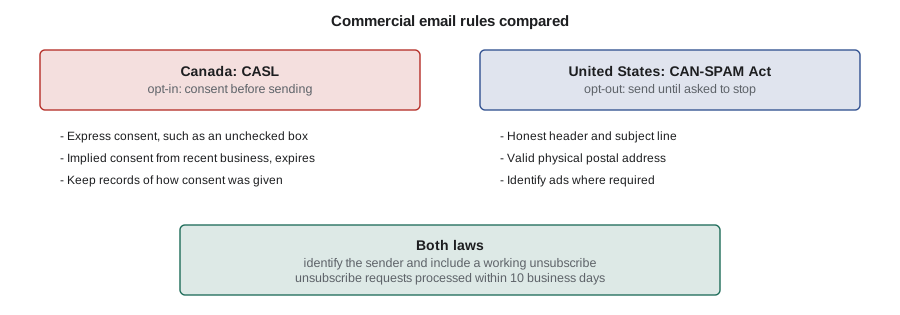
Sending a newsletter that promotes your services or sells prints is commercial email, and both Canada and the United States regulate it, though in very different ways. If you send to people in both countries, follow the stricter rules.
Canada's Anti-Spam Legislation (CASL) uses an opt-in model: you need consent before sending a commercial electronic message. Express consent is a clear agreement to receive messages, such as ticking an unchecked box on your sign-up form, and does not expire until withdrawn. Implied consent arises in limited situations, such as an existing business relationship (for example, a purchase or contract within the past two years) or an enquiry within the past six months, and it expires. Every message must identify you, include contact information and contain an unsubscribe mechanism, and unsubscribe requests must be processed within 10 business days. Administrative monetary penalties can reach $1 million for an individual and $10 million for a business per violation. Keep records of how and when each person consented.
The US CAN-SPAM Act uses an opt-out model: you may send commercial email without prior consent, but you must not use false or misleading header information or subject lines, you must identify the message as an advertisement where required, include a valid physical postal address and provide a clear way to opt out. Opt-out requests must be honored within 10 business days. Each separate email in violation can bring civil penalties of more than $50,000 under the FTC's inflation-adjusted figures. Many photographers use opt-in sign-ups anyway, because they produce better engagement and meet Canadian and European rules if any subscribers live there.
Images, consent and platform rights
Posting images of clients, models and members of the public on social media raises the same consent and personality-rights questions as using them in a portfolio (lesson 1), with the added risk that posts spread quickly beyond your control. Get written permission for promotional use, respect requests to remove images and be especially careful with children, vulnerable people and private events. Read platform terms: most give the platform a broad license to display and distribute what you upload, though you keep copyright. Some platforms may use uploaded content to train automated systems; check current settings and terms if this concerns you.
Professional tone and boundaries
Social media blurs personal and professional life. Decide in advance what you will share and what you will keep private, keep a professional tone in public replies, and move disputes or complaints to private messages or email. Avoid criticizing clients, competitors or collaborators publicly. Disclose paid partnerships and gifted products clearly; advertising disclosure rules apply to photographers promoting gear or services just as they apply to influencers (CRE-320 covers this in depth). Protect your wellbeing by scheduling posts, limiting notifications and taking breaks; CRE-350 covers creator burnout and online harassment.
Writing captions that work
A caption on a social post or in a newsletter should add what the image cannot say on its own: the client or publication, the place, the idea behind the work or a short note on how it was made. Lead with the most useful information, keep it brief and end with one clear invitation, such as a link to the full project or a reply address. Credit collaborators by name or handle, and avoid long strings of hashtags that make posts look automated.
Common mistakes
MistakeBuilding your whole presence on one social platform
InsteadUse platforms for discovery and move interested people to your website and email list.
MistakeMeasuring success by followers and likes
InsteadTrack website clicks, enquiries and paid work you can trace to each channel.
MistakePosting intensively and then disappearing
InsteadChoose a modest rhythm you can sustain for a year.
MistakeAdding people to your newsletter without consent
InsteadUse a sign-up form with an unchecked box and keep consent records, following CASL where it applies.
MistakePosting client or model images without promotional permission
InsteadGet written consent covering social media and respect removal requests.
Summary and key terms
- Social platforms are rented; your website and email list are owned channels.
- Choose platforms by where your clients and supporters actually are.
- A modest, consistent posting rhythm beats bursts of activity.
- Measure clicks, enquiries and paid work rather than followers and likes.
- A newsletter to people who opted in often produces more work per hour than social media.
- Canada's CASL requires consent before commercial email; the US CAN-SPAM Act requires a working opt-out and honest identification.
- Get written consent for promotional posts of identifiable people and disclose paid partnerships.
- Owned channel
- A channel you control, such as your website or email list
- Rented channel
- A platform controlled by another company, where reach can change without notice
- Vanity metric
- A number such as followers or likes that looks impressive but may not predict work
- Conversion rate
- The share of people at one stage who move to the next, such as visitors who enquire
- Segment
- A subgroup of a mailing list that receives tailored messages
- Express consent
- A clear, recorded agreement to receive commercial messages
- Implied consent
- Consent inferred from a relationship such as a recent purchase or enquiry, which expires under CASL
- CASL
- Canada's Anti-Spam Legislation, which requires consent before most commercial electronic messages
- CAN-SPAM Act
- The US law that sets rules for commercial email, including opt-out and identification requirements
- Paid partnership
- A sponsored post or relationship that must be disclosed to viewers
Practice problems
Work each problem on paper first, then reveal the answer to check.
What is the difference between an owned and a rented channel?
Show answer
You control owned channels such as your website and email list; platforms control rented channels and can change your reach.
With 4 hours a week, a 4-hour monthly newsletter and 40-minute image posts, how many posts fit per month?
Show answer
\( 16 - 4 = 12 \) hours; \( 12 / (2/3) = 18 \) posts a month.
Reach is 12,000, website visit rate 1 % and enquiry rate 3 %. How many enquiries per month?
Show answer
\( 12{,}000 \times 0.01 \times 0.03 = 3.6 \).
Name two metrics more useful than follower count.
Show answer
Clicks to your website and enquiries traced to the channel (also email sign-ups and paid jobs).
Under CASL, how long do you have to process an unsubscribe request?
Show answer
10 business days.
What must a CAN-SPAM-compliant email include?
Show answer
Honest header and subject, identification as an ad where required, a physical postal address and a working opt-out.
A newsletter goes to 900 people; 2 % click and 1 in 12 of those buy a $180 print with 50 % profit. What is the profit per issue?
Show answer
\( 900 \times 0.02 = 18 \) clicks; 1.5 sales; \( 1.5 \times 180 \times 0.5 = 135 \) dollars.
Why use opt-in sign-ups even in the US?
Show answer
They produce better engagement and meet Canadian and European rules for subscribers there.
What should you do before posting images of a private event on social media?
Show answer
Get written permission for promotional use from the identifiable people and the client.
Why should you move disputes to private messages?
Show answer
Public arguments damage your professional reputation and can escalate quickly.
Lesson quiz · 5 questions
Score 60% or more to complete this lesson.
Create a free account to save your progress, take quizzes and earn a certificate.