
VIS-410 · Lesson 11 of 12 · 32 min
Sustaining a creative career
Talent and a strong portfolio open doors, but sustaining a creative career for decades depends on habits that are rarely taught in art school: managing irregular income, setting realistic prices from your own numbers, keeping money aside for taxes and slow months, protecting your health and energy, continuing to learn and preserving your life's work. This lesson brings those habits together. It builds on business basics in PHOT-302 and the creator finance material in CRE-330, and it is general information rather than tax, legal or financial advice; an accountant who works with creative professionals is one of the best investments a photographer can make.
Many ways to make a living
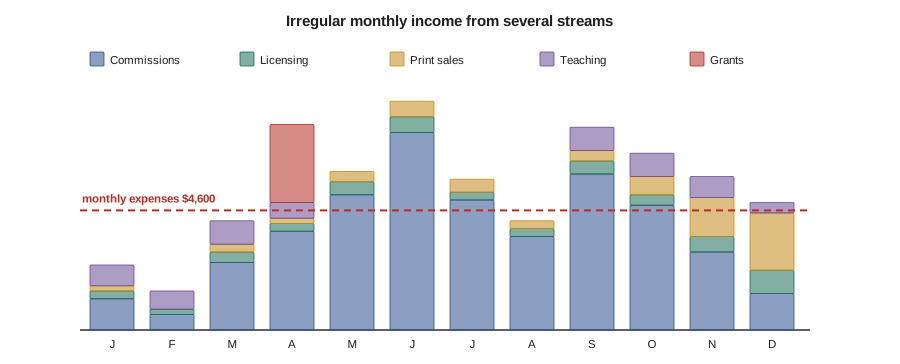
Few photographers earn all their income from a single source. Most working careers combine several streams: commissioned work, licensing, print sales, teaching, workshops, grants, assisting, retouching, video and sometimes non-photography work. A portfolio career spreads risk, smooths income and lets artistic and commercial work support each other. The challenge is to keep the mix intentional rather than accidental, so that each stream supports your goals rather than consuming all your time.
Building your income model
Your prices and plans should come from your own numbers. Start with three figures: your annual business costs (equipment, software, insurance, studio, marketing, memberships, accounting), the personal income you need before tax, and the number of days you can realistically bill. Billable days are far fewer than working days: marketing, editing, administration, travel, learning and slow seasons take a large share of time.
Worked problem
Freelance annual income model
A photographer has annual business costs of $18,000, wants $55,000 a year in personal income before tax, and estimates a tax and payroll contribution reserve of $15,000. She works about 230 days a year, but only about 35 percent of them are billable shooting or editing days paid by clients. What minimum day rate does she need?
Show solution
- Billable days: \( 230 \times 0.35 \approx 80 \) days.
- Total amount to earn: \( 18{,}000 + 55{,}000 + 15{,}000 = 88{,}000 \) dollars.
- Minimum day rate: \( 88{,}000 / 80 = 1{,}100 \) dollars a day.
Answer: About $1,100 per billable day. Many new photographers charge far less because they divide by all working days, not billable ones, and forget costs and taxes.
Adjust the model as your business changes. If you add other income streams, such as teaching or print sales, subtract their expected profit from the total before dividing. Revisit the model every year and before major decisions such as buying expensive equipment or renting a studio.
Worked problem
Effect of more billable days
Using the same costs and targets, what happens to the minimum day rate if better marketing raises billable days to 100?
Show solution
- Minimum day rate: \( 88{,}000 / 100 = 880 \) dollars.
Answer: The minimum falls to $880, a 20 percent reduction, which shows why steady marketing and repeat clients matter as much as rates.
Managing irregular income
Creative income rarely arrives evenly. A busy season may be followed by quiet months; clients may pay 30, 60 or even 90 days after a job. A cash buffer, money set aside to cover several months of expenses, turns a slow month from a crisis into a normal part of the year.
Worked problem
How many months can you cover?
A photographer's combined monthly business and personal expenses are $4,600. She has $13,800 in a separate savings account. Her income over the last year ranged from $1,500 in February to $11,000 in June. How many months of expenses does her buffer cover, and how much more would she need for a six-month buffer?
Show solution
- Buffer months: \( 13{,}800 / 4{,}600 = 3 \) months.
- Six months requires \( 6 \times 4{,}600 = 27{,}600 \) dollars, so she needs \( 27{,}600 - 13{,}800 = 13{,}800 \) dollars more.
Answer: She has a three-month buffer; reaching six months requires another $13,800, which she could build by saving a fixed share of every payment.
- Pay yourself a regular amount from a business account rather than spending income as it arrives.
- Save a fixed percentage of every payment for taxes and a fixed percentage for the buffer.
- Invoice promptly, state payment terms clearly and follow up overdue invoices politely but firmly.
- Take deposits for commissions, typically 25 to 50 percent, to cover early costs and confirm bookings.
Taxes and records
Self-employed photographers are responsible for their own income tax, payroll-style contributions and, in many cases, sales taxes. Keep business and personal finances separate, keep receipts and records for every income and expense, and set aside money for taxes from every payment. Rules change and depend on your situation, so check current figures with your tax authority or an accountant.
In the United States, self-employed photographers generally report business income and expenses on Schedule C and pay self-employment tax for Social Security and Medicare on Schedule SE, at a combined rate of 15.3 percent on most net earnings up to the Social Security wage base, in addition to income tax. Most self-employed people make quarterly estimated tax payments to avoid penalties. Sales tax on prints and some services is set by each state and, in some places, cities, and rules for photography services vary widely. Clients who pay you $2,000 or more in a year may send Form 1099-NEC for payments from 2026 onward; you must report all income whether or not you receive one. Grants and prizes are generally taxable income; ask an accountant.
Worked problem
Setting aside tax from each payment
A photographer receives a $3,200 payment for a commission. Her accountant suggests setting aside 28 percent of income for income tax and contributions, and she saves 10 percent toward her buffer. How much does she move to each account, and how much is available for expenses and pay?
Show solution
- Tax reserve: \( 3{,}200 \times 0.28 = 896 \) dollars.
- Buffer: \( 3{,}200 \times 0.10 = 320 \) dollars.
- Available: \( 3{,}200 - 896 - 320 = 1{,}984 \) dollars.
Answer: $896 to the tax account, $320 to the buffer and $1,984 for expenses and pay. The right percentages depend on your income and location, so set them with an accountant.
Insurance and protection
Insurance protects years of work from a single bad day. Most professional photographers carry equipment insurance against theft and damage, commercial general liability insurance (many venues and clients require proof of coverage), and sometimes professional liability, data and cyber coverage. Consider disability insurance, because self-employed people usually have no employer coverage if they cannot work. Associations often offer group rates (lesson 10).
Wellbeing and sustainable working habits
Burnout is common in creative work: irregular hours, financial pressure, constant self-promotion and the emotional investment in your work all take a toll. Sustainable habits include setting working hours and protecting time off, saying no to underpaid or poorly matched work, building a peer network, managing the physical demands of carrying gear and long shoots, and seeking help early when stress or low mood persists. CRE-350 covers burnout, wellbeing and online harassment in depth for anyone working publicly online. If you are struggling, talking to a doctor or counselor is a strong professional decision, not a weakness.
Continuing education
Technology, markets and visual culture change quickly. Plan a small yearly budget of time and money for learning: workshops, courses, conferences, mentoring and reading. Learn adjacent skills that broaden what you can offer, such as video, lighting for motion, retouching, color management or writing. Study photographers and artists outside your specialty. Teaching, whether workshops or school courses, can also deepen your understanding while adding income.
Archiving your work
Your archive is the long-term record of your career and, for many artists, part of their legacy. A good archive is organized, described and protected against loss.
- Use a consistent folder structure and file naming system, and a catalog with keywords, captions and ratings.
- Embed metadata: creator, copyright, contact, captions and keywords in IPTC fields (lesson 4).
- Follow the 3-2-1 rule: at least three copies, on two different types of storage, with one copy off site or in the cloud.
- Check backups regularly by restoring sample files, and migrate data to new storage every few years before drives fail or formats become obsolete.
- For important work, keep archival prints or proof books as well as digital files.
- Record your exhibitions, publications and sales in a CV and inventory, and think about what should happen to your archive and copyrights if you can no longer manage them.
Worked problem
Planning archive storage
A photographer adds about 1.8 TB of raw files and edits each year. She keeps a working copy, a local backup and a cloud copy, and plans for 5 years of growth. How much storage does each copy need, and how many 8 TB drives are needed for the two local copies with 20 percent free space kept as headroom?
Show solution
- Five years of data: \( 5 \times 1.8 = 9 \) TB per copy.
- With 20 percent headroom: \( 9 / 0.8 = 11.25 \) TB per local copy.
- Drives per local copy: \( 11.25 / 8 \approx 1.4 \), so 2 drives each; two local copies need 4 drives.
Answer: About 9 TB of data per copy, about 11.25 TB of capacity per local copy with headroom, so 4 drives of 8 TB for the two local copies, plus cloud storage for about 9 TB.
Reviewing your practice each year
Once a year, step back and review your practice as a business and as a body of work. Which income streams and clients were most profitable and most satisfying? Which marketing efforts produced work? How did your portfolio evolve? What do you want more and less of next year? Set two or three concrete goals and a plan to reach them; the capstone in lesson 12 gives you a template.
Planning for the long term
A creative career can last forty years or more, so think beyond the next job. Save for retirement as early as you can, using the registered savings plans available in your country, because self-employed people have no employer pension. Review your insurance as your equipment and income grow. Plan for major equipment replacement by setting aside a small amount each month rather than facing a large bill when a camera fails.
Common mistakes
MistakeSetting your day rate by dividing income by all working days
InsteadDivide total costs, income target and tax reserve by realistic billable days.
MistakeSpending income as it arrives
InsteadPay yourself regularly and set aside fixed percentages for taxes and a buffer.
MistakeMixing business and personal finances
InsteadUse separate accounts and keep receipts and records for every transaction.
MistakeKeeping a single copy of your archive on one drive
InsteadFollow the 3-2-1 backup rule and test restores regularly.
MistakeTreating burnout as a sign of commitment
InsteadProtect time off, say no to poorly matched work and seek help early.
Summary and key terms
- Most photographers combine several income streams into a portfolio career.
- Calculate your minimum day rate from costs, income target, tax reserve and realistic billable days.
- A cash buffer of several months turns slow periods into normal parts of the year.
- Set aside tax from every payment and understand self-employment rules in your country.
- Insurance, including liability and disability coverage, protects years of work.
- Sustainable working habits and continuing education keep a career going for decades.
- Archive work with consistent organization, metadata and 3-2-1 backups.
- Portfolio career
- A working life that combines several income streams
- Billable day
- A day of work that a client pays for directly
- Minimum day rate
- The lowest rate at which billable days cover costs, income and taxes
- Cash buffer
- Savings set aside to cover expenses during slow months
- Deposit
- An advance payment that confirms a booking and covers early costs
- Small supplier threshold
- In Canada, the $30,000 revenue level above which GST/HST registration is required
- Self-employment tax
- In the US, Social Security and Medicare tax paid by self-employed people
- Installments
- Advance tax payments made during the year, often quarterly
- 3-2-1 backup rule
- Three copies of data on two types of storage with one copy off site
- Disability insurance
- Insurance that replaces income if illness or injury prevents work
Practice problems
Work each problem on paper first, then reveal the answer to check.
Costs $15,000, target income $50,000, tax reserve $12,000 and 70 billable days. What is the minimum day rate?
Show answer
\( 77{,}000 / 70 = 1{,}100 \) dollars.
Why are billable days much fewer than working days?
Show answer
Marketing, editing, administration, travel, learning and slow seasons take much of the working time.
Monthly expenses are $3,900 and savings are $11,700. How many buffer months?
Show answer
\( 11{,}700 / 3{,}900 = 3 \) months.
A $2,500 payment with 25 % for tax and 10 % for the buffer leaves how much?
Show answer
\( 2{,}500 \times 0.65 = 1{,}625 \) dollars.
Why take a deposit for a commission?
Show answer
It confirms the booking and covers early costs such as crew, props or travel.
What is a portfolio career?
Show answer
A working life that combines several income streams, such as commissions, licensing, prints, teaching and grants.
What is the 3-2-1 backup rule?
Show answer
Three copies, on two types of storage, with one copy off site or in the cloud.
A photographer adds 2.4 TB a year. How much data per copy after 4 years?
Show answer
\( 4 \times 2.4 = 9.6 \) TB.
Name two kinds of insurance most professional photographers carry.
Show answer
Equipment insurance and commercial general liability insurance.
What should an annual practice review cover?
Show answer
Profitable and satisfying streams, effective marketing, portfolio progress and goals for next year.
Lesson quiz · 5 questions
Score 60% or more to complete this lesson.
Create a free account to save your progress, take quizzes and earn a certificate.