
TRD-106 · Lesson 9 of 12 · 19 min
Respect, inclusion and harassment on site
Construction has a reputation as a tough place, and for a long time some of that toughness included jokes, nicknames, hazing of new apprentices and comments that drove people out of the trades. That is changing. The trades need more workers than ever, and they need people of every background, gender and age to fill the gap. Crews that treat everyone with respect keep their people, learn faster and work more safely, because people who feel respected are more likely to speak up about hazards and mistakes. This lesson covers what respect looks like on a crew, what harassment is, what the law requires, and what to do if you experience or see it.
What respect looks like on a crew
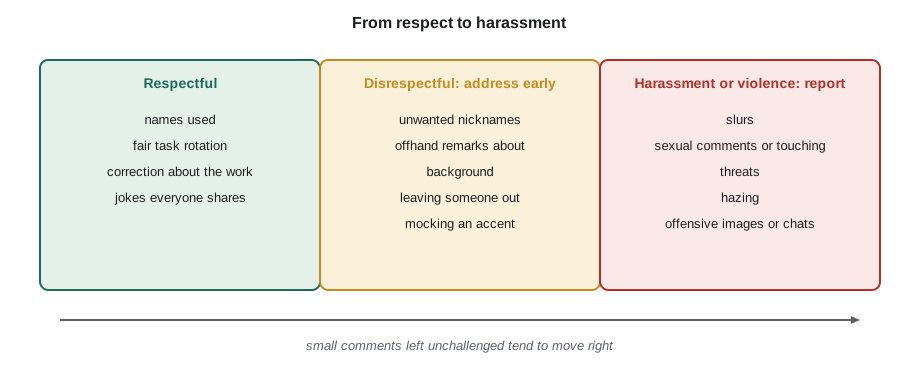
Respect on a job site is not about being formal or never joking. It is about treating each person as a full member of the crew. On Kingsway Tower, it shows in everyday things: people are called by their names, not by nicknames they did not choose; apprentices are taught rather than ridiculed; tasks are shared fairly rather than always dumping the worst jobs on the newest, youngest or only woman on the crew; people's accents, religions, bodies and personal lives are not used as jokes; tools and equipment fit the people using them; and washrooms are clean, private and available to everyone.
Maya is one of three women among about sixty workers on site in her first month. Most of the crew treat her the same as anyone else. A few early incidents (being called sweetheart by a worker from another trade, being told by someone she did not know that she should not be lifting pipe) showed her how small comments add up. What made the difference was that Luis and Dave noticed, said something on the spot, and made it clear that on their crew, that was not how people were treated.
Inclusion means more than avoiding harm. It means making sure everyone can do the work and be part of the crew: introducing new people, explaining site slang, including everyone in the lunch-room conversation, making sure apprentices of every background get the same chances to learn, and making room for workers who pray, fast, have childcare duties or need accommodation for a disability.
What harassment is
In the United States, harassment based on race, color, religion, sex (including pregnancy, sexual orientation and gender identity), national origin, age (40 and over), disability or genetic information is a form of discrimination under federal laws enforced by the Equal Employment Opportunity Commission (EEOC), including Title VII of the Civil Rights Act. It becomes unlawful when enduring it is made a condition of keeping the job, or when it is severe or pervasive enough to create a work environment a reasonable person would find intimidating, hostile or abusive. In January 2026, the EEOC rescinded its 2024 harassment enforcement guidance, but the laws themselves did not change. Ohio's own civil rights law also prohibits discrimination and harassment at work, and many employers' policies go further than the law by banning any bullying or harassing behavior.
Harassment can be spoken, written, physical or visual. Examples on a site include: slurs, insults or jokes about a person's race, religion, accent, gender or sexuality; unwanted touching, comments about someone's body or sexual remarks; offensive pictures, graffiti or messages in a porta-potty, trailer or group chat; hazing new workers with humiliating or dangerous tasks; repeatedly excluding someone, hiding their tools or sabotaging their work; and threats or intimidation. It also includes harassment by text, by photo or in a crew group chat, even outside working hours, when it affects the workplace.
What is not harassment: reasonable direction and correction of work by a supervisor, assigning tasks, performance feedback or discipline delivered properly, and ordinary disagreements about the work. Being told firmly that your joint leaks and you need to redo it is supervision. Being called an idiot in front of the crew every day is not.
What employers must do
Employers must take reasonable steps to prevent and correct harassment. In practice, that means a written anti-harassment policy, a complaint process with more than one person to report to, prompt and fair investigations, protection against retaliation and training for workers and supervisors. An employer that has these in place and acts on complaints is in a much stronger position if a case is brought. On construction sites, OSHA requires toilets for workers based on crew size, and since January 2025 its construction rule has required that personal protective equipment fit each worker properly, a change aimed partly at women and smaller workers who were often given gear that did not fit.
Employers are also responsible for what happens in their crews' shared spaces: the trailer, the lunch room, the toilets and the crew group chat. Offensive graffiti in a porta-potty, for example, should be removed and reported to the general contractor, and many sites treat it as a serious matter.
If it happens to you
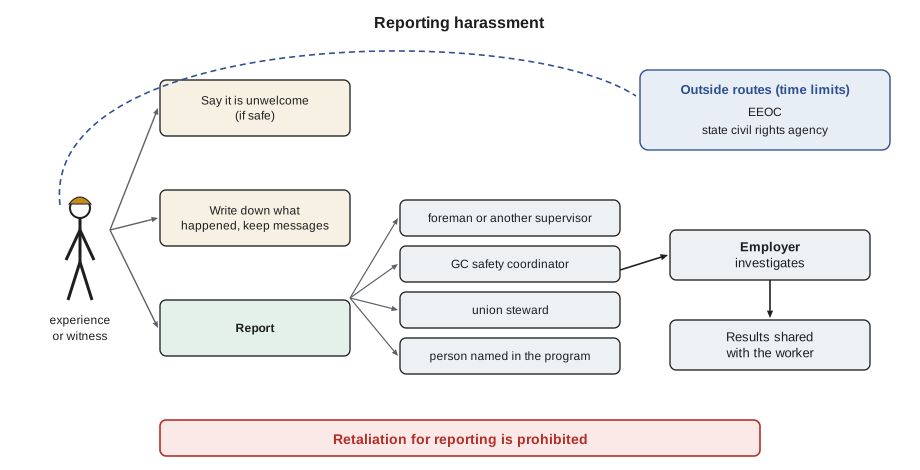
If you experience harassment, you have options. Which one you choose depends on how serious it is, who is doing it and how safe you feel.
- Say something, if you feel safe: a short, clear statement that the behavior is unwelcome. Don't call me that. My name is Maya. Often that is enough for small things from people who did not think.
- Write it down: what happened, when, where, who was there, what was said or done. Keep texts, photos or messages. Notes written at the time are strong evidence later.
- Report it: to your foreman, to another supervisor, to the general contractor's safety coordinator, to your union steward or representative, or to whoever your employer's policy names. You do not have to confront the person first, and you can report to someone else if your supervisor is the problem.
- Use outside routes if needed: the EEOC or the Ohio Civil Rights Commission. These have time limits, so do not wait too long.
- Get support: a trusted coworker, a mentor, an employee assistance program, a union, or a community organization for workers in the trades.
The law protects you from being punished for reporting harassment in good faith. Retaliation, such as being moved to worse jobs, cut hours or being laid off for complaining, is itself prohibited.
If you see it happening
Many harassment situations on site have bystanders. What bystanders do makes a big difference: silence tells the harasser it is acceptable and tells the target nobody will help. You do not have to confront anyone aggressively to help. Trainers often describe five options, sometimes called the five Ds:
- Direct: say something on the spot if it is safe. Hey, not cool. Knock it off.
- Distract: interrupt the situation. Maya, can you give me a hand over here? Often this defuses it without a confrontation.
- Delegate: get help from someone with authority, such as the foreman or the safety coordinator.
- Delay: check in with the person afterward. That wasn't okay. Are you all right? Do you want to report it? I'll back you up.
- Document: write down what you saw, or keep the message, in case the person decides to report it.
When the drywall worker called Maya sweetheart in her first week, Luis was standing next to her. He said, evenly: Her name's Maya. That was all. The worker said sorry and it did not happen again. Small, calm interventions like that, made early, stop most behavior before it grows.
Hazing and initiation
Some sites have traditions of initiating new apprentices: sending them for a left-handed wrench, a bucket of steam or a can of striped paint. A harmless joke that the apprentice is in on can be part of joining a crew. But hazing that humiliates, isolates, endangers or targets someone (making them do dangerous tasks, physical pranks, sexual or degrading acts, or singling out people of one background) is harassment, and it can also be a safety hazard. A good test is whether the apprentice is laughing with the crew or the crew is laughing at the apprentice, and whether the same thing would be done to every new person regardless of who they are.
Online and after hours
Much of a crew's conversation now happens in group chats and on social media. Those spaces can carry harassment too: a meme mocking someone's religion posted to the crew chat, a photo of a coworker taken without permission and shared with comments, or messages sent late at night to someone who has asked for them to stop. When the conduct is connected to work, involves coworkers and affects how people are treated on the job, employers can and do treat it as workplace harassment, even if it happened off site and outside working hours.
A few simple habits keep you on the right side of this: do not post anything about a coworker you would not say to their face in front of the foreman; do not share photos or videos of coworkers without their agreement; leave a group chat, or say something, when it turns offensive; and keep screenshots if you are on the receiving end of harassing messages. Social gatherings with the crew, such as an end-of-job barbecue or drinks after a long week, are a normal part of site life, but the same standards of respect apply there as on site.
Building a respectful crew
Everyone on a crew shapes its culture, not just the foreman. Apprentices can help by learning and using people's names, including newcomers, refusing to pass on offensive jokes or images, speaking up early about small things, and backing up coworkers who report problems. Journeyworkers and foremen set the tone most strongly: what they laugh at, what they ignore and what they stop shows the crew what is acceptable.
Some general contractors run anonymous surveys to check how workers feel about respect on site. The program below summarizes a short example survey from Kingsway Tower, showing the share of workers who agreed with each statement and flagging any statement where fewer than four in five agreed.
# summarize an anonymous respect survey (invented example responses)
responses = {   # statement: list of answers (1 = strongly disagree ... 5 = strongly agree)
    "I am treated with respect on this site": [5, 4, 4, 5, 3, 4, 5, 4, 2, 5, 4, 4],
    "I would feel safe reporting harassment": [4, 3, 4, 5, 2, 3, 4, 4, 2, 5, 3, 4],
    "Washrooms are clean and private": [3, 2, 4, 3, 2, 4, 3, 3, 2, 4, 3, 3],
    "New workers are taught, not ridiculed": [5, 4, 5, 5, 4, 4, 5, 4, 3, 5, 4, 5],
}
for statement, ans in responses.items():
    agree = sum(1 for a in ans if a >= 4) / len(ans)
    flag = "  <- follow up" if agree < 0.80 else ""
print(f"{100 * agree:5.1f} % agree: {statement}{flag}")83.3 % agree: I am treated with respect on this site 58.3 % agree: I would feel safe reporting harassment <- follow up 25.0 % agree: Washrooms are clean and private <- follow up 91.7 % agree: New workers are taught, not ridiculed
In this example, the survey points to two things to follow up: whether workers feel safe reporting, and the state of the washrooms. Both are fixable, and both affect whether people stay in the trades.
Common mistakes
MistakeTreating harassment as just part of construction culture.
InsteadTreat it as a hazard: name it, report it and stop it.
MistakeStaying silent as a bystander.
InsteadUse one of the five Ds: direct, distract, delegate, delay or document.
MistakeThinking you must confront the person before reporting.
InsteadYou can report directly, including to someone other than your supervisor.
MistakeWaiting months to write down what happened.
InsteadWrite notes at the time and keep messages.
MistakeCalling every correction harassment.
InsteadReasonable direction and feedback about the work is supervision, not harassment.
MistakeJoining in hazing because it was done to you.
InsteadAsk whether the new person is laughing with the crew or being targeted.
Summary and key terms
- Respect means names, fair task sharing, teaching rather than ridicule, and a workplace that fits everyone.
- Harassment is unwelcome comment or conduct, including sexual harassment and harassment based on protected grounds, in person or online.
- Reasonable supervision and feedback about the work are not harassment.
- Employers must have policies, complaint routes, investigations and protection against retaliation.
- If it happens to you: say it is unwelcome if safe, write it down, report it and get support.
- If you see it: direct, distract, delegate, delay or document.
- Workplace harassment
- Unwelcome comment or conduct directed at a worker in the workplace.
- Sexual harassment
- Unwelcome comment or conduct of a sexual nature or because of sex, sexual orientation or gender identity.
- Protected grounds
- Characteristics such as race, religion, sex, age and disability that human rights or civil rights laws protect from discrimination.
- Retaliation
- Punishing someone for reporting harassment or raising a concern; it is prohibited.
- Bystander
- A person who sees harassment happen to someone else.
- Hazing
- Humiliating, dangerous or degrading treatment of a new worker presented as initiation.
- Accommodation
- Changes to work rules or conditions so a person can work despite a disability, religious practice or family need.
Practice problems
Work each problem on paper first, then reveal the answer to check.
Give three examples of harassment on a construction site.
Show answer
Any three of: slurs or jokes about race or religion, sexual comments or touching, offensive graffiti or group chat messages, humiliating hazing, threats, sabotaging someone's work.
Is a foreman telling you firmly to redo a leaking joint harassment? Why?
Show answer
No; reasonable direction and correction of work is supervision.
What should you write down if you experience harassment?
Show answer
What happened, when, where, who was there and what was said or done, plus any messages or photos.
Name the five Ds for bystanders.
Show answer
Direct, distract, delegate, delay, document.
Can you report harassment to someone other than your supervisor?
Show answer
Yes; to another supervisor, the general contractor, a union representative or the person named in the policy.
What is retaliation, and is it allowed?
Show answer
Punishing someone for reporting; it is prohibited.
Lesson quiz · 5 questions
Score 60% or more to complete this lesson.
Create a free account to save your progress, take quizzes and earn a certificate.