
TRD-106 · Lesson 5 of 12 · 22 min
Reading and writing work orders and job tickets
A work order is a written instruction to do a specific piece of work. It may be a printed form, a screen on a tablet, a page in a service app or a ticket clipped to a clipboard. On new construction, work is mostly assigned from the drawings and the schedule, but work orders still appear for extra work, deficiency repairs, service calls and maintenance. In service work, such as a plumbing or electrical company sending a technician to a home or business, almost every job starts with one. Learning to read a work order carefully, and to write a clear job ticket when the work is done, is one of the most practical communication skills in the trades.
This lesson uses two documents from Maya's year. The first is a work order Northbridge received from Stonebridge to fix a leaking valve in a model suite that was already finished and being shown to buyers. The second is the job ticket Luis and Maya filled out afterward. Between them, they show what each part of the paperwork is for and how small gaps cause big problems.
What a work order contains
Work order formats vary between companies, but most contain the same information. Reading every field before you start is the habit that matters most. Missing one line, such as an access restriction or a note about the customer, is how technicians end up at the wrong door, in the wrong suite, with the wrong parts.
| Field | What it tells you | Example from the model suite order |
|---|---|---|
| Order number and date | How the job is tracked and billed | WO-2291, issued Tuesday |
| Customer or requester | Who asked for the work and who to contact | Stonebridge, site super; contact Priya Nair (sales office) |
| Location | Exact address, building, floor, unit, room | Level 2, suite 205 (model suite), kitchen |
| Description of work | What the customer says is wrong or wants done | Water dripping under kitchen sink; cabinet base wet |
| Priority and timing | How urgent it is and when work can happen | Urgent; show suite open 10:00 to 4:00, work before 10:00 |
| Access and conditions | Keys, alarm codes, hours, protection required | Key from sales office; floor protection required; no dust |
| Equipment or system | The asset involved, with tag or model number | Kitchen sink supply, hot and cold angle stops |
| Special instructions | Safety notes, customer preferences, restrictions | Furnished suite: shoe covers on, do not move furniture |
| Authorization | Who approved the work and how it is paid | Warranty deficiency, Northbridge cost |
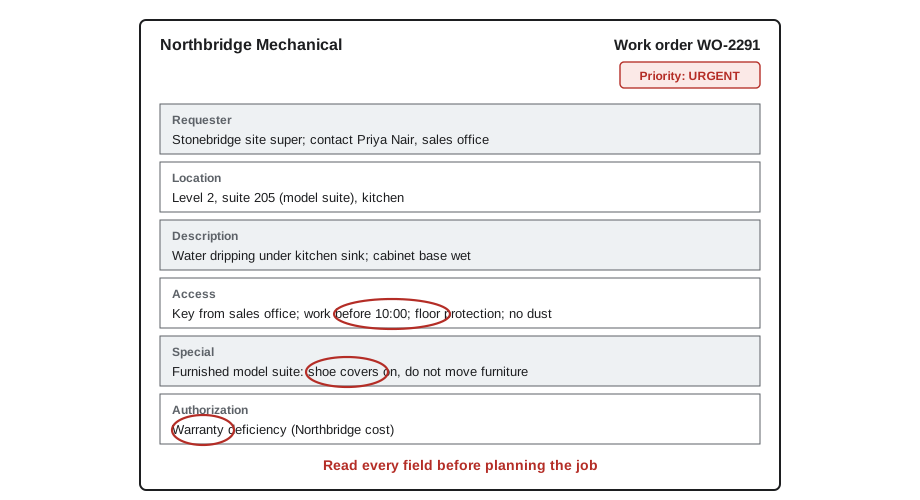
Luis reads the order out loud to Maya at the gang box the afternoon before. Three details change how they plan the job: the work must be done before 10:00, because buyers tour the suite after that; the suite is furnished, so they need floor protection and shoe covers and must not move furniture; and it is a warranty deficiency, so Northbridge pays for it and Dave will want to know the cause.
Reading the description critically
The description of work is usually written by someone who is not a tradesperson: a property manager, a homeowner, a sales assistant or a general contractor's coordinator. It describes the symptom, not the cause, and it may be wrong. Water dripping under kitchen sink could be a loose compression nut, a cracked supply line, a leaking drain joint, a failed dishwasher connection or condensation. A good technician treats the description as a starting point and plans for the likely causes.
Before the job, Luis and Maya talk through what could cause the leak and what parts they might need: angle stops, braided supply lines, a slip-joint washer kit, a trap, and the right wrenches. They also bring a flashlight, towels, a bucket, a moisture meter and the floor protection. Taking the time to think about the description before going means they will probably not need a second trip.
If the description does not make sense, or seems incomplete, call the requester before going. A two-minute call (Is it dripping from the pipes, or from the dishwasher hose? Is the shutoff under the sink working?) can save a wasted visit.
Questions to ask before you go
- Is the location exact? Do I know the address, building, floor, unit and room?
- Do I know how to get in: keys, codes, contact person, hours of access?
- Do I understand the problem well enough to bring the likely parts and tools?
- Are there any hazards or conditions: occupied space, furnished rooms, pets, children, a hospital or food area, a confined space, asbestos or other hazardous material in an older building?
- Who approved the work, and is it authorized? Am I allowed to do extra work if I find something else?
- Who do I report to when I arrive, and who do I tell when I leave?
The authorization question matters more than many apprentices realize. If you find a second problem while on site, such as a corroded valve beside the one you were sent to replace, you usually cannot just fix it and add it to the bill. The customer has to approve extra work, and in construction, extras often need a written change order. Lesson 6 explains why.
Doing the job and recording as you go
On Wednesday at 7:15, Luis and Maya pick up the key from the sales office, lay floor protection from the suite door to the kitchen, put on shoe covers, and open the sink cabinet. The base is wet and swollen. With a flashlight and towel, they find that the cold water angle stop's compression nut is weeping, and that the braided supply line above it is fine. They shut the main suite valve, replace the angle stop, test, and watch it for fifteen minutes with paper towel under the joint. Dry.
Maya takes photos as they go: the wet cabinet before, the leaking nut, the new valve installed, the dry towel after the test, and the cabinet base with a moisture meter reading. She also notes the times: arrived 7:15, water off 7:40, water on 8:05, finished and cleaned up 8:35. These notes and photos become the job ticket.
Writing the job ticket
A job ticket, also called a service report, work record or completion report, is the written account of what was done. It tells the customer what they are paying for, tells the office what to bill, tells the next technician what happened if the problem comes back, and protects the company if there is a dispute. A good job ticket can be understood by someone who was not there.
A job ticket should include: what you found (the cause, not just the symptom), what you did, the parts and materials used, the time on site, any tests performed and their results, any other problems noticed and recommended, and the customer's signature or acknowledgment where required. It should be written in plain language, in full sentences or clear notes, without guessing or blaming.
Worked problem
Two versions of the same ticket
Compare two job tickets for the model suite leak. Ticket A: Fixed leak under sink. Ticket B: Found cold water angle stop under kitchen sink leaking at the compression nut; supply line and drain dry. Shut suite valve, replaced angle stop with new quarter-turn valve, tested at line pressure 15 minutes, no leak. Cabinet base wet and swollen (moisture meter reads high at front left corner); recommend cabinet base inspection by millwork contractor. Parts: 1 quarter-turn angle stop, 1 compression sleeve. Time on site 7:15 to 8:35 (2 persons). Photos attached (5). Which is better, and why?
Show solution
- Ticket A tells the reader almost nothing: not what leaked, not what was replaced, not whether it was tested, not that the cabinet is damaged.
- Ticket B names the cause, the repair, the test and result, the parts, the time and the people.
- Ticket B also flags a second problem (the swollen cabinet base) and recommends who should deal with it, without trying to fix it outside the work order.
- If the leak comes back, or if the millwork contractor says the cabinet was damaged later, Ticket B and the photos show exactly what was found and done.
Answer: Write the cause, the repair, the test, the parts, the time and anything else found.
The program below checks a job ticket for the fields Dave requires before he signs it off. It is the kind of check many service apps do automatically when a technician tries to close a job.
# check that a job ticket has every required field before it is closed
required = ["found", "done", "parts", "test", "time_on_site", "photos", "other_issues"]
ticket_a = {"done": "Fixed leak under sink"}
ticket_b = {"found": "cold angle stop leaking at compression nut",
            "done": "replaced angle stop with quarter-turn valve",
            "parts": "1 angle stop, 1 compression sleeve",
            "test": "line pressure 15 min, no leak",
            "time_on_site": "07:15-08:35, 2 persons",
            "photos": 5,
            "other_issues": "cabinet base swollen; recommend millwork inspection"}
for name, t in (("A", ticket_a), ("B", ticket_b)):
    missing = [f for f in required if not t.get(f)]
    status = "ready to close" if not missing else "missing: " + ", ".join(missing)
print(f"ticket {name}: {status}")ticket A: missing: found, parts, test, time_on_site, photos, other_issues ticket B: ready to close
Writing clearly
Many tradespeople say they are not writers, but a job ticket is not an essay. It is a set of facts in order. A few rules make it clear:
- Write what you saw and did, not what you assume. Found compression nut weeping is a fact. Previous plumber did a bad job is an opinion.
- Be specific: name the item, the location, the size and the quantity.
- Use the customer's words for the location if they are clear (kitchen sink, unit 205) and the trade's words for the work (angle stop, compression sleeve).
- Put things in the order they happened.
- Avoid abbreviations the reader may not know, or explain them once.
- Do not blame. If you think another trade caused the problem, describe what you found and let the foreman or office decide what to do with it.
- Write it before you leave the site, while the details are fresh.
Writing is a skill that improves with practice, and many apprentices find their tickets get shorter and clearer within a few months. If writing in English (or French or Spanish) is hard for you, ask your foreman whether the company's app allows voice notes, photos with captions or checklists, and ask a journeyworker to review your first few tickets.
Customer sign-off
Many work orders, especially in service work, require the customer or their representative to sign the ticket, or acknowledge it in the app, when the job is done. Before asking for a signature, explain in plain words what you found, what you did, and anything they need to know or do: The leak was a valve under the sink. We replaced it and tested it, and it's dry now. The cabinet base got wet and is swollen at the front; I've noted it so the millwork contractor can look at it. Then let them read the ticket before signing. Never ask a customer to sign a blank or incomplete ticket.
On the model suite job, the requester was Stonebridge, so Luis returned the key to the sales office, told Priya the suite was ready for the 10:00 tour, and sent the ticket and photos to Dave, who forwarded them to Stonebridge's superintendent.
Electronic work orders
More and more companies use apps instead of paper. The app shows the work order on a phone or tablet, records the arrival and departure times automatically, lets the technician add photos, parts and notes, and collects the customer's signature on screen. The same rules apply: read every field, plan before going, record as you go, and write a ticket that someone who was not there could understand. Apps add a few new risks: tapping through required fields without reading them, choosing the wrong item from a drop-down list, and photos that are attached to the wrong job. Take the extra moment to check.
Common mistakes
MistakeReading only the description and skipping the access and special instructions.
InsteadRead every field, out loud with your partner if possible, before planning the job.
MistakeTreating the description as the diagnosis.
InsteadTreat it as the symptom; plan for the likely causes and call the requester if it is unclear.
MistakeFixing a second problem without approval.
InsteadNote it, tell the customer and your foreman, and get authorization before doing extra work.
MistakeWriting Fixed leak on the ticket.
InsteadWrite the cause, the repair, the test and result, the parts, the time and any other issues.
MistakeBlaming another trade on the ticket.
InsteadDescribe what you found; let the foreman decide what to do with it.
MistakeAsking a customer to sign an incomplete ticket.
InsteadExplain the work, let them read the ticket, then ask for the signature.
Summary and key terms
- A work order gives the location, problem, priority, access, special instructions and authorization; read every field before starting.
- The description is a symptom written by a non-tradesperson; plan for the likely causes and call if unclear.
- Extra work found on site needs authorization before it is done.
- Record times, findings and photos as you work.
- A job ticket states the cause, what was done, parts, tests and results, time on site and other issues, in plain factual language.
- Explain the work to the customer and let them read the ticket before they sign.
- Work order
- A written instruction to do a specific piece of work.
- Job ticket
- The written record of what was found and done on a job; also called a service report or work record.
- Requester
- The person or company that asked for the work.
- Deficiency
- A defect or incomplete item that a contractor must correct.
- Authorization
- Approval for work to be done and paid for.
- Extra work
- Work beyond what was ordered, which needs separate approval.
- Angle stop
- A small shutoff valve under a fixture that controls the water supply to it.
Practice problems
Work each problem on paper first, then reveal the answer to check.
Name five fields found on most work orders.
Show answer
Any five of: order number and date, requester, location, description, priority and timing, access, equipment, special instructions, authorization.
Why should you treat the description of work as a symptom?
Show answer
It is often written by a non-tradesperson and describes what they see, not the cause.
You find a second corroded valve while on a job. What should you do?
Show answer
Note it, tell the customer and your foreman, and get authorization before fixing it.
List six things a good job ticket includes.
Show answer
Cause found, work done, parts, tests and results, time on site, other issues and recommendations (and photos or signature where required).
Why write the ticket before leaving the site?
Show answer
Details are fresh and photos and times are easy to match.
What should you say to a customer before asking for a signature?
Show answer
Explain in plain words what you found, what you did and anything they need to know or do.
Lesson quiz · 5 questions
Score 60% or more to complete this lesson.
Create a free account to save your progress, take quizzes and earn a certificate.