
TRD-106 · Lesson 2 of 12 · 24 min
Starting out as an apprentice
The first months of an apprenticeship shape how a tradesperson works for the rest of their career. They are also when apprentices are most likely to be hurt, most likely to feel lost and most likely to quit. Much of that comes down to communication: knowing what is expected, asking questions without feeling foolish, admitting mistakes early and building trust with the crew. This lesson follows Maya through her first weeks on Kingsway Tower and sets out the habits that helped her become someone the crew wanted to keep.
Maya registered as an apprentice plumber in a registered apprenticeship program after Northbridge offered her a job. Her apprenticeship combines on-the-job learning, where she logs hours and skills under a sponsor, and related technical instruction in classes. Her journeyworker signs off the skills on her work process schedule as she learns them. Plumbing is licensed in most US states and many cities, and her hours as a registered apprentice count toward the experience she will need to sit for a journeyworker license.
What a crew expects from a new apprentice
Nobody expects a first-year apprentice to know the trade. What a crew does expect is a set of habits that make the apprentice safe to work with and worth teaching. When Dave hires an apprentice, he is not looking for skill; he is looking for someone who shows up, listens, asks, tries and owns their mistakes. Luis put it more simply on Maya's first day: be on time, be ready, be safe, and be honest.
- Show up on time and ready. On most sites, being on time means being at the gang box with your tools and personal protective equipment before the start time, not walking through the gate at the start time. If you are going to be late or absent, call or text your foreman before the shift starts, not after.
- Have your basic tools and gear. Your trade and employer will tell you what you are expected to supply. Keep it clean, organized and labeled with your name.
- Listen fully. When someone is explaining a task, stop what you are doing, look at them and listen to the whole explanation before starting.
- Ask when you do not know. A question takes thirty seconds. Undoing a wrong installation can take a day.
- Do what you said you would do, and say so when you are done. Closing the loop builds trust faster than anything else.
- Keep your work area clean. Housekeeping is part of the job, not a punishment, and a tidy apprentice is noticed.
- Own your mistakes. Everyone makes them. The apprentice who reports a mistake right away is trusted; the one who hides it is not.
Learning names, places and routines
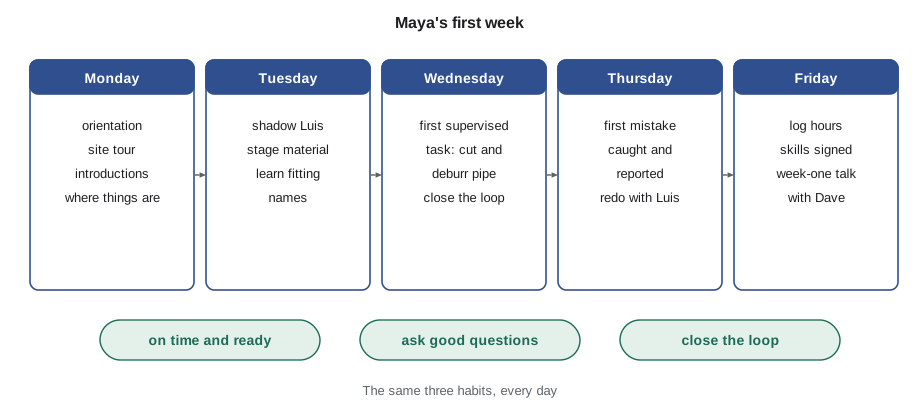
The first week is full of new words: fittings, tools, materials, places on the site, names of people and trades. Maya kept a small notebook in her vest pocket and wrote down every new term with a quick sketch, plus every name she heard with the person's company and role. At the end of each day, she spent ten minutes going over it. By the third week, she could follow almost any conversation on the floor.
Learning the site is as important as learning the trade. Find out where the material is stored and how it is organized, where the gang boxes and tool cribs are, where the washrooms, lunch room, first aid kit, eyewash station and fire extinguishers are, where the muster point is, and which hoist or stairs serve which floors. Learn the site's rules on parking, smoking, phone use and radios. Knowing these things means you can be sent for something without needing directions every time.
Routines matter too. On Kingsway Tower, the day starts with a short toolbox talk at the Northbridge gang box at 6:55 a.m., then the crew splits up. Breaks are at 9:00 and 2:00, lunch at noon. The site safety coordinator holds a site-wide talk every Monday. Material deliveries come through the north gate before 9:00. Cleanup starts twenty minutes before the end of the shift. An apprentice who knows the routines never has to be told twice where to be.
How to ask good questions
Many apprentices worry that asking questions makes them look slow. Experienced tradespeople see it the other way around: the apprentice who never asks is the one they worry about, because they assume that person is guessing. The skill is not whether to ask but how. A good question shows you have thought about the problem, gets you a useful answer quickly and does not interrupt someone at a bad moment.
| Weak question | Better question | Why it is better |
|---|---|---|
| What do I do now? | I've finished cutting the eight risers. Should I start deburring them, or stage the fittings for the next run first? | Shows what is done and offers options |
| Is this right? | I've set the hanger at 1.2 meters from the end like the drawing shows. Can you check it before I do the other five? | Says what was done and why, and asks for a check at the right point |
| Where's the stuff? | I need two more 50 mm couplings. Are they in the trailer or on level 4? | Names exactly what is needed |
| I don't get it. | I understand the slope, but I'm not sure how to start the measurement from the existing pipe. Can you show me the first one? | Pinpoints the part that is unclear |
Timing matters too. Do not interrupt someone in the middle of a careful measurement, a lift or a conversation with the general contractor unless it is urgent or about safety. If your question can wait, collect two or three and ask them together at a natural break. If it cannot wait, say so: Sorry to interrupt, this is quick but I need it before I can go on.
Finally, write down the answer. Asking the same question twice is not a crime, but asking it five times tells the crew you are not paying attention. Maya's notebook saved her from that more than once.
Closing the loop
Closing the loop means letting the person who gave you a task know it is done, or letting them know early if you cannot finish it. It sounds trivial, but it is one of the most common things new apprentices forget, and it is one of the main reasons foremen lose trust. If Luis asks Maya to bring up a box of fittings from the trailer, and she gets it but does not tell him, he may waste time looking for it or send someone else. If she cannot find the box, and she spends forty minutes searching without telling anyone, the crew loses forty minutes.
A closed loop has three parts: you repeat back the task so both of you agree on what it is, you do it or report early that you cannot, and you tell the person when it is done. On Kingsway Tower, Luis likes a short report with a fact or two: Done: eight risers cut and deburred, stacked by column C-4, offcuts in the bin. That message tells him the task is finished, where to find the work and that the area is clean.
Worked problem
A loop that stayed open
On her second Wednesday, Dave asks Maya to get the pipe threader from the Northbridge trailer and bring it to level 5. The trailer is locked and the key holder is at lunch. Maya waits at the trailer for 35 minutes, then brings the threader up. Meanwhile, Luis and another journeyworker have been standing at level 5 waiting for it. What should she have done?
Show solution
- She should have repeated back the task and noted where it was needed and how urgently.
- When she found the trailer locked, she should have called or texted Dave or Luis right away: The trailer's locked and the key holder is at lunch. Do you want me to wait, or is there another key?
- That gives them the choice: send someone with a key, change the plan for the next half hour, or have her wait.
- When she arrives with the threader, she says so: Threader's here on level 5, cord's run to the panel by the stair.
Answer: Report early when a task is blocked, so the crew can change the plan instead of waiting.
Taking feedback
Apprentices get corrected constantly. That is how the trade is learned. Some of the feedback will be gentle, some will be blunt, and occasionally some will be unfair. The way you take it has a big effect on how much more you are taught.
When someone corrects your work, listen to the end, make sure you understand what they want changed and why, and then fix it. Avoid arguing on the spot or explaining at length why you did it that way. If you think the feedback is wrong, ask a question rather than pushing back: Okay, I'll redo it. Just so I know for next time, is it because of the cleanout clearance? Most journeyworkers are happy to explain once they see you are listening.
Blunt feedback is common on construction sites, and it is not the same as disrespect. A journeyworker who says That's crooked, pull it and do it again is giving you useful information in a few words. Feedback crosses a line when it becomes personal, humiliating, threatening or about who you are rather than what you did: insults, slurs, mocking your background or body, or yelling to belittle you. Lesson 9 covers what to do about that. For ordinary corrections, a short thanks and a fix is the right response.
Owning mistakes
On her second Thursday, Maya cut a run of pipe 40 mm short because she read the tape from the wrong end of a mark. She noticed only after she had glued the first fitting. She had a choice: try to hide it with an extra coupling and hope nobody noticed, or tell Luis. She told him. Luis showed her how to fix it properly, told her it happens to everyone, and pointed out that if she had hidden it and the joint had failed under test, the crew would have lost a day finding the leak in a closed ceiling.
Reporting your own mistake right away almost always costs less than the alternative. Material is cheap compared with rework, and rework before the ceiling is closed is cheap compared with rework after. More importantly, it shows the crew they can trust what you tell them. When reporting a mistake, say what happened, what you have already done about it and what you think the fix is: I cut this piece 40 mm short. I've stopped before gluing the second end. I think I need a new length from the stock pile. Is that right?
Tracking your hours and skills
An apprenticeship is measured in hours and skills. Every apprentice should keep their own record, even if the employer keeps one too. Records get lost, companies change, and you are the person who cares most about your progress. Maya logs her hours every Friday in her apprenticeship logbook and keeps a list of the skills from her training standard, with dates when Luis watched her do each one and signed it off.
The program below is a small version of the tracker she keeps on her phone. It adds up the hours from a few weeks, compares them with an example target for the first level, and lists the skills not yet signed. The targets are example values; your own trade and province or state set the real ones.
# apprentice hours and skills tracker (example targets, not official values)
weeks = {"week 1": [8, 8, 8, 8, 8], "week 2": [8, 8, 10, 8, 8], "week 3": [8, 8, 8, 0, 8],
         "week 4": [10, 10, 8, 8, 8]}
target_hours = 1800          # example target for the first level
skills = {"cut and deburr pipe": "signed", "measure and mark": "signed",
          "install hangers": "in progress", "solvent-weld joints": "in progress",
          "read isometric drawings": "not started", "pressure test a section": "not started"}
total = sum(sum(days) for days in weeks.values())
for w, days in weeks.items():
    print(f"{w}: {sum(days):3} h")
print(f"total {total} h of {target_hours} h ({100 * total / target_hours:.1f} %)")
todo = [s for s, st in skills.items() if st != "signed"]
print("skills still to sign:", ", ".join(todo))week 1: 40 h week 2: 42 h week 3: 32 h week 4: 44 h total 158 h of 1800 h (8.8 %) skills still to sign: install hangers, solvent-weld joints, read isometric drawings, pressure test a section
A record like this also helps when you talk to your journeyworker or foreman about what you want to learn next. Instead of asking vaguely for more responsibility, Maya can say: I've done a lot of cutting and hangers. I'd like to learn to read the isometrics and help with the next pressure test.
Looking after yourself
New apprentices often push themselves too hard to impress. They skip breaks, carry too much, stay quiet about pain and say yes to every request. That leads to injuries and burnout. The crew needs you to last. Take your breaks, drink water, lift within your limits and ask for help with heavy or awkward loads. If you are hurt, report it right away, even if it seems minor. If you are struggling with the hours, the commute, money or the pressure, tell someone you trust: your journeyworker, your foreman, a union representative if you have one, or your apprenticeship counselor. Many employers and unions also have employee assistance programs with confidential support.
Remember too that you have rights from your first day. You have the right to know about hazards, to take part in health and safety, and to refuse work you believe is dangerous, as TRD-101 explained. Being new does not reduce those rights.
Common mistakes
MistakeArriving at the gate at the start time.
InsteadBe at the gang box with tools and gear before the start time.
MistakeGuessing instead of asking.
InsteadAsk a specific question at a sensible moment and write down the answer.
MistakeFinishing a task without telling anyone.
InsteadClose the loop: say it is done, where the work is and that the area is clean.
MistakeWaiting silently when a task is blocked.
InsteadReport early so the crew can change the plan.
MistakeArguing every correction.
InsteadListen, fix it, and ask why if you want to understand.
MistakeHiding a mistake.
InsteadReport it right away with what happened, what you did and what you think the fix is.
Summary and key terms
- Crews expect habits, not skill: be on time, be ready, be safe, listen, ask, close the loop, keep the area clean and own mistakes.
- Learn the site's places and routines as well as the trade's words.
- Good questions say what you have done, what you need and why, and are asked at the right moment.
- Closing the loop means repeating back the task, reporting early if blocked and saying when it is done.
- Take ordinary feedback with a short thanks and a fix; feedback that turns personal or humiliating is a different matter.
- Keep your own record of hours and skills, and look after your health from the first day.
- Apprentice
- A person learning a trade through paid on-the-job training combined with classroom training.
- Sponsor
- The employer or other party responsible for an apprentice's on-the-job training.
- Closing the loop
- Confirming a task, reporting problems early and saying when it is finished.
- Gang box
- A lockable steel box that holds a crew's tools and supplies on site.
- Logbook
- The record of an apprentice's hours and skills signed off by a journeyworker.
- Housekeeping
- Keeping work areas clean and organized to prevent injuries and lost time.
- Rework
- Work that has to be torn out and done again because it was wrong.
Practice problems
Work each problem on paper first, then reveal the answer to check.
What three things make up a closed loop?
Show answer
Repeat back the task, report early if you cannot finish it, and say when it is done.
Rewrite the question Is this right? as a better question.
Show answer
For example: I've set this hanger at 1.2 m like the drawing shows. Can you check it before I do the rest?
Why is it cheaper to report a mistake right away?
Show answer
It can be fixed before it is covered up or tested, and it keeps the crew's trust.
What should you do if you will be late for work?
Show answer
Call or text your foreman before the shift starts.
Why keep your own record of hours and skills?
Show answer
Records get lost and you care most about your progress; it also helps you ask for the next skills to learn.
When does blunt feedback cross a line?
Show answer
When it becomes personal, humiliating, threatening or about who you are rather than the work.
Lesson quiz · 5 questions
Score 60% or more to complete this lesson.
Create a free account to save your progress, take quizzes and earn a certificate.