
TRD-106 · Lesson 11 of 12 · 21 min
Mentoring and being mentored
Every trade is passed from one person to another. Textbooks, college blocks and online courses like this one teach the theory, but the skill in a tradesperson's hands is learned beside someone who already has it. That relationship, between a journeyworker and an apprentice, is the heart of an apprenticeship. When it works well, the apprentice learns faster, works more safely and is much more likely to finish. When it works badly, apprentices drift, get hurt or quit. This lesson looks at mentoring from both sides: how to be a good apprentice to learn from, and how, eventually, to be a good mentor yourself.
Research on registered apprentices has found that a large share of people who start an apprenticeship do not complete it, and that many who leave point to problems on the job, such as not enough work, not learning the full range of skills, poor relationships at work or feeling unwelcome. Organizations that support the trades have identified workplace mentoring as one of the factors that can make the biggest difference to whether an apprentice finishes.
What a mentor does
A mentor in the trades is more than a supervisor. A supervisor makes sure the work gets done; a mentor makes sure the apprentice learns from doing it. Luis does both for Maya. Over her first year, she notices that the best mentoring she gets has a few features: Luis tells her what they are going to do and why before they start; he shows her the task first, then lets her try while he watches; he gives her specific feedback right away; he gradually gives her more responsibility; and he talks to her about the trade beyond the task in front of them: why a code rule exists, how to read a drawing, how to plan a day, how to deal with a difficult customer.
Mentors also share the unwritten knowledge of the trade: the tricks that make a task easier, the mistakes that everyone makes once, the way the site really works, who to ask for what, and how to look after your body over a long career. This tacit knowledge is hard to put in a book, and it is one of the main things an apprentice gains from a good mentor.
Show, tell, do, review
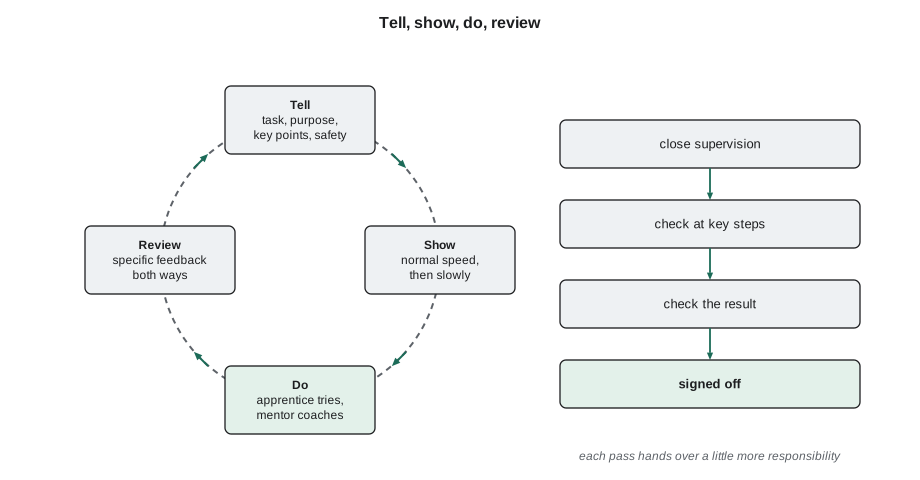
Many trade mentoring programs teach a simple cycle for passing on a skill. The names vary, but the steps are similar:
- Tell: explain the task, its purpose and the key points, including safety, before starting.
- Show: demonstrate the task at normal speed, then slowly, pointing out each key step.
- Do: the apprentice does the task while the mentor watches closely and coaches.
- Review: the mentor gives feedback on what went well and what to improve, and the apprentice says what they learned. Then the apprentice practices with less supervision, and the mentor checks the result.
Worked problem
Learning to solder a copper joint
Luis teaches Maya to solder a 3/4 inch copper joint for the domestic water risers. How does he use the cycle?
Show solution
- Tell: he explains why the joint must be clean, fluxed and evenly heated, what lead-free solder and flux to use, and the hot work rules (permit, fire extinguisher, heat shield, fire watch).
- Show: he solders one joint at normal speed, then a second slowly, pointing out where to heat, when the flux sizzles, where to feed the solder and how it draws into the joint.
- Do: Maya cleans, fluxes and solders a joint on a practice piece while Luis watches and coaches: Heat the fitting, not the pipe. Now feed the solder on the far side.
- Review: Luis points out that her joint is good but has a drip of excess solder, and shows her how to wipe it. Maya says she was not sure when to stop heating. They do three more practice joints.
- Next passes: Maya solders joints on the risers with Luis checking each one, then checking every few, then checking the run after a pressure test. By the end of the month, the skill is signed in her logbook.
Answer: Tell, show, do and review, then gradually reduce supervision as the skill becomes reliable.
Giving and receiving feedback
Feedback is how skills improve. Good feedback is specific, timely, about the work rather than the person, and includes both what went well and what to change. Your hanger spacing is right, but this one isn't level. Check it with the torpedo level before you tighten it is useful. Good job or That's garbage is not.
As an apprentice, you can make feedback easier to give. Ask for it: Can you check this before I do the rest? or What could I have done better on that run? Listen to the end, ask a question if you do not understand, thank the person, and act on it. If you get the same feedback twice, write it down, because it is clearly important. Over time, start reviewing your own work before your mentor does, and tell them what you noticed. That shows you are learning to judge quality yourself, which is what a journeyworker does.
Mentors benefit from feedback too. A good apprentice can tell a mentor, respectfully, what helps them learn: It really helps when you show me slowly first, or I learn better if I can try it and then you check, rather than watching for a long time. Most mentors appreciate this, because it makes their teaching more effective.
Being a good apprentice to mentor
Mentoring is a two-way relationship. A journeyworker is more likely to invest time in an apprentice who makes that time worthwhile. From Maya's year, the habits that made Luis want to teach her more were the same ones from Lesson 2, applied to learning:
- Show up ready to learn, with the right tools and gear.
- Pay attention when being shown something; put the phone away and watch the hands.
- Ask why, not just how. Understanding the reason makes the skill stick and lets you handle situations that are a bit different.
- Take notes and sketches, and review them.
- Practice on scrap or in spare moments.
- Track your skills and tell your mentor what you want to learn next.
- Own your mistakes and learn from them.
- Say thank you. Mentoring is often unpaid extra effort, and recognition matters.
The program below is a version of the tracker Maya keeps for the cycle in her logbook. For each skill, it records how far through the cycle she is and how much supervision she still needs, and suggests what to ask Luis for next.
# where is each skill in the mentoring cycle, and what to ask for next?
stages = ["told", "shown", "done with coaching", "checked at key steps", "checked at end", "signed off"]
skills = {"solder copper joints": 5, "install hangers": 4, "solvent-weld PVC": 3,
          "read isometric drawings": 1, "pressure test a section": 2, "set a toilet": 0}
next_ask = {0: "ask to be shown", 1: "ask to try it with coaching", 2: "ask for more practice with coaching",
            3: "ask to be checked only at key steps", 4: "ask to be checked at the end",
            5: "ask for a sign-off"}
for skill, s in sorted(skills.items(), key=lambda kv: kv[1]):
    if s >= len(stages) - 1:
        print(f"{skill:26} signed off")
    else:
print(f"{skill:26} {stages[s]:22} -> {next_ask[s + 1] if s + 1 < len(stages) - 1 else 'ask for a sign-off'}")set a toilet told -> ask to try it with coaching read isometric drawings shown -> ask for more practice with coaching pressure test a section done with coaching -> ask to be checked only at key steps solvent-weld PVC checked at key steps -> ask to be checked at the end install hangers checked at end -> ask for a sign-off solder copper joints signed off
Reflection helps too. At the end of each week, Maya spends a few minutes writing down three things in her notebook: one skill that improved, one mistake and what she learned from it, and one thing she wants to ask Luis about the next week. Over a year, those notes became a record of her progress that she could look back on before her college blocks and her review with Dave.
When the relationship is not working
Not every pairing works. Some journeyworkers are excellent tradespeople but poor teachers. Some are under so much schedule pressure that teaching is the first thing dropped. Personalities clash. Occasionally, a journeyworker treats apprentices as cheap labor, gives them only cleanup and carrying, or belittles them. An apprentice who is not learning, or is being treated badly, should not just wait it out.
Start with a direct, respectful conversation, as Lesson 8 described: describe the pattern, say what you want to learn and ask what you can do. If that does not help, talk to your foreman, who can rotate you to another journeyworker or task. Your apprenticeship authority or training coordinator, your union if you have one, and your college instructors can also give advice. You are entitled to learn the full range of skills in your trade; that is the point of an apprenticeship. If the problem is harassment rather than poor teaching, Lesson 9's routes apply.
Peer mentoring and other sources of learning
Mentoring does not only come from your assigned journeyworker. Other journeyworkers on the crew, more senior apprentices, foremen and even workers from other trades all have something to teach. Sam Torres and Maya, both first-year apprentices in different trades, end up teaching each other a lot: Sam explains how electrical boxes are laid out and why they need certain clearances from plumbing; Maya explains why drains need slope and why she sometimes needs the space Sam wants. That makes them both better at coordinating, which Lesson 7 showed is half the battle on a shared floor.
Mentoring can also run in the other direction. Apprentices are often quicker with phones, apps, tablets and digital drawings than older journeyworkers. Showing a mentor how to find the current drawing revision on the tablet, or how to attach photos to the daily log, is a way of giving back, and it builds the relationship.
Groups for people who are under-represented in the trades, such as women, Indigenous workers and newcomers, often run mentoring programs that pair apprentices with experienced tradespeople from similar backgrounds. These can be a valuable source of advice and support alongside the mentoring on the job.
Becoming a mentor
Within a few years, today's apprentice is tomorrow's journeyworker with an apprentice of their own. Many tradespeople say mentoring was one of the most rewarding parts of their career. The skills are the ones described in this lesson: plan what you will teach, use the cycle, give specific feedback, gradually hand over responsibility, share the unwritten knowledge, and treat the apprentice with the respect you wanted when you started. Remember what it felt like to be new, and that the person you are teaching may one day be the journeyworker who trains your own children.
Good mentors also look after their apprentice's safety first. An apprentice should never be assigned a task they have not been trained for, left alone in a hazardous situation, or pressured to hurry in ways that cut corners. A mentor who models safe work, speaks up about hazards and admits their own mistakes teaches all of that without saying a word.
Common mistakes
MistakeWatching passively while being shown a task.
InsteadPay attention, ask why, take notes and ask to try it.
MistakeWaiting to be told what to learn next.
InsteadTrack your skills and tell your mentor what you want to learn.
MistakeTaking feedback personally.
InsteadTreat it as information about the work; thank the person and act on it.
MistakeStaying silent when you are not learning.
InsteadHave a direct conversation, then go to your foreman or training coordinator if needed.
MistakeLearning only from your assigned journeyworker.
InsteadLearn from the whole crew, other trades and peer mentors.
MistakeAs a mentor, handing over a task without demonstrating it.
InsteadUse tell, show, do and review, then reduce supervision gradually.
Summary and key terms
- Mentoring is central to apprenticeship, and good mentoring makes apprentices more likely to finish.
- A mentor explains, demonstrates, coaches, gives feedback, hands over responsibility gradually and shares the unwritten knowledge of the trade.
- The cycle of tell, show, do and review passes on a skill, with supervision reduced each time.
- Good feedback is specific, timely and about the work; ask for it, listen, thank and act.
- Apprentices make mentoring work by being ready, curious, organized and honest.
- If mentoring is not working, talk directly first, then to your foreman or training coordinator; learn from the whole crew and other trades.
- Mentor
- An experienced person who guides and teaches a less experienced one.
- Mentee
- The person being mentored.
- Tacit knowledge
- Practical know-how that is learned by experience and hard to write down.
- Tell, show, do, review
- A four-step cycle for teaching a practical skill.
- Peer mentoring
- Learning from people at a similar level, such as other apprentices.
- Reverse mentoring
- A less experienced person teaching a more experienced one, often about technology.
- Training coordinator
- The person or office that oversees an apprentice's training program.
Practice problems
Work each problem on paper first, then reveal the answer to check.
What is the difference between a supervisor and a mentor?
Show answer
A supervisor makes sure the work gets done; a mentor makes sure the apprentice learns from doing it.
Name the four steps of the mentoring cycle.
Show answer
Tell, show, do, review.
Turn Good job into specific feedback.
Show answer
For example: Your hanger spacing is right and the joints are clean; next time check each hanger with the level before tightening.
Give four habits that make an apprentice easy to mentor.
Show answer
Any four of: show up ready, pay attention, ask why, take notes, practice, track skills, own mistakes, say thank you.
What should you do if your journeyworker only gives you cleanup work?
Show answer
Have a direct, respectful conversation; if that does not help, talk to your foreman or training coordinator.
What is reverse mentoring? Give an example.
Show answer
A less experienced person teaching a more experienced one, such as an apprentice showing a journeyworker how to use the drawing app.
Lesson quiz · 5 questions
Score 60% or more to complete this lesson.
Create a free account to save your progress, take quizzes and earn a certificate.