
TRD-106 · Lesson 1 of 12 · 24 min
The crew and the chain of command
Every building is put together by people talking to each other. A pipe ends up in the right place because a drawing told a foreman, the foreman told a journeyworker, the journeyworker showed an apprentice, and somebody checked it before the drywall went up. When that chain works, nobody notices it. When it breaks, a sleeve is missed in a concrete deck, two trades fight over the same ceiling space, or someone walks into an area that was supposed to be closed. Most rework on a construction site, and a large share of injuries, can be traced back to a message that was not sent, not heard or not understood.
This course is about the communication side of the trades: how a crew is organized, how work is planned and handed out, how you talk on a radio, how you read and write the paperwork, how you work alongside other trades and with customers, and how you learn from the people around you. It follows Maya Chen, a first-year plumbing apprentice with Northbridge Mechanical, through her first year on Kingsway Tower, a twelve-story residential building in Columbus. The people she works with are the same ones you met in TRD-101 to TRD-105: her journeyworker and mentor Luis Ferreira, her foreman Dave Kowal, the general contractor's site safety coordinator Anika Shah, the general contractor's lead rigger Hector Ruiz, and Sam Torres, a first-year electrical apprentice with Brightline Electric.
The first thing Maya has to understand is who is who. On her first morning, she counts at least forty people on the ground floor before 7:00 a.m. Some wear Northbridge stickers on their hard hats, some wear Brightline, some wear the general contractor's logo, and a few wear nothing she recognizes. Knowing which of them can tell her what to do, and which of them she should go to with a question, is the foundation for everything else in this course.
Who is on a construction project
A project like Kingsway Tower has three layers of organization. At the top is the owner, the developer who is paying for the building. The owner hires designers (architects and engineers) to draw it and a general contractor to build it. The general contractor controls the site and coordinates the trades; under OSHA's multi-employer citation policy it is usually the controlling employer, with responsibility for hazards it can reasonably prevent or correct across the whole project. On Kingsway Tower, that is Stonebridge Construction.
The general contractor does some work with its own forces, such as concrete forming, rigging and general labor, but most of the building is installed by trade contractors, also called subcontractors or subtrades. Each trade contractor is a separate company with its own workers, its own supervisors and its own safety program. Northbridge Mechanical installs the plumbing, heating and ventilation. Brightline Electric installs the power, lighting and fire alarm wiring. Other trade contractors do the steel studs and drywall, the windows, the elevators, the sprinklers, the roofing and the finishes.
Inside each trade contractor is a crew structure. A project manager in the office handles the contract, the budget, the schedule and the paperwork with the general contractor. A superintendent or general foreman runs the company's work on one or more sites. A foreman runs a crew on one site. Journeyworkers do the skilled work and lead small groups. Apprentices learn the trade by working with journeyworkers. Some companies also have lead hands, who are senior journeyworkers running a few people without being foremen.
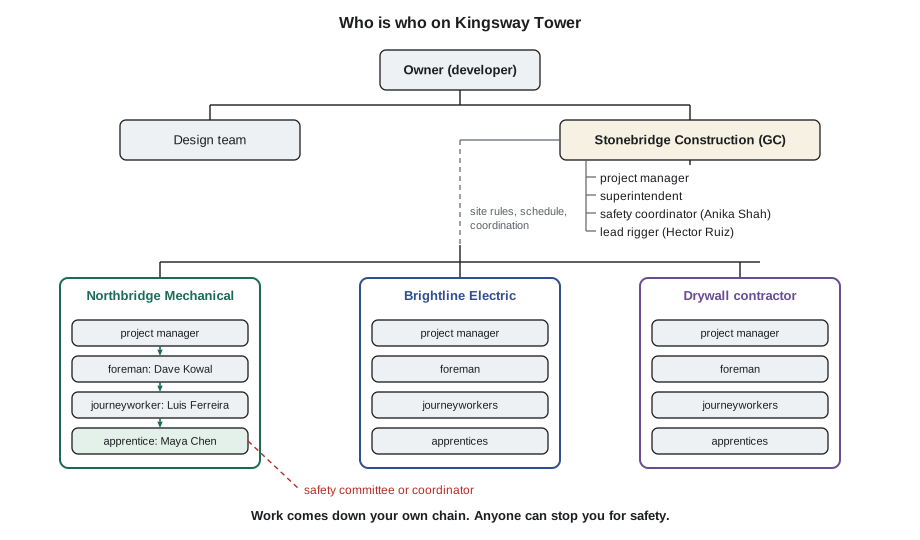
Your chain of command
The chain of command is the line of people who can assign your work and who are responsible for you. For Maya, it runs: Luis, then Dave, then Northbridge's site superintendent and project manager. That is the line she takes direction from, and the line she reports to. If Hector Ruiz from Stonebridge asks her to move a pallet of pipe, she can help if it is safe and quick, but if he asks her to start a different job, she checks with Luis or Dave first, because they are responsible for what she does, what she is trained for and what Northbridge is being paid to do.
This matters for three reasons. First, safety: your supervisor knows what you have been trained on and what hazards are in your work area. A person from another company may not. Second, the contract: Northbridge is paid to do certain work. If Maya spends a morning helping the drywall contractor, Northbridge loses those hours, and the general contractor may later argue about who pays. Third, accountability: if something goes wrong, there needs to be a clear answer to the question of who told you to do it.
None of this means you ignore people from other companies. A general contractor's superintendent, safety coordinator or rigger has authority over site rules: where you can stage material, which areas are closed, what personal protective equipment is required, when the crane is lifting. If they tell you to stop work, leave an area or put on a face shield, you do it right away and then tell your foreman. The general rule is simple: anyone can stop you for safety; only your own chain can assign you work.
Who does what on the crew
| Role | Main job | What they need from you |
|---|---|---|
| Foreman (Dave) | Plans the crew's day, assigns tasks, orders material, keeps the schedule, attends coordination meetings, signs time sheets | Accurate time and progress reports, early warning of problems, material counts |
| Journeyworker (Luis) | Does skilled work, lays out and checks installations, trains and supervises apprentices | Attention, questions, careful work, honesty about what you do not know |
| Apprentice (Maya) | Learns the trade by doing supervised work, moves and prepares material, keeps the work area clean | Clear instructions, demonstrations, feedback, safe tasks matched to training |
| Lead hand | Runs a small group on one area or task under the foreman | The same as a journeyworker, plus quick updates |
| GC superintendent | Runs the whole site, sets the schedule, coordinates the trades | Your foreman's updates; from you, compliance with site rules |
| GC safety coordinator (Anika) | Runs orientations, inspections and the site safety program | Hazard reports, near-miss reports, participation in talks and inspections |
Maya learns quickly that each of these people has a different kind of information. Luis knows how to do the work. Dave knows what work is next and why. Anika knows the site rules and the hazards on other floors. Hector knows when the crane is flying loads over her work area. Getting the right question to the right person saves time for everyone.
How information flows
Information on a site moves in three directions. Downward communication is instructions: the general contractor's schedule becomes Dave's plan for the week, which becomes Luis's task for the day, which becomes Maya's job for the next two hours. Upward communication is reports: Maya tells Luis that a sleeve is in the wrong place, Luis tells Dave, Dave raises it at the coordination meeting with the general contractor. Sideways communication is coordination between trades at the same level: Luis and the Brightline journeyworker agree who runs first through a tight corridor ceiling.
Each direction has its own risks. Downward messages lose detail as they are passed along, especially if they are only spoken. Upward messages often are not sent at all, because apprentices worry about looking ignorant or getting someone in trouble. Sideways messages can become arguments when two crews both want the same space. The rest of this course gives you tools for each one: toolbox talks and work orders for downward communication, logs and reports for upward communication, and coordination and conflict skills for sideways communication.
The longer the chain, the more detail drops out at each step. The program below simulates a message passed along a chain of people, where each person has a small chance of dropping or garbling each detail. It is a toy model with invented probabilities, but it shows why important instructions should be written down, repeated back and checked at the place of work, rather than passed along by word of mouth.
# how many details survive a spoken message passed along a chain? (toy model)
import random
random.seed(7)
details = ["level 6", "east corridor", "100 mm sleeve", "grid C-4", "pour Thursday",
           "cap both ends", "label with tag", "photo before pour"]
p_keep = 0.90          # chance each person passes on each detail correctly (invented)
trials = 2000
for people in (1, 2, 3, 4, 5, 6):
    survived = 0
    for _ in range(trials):
        survived += sum(1 for d in details if all(random.random() < p_keep for _ in range(people)))
    avg = survived / trials
print(f"{people} hand-offs: {avg:4.1f} of {len(details)} details arrive ({100 * avg / len(details):3.0f} %)")1 hand-offs: 7.2 of 8 details arrive ( 90 %) 2 hand-offs: 6.5 of 8 details arrive ( 81 %) 3 hand-offs: 5.8 of 8 details arrive ( 73 %) 4 hand-offs: 5.2 of 8 details arrive ( 66 %) 5 hand-offs: 4.7 of 8 details arrive ( 59 %) 6 hand-offs: 4.2 of 8 details arrive ( 53 %)
With a 90 percent chance of passing each detail correctly, a message that goes through four people arrives with only about two thirds of its details intact. Real people are often better than that on simple messages and worse on complicated ones. The lesson is the same: shorten the chain where you can, write down what matters, and repeat back what you heard.
Formal and informal communication
Some communication on a site is formal: it follows a set procedure and leaves a record. Work orders, toolbox talk sign-in sheets, daily logs, inspection forms, requests for information and change orders are formal. Formal communication is slower, but it can be checked later, and it settles arguments about who said what.
Most communication is informal: a word at the start of the shift, a call across the floor, a text message, a sketch on a piece of drywall. Informal communication is fast and flexible, and a site could not run without it. Its weakness is that it is easy to forget, easy to misunderstand and impossible to prove later. A good rule is that anything that changes the work, the cost, the schedule or the safety of the job should end up in writing, even if it started as a conversation. Lesson 6 covers the records that do that.
Workers also have formal channels for health and safety concerns that do not run through their foreman. Many general contractors and trade contractors run safety committees with worker members, and workers can raise concerns directly with the site safety coordinator. Under the OSH Act, any worker can also file a complaint with OSHA about a serious hazard, and federal law prohibits retaliation against a worker who raises a safety concern. Maya can use these channels if she believes a hazard is not being dealt with through her own chain.
Respecting the chain without hiding behind it
A strong chain of command does not mean apprentices keep quiet. The best foremen want to hear about problems early and from anyone. What they do not want is to hear about a problem for the first time from the general contractor, the inspector or the customer. Maya's rule, which Luis taught her on her second day, is: tell the person directly above you first, tell them early, and bring the facts.
Going around your chain should be the exception. If Luis tells Maya to do something unsafe, she can refuse and go to Dave. If Dave does not act on a serious hazard, she can go to Anika or the health and safety representative. Using these routes is not disloyal; it is what they are for. But for ordinary questions about the work, such as which fitting to use, where a line runs or what to do next, the answer comes from her own crew.
Worked problem
Who should Maya ask?
During her first week, four situations come up. (1) She is not sure whether a cleanout goes on the left or right of a stack. (2) A Stonebridge laborer tells her to move her gang box because a concrete pump is setting up there. (3) A Brightline electrician asks her to help pull wire for an hour because they are short-handed. (4) She sees an unguarded floor opening on level 7.
Show solution
- (1) A question about how to do the work goes to Luis, her journeyworker.
- (2) The general contractor controls site logistics. She moves the box, then tells Luis where it went.
- (3) Helping another trade with its work is an assignment, so she says she has to check with her foreman first, and asks Dave.
- (4) A hazard is everyone's business. She keeps people away if she can, then reports it immediately to Luis or Dave and to Anika, the site safety coordinator.
Answer: Work questions and assignments go up her own chain; site rules and hazards involve the general contractor as well.
Your first conversations
Most of what an apprentice learns about the chain of command comes from a few early conversations. On Maya's first day, Dave took ten minutes to explain who she reported to, what hours the crew worked, where the gang box and the material were, how she would get her tasks, and who to call if she was hurt. Luis then walked her around the floor and introduced her to the Brightline foreman, the drywall lead hand and Anika. Those introductions made it much easier for her to ask questions later.
If nobody gives you that introduction, ask for it. Good questions for your first day are: Who do I report to? What time does the crew start and finish, and when are breaks? Where do I find my tasks each day? Who do I call if I am hurt or see a hazard? Where are the first aid kit, the eyewash station and the muster point? Who is the health and safety representative? Is there anything about this site I should know before I start?
Common mistakes
MistakeStarting a job because someone from another company asked you to.
InsteadHelp with a quick safe task if you like, but check with your own foreman before taking on work.
MistakeIgnoring a stop-work instruction from the general contractor because they are not your boss.
InsteadAnyone can stop you for safety. Stop, then tell your foreman.
MistakeKeeping a problem to yourself because you do not want to look inexperienced.
InsteadTell the person above you early, with the facts. Foremen want to hear about problems first from their own crew.
MistakePassing on a detailed instruction by word of mouth through several people.
InsteadWrite important details down, repeat them back and check them at the place of work.
MistakeGoing over your foreman's head for an ordinary work question.
InsteadUse your own chain for work questions; use other channels for safety concerns that are not being addressed.
Summary and key terms
- A project has an owner, designers, a general contractor and trade contractors, each with its own people and responsibilities.
- Your chain of command is the line of people who assign your work and are responsible for you: usually journeyworker, foreman, superintendent and project manager.
- Anyone can stop you for safety; only your own chain can assign you work.
- Information flows down as instructions, up as reports and sideways as coordination, and detail is lost at each hand-off.
- Anything that changes the work, cost, schedule or safety should end up in writing.
- Use formal health and safety channels when a hazard is not dealt with through your own chain.
- Chain of command
- The line of people who can assign your work and are responsible for you.
- General contractor
- The company hired by the owner to build the project and coordinate the trade contractors.
- Trade contractor
- A company that installs one part of the building, such as plumbing or electrical; also called a subcontractor or subtrade.
- Foreman
- The supervisor who runs a crew on one site.
- Journeyperson
- A fully qualified tradesperson who has completed an apprenticeship.
- Lead hand
- A senior journeyworker who leads a small group under the foreman.
- Formal communication
- Communication that follows a set procedure and leaves a record, such as a work order or log.
- Informal communication
- Everyday spoken or quick written communication with no set procedure.
Practice problems
Work each problem on paper first, then reveal the answer to check.
Name the three directions in which information flows on a site and give an example of each.
Show answer
Down (a foreman assigns a task), up (an apprentice reports a problem), sideways (two trades agree on routing).
Why should Maya check with her foreman before helping another trade for an hour?
Show answer
It is an assignment of work; her foreman is responsible for her tasks, training and the hours Northbridge is paid for.
What should you do if the general contractor's superintendent tells you to leave an area?
Show answer
Leave right away, then tell your foreman.
Why do detailed spoken messages break down over several hand-offs?
Show answer
Each person may drop or change details, so the losses add up; writing and repeating back reduces that.
Give three questions to ask on your first day.
Show answer
Any three of: who do I report to, what are the hours and breaks, where do I get tasks, who do I call if hurt, where are first aid and the muster point, who is the health and safety representative.
When is it right to go outside your own chain of command?
Show answer
When a safety concern is not being dealt with, or you have been asked to do something unsafe.
Lesson quiz · 5 questions
Score 60% or more to complete this lesson.
Create a free account to save your progress, take quizzes and earn a certificate.