
TRD-106 · Lesson 7 of 12 · 21 min
Working with other trades and coordination
A building is installed by many trades sharing the same space. On a typical floor of Kingsway Tower, in the same few weeks, there are concrete finishers, steel stud framers, plumbers, sheet metal workers, electricians, sprinkler fitters, fire alarm technicians, insulators, drywallers and painters, plus the general contractor's laborers and riggers. They share floor space, ceiling space, hoists, lifts, power, washrooms and the general contractor's attention. How well they work together decides whether the floor finishes on time, how much rework is needed and how safe the area is.
Coordination is mostly the foreman's job, but the conversations that make it work happen at every level. When Luis and a Brightline journeyworker agree who runs first through a tight corridor, that is coordination. When Maya moves her pipe so the drywallers can start, that is coordination. This lesson explains how trades are sequenced, how coordination meetings and lookahead schedules work, and how apprentices can be good neighbors on a shared floor.
Sequence: who goes first
Each floor of a building goes up in a rough sequence. On Kingsway Tower's residential floors, it goes like this: concrete slab poured and stripped; layout marked; steel stud framing for walls; in-wall and in-ceiling rough-ins by plumbing, sheet metal, sprinklers and electrical; inspections; insulation; drywall; taping and painting; finishes, fixtures and devices. Within the rough-in stage, there is a further order, because larger and less flexible systems need the space first.
A common rule of thumb in ceilings is that systems that must slope or are the biggest go first: gravity drains and vents, which need a fixed slope and cannot bend around things easily; then large ductwork; then sprinkler mains; then domestic water piping; then electrical conduit and cable tray, which are the most flexible. Each project sets its own sequence based on its drawings, but the logic is the same: the least flexible system gets the best route.
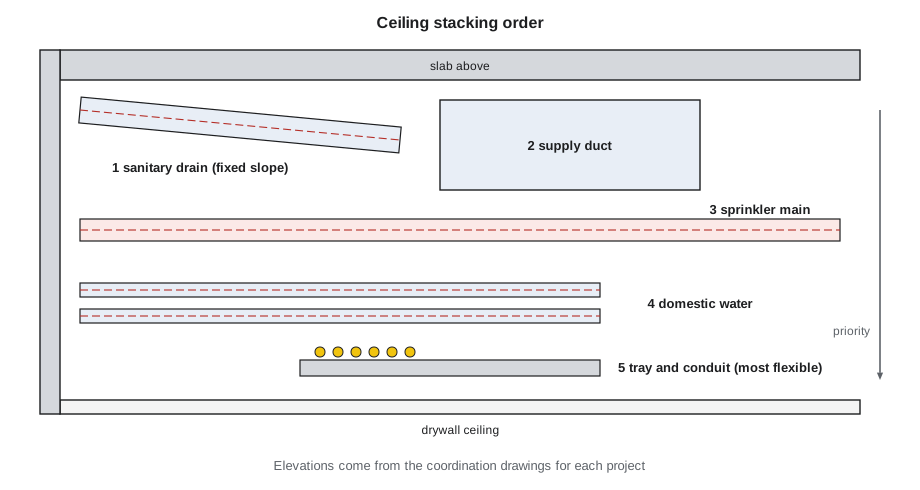
The sequence matters to apprentices because getting it wrong causes conflict. If an electrician runs conduit through a space where a drain needs to slope, the plumber either reroutes (if the drain can be moved) or the conduit comes out. If a sheet metal crew hangs duct below the sprinkler main's elevation, the sprinkler fitter may have nowhere to go. These conflicts are expensive and they are mostly avoidable with coordination.
Coordination drawings and meetings
On larger projects, the trades produce coordination drawings or a combined three-dimensional model that shows every pipe, duct, conduit and tray in each ceiling, with elevations. They meet to find and resolve clashes before anything is installed. On Kingsway Tower, the mechanical, electrical and sprinkler contractors each contributed their systems to a shared model that Stonebridge coordinated, and the floor plans used on site show agreed elevations for each system.
Once the work starts, coordination continues at weekly meetings. Every Tuesday morning, Stonebridge's superintendent meets the foremen of all the trades on site. They go over the three-week lookahead schedule, the areas that are ready or not ready, deliveries, crane and hoist bookings, inspections, safety issues and problems between trades. Dave brings Northbridge's plan and leaves with commitments and dates. Apprentices rarely attend, but they feel the results: the meeting is where it is decided that Northbridge gets level 8 on Monday and the drywallers start there on the following Thursday.
A lookahead schedule breaks the overall project schedule into the next two to six weeks, by area and trade, in enough detail for the foremen to plan crews, material and equipment. Some sites use a collaborative planning method where each trade foreman commits to the work they can actually complete each week, and the group tracks how many of those commitments were kept. The idea is that promises made by the people who do the work, and checked every week, are more reliable than a schedule handed down from above.
Sharing space and equipment
Space is the scarcest resource on a busy floor. Two crews cannot work from the same scissor lift in the same spot, and material stacked in a corridor blocks everyone. Most sites manage this with bookings and rules: hoists and lifts are booked through the general contractor; material is staged in agreed laydown areas; corridors and exits are kept clear; and areas are assigned to trades for set periods.
Even with bookings, crews overlap. The program below checks a week's area bookings on one floor for overlaps, the same way a superintendent's scheduling tool would flag them. Each booking is a trade, an area and a range of days.
# flag overlapping area bookings on level 8 for one week (days 1 = Mon ... 5 = Fri)
bookings = [
    ("Northbridge plumbing", "corridor east", 1, 3),
    ("Brightline electrical", "corridor east", 3, 4),
    ("sheet metal", "corridor west", 1, 2),
    ("sprinklers", "corridor west", 3, 5),
    ("drywall framing", "suites 801-806", 2, 5),
    ("Northbridge plumbing", "suites 801-806", 4, 5),
]
DAYS = "Mon Tue Wed Thu Fri".split()
conflicts = 0
for i in range(len(bookings)):
    for j in range(i + 1, len(bookings)):
        a, b = bookings[i], bookings[j]
        if a[1] == b[1] and a[2] <= b[3] and b[2] <= a[3]:
            d1, d2 = max(a[2], b[2]), min(a[3], b[3])
            print(f"{a[1]}: {a[0]} and {b[0]} overlap {DAYS[d1 - 1]} to {DAYS[d2 - 1]}")
            conflicts += 1
print(f"{conflicts} overlaps to sort out at the coordination meeting")corridor east: Northbridge plumbing and Brightline electrical overlap Wed to Wed suites 801-806: drywall framing and Northbridge plumbing overlap Thu to Fri 2 overlaps to sort out at the coordination meeting
An overlap is not always a problem; two trades can often share an area if they agree how. But each one should be talked about before the day it happens, not discovered when both crews arrive with their lifts.
Talking to other trades on the floor
Most coordination between trades happens in short conversations on the floor. Luis's approach, which Maya picked up by watching him, has four parts:
- Introduce yourself and your crew early. Knowing the names of the other foremen and journeyworkers on your floor makes every later conversation easier.
- Talk before you start, not after. If your work will affect another trade (blocking access, running through their space, shutting off a system, making dust or noise), tell them first.
- Look for a solution that works for both crews. Usually there is one: you go first in the morning and they go first in the afternoon, you leave a gap for their tray, they move their lift to the other side.
- If you cannot agree, take it to your foremen. Do not argue on the floor, and do not undo another trade's work to make room for yours.
The last point is a firm rule on almost every site. Never cut, move, disconnect or remove another trade's work, even if it is in your way and even if you think it was installed in the wrong place. Tell your foreman, who will raise it with the other trade's foreman or the general contractor. Moving someone else's pipe, wire or duct can damage it, void warranties, create hidden hazards (a disconnected sprinkler line, an exposed live conductor) and start a serious dispute.
Worked problem
A clash in the level 8 corridor
Maya and Luis arrive to install a 4 inch sanitary drain in the level 8 east corridor. They find that Brightline has hung a cable tray at an elevation that leaves the drain no room to keep its slope. Brightline's journeyworker is working nearby. What should Luis and Maya do?
Show solution
- Check the coordination drawing to confirm the agreed elevations for the drain and the tray.
- Talk to the Brightline journeyworker calmly: show the drawing, explain that the drain needs the space to keep its slope, and ask whether the tray can be raised or moved.
- If the tray was hung at the wrong elevation and the Brightline crew agrees, they move it themselves. If they do not agree, or if moving it needs their foreman's approval, Luis tells Dave, and Dave raises it with Brightline's foreman and Stonebridge.
- Meanwhile, Luis and Maya do not touch the tray. They move to another task and note the delay and its cause for Dave's daily log.
- Maya photographs the clash with the grid line in view, so the foremen can see it without walking up.
Answer: Use the drawings, talk first, never move another trade's work, and record the delay.
Protecting other people's work
On a shared floor, every trade's finished work is at risk from every other trade. Pipes are stepped on, ducts are dented by ladders, drywall is gouged by carts, finished floors are scratched by lifts, and installed devices are sprayed with paint. Damage to other trades' work is a major source of cost and conflict on construction projects, and it often goes unreported.
Good habits: look up and around before moving a ladder or lift; carry long material carefully through finished areas; do not use installed pipes, conduit or ducts as handholds, ladders or supports for your own work; protect finished surfaces with mats, boards or covers when working near them; clean up dust and debris that your work makes; and if you damage something, report it to your foreman right away, even if nobody saw. The other trade will find out eventually, and it is far better that they hear it from your company than discover it later.
Sharing the site's facilities
Being a good neighbor also means respecting the shared parts of the site: keep washrooms, lunch rooms and laydown areas clean; return borrowed tools and equipment promptly and in the same condition; do not take another trade's material, even a few fittings, without asking; keep extension cords and hoses tidy and out of walkways; and leave a work area at the end of the day the way you would want to find it. These things sound small, but they decide whether other trades are willing to help your crew when you need it.
Good relationships with other trades pay off in small ways every day: a Brightline electrician who lends a fish tape, a drywaller who leaves a gap in a wall for a late pipe, a laborer who tells you the hoist is free. They are built by the same habits: greeting people, keeping your word, cleaning up, saying thank you and never leaving someone else to deal with a mess you made.
When your work affects another system
Some tasks affect systems that other people depend on. Shutting off water to a floor affects every trade that uses it for mixing, cleaning or testing. Opening a fire-rated wall affects the building's fire separations. Isolating part of a sprinkler or fire alarm system can leave an occupied part of the building unprotected. These tasks usually need a permit or approval from the general contractor and advance notice to the affected trades, and sometimes to the building's owner or occupants and the fire department.
On Kingsway Tower, when Northbridge needed to shut off domestic water to levels 5 to 8 for two hours to connect a new riser, Dave gave Stonebridge 48 hours' notice in writing, Stonebridge told the other trades at the Tuesday meeting and posted a notice at the hoist, and the shutdown happened at the agreed time. Nobody was surprised. That is what good coordination looks like.
Common mistakes
MistakeStarting work that blocks another trade without telling them.
InsteadTalk to the affected trade before you start.
MistakeMoving another trade's pipe, duct or wire because it is in your way.
InsteadNever touch another trade's work; tell your foreman.
MistakeArguing with another trade on the floor.
InsteadLook for a solution together, and take disagreements to the foremen.
MistakeUsing installed pipes or conduit as a handhold or support.
InsteadUse proper access and supports for your own work.
MistakeKeeping quiet about damage you caused.
InsteadReport it right away to your foreman.
MistakeShutting off a shared system without notice.
InsteadGet approval and give the affected trades advance notice.
Summary and key terms
- Trades follow a sequence, and in ceilings the least flexible systems usually get the best route first.
- Coordination drawings, weekly meetings and lookahead schedules plan who works where and when.
- Space and shared equipment are booked; overlaps should be discussed before they happen.
- Talk to other trades early, look for solutions that work for both, and take disagreements to the foremen.
- Never cut, move or disconnect another trade's work.
- Protect other trades' work, keep shared areas clean, report damage and give notice before affecting shared systems.
- Sequence
- The order in which trades and systems are installed.
- Coordination drawing
- A drawing or model combining several trades' systems to find and resolve clashes before installation.
- Clash
- A place where two systems are designed or installed in the same space.
- Lookahead schedule
- A detailed schedule for the next few weeks, by area and trade.
- Laydown area
- An agreed place on site for storing material.
- Shutdown
- A planned interruption of a building system, such as water or power, to allow work.
- Coordination meeting
- A regular meeting of the general contractor and trade foremen to plan work and resolve problems.
Practice problems
Work each problem on paper first, then reveal the answer to check.
Why do gravity drains usually get priority in a ceiling?
Show answer
They need a fixed slope and cannot easily bend around other systems.
What is a lookahead schedule?
Show answer
A detailed schedule of the next two to six weeks by area and trade.
You find another trade's conduit blocking your pipe route. What should you do?
Show answer
Check the drawings, talk to that trade, and if it is not resolved tell your foreman; never move their work.
Give three ways to protect other trades' work.
Show answer
Any three of: look before moving ladders or lifts, carry material carefully, do not use installed work as supports, protect finished surfaces, clean up, report damage.
What should happen before a water shutdown that affects several floors?
Show answer
Approval from the general contractor and advance notice to the affected trades.
Why report damage you caused even if nobody saw?
Show answer
The other trade will find out, and it is better to hear it from your company; hiding it destroys trust.
Lesson quiz · 5 questions
Score 60% or more to complete this lesson.
Create a free account to save your progress, take quizzes and earn a certificate.