
TRD-106 · Lesson 12 of 12 · 21 min
Handing off the job and putting it together
Every piece of work is eventually handed to someone else: the next shift, another crew, the next trade, an inspector, the general contractor or the owner. A hand-off is a moment of risk. Information that was obvious to the person doing the work (that a valve is open, that a pipe has not been tested, that a hole is temporarily covered) can be lost when someone else takes over. Many incidents and costly mistakes happen at hand-offs. This last lesson looks at how good crews hand off work, and then brings the course together through Maya's review of her first year.
Shift and crew hand-offs
The simplest hand-off is between people on the same crew: one journeyworker finishing a task that another started, or a crew picking up work the next morning where it left off. On Kingsway Tower, Luis often hands an area to another Northbridge journeyworker when he is moved to another floor. He uses a short, structured hand-off, face to face where possible, at the work location:
- Status: what is finished, what is partly done and what has not started.
- Conditions: anything open, live, pressurized, isolated, locked out, temporary or unsafe. Valves open or closed, lockouts on, openings covered, temporary supports, work not yet tested.
- Next steps: what needs to happen next, in what order, and what is waiting on someone else.
- Issues: problems found, questions sent to the foreman, coordination agreed with other trades.
- Where things are: drawings with mark-ups, material, tools, permits, test records.
Health care uses similar structured hand-offs between shifts because they reduce the chance of something important being missed. On a site, the same idea applies: a hand-off that follows the same pattern every time is much less likely to leave out the one detail that matters.
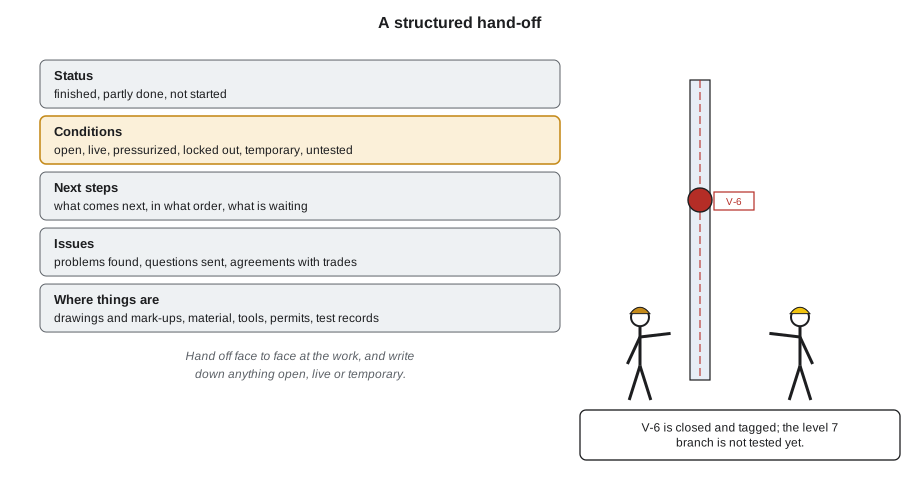
Written hand-offs matter when people cannot meet. Tags on valves and breakers, notes on the drawings, entries in the daily log and messages to the foreman all carry information across shifts. Lockout and tag-out procedures, covered in TRD-101, have strict rules for transferring locks between shifts; never remove someone else's lock, and never assume a system is safe because a lock is gone.
Handing an area to the next trade
When Northbridge finishes its rough-in on a floor, the area is handed to the insulators and drywallers. Before the walls are closed, several things must happen: the plumbing must be tested and inspected, the test results recorded, any deficiencies fixed, the work photographed, and the area cleaned of Northbridge's material and debris. Dave walks the floor with the general contractor's superintendent and signs a sign-off sheet or marks the area complete in the general contractor's app, so the drywall crew knows they can close the walls.
Closing walls before the plumbing is tested and inspected is one of the most expensive mistakes on a building project: if the test or inspection then fails, walls must be opened, and the cost lands on whoever let the cover-up happen. That is why the hand-off to the next trade is a formal step with a record, not just a shout across the floor.
Apprentices help by making sure their work is complete, labeled and cleaned up before the hand-off, by telling their journeyworker about anything unfinished or uncertain, and by not leaving material or tools in an area handed to another trade.
Turnover to the owner
At the end of the project, the building is turned over to the owner. For a trade contractor like Northbridge, turnover involves several communication tasks:
- Deficiency or punch lists: walk-throughs by the general contractor, designers and owner produce lists of items to fix or finish. Each trade must complete its items and record them as done.
- As-built drawings: drawings marked up to show where things were actually installed, including any changes from the design. Apprentices and journeyworkers contribute by marking changes on the drawings as they go.
- Operation and maintenance information: manuals, warranties, product data and maintenance schedules for equipment.
- Test and inspection records: pressure tests, flushing and disinfection of water lines, equipment start-up reports and inspection approvals.
- Training: showing the building's maintenance staff how to operate and maintain the systems.
- Labeling: valve tags, pipe labels and equipment identification so the building's staff can find and operate things.
Good turnover depends on communication throughout the project. A crew that marked its field changes on the drawings, kept its test records and labeled its valves as it went can turn the building over in days. A crew that did not may spend weeks reconstructing information, or hand over a building that its owners cannot maintain properly.
The program below summarizes Northbridge's punch list for the residential floors, the kind of report Dave sends Stonebridge each week near the end of the job.
# punch list status for Northbridge on Kingsway Tower (invented example)
from collections import Counter
items = [
    ("L2", "valve tag missing", "done"), ("L2", "escutcheon loose", "done"),
    ("L5", "toilet rocks", "done"), ("L5", "hose bib drips", "open"),
    ("L8", "access panel not installed", "waiting on drywall"), ("L8", "label missing on riser", "open"),
    ("L10", "trap leak at lav", "done"), ("L11", "dishwasher drain loop", "open"),
    ("L12", "roof drain strainer missing", "waiting on material"), ("L12", "PRV setting not recorded", "open"),
]
status = Counter(s for _, _, s in items)
print(f"{len(items)} items: " + ", ".join(f"{n} {s}" for s, n in status.most_common()))
for floor, what, s in items:
    if s != "done":
        print(f"  {floor:4} {what:30} {s}")
print(f"{100 * status['done'] / len(items):.0f} % complete")10 items: 4 done, 4 open, 1 waiting on drywall, 1 waiting on material L5 hose bib drips open L8 access panel not installed waiting on drywall L8 label missing on riser open L11 dishwasher drain loop open L12 roof drain strainer missing waiting on material L12 PRV setting not recorded open 40 % complete
Items waiting on another trade or on material are flagged separately, because Northbridge cannot close them alone. That is coordination again: the report tells Stonebridge exactly what it needs to chase.
Leaving a job well
Crews do not only hand off work; they also leave sites. When Northbridge's work on a floor or a whole project winds down, crew members are moved to other jobs, and the people left behind need to know where things stand. Before leaving a site for the last time, a good tradesperson returns borrowed tools and keys, clears out the gang box and material they were responsible for, tells the foreman about anything unfinished, hands over drawings with mark-ups, and says goodbye to the people they worked with, including the other trades and the general contractor's staff.
That last step matters more than it looks. The construction industry is smaller than it seems. The Brightline foreman Maya coordinated with this year may be the general contractor's superintendent on her next project; the drywall lead hand may become a customer when he renovates his house; the Stonebridge safety coordinator may one day be asked for a reference. Leaving each job with relationships in good shape is one of the quiet ways tradespeople build a career.
Hand-offs also apply to knowledge. When Maya learns something on Kingsway Tower that the next apprentice will need (where the shutoffs for the temporary water are, which supplier delivers on time, which fittings are always short), she adds it to the notes in Northbridge's site binder or tells Dave, so it is not lost when she moves on.
Putting it all together: Maya's first year
At the end of her first year, Dave sits down with Maya for a review. He asks her what she has learned about the communication side of the job, and she runs through the habits that made the biggest difference. They are a good summary of this course.
| Lesson | The habit | Where it paid off for Maya |
|---|---|---|
| 1. The crew | Know your chain of command; anyone can stop you for safety, only your chain assigns work | Checked with Dave before helping Brightline; reported the open floor cover to Anika |
| 2. Starting out | Be on time and ready, ask good questions, close the loop, own mistakes | Reported her short pipe before it failed a test |
| 3. Planning | Take part in toolbox talks; field-check before starting | Her question about the loose cover got it fixed |
| 4. Talking clearly | Repeat back numbers; use radio words and the phonetic alphabet | Repeat-back caught a wrong cutting length |
| 5. Work orders | Read every field; write tickets with cause, fix, test and time | Model suite repair done before the 10:00 tour |
| 6. Records | Accurate time, specific reports, labeled photos, no field changes without telling the foreman | Her drain-through-beam report became an RFI and a paid change |
| 7. Other trades | Talk first, never move another trade's work | Corridor clash solved without a fight |
| 8. Conflict | Keep it about the work; escalate with facts | Got fair task rotation by talking to Luis |
| 9. Respect | Speak up early; know the reporting routes | Comments stopped when the crew spoke up |
| 10. Customers | Call ahead, protect, explain, clean up | Dust complaint turned into a thank-you |
| 11. Mentoring | Tell, show, do, review; ask for feedback | Soldering signed off in a month |
| 12. Hand-offs | Status, conditions, next steps, issues, locations | No surprises when the drywallers closed level 6 |
Dave tells Maya that her skills have come along well for a first-year apprentice, but that what made him want to keep her was something else: he could trust what she told him. When she said a task was done, it was done. When she said there was a problem, there was. When she made a mistake, he heard it from her first. That trust is built entirely from communication, and it is what turns an apprentice into a journeyworker that crews want to work with.
Worked problem
Maya's goals for second year
As part of the review, Dave asks Maya to set three communication goals for her second year, alongside her skill goals. What might they be?
Show solution
- Write her own job tickets for service calls, with Grace or Luis reviewing them for the first month.
- Attend one Tuesday coordination meeting with Dave each month to learn how the trades plan the floors.
- Lead a task talk for a small task once a week, with Luis listening and giving feedback.
- Mentor the new first-year apprentice starting in the spring on site orientation, radio use and closing the loop.
Answer: Communication skills grow with practice, just like trade skills, and need goals too.
Communication as a trade skill
It is tempting to think of communication as something separate from the trade: a soft skill, nice to have, while the real skill is in the hands. Experienced tradespeople know better. Every task in this course connects to the quality of the work and the safety of the crew: a repeat-back that prevents a wrong cut, a field check that finds an open floor, a ticket that settles a warranty dispute, a hand-off that stops someone opening a live line. Communication is part of the trade, and like any part of the trade, it is learned by watching good people, practicing, getting feedback and doing it again.
The other trade core courses cover safety (TRD-101), math (TRD-102), drawings (TRD-103), tools and materials (TRD-104) and rigging and access (TRD-105). This course is the thread that ties them together on site, because every one of those skills depends on people sharing information clearly, at the right time, with the right person.
Common mistakes
MistakeHanding off work with a quick wave and a sentence.
InsteadUse a structured hand-off: status, conditions, next steps, issues and where things are.
MistakeLeaving out conditions that are open, live or temporary.
InsteadState them explicitly and write them down, and tag valves and breakers.
MistakeLetting walls be closed before testing and inspection.
InsteadMake the hand-off to the next trade a formal, recorded step.
MistakeLeaving field changes off the drawings.
InsteadMark changes on the drawings as you go, so the as-builts are accurate.
MistakeTreating communication as separate from the trade.
InsteadPractice it, set goals for it and get feedback on it like any other skill.
Summary and key terms
- Hand-offs are moments of risk; use a structured pattern face to face at the work location.
- Always state conditions that are open, live, pressurized, isolated, temporary or untested.
- Handing an area to the next trade is a formal step: tested, inspected, recorded, cleaned and signed off.
- Turnover to the owner depends on punch lists, as-builts, O&M information, test records, training and labels built up during the project.
- The habits in this course build trust, and trust is what crews value most in an apprentice.
- Communication is a trade skill that improves with practice, feedback and goals.
- Hand-off
- The transfer of work and its information from one person, crew or trade to another.
- Sign-off
- A recorded confirmation that work is complete and an area can be handed over.
- Punch list
- A list of items to fix or finish before a project is complete; also called a deficiency list.
- As-built drawings
- Drawings marked up to show what was actually installed.
- Turnover
- Handing a completed building and its information to the owner.
- O&M manual
- Operation and maintenance information for the building's systems and equipment.
Practice problems
Work each problem on paper first, then reveal the answer to check.
Name the five parts of a structured hand-off.
Show answer
Status, conditions, next steps, issues and where things are.
Why must conditions such as open valves be stated explicitly at a hand-off?
Show answer
They are obvious to the person who did the work but invisible to the next person, and can cause injuries or damage.
What must happen before a floor is handed to the drywallers?
Show answer
Testing and inspection, recorded results, deficiencies fixed, photos, cleanup and a sign-off.
List four items included in turnover to the owner.
Show answer
Any four of: punch list completion, as-built drawings, O&M information, test and inspection records, training, labeling.
Why did Dave value Maya most as an apprentice?
Show answer
He could trust what she told him.
Give one communication goal you could set for your next year.
Show answer
For example: write my own job tickets, attend a coordination meeting, lead a task talk, mentor a new apprentice.
Lesson quiz · 5 questions
Score 60% or more to complete this lesson.
Create a free account to save your progress, take quizzes and earn a certificate.