
TRD-106 · Lesson 10 of 12 · 22 min
Customer service in occupied homes and businesses
Much trade work happens in places where people live, work, shop or receive care: renovations, service calls, repairs, tenant improvements in occupied office towers, and new buildings where the first floors are occupied while the upper floors are still under construction. In these settings, the customer is not a general contractor on a drawing; it is a family whose kitchen you are standing in, a store manager who needs to open at 9:00, or a nurse whose patients are on the other side of a temporary wall. How you behave in their space matters as much as how well you do the work, and often decides whether your company is called back.
In the spring of her first year, Maya gets her first taste of occupied work. Kingsway Tower's lower floors receive occupancy early, and residents move into levels 2 to 4 while Northbridge is still finishing levels 10 to 12. Several deficiency repairs and warranty calls take her into suites where people live. She also spends two weeks with Northbridge's service department, riding with a service plumber, Grace Lin, on calls to homes and small businesses. This lesson draws on both.
The customer's point of view
For a homeowner or tenant, letting tradespeople into their home is stressful. They worry about dirt, damage, noise, cost, how long it will take, whether their belongings and privacy will be respected, and whether they can trust the people in their space. A business worries about disruption to its customers, staff and income. Most customer complaints about trades are not about the quality of the work. They are about lateness, mess, poor communication, surprises on the bill and feeling ignored or disrespected.
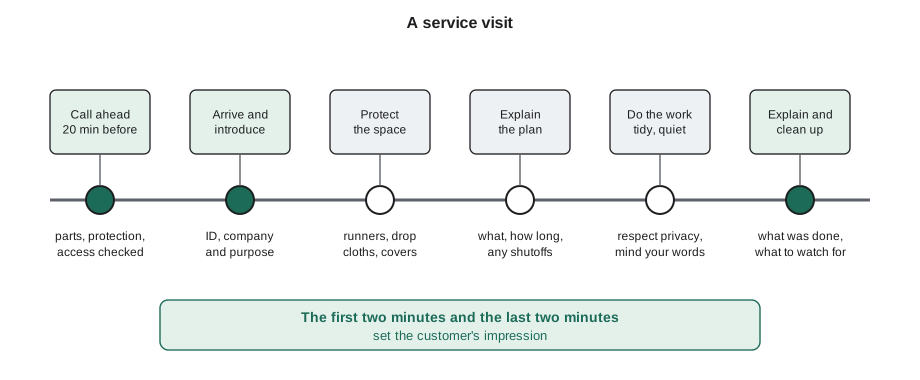
Grace's view, after twenty years in service work, is that customers judge the visit in the first two minutes and the last two minutes. If you arrive on time, introduce yourself, explain what you will do and protect their home, they relax. If you clean up, explain what you did and what to watch for, they remember you well. What happens in between matters too, but those two moments set the tone.
Before you arrive
Good service starts before the door opens. Read the work order fully, as Lesson 5 showed, paying attention to access instructions and special notes: pets, children, accessibility needs, health conditions, language, parking, alarm codes and the best times to work. Bring the right parts and tools so you do not have to make repeated trips. Bring floor protection, drop cloths, shoe covers, a vacuum and cleaning supplies.
If you will be late, call or text the customer before the appointment time with a realistic new arrival time. Customers are usually understanding about delays; they are not understanding about being left waiting without a word. Grace calls each customer about twenty minutes before arriving, which gives them time to secure pets, move the car out of the driveway or clear the area under the sink.
Arriving and introducing yourself
At the door, introduce yourself, your company and why you are there: Hi, I'm Maya Chen with Northbridge Mechanical. I'm here with Grace about the leak under your kitchen sink. Carry company identification and show it if asked. Wait to be invited in. Ask where you can park, where to bring tools in, and whether there is anything you should know about the space.
Before starting, take a couple of minutes to confirm the problem with the customer in their own words, look at the area, and explain what you are going to do and roughly how long it will take. If you need to shut off water, power or heat, say so and for how long. If anyone in the home has a medical device or needs water or power at a particular time, ask before you shut anything off.
Protecting the customer's space
Lay floor protection from the door to the work area before you carry anything in. Use runners on carpets and hard floors, drop cloths under the work and around it, and shoe covers if your boots are dirty or the customer asks. Clear a work area with the customer's permission, and ask before moving furniture or belongings; if something must be moved, let the customer do it or move it carefully together. Protect cabinets, countertops and fixtures near the work from tools, debris, water and heat.
Dust, noise and smells travel. Close doors to the rest of the home, use dust control (vacuum attachments on drills, plastic sheeting for larger work), and ask about ventilation if you are using adhesives, solvents or solder. In a business, ask where the quietest and least disruptive route and time is.
Respecting privacy and property
You are a guest in someone's home or workplace. Stay in the areas you need for the work. Do not open drawers, closets or rooms you do not need, do not comment on the customer's belongings, home or lifestyle, and do not use the customer's washroom, phone, food or Wi-Fi without asking. Keep personal phone calls for your truck. Do not photograph the customer's belongings, people or documents; take only the photos needed for the work order, focused on the work.
Be careful what you say. Customers overhear conversations between workers, and a joke or a complaint about the job, another trade or the customer can undo an hour of good work. Swearing that might pass on a construction floor is not acceptable in someone's home. Do not talk about other customers or their homes.
Children and pets need special care. Keep tools, chemicals, sharp offcuts and open holes out of reach, and keep doors and gates closed if the customer asks. If a child is hanging around the work area, ask the parent kindly to keep them clear for safety. Never be alone in a room with a child if you can avoid it, and never discipline someone else's child. If a pet is aggressive or loose in your work area, stop and ask the owner to secure it.
Communicating during the work
Keep the customer informed, especially if the job changes. If you find something unexpected (a corroded pipe, water damage behind a wall, a code problem), stop and explain it before doing anything beyond the work order. Use plain language and show them: The valve you called about is fixed, but the drain pipe behind it is badly corroded. Here, you can see the rust. It isn't leaking yet, but it may soon. Then explain the options and who decides about extra work and cost. On a service call, that may be you with the company's pricing; on a warranty or construction job, it is usually your foreman or office.
Do not promise things you cannot control: prices you have not confirmed, completion dates that depend on parts or other trades, or work outside your scope. It's better to say I'll check with my office and call you by end of day than to promise and fail. And do not criticize other contractors' work to the customer. Describe what you see factually and let the customer draw their conclusions.
If a customer speaks a different language from you, use simple words, show rather than tell, and use translation apps or a family member to help. Be patient. If the customer has a hearing, vision or mobility impairment, ask how they prefer to communicate and adjust: face them when speaking, write things down, describe what you are doing or make sure the path you leave is clear.
Occupied commercial and institutional spaces
Work in occupied businesses, schools, hospitals and long-term care homes adds rules. Offices may restrict noisy work to evenings and weekends. Restaurants and food stores have hygiene rules and cannot have dust near food. Schools have rules about workers on site during class hours and contact with students. Hospitals and care homes use infection control risk assessments to decide what containment, negative air pressure, cleaning and access rules apply, and work near patients may require special training. These rules usually come with the work order or the general contractor's site plan, and they are not optional.
Before starting in an occupied commercial building, find out who your contact is, where you sign in, which areas you may use, what hours you may work, and what the building's emergency procedures are. If your work will affect the building's fire alarm, sprinklers or exits, the building owner and, where required, the fire department must be told in advance, and a fire watch may be needed while the system is impaired.
Handling complaints
Sooner or later, a customer will be unhappy. Something got dirty, the work took longer than they expected, the price was higher, or a problem came back. How you respond often matters more than the problem itself. A simple approach:
- Listen without interrupting, and let them finish.
- Acknowledge their concern: I understand, this isn't what you expected.
- Apologize for the experience without arguing or making excuses, even if it was not your fault: I'm sorry this has been frustrating.
- Fix what you can on the spot: clean up the dirt, explain what happened, check the work again.
- For what you cannot fix or decide (refunds, price disputes, warranty decisions), tell them who will follow up and when, and then make sure your office actually hears about it.
- Never argue, raise your voice, or blame the customer, another trade or your own company in front of them.
Worked problem
A complaint about dust in Suite 304
Maya and Luis replace a section of drain in the ceiling of an occupied suite on Kingsway Tower's third floor. They use plastic sheeting and a vacuum, but when the resident comes home, she finds a fine layer of drywall dust on her bookshelf near the work area and is upset. What should they do?
Show solution
- Listen to her fully and look at the dust with her.
- Acknowledge it: You're right, there's dust on the shelf, and that's not acceptable.
- Apologize: I'm sorry. We should have covered the shelf as well.
- Fix what they can: with her permission, wipe and vacuum the shelf and nearby surfaces right away.
- Explain the follow-up: Luis tells her he will report it to his foreman and the building manager, and that if anything is damaged, they will be in touch.
- Report it to Dave the same day, and note in their own planning to cover all nearby furniture on future ceiling work in occupied suites.
Answer: Listen, acknowledge, apologize, fix what you can, hand off the rest and learn from it.
Finishing and leaving
The last two minutes count. Before leaving, test the work, clean up completely (including dust on surfaces, footprints, offcuts and packaging), remove your floor protection carefully so dirt on it does not spill, and put back anything you moved. Then explain to the customer in plain words what you did, anything they should watch for (for example, Check under the sink tomorrow morning; if you see any moisture, call us), and how to reach the company. If the work order requires a signature, ask for it after explaining, as Lesson 5 covered.
Grace finishes every visit with a quick check against a mental list. The program below turns her list into a checklist that prints what is still to do before leaving.
# end-of-visit checklist (Grace's list)
checks = {
    "work tested and working": True,
    "water, power or heat back on and confirmed": True,
    "all tools, parts and offcuts collected": True,
    "work area cleaned, including nearby surfaces": False,
    "floor protection removed without spilling dirt": False,
    "moved items put back": True,
    "customer told what was done and what to watch for": False,
    "work order signed and photos attached": False,
}
todo = [item for item, done in checks.items() if not done]
print(f"{len(checks) - len(todo)} of {len(checks)} done")
for item in todo:
print("still to do:", item)4 of 8 done still to do: work area cleaned, including nearby surfaces still to do: floor protection removed without spilling dirt still to do: customer told what was done and what to watch for still to do: work order signed and photos attached
A good visit ends with the customer feeling that their home or business was respected, that they understand what was done, and that they know who to call. That is what earns repeat work and referrals, and in service trades, those are what keep the trucks busy.
Common mistakes
MistakeArriving late without calling.
InsteadCall or text before the appointment time with a realistic new arrival time.
MistakeCarrying tools in before laying floor protection.
InsteadProtect the floor from the door to the work area first.
MistakeDoing extra work without explaining or getting approval.
InsteadStop, show the customer, explain the options and who decides.
MistakePromising a price or date you cannot confirm.
InsteadSay you will check and follow up, then do it.
MistakeArguing with an unhappy customer.
InsteadListen, acknowledge, apologize, fix what you can and hand off the rest.
MistakeLeaving without explaining the work.
InsteadExplain what was done, what to watch for and how to reach the company.
Summary and key terms
- Customers judge the visit mostly on punctuality, cleanliness, communication, honesty about cost and respect.
- Prepare before arriving, call ahead and tell the customer if you will be late.
- Introduce yourself, confirm the problem and explain the plan, including any shutoffs.
- Protect floors and surfaces, respect privacy, take care around children and pets and watch what you say.
- Explain unexpected findings before doing extra work, and never promise what you cannot control.
- Handle complaints by listening, acknowledging, apologizing and fixing or handing off; finish by testing, cleaning and explaining.
- Occupied space
- A home, business or institution where people are living or working while trade work is done.
- Floor protection
- Runners, boards or sheets laid to protect finished floors from dirt and damage.
- Shoe covers
- Disposable covers worn over boots to keep floors clean.
- Infection control risk assessment
- A process used in health care buildings to decide the containment and cleaning needed for construction work.
- Fire watch
- A person assigned to watch for fire while a fire protection system is out of service or during hot work.
- Scope
- The work you have been authorized to do.
Practice problems
Work each problem on paper first, then reveal the answer to check.
Why do the first and last two minutes of a visit matter so much?
Show answer
They set the customer's impression: arriving well and leaving well are what customers remember most.
What should you do before shutting off water in an occupied home?
Show answer
Tell the customer for how long, and ask whether anyone depends on water or power for medical or other reasons.
Give three ways to respect a customer's privacy.
Show answer
Any three of: stay in the work area, do not open drawers or rooms, do not comment on belongings, ask before using their facilities, photograph only the work.
You find a corroded pipe that is not on the work order. What should you do?
Show answer
Stop, show and explain it to the customer, explain the options and who decides, and get approval before extra work.
List the steps for handling a complaint.
Show answer
Listen, acknowledge, apologize, fix what you can, tell them who will follow up, and never argue.
What should you tell the customer before leaving?
Show answer
What was done, what to watch for and how to reach the company.
Lesson quiz · 5 questions
Score 60% or more to complete this lesson.
Create a free account to save your progress, take quizzes and earn a certificate.