
TRD-102 · Lesson 7 of 12 · 29 min
Trigonometry on the job: angles, rise and run
The Pythagorean theorem connects the three sides of a right triangle, but it says nothing about the angles. Trigonometry fills that gap. With it, a tradesperson who knows one side and one angle can find every other side, and one who knows two sides can find the angle. That covers bending conduit, setting a ramp or a pipe at an angle, working out how high a boom reaches, and checking a ladder's setup angle.
Trigonometry has a reputation for being difficult, but the job-site version needs only three ratios and a calculator. Sam Torres uses it every time he bends conduit; Maya will use it for pipe offsets in lesson 8. This lesson builds the foundation for both.
Naming the sides
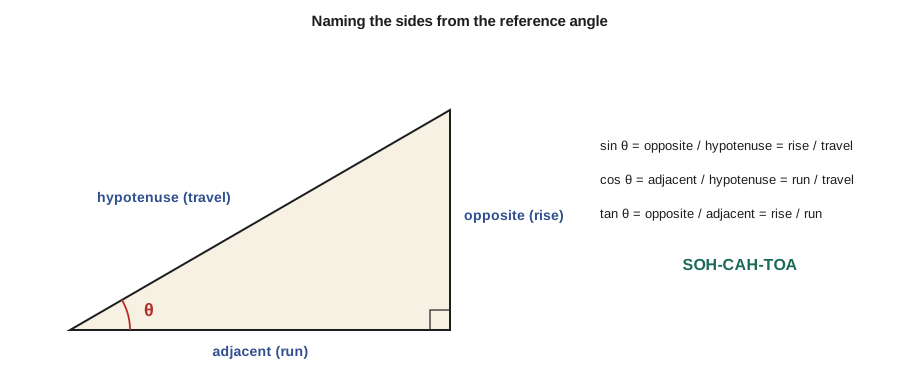
In a right triangle, pick one of the two angles that is not the right angle and call it the reference angle, usually written with the Greek letter theta. The sides are then named relative to that angle:
- The hypotenuse is the longest side, opposite the right angle, as in lesson 6.
- The opposite side is across from the reference angle; it does not touch it.
- The adjacent side touches the reference angle and is not the hypotenuse.
In trade language, if the reference angle sits at the bottom of a slope, the opposite side is the rise, the adjacent side is the run, and the hypotenuse is the travel or the length along the slope. Keeping those three words in mind makes trigonometry feel familiar.
Sine, cosine and tangent
The three trigonometric ratios compare pairs of sides. For any particular angle, each ratio has a fixed value no matter how big the triangle is. That is what makes them useful: a 30 degree slope has the same rise-to-run ratio whether it is a short pipe offset or a long ramp.
Many people remember these with the word SOH-CAH-TOA: sine is opposite over hypotenuse, cosine is adjacent over hypotenuse, tangent is opposite over adjacent. In trade words: sine is rise over travel, cosine is run over travel, tangent is rise over run.
| Angle | sin | cos | tan | Where it shows up |
|---|---|---|---|---|
| 10° | 0.174 | 0.985 | 0.176 | Small conduit offsets |
| 22.5° | 0.383 | 0.924 | 0.414 | Pipe and conduit offsets |
| 30° | 0.500 | 0.866 | 0.577 | Conduit offsets |
| 45° | 0.707 | 0.707 | 1.000 | The most common pipe offset |
| 60° | 0.866 | 0.500 | 1.732 | Steep offsets |
| 75.5° | 0.968 | 0.250 | 3.873 | A ladder with its base out one quarter of its length |
Note that sin 30° is exactly 0.5, so at 30 degrees the travel is exactly twice the rise. At 45 degrees, the rise and run are equal and tan 45° is exactly 1. These two facts are worth remembering because they are used constantly.
Making sure the calculator is in degrees
Calculators can measure angles in degrees or in radians, a unit used in higher mathematics. All trade work uses degrees. If sin 30 comes out as -0.988 instead of 0.5, the calculator is in radians. Look for a DEG indicator on the display, or a setting in a phone calculator's scientific mode. Check it at the start of every job; it is one of the most common causes of wildly wrong answers.
Finding a side
To find an unknown side, choose the ratio that links the side you know, the side you want and the angle. Write the ratio, then rearrange.
Worked problem
Finding the rise from the travel and angle
A conveyor ramp for materials at the loading dock is 20 ft long and set at 12°. How high does it rise?
Show solution
- Known: hypotenuse 20 ft and angle 12°. Wanted: opposite (rise). Use sine.
- \(\sin 12° = \frac{\text{rise}}{20}\), so \(\text{rise} = 20 \times \sin 12° = 20 \times 0.2079 = 4.16\) ft.
Answer: About 4.16 ft, or 4 ft 1-15/16 in.
Worked problem
Finding the travel from the rise and angle
Sam needs a conduit to climb 6 in at 30° to clear a beam flange. What length of conduit is on the slope?
Show solution
- Known: opposite 6 in and angle 30°. Wanted: hypotenuse. Use sine.
- \(\text{travel} = \frac{\text{rise}}{\sin 30°} = \frac{6}{0.5} = 12\) in.
Answer: 12 in. At 30 degrees, travel is always twice the rise.
Worked problem
Finding the run
A boom lift's boom is 40 ft long at 65° from horizontal. How far out horizontally does the tip reach from the pivot?
Show solution
- Known: hypotenuse 40 ft and angle 65°. Wanted: adjacent (run). Use cosine.
- \(\text{run} = 40 \times \cos 65° = 40 \times 0.4226 = 16.9\) ft.
Answer: About 16.9 ft. The vertical reach would use sine: 40 x sin 65° = 36.3 ft above the pivot.
Finding an angle
When you know two sides and want the angle, use the inverse functions, written \(\sin^{-1}\), \(\cos^{-1}\) and \(\tan^{-1}\), or on some calculators asin, acos and atan. They answer the question: which angle has this ratio? On most calculators they are the second function of the sin, cos and tan keys.
Worked problem
The angle of a slope
An accessible ramp rises 30 in over a run of 30 ft. What angle does it make with the floor?
Show solution
- Known: opposite 30 in and adjacent 360 in. Use tangent.
- \(\tan\theta = \frac{30}{360} = 0.0833\).
- \(\theta = \tan^{-1}(0.0833) = 4.76°\).
Answer: About 4.8 degrees. A slope of 1 in 12 is the steepest generally allowed for accessible ramps; lesson 9 returns to ramps.
Worked problem
A ladder angle
A ladder's feet are 3 ft from the wall and the ladder touches the wall 12 ft up. Is it close to the recommended angle of about 75 degrees?
Show solution
- \(\tan\theta = \frac{12}{3} = 4\), so \(\theta = \tan^{-1}(4) = 76.0°\).
Answer: Yes. Setting the base out one quarter of the ladder's working length, the 1-to-4 rule from TRD-101, gives about 75.5 degrees; one out for every four up gives about 76 degrees. Both are close enough.
Choosing the right ratio
Every trigonometry problem comes down to the same short procedure. Following it every time prevents most errors.
- Sketch the triangle and mark the right angle and the reference angle.
- Label the side you know and the side you want as opposite, adjacent or hypotenuse.
- Pick the ratio that contains both: SOH if opposite and hypotenuse, CAH if adjacent and hypotenuse, TOA if opposite and adjacent.
- Write the equation, rearrange, then calculate. Check that the hypotenuse is the longest side and that the angle makes sense.
| You know | You want | Use |
|---|---|---|
| Angle and hypotenuse | Opposite (rise) | opposite = hypotenuse x sin |
| Angle and hypotenuse | Adjacent (run) | adjacent = hypotenuse x cos |
| Angle and adjacent | Opposite | opposite = adjacent x tan |
| Angle and opposite | Hypotenuse | hypotenuse = opposite / sin |
| Opposite and adjacent | Angle | angle = inverse tan (opposite / adjacent) |
| Opposite and hypotenuse | Angle | angle = inverse sin (opposite / hypotenuse) |
Angles in conduit bending
Electricians bend conduit to standard angles because the multipliers are easy to remember and the bender has marks for them. An offset is made of two equal bends in opposite directions. The distance between the bends along the conduit is the offset depth times a multiplier, which is simply one over the sine of the bend angle. Lesson 8 develops this for both pipe and conduit, but the link to trigonometry is direct: the multiplier for 30 degrees is 1 / sin 30° = 2, and for 45 degrees it is 1 / sin 45° = 1.414.
Benders and pipe fittings work with whole-number angles chosen for convenience, so the trigonometry is usually already in a chart. Knowing where the chart comes from lets you handle an angle that is not on it, or check a chart that has been copied wrong.
Trigonometry in code
Python's math module works in radians, so a program has to convert degrees with math.radians before calling sin, cos or tan, and convert back with math.degrees after an inverse function. This is the same trap as a calculator left in radian mode, and the code makes the conversion visible.
import math

def rise_from(travel, angle_deg):
    return travel * math.sin(math.radians(angle_deg))

def run_from(travel, angle_deg):
    return travel * math.cos(math.radians(angle_deg))

def angle_from(rise, run):
    return math.degrees(math.atan2(rise, run))

print(f"ramp 20 ft at 12 deg: rise {rise_from(20, 12):.2f} ft")
print(f"boom 40 ft at 65 deg: reach out {run_from(40, 65):.1f} ft, up {rise_from(40, 65):.1f} ft")
print(f"ramp 30 in over 360 in: {angle_from(30, 360):.2f} deg")
print(f"ladder 12 ft up, 3 ft out: {angle_from(12, 3):.1f} deg")
print(f"wrong mode check: sin(30) in radians = {math.sin(30):.3f}")ramp 20 ft at 12 deg: rise 4.16 ft boom 40 ft at 65 deg: reach out 16.9 ft, up 36.3 ft ramp 30 in over 360 in: 4.76 deg ladder 12 ft up, 3 ft out: 76.0 deg wrong mode check: sin(30) in radians = -0.988
The last line shows what happens if you forget the conversion: sin of 30 radians is about -0.988, a nonsense answer for a 30 degree slope. Spotting a result like that is exactly the kind of check this course encourages.
Angles, slopes and percent grades
The same slope can be described three ways: as an angle in degrees, as a ratio of rise to run, or as a percent grade. Tangent is the bridge between them, because tangent is rise over run.
| Description | Rise to run | Percent grade | Angle |
|---|---|---|---|
| A drain at a quarter inch per foot | 1 : 48 | 2.08 % | 1.19° |
| A ramp at one in twelve | 1 : 12 | 8.33 % | 4.76° |
| A one in four ladder base | 4 : 1 (rise to run) | 400 % | 75.96° |
| A 45° offset | 1 : 1 | 100 % | 45° |
Small slopes are easier to understand as grades or ratios; nobody describes a drain as falling at 1.19 degrees. Steep angles, like a ladder or a conduit bend, are easier in degrees. Lesson 9 uses grades and ratios for drains, ramps and stairs.
Digital angle finders and smart levels
Many tradespeople now carry a digital level or angle finder that reads in degrees, percent, or inches per foot. The tool does the trigonometry, but you still need to understand it, for two reasons. First, you must set the right unit; a reading of 2.0 means very different slopes in degrees and in percent. Second, the reading is only as good as the surface it sits on and its calibration. A quick check is to read a surface, turn the tool end for end on the same spot, and read again. The two readings should match; if they do not, the tool needs calibrating.
Worked problem
Checking a ladder with trigonometry
A 20 ft extension ladder leans against the parkade wall with its base 5 ft out. What angle does it make with the ground, and is it close to the recommended 75 degrees?
Show solution
- Known: hypotenuse 20 ft and adjacent 5 ft. Use cosine.
- \(\cos\theta = \frac{5}{20} = 0.25\), so \(\theta = \cos^{-1}(0.25) = 75.5°\).
Answer: About 75.5°, which is the one-in-four setup taught in TRD-101. Measured along the ladder, the base is out one quarter of the working length.
When you use any of these tools or formulas, write the unit next to every slope you record: 2 percent, 1 in 50, a quarter inch per foot or 1.15 degrees. A bare number on a drawing markup or a daily report is an invitation for someone to read it in the wrong unit.
Common mistakes
MistakeLeaving the calculator in radian mode.
InsteadCheck for DEG on the display before starting.
MistakeLabeling sides from the wrong angle.
InsteadName opposite and adjacent from the reference angle you chose.
MistakeUsing sine when the known side is the adjacent.
InsteadPick the ratio that contains the side you know and the side you want.
MistakeMultiplying instead of dividing when finding the hypotenuse.
InsteadHypotenuse = opposite / sin or adjacent / cos; it must come out longest.
MistakeUsing the inverse function on a side length instead of a ratio.
InsteadDivide the two sides first, then apply inverse tan, sin or cos.
Summary and key terms
- Name sides from the reference angle: opposite (rise), adjacent (run), hypotenuse (travel).
- SOH-CAH-TOA: sine = opposite / hypotenuse, cosine = adjacent / hypotenuse, tangent = opposite / adjacent.
- Ratios depend only on the angle, not on the size of the triangle.
- Use inverse functions to find an angle from two sides.
- sin 30° = 0.5 and tan 45° = 1 are worth memorizing.
- Always work in degree mode and check that answers make sense.
- Reference angle
- The angle from which the opposite and adjacent sides are named.
- Opposite
- The side across from the reference angle; the rise.
- Adjacent
- The side next to the reference angle that is not the hypotenuse; the run.
- Sine
- The ratio of opposite to hypotenuse.
- Cosine
- The ratio of adjacent to hypotenuse.
- Tangent
- The ratio of opposite to adjacent.
- Inverse function
- A function that returns the angle for a given ratio.
Practice problems
Work each problem on paper first, then reveal the answer to check.
A 16 ft ramp is set at 8°. What is its rise?
Show answer
16 x sin 8° = 2.23 ft.
A pipe rises 16 in at 45°. What is the travel?
Show answer
16 / 0.707 = 22.6 in.
A slope rises 3 ft over a 12 ft run. What is the angle?
Show answer
inverse tan 0.25 = 14.0°.
A 10 ft board leans at 60°. What is its run?
Show answer
10 x cos 60° = 5 ft.
What is the travel for a 10 in rise at 22.5°?
Show answer
10 / 0.383 = 26.1 in.
Lesson quiz · 5 questions
Score 60% or more to complete this lesson.
Create a free account to save your progress, take quizzes and earn a certificate.