
TRD-102 · Lesson 5 of 12 · 33 min
Volume: concrete, fill and excavation
Volume is the amount of space a solid or liquid occupies. In the trades it decides how much concrete to order, how much soil leaves a trench and how much has to come back, how much water a piping system holds when it is filled for a test, and how big a tank or sump must be. Volume mistakes are expensive: a concrete truck that arrives short leaves a cold joint in a slab, and one that arrives with too much leaves the contractor paying for concrete that goes back to the plant.
At Kingsway Tower, Maya's crew pours small concrete housekeeping pads for the domestic water heaters and booster pumps in the basement mechanical room, digs and backfills a trench for the storm connection outside, and fills the new risers with water for pressure testing. Each job is a volume calculation. Concrete in the United States is ordered by the cubic yard.
Volume of prisms and cylinders
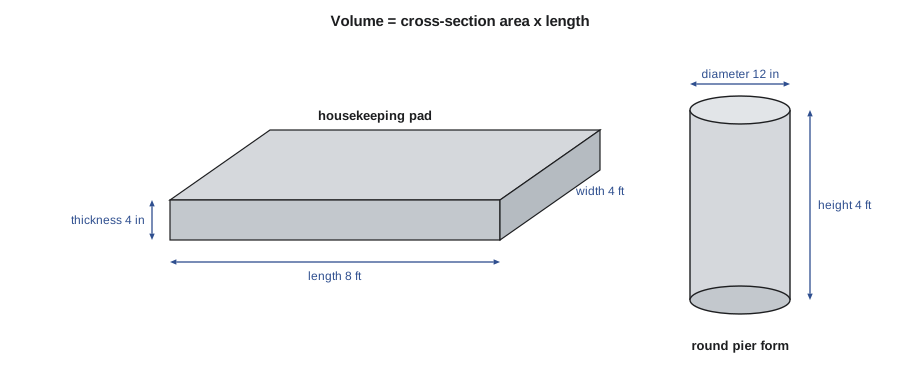
A prism is a solid with the same cross-section all along its length: a slab, a beam, a wall, a footing, a trench. Its volume is the area of the cross-section times the length. A rectangular block is the simplest case: length times width times depth. A cylinder is a prism with a circular cross-section, such as a pier, a round column, a pipe or a tank.
As with area, all three dimensions must be in the same unit before you multiply. The trap with slabs is that length and width are given in meters or feet but thickness in millimeters or inches. Convert the thickness first: 100 mm is 0.100 m; 4 in is 4/12 = 0.333 ft.
Concrete
Concrete is ordered in cubic yards, usually to the nearest quarter or half yard depending on the supplier. Ready-mix trucks commonly carry up to about 10 cubic yards, and small loads often carry an extra charge. Every concrete order should include an allowance for waste, spillage, uneven subgrade and form bulging, typically 5 to 10 percent depending on the job.
Worked problem
A housekeeping pad
The pad for the two water heaters is 8 ft long, 4 ft wide and 4 in thick. How much concrete should be ordered with 10 percent waste, rounded up to the next quarter cubic yard?
Show solution
- Thickness in feet: \(4 \div 12 = 0.333\) ft.
- Volume: \(8 \times 4 \times 0.333 = 10.67\) cu ft.
- In cubic yards: \(10.67 \div 27 = 0.395\) cu yd.
- With waste: \(0.395 \times 1.10 = 0.435\) cu yd.
- Round up: 0.5 cu yd (many suppliers have a minimum load; small pads are often mixed on site from bags).
Answer: Order 0.5 cu yd.
Worked problem
A slab on grade
A new slab for the parking ramp's electrical room is 20 ft by 15 ft and 6 in thick. How much concrete should be ordered with 5 percent waste, to the next half cubic yard?
Show solution
- \(20 \times 15 \times 0.5 = 150\) cu ft.
- \(150 \div 27 = 5.56\) cu yd.
- With waste: \(5.56 \times 1.05 = 5.83\) cu yd.
- Round up to 6.0 cu yd.
Answer: Order 6.0 cu yd.
When concrete is mixed from bags, each bag yields a stated volume. Divide the volume needed by the yield per bag and round up. The bag label is the authority, because yields vary by product and bag size.
Worked problem
Round piers
Four pipe-rack support piers are formed with 12 in diameter tubes, each 4 ft deep. What volume of concrete do they need, before waste?
Show solution
- Radius: \(0.5\) ft.
- One pier: \(\pi \times 0.5^2 \times 4 = 3.14\) cu ft.
- Four piers: \(4 \times 3.14 = 12.57\) cu ft, which is \(12.57 \div 27 = 0.47\) cu yd.
Answer: About 0.47 cu yd.
Excavation and backfill
Soil does not keep a fixed volume. When it is dug, it loosens and takes up more space; this increase is called swell. When it is placed back and compacted, it squeezes into less space than the loose material, and sometimes less than it occupied in the ground; this is shrinkage. Earthwork volumes are therefore described in three states: bank (in place, undisturbed), loose (after digging, in a truck or a pile) and compacted (placed and compacted in a fill).
| State | What it describes | Used for |
|---|---|---|
| Bank | Soil in its natural place in the ground | Measuring the hole to be dug |
| Loose | Dug soil with air spaces between particles | Truck loads and stockpile space |
| Compacted | Soil placed in layers and compacted | Backfill and engineered fill |
Swell depends on the soil. Sand and gravel swell less; clay swells more. Figures from about 10 to 40 percent are common, with around 25 percent a reasonable planning number for ordinary soils when no better information is available. The geotechnical report or the site superintendent will give the figure to use on a given job.
Worked problem
A storm trench
The storm connection trench is 60 ft long, 3 ft wide and 6 ft deep, with vertical sides inside a trench box. How many loose cubic yards must be trucked away if the soil swells 25 percent?
Show solution
- Bank volume: \(60 \times 3 \times 6 = 1080\) cu ft, which is \(1080 \div 27 = 40\) cu yd.
- Loose volume: \(40 \times 1.25 = 50\) cu yd.
Answer: 50 cu yd of loose soil, several truckloads.
Backfill volume is the trench volume minus the volume taken up by the pipe and its bedding. For small pipes in a large trench the pipe hardly matters; for large pipes it does. Remember that the trench in this example has vertical sides only because a trench box protects the workers. A sloped or benched excavation, as required where workers enter without a protective system, removes far more soil. The volume of a trench with sloped sides is its trapezoid cross-section area, from lesson 4, times its length.
Worked problem
A sloped trench
A shallow trench elsewhere on site is 4 ft deep with a 2 ft wide bottom and sides sloped so that the top is 10 ft wide. It is 30 ft long. What is its bank volume?
Show solution
- Cross-section (trapezoid): \(\tfrac{2 + 10}{2} \times 4 = 24\) sq ft.
- Volume: \(24 \times 30 = 720\) cu ft, or \(720 \div 27 = 26.7\) cu yd.
Answer: About 26.7 cu yd.
Liquid volume in pipes and tanks
Plumbers and pipefitters need liquid volumes to fill systems for testing, to size expansion tanks and to calculate how much glycol or chemical treatment a closed loop needs. The volume of a pipe is the area of its inside diameter times its length. One cubic foot holds about 7.48 US gallons, and one gallon is 231 cubic inches.
Worked problem
Water in a riser
A domestic cold water riser is 2.5 in inside diameter and runs 130 ft up the building. How many gallons does it hold?
Show solution
- Radius: \(1.25\) in. Length: \(130 \times 12 = 1560\) in.
- Volume: \(\pi \times 1.25^2 \times 1560 = 7658\) cu in.
- In gallons: \(7658 \div 231 = 33.2\) gal.
Answer: About 33 gallons.
Inside diameter matters. The nominal size of a pipe or tube is not its inside diameter, and the inside diameter of the same nominal size varies with the type of pipe and its wall thickness. Look up the actual inside diameter in the manufacturer's table when the volume needs to be accurate, such as when dosing chemicals.
Volume units and conversions
| To convert | Multiply by |
|---|---|
| cu ft to cu yd | 1/27 (divide by 27) |
| cu yd to m³ | 0.7646 |
| m³ to cu yd | 1.308 |
| m³ to liters | 1,000 |
| cu ft to US gallons | 7.48 |
| US gallons to liters | 3.785 |
| cu in to US gallons | 1/231 |
Volume factors are length factors cubed. A cubic yard is 3 x 3 x 3 = 27 cubic feet. A cubic meter is 1.0936 x 1.0936 x 1.0936 = 1.308 cubic yards. That is why a cubic meter of concrete is noticeably more than a cubic yard, about 31 percent more.
A concrete order in code
This program works out a concrete order for several pours, adds waste and rounds up to the supplier's increment. It uses the ceiling function, which always rounds up, the rule for purchases.
import math

pours = [  # name, length, width, thickness (ft)
    ("heater pad", 8, 4, 4 / 12),
    ("pump pad", 5, 3.5, 4 / 12),
    ("electrical room slab", 20, 15, 6 / 12),
]
WASTE = 0.10
STEP = 0.25          # supplier increment in cu yd

total = 0.0
for name, l, w, t in pours:
    v = l * w * t / 27
    total += v
    print(f"{name:22s} {v:6.2f} cu yd")
order = math.ceil(total * (1 + WASTE) / STEP) * STEP
print(f"{'total':22s} {total:6.2f} cu yd; with waste {total * (1 + WASTE):.2f}; order {order:.2f} cu yd")heater pad 0.40 cu yd pump pad 0.22 cu yd electrical room slab 5.56 cu yd total 6.17 cu yd; with waste 6.78; order 7.00 cu yd
Ordering all three pours together on one truck saves the small-load charges, provided the forms are ready at the same time. That is a scheduling decision for the foreman, but the math tells him what is at stake.
From volume to weight: density
A volume calculation often leads straight to a weight question. Will the truck carry it? Can the floor support it? Can the crane lift the bucket? The link is density, the mass of one unit of volume.
| Material | Approximate density (metric) | Approximate density (US) |
|---|---|---|
| Water | 1000 kg/m³ | 62.4 lb/cu ft |
| Normal concrete | 2400 kg/m³ | 150 lb/cu ft |
| Steel | 7850 kg/m³ | 490 lb/cu ft |
| Dry sand | about 1600 kg/m³ | about 100 lb/cu ft |
| Compacted gravel | about 2000 kg/m³ | about 125 lb/cu ft |
| Softwood lumber | about 500 kg/m³ | about 30 lb/cu ft |
Worked problem
Weight of a concrete bucket
A crane bucket holds 1 cu yd of concrete. How much does the concrete weigh?
Show solution
- 1 cu yd is 27 cu ft.
- \(27 \times 150 = 4050\) lb, plus the weight of the bucket itself.
Answer: About 4050 lb of concrete, or just over 2 tons, before adding the bucket.
Footings, columns and stairs
Concrete on a building comes in shapes other than slabs. The same rule, area of the cross-section times length, handles nearly all of them.
- A strip footing is a long rectangular prism: width times depth times total length around the building.
- A round column or sonotube is a cylinder: pi times radius squared times height. Use the inside diameter of the form.
- A pad footing is a rectangular prism under each column; multiply one pad by the number of pads.
- Poured concrete stairs are a prism whose cross-section is the saw-tooth shape of the stair seen from the side: the triangles of the steps on top of the sloping slab underneath. Find the side area, then multiply by the stair width.
Worked problem
Column forms
Twelve round columns on the parking level are 16 in in diameter and 10 ft tall. How much concrete do they need?
Show solution
- Radius 8 in is 0.667 ft. One column: \(\pi \times 0.667^2 \times 10 = 13.96\) cu ft.
- Twelve: \(12 \times 13.96 = 167.6\) cu ft, divided by 27 is 6.21 cu yd.
Answer: About 6.2 cu yd before waste.
Two habits keep concrete numbers honest. First, sketch the shape and write every dimension in the same unit before multiplying; most concrete errors come from mixing millimeters and meters, or inches and feet, in one calculation. Second, compare the answer with something you know. A typical ready-mix truck carries somewhere around 8 to 10 cubic meters (about 10 to 12 cubic yards). If your column pour comes out as three truckloads, or as a wheelbarrow, recheck the units before calling the supplier.
Common mistakes
MistakeLeaving slab thickness in millimeters or inches while length and width are in meters or feet.
InsteadConvert thickness first: 100 mm = 0.1 m, 4 in = 0.333 ft.
MistakeDividing cubic feet by 3 or 9 to get cubic yards.
InsteadDivide by 27.
MistakeOrdering the exact calculated concrete volume.
InsteadAdd 5 to 10 percent waste and round up to the supplier's increment.
MistakePlanning truckloads with bank volume.
InsteadApply swell to get the loose volume that goes into trucks.
MistakeUsing nominal pipe size as the inside diameter for liquid volume.
InsteadLook up the actual inside diameter for the pipe type.
Summary and key terms
- Volume of a prism is cross-section area times length; a cylinder is pi r squared times length.
- All dimensions must be in the same unit before multiplying.
- Concrete is ordered in cubic yards with a waste allowance, rounded up.
- Soil swells when dug and shrinks when compacted; plan trucks with loose volume.
- Liquid volume in pipe uses the inside diameter.
- Volume conversion factors are length factors cubed.
- Prism
- A solid with a constant cross-section along its length.
- Bank volume
- The volume of soil in its natural state in the ground.
- Swell
- The increase in soil volume when it is dug and loosened.
- Shrinkage
- The decrease in volume when loose soil is compacted.
- Housekeeping pad
- A low concrete base that raises equipment off the floor.
- Inside diameter
- The diameter of the bore of a pipe, which sets the volume it holds.
Practice problems
Work each problem on paper first, then reveal the answer to check.
Find the volume in cubic yards of a 9 ft by 6 ft pad 6 in thick.
Show answer
27 cu ft = 1.0 cu yd.
A trench 80 ft long, 2 ft wide and 4 ft deep swells 20 percent. Loose cubic yards?
Show answer
640 / 27 = 23.7; x 1.2 = 28.4 cu yd.
How many gallons in a tank 4 ft in diameter and 5 ft high?
Show answer
pi x 2 squared x 5 = 62.8 cu ft x 7.48 = 470 gal.
Convert 5 cu yd to cubic meters.
Show answer
5 x 0.7646 = 3.82 m³.
A slab needs 4.6 cu yd. With 10 percent waste and a half-yard increment, what do you order?
Show answer
5.06, so 5.5 cu yd.
Lesson quiz · 5 questions
Score 60% or more to complete this lesson.
Create a free account to save your progress, take quizzes and earn a certificate.