
TRD-102 · Lesson 2 of 12 · 31 min
Decimals, percentages and converting between them
Fractions are the language of the tape measure, but calculators, spreadsheets, survey instruments and price lists speak in decimals. Percentages show up in waste allowances, slopes, discounts, price increases and test results. A tradesperson who can move smoothly between fractions, decimals and percentages can check a supplier's quote, set a pipe at the right fall and work out how much extra material to order, without having to hand the problem to someone else.
On Kingsway Tower, Maya meets all three forms in one morning. The surveyor's layout sheet gives elevations in decimal feet. The plumbing specification asks for a 10 percent allowance on fittings. Luis's calculator shows 29.6875 for a hanger spacing he wants marked on the deck. This lesson builds the conversions she needs.
Place value and rounding
A decimal number is just a fraction whose denominator is a power of ten. The first place after the point is tenths, then hundredths, then thousandths. So 0.375 means 375 thousandths, which reduces to 3/8. Thinking in place value helps you judge whether an answer is sensible: 0.0625 is six hundredths and a bit, a small amount; 0.625 is more than half.
Rounding is where many job-site errors begin. The rule is simple: look at the digit after the place you are rounding to; if it is 5 or more, round up, otherwise leave it. But on site the purpose decides the direction:
- For dimensions you will cut or mark, round to the precision of your tool: the nearest sixteenth or millimeter.
- For material quantities, always round up to a whole unit you can buy. You cannot order 13.2 sheets of drywall or 2.37 bags of grout; you order 14 sheets and 3 bags.
- For time and labor estimates, round up as well; jobs rarely finish early.
- Keep full precision through a calculation and round only the final answer. Rounding at each step builds up error.
Worked problem
Rounding in the middle of a calculation
A run of pipe needs 7 pieces each 1.2857 m long. Compare rounding each piece to 1.29 m with keeping full precision.
Show solution
- Rounded first: \(7 \times 1.29 = 9.03\) m.
- Full precision: \(7 \times 1.2857 = 8.9999\) m, about 9.00 m.
- The early rounding added 30 mm to the total. Over a long run with many pieces the difference grows.
Answer: Keep full precision and round only at the end: 9.00 m.
Fractions to decimals and back
To change a fraction to a decimal, divide the top by the bottom: \(5/8 = 5 \div 8 = 0.625\). The decimal equivalents of the sixteenths in lesson 1 are worth memorizing, especially 0.125 (1/8), 0.25 (1/4), 0.375 (3/8), 0.5, 0.625 (5/8), 0.75 (3/4) and 0.875 (7/8). With those, you can recognize most calculator answers at a glance.
To change a decimal of an inch to the nearest sixteenth, multiply the decimal part by 16 and round to a whole number. That whole number is the number of sixteenths; reduce it if it is even. For 29.6875 in: \(0.6875 \times 16 = 11\), so the answer is 29-11/16 in exactly. For 14.43 in: \(0.43 \times 16 = 6.88\), which rounds to 7, so 14-7/16 in.
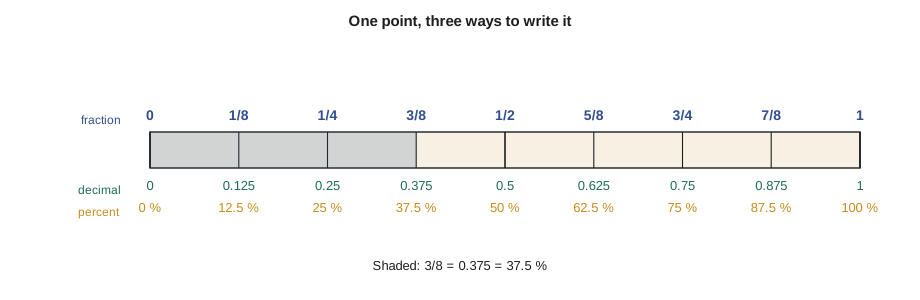
The same method works for any denominator. Carpenters doing finish work sometimes want thirty-seconds: multiply by 32. A machinist's drawing may want thousandths of an inch, which are already decimals. The key is to decide the precision you need first, then convert once.
Decimal feet and feet-inches
Surveyors, civil engineers and grade checkers in the United States often work in decimal feet. Elevations on site plans are usually given that way, for example 812.35 ft, and many grade rods are marked in tenths and hundredths of a foot rather than inches. That trips up new workers: 0.5 ft is 6 in, not 5 in, and 0.25 ft is 3 in.
To convert decimal feet to feet and inches, keep the whole feet, multiply the decimal part by 12 to get inches, then convert any decimal of an inch to sixteenths. To go the other way, divide the inches by 12 and add them to the feet.
Worked problem
Decimal feet to a tape reading
A benchmark elevation is 87.35 ft. Express the 0.35 ft part in inches to the nearest sixteenth.
Show solution
- \(0.35 \times 12 = 4.2\) in.
- \(0.2 \times 16 = 3.2\), which rounds to 3 sixteenths.
- So 0.35 ft is 4-3/16 in, and the elevation is 87 ft 4-3/16 in.
Answer: 87 ft 4-3/16 in.
Worked problem
Feet-inches to decimal feet
A pipe invert is 3 ft 8-1/2 in below a floor. Express it in decimal feet.
Show solution
- \(8\tfrac{1}{2} \div 12 = 8.5 \div 12 = 0.7083\) ft.
- So the depth is \(3.7083\) ft, about 3.71 ft.
Answer: About 3.71 ft.
| Inches | Decimal feet | Inches | Decimal feet |
|---|---|---|---|
| 1 | 0.083 | 7 | 0.583 |
| 2 | 0.167 | 8 | 0.667 |
| 3 | 0.25 | 9 | 0.75 |
| 4 | 0.333 | 10 | 0.833 |
| 5 | 0.417 | 11 | 0.917 |
| 6 | 0.5 | 12 | 1.0 |
A handy fact: 0.01 ft is 0.12 in, almost exactly 1/8 in. So when a grade sheet says the pipe must be within 0.02 ft, it means within about a quarter of an inch.
Percentages
Percent means per hundred. 25 percent is 25 per hundred, or 0.25, or 1/4. To change a percentage to a decimal, divide by 100 (move the point two places left): 12.5 percent is 0.125. To change a decimal to a percentage, multiply by 100: 0.02 is 2 percent.
Most job-site percentage problems are one of three kinds. Learn to recognize which one you have, and the arithmetic is straightforward.
| Question | Method | Example |
|---|---|---|
| What is P percent of a quantity? | Quantity x P / 100 | 15 percent of 240 m is 240 x 0.15 = 36 m |
| What percent is A of B? | A / B x 100 | 18 of 240 fittings is 18 / 240 x 100 = 7.5 percent |
| A quantity increases or decreases by P percent. What is the new amount? | Quantity x (1 + P / 100) or x (1 - P / 100) | 240 m plus 10 percent waste is 240 x 1.10 = 264 m |
Worked problem
Waste allowance
Maya's takeoff for one floor shows 186 m of 1/2 in copper. The company adds 10 percent for waste and offcuts. How much should be ordered, in 6 m lengths?
Show solution
- Add 10 percent: \(186 \times 1.10 = 204.6\) m.
- Number of lengths: \(204.6 \div 6 = 34.1\).
- Round up: 35 lengths.
Answer: 35 lengths of 6 m pipe. (On a US job using 20 ft lengths and a takeoff in feet, the method is the same.)
Worked problem
Percent change in price
A box of fittings was 48.00 last month and is 52.80 now. What is the percentage increase?
Show solution
- Change: \(52.80 - 48.00 = 4.80\).
- Percent of the original price: \(4.80 \div 48.00 \times 100 = 10\) percent.
Answer: A 10 percent increase. Always divide by the original amount, not the new one.
Two common traps: first, percentages of different bases do not simply add. A 10 percent increase followed by a 10 percent discount does not return to the original; it ends at 99 percent of it, because the discount applies to the larger amount. Second, a percentage of a percentage is easy to misstate: if a slope rises from 1 percent to 2 percent, it has gone up by one percentage point, which is a 100 percent increase in the slope.
Percent as a rate: slopes and fills
Slopes are often written as percentages. A 2 percent slope means the pipe or surface drops 2 units for every 100 units of horizontal distance, which is very close to 1/4 in per foot. Lesson 9 covers slopes fully; for now, notice that percent slope is just a percentage applied to a length. A 60 ft run at 2 percent drops \(60 \times 0.02 = 1.2\) ft, or about 14-3/8 in.
Percentages also describe how full something is. A storage tank gauge reading 65 percent on a 1,000 liter tank means about 650 liters remain. A concrete truck that is 80 percent loaded on an 8 m³ drum carries about 6.4 m³. The same multiplication applies in any unit.
Calculator habits
A calculator does not make mistakes in arithmetic, but it will faithfully calculate the wrong thing. Good habits catch those errors:
- Estimate first. Before pressing keys for 186 x 1.10, think: a bit more than 186, about 205. If the screen shows 2046, you missed the decimal point.
- Enter percentages as decimals (0.10) or use the percent key carefully; on some calculators the percent key behaves differently from others.
- Use the memory keys, or write intermediate answers down with their units, so you do not re-enter them wrong.
- Clear the calculator before starting a new problem.
- For long chains, do the calculation twice, ideally in a different order. If the answers agree, you can trust them.
Construction calculators that work directly in feet, inches and fractions, or in metric with automatic conversions, are popular in many trades and worth learning if your employer uses them. They remove some conversion steps, but you still need to know whether the answer makes sense.
Checking conversions in code
This program converts decimal feet to feet, inches and sixteenths, and back again. It is a model of the steps you do by hand.
from fractions import Fraction

def dec_ft_to_ft_in(ft):
    whole_ft = int(ft)
    inches = (ft - whole_ft) * 12
    sixteenths = round(inches * 16)
    whole_in, part = divmod(sixteenths, 16)
    if whole_in == 12:                 # rounding carried into the next foot
        whole_ft, whole_in = whole_ft + 1, 0
    frac = f"-{Fraction(part, 16)}" if part else ""
    return f"{whole_ft} ft {whole_in}{frac} in"

def ft_in_to_dec_ft(feet, inches, num=0, den=16):
    return feet + (inches + num / den) / 12

for e in [87.35, 3.7083, 0.99, 12.5]:
    print(f"{e:8.4f} ft -> {dec_ft_to_ft_in(e)}")
print(f"3 ft 8-1/2 in -> {ft_in_to_dec_ft(3, 8, 1, 2):.4f} ft")87.3500 ft -> 87 ft 4-3/16 in 3.7083 ft -> 3 ft 8-1/2 in 0.9900 ft -> 0 ft 11-7/8 in 12.5000 ft -> 12 ft 6 in 3 ft 8-1/2 in -> 3.7083 ft
Look at 0.99 ft: it is 11.88 in, which rounds to 11-7/8 in. The program also handles the case where rounding pushes the inches up to 12 and carries a foot, a step that is easy to forget by hand.
Rounding for cutting versus rounding for ordering
The same number can be rounded two different ways depending on what it is for, and choosing the wrong way is one of the most common sources of shortfalls on site. Luis puts it simply: round to the tape when you cut, round up when you buy.
- When you cut, round to the nearest mark you can actually read and hit: the nearest sixteenth of an inch or the nearest millimeter. Rounding a cut length up or down by half a mark either way is normal.
- When you order or count material, always round up to a whole unit. If a calculation says 7.2 lengths of pipe, 7 lengths will not do the job; you need 8. If concrete works out to 4.31 cubic units, you order the next increment the supplier sells.
- When you check against a limit, such as a maximum hanger spacing or a minimum slope, round in the safe direction. A spacing limit is met by rounding the number of hangers up, which makes the spacing smaller.
Worked problem
Two kinds of rounding in one job
Maya needs 136.4 ft of 3/4 in copper for a run of branches. Copper comes in 20 ft lengths. She also needs to cut one branch at 7.94 ft. How many lengths does she order, and what does she write on the cut list?
Show solution
- Order: \(136.4 \div 20 = 6.82\) lengths. Round up to 7, then add one for waste and offcuts: 8 lengths.
- Cut: 7.94 ft is 7 ft plus \(0.94 \times 12 = 11.28\) in. \(0.28 \times 16 = 4.5\), so 11-5/16 in to the nearest sixteenth (rounding the half up).
- She writes 7 ft 11-5/16 in.
Answer: Order 8 lengths; cut 7 ft 11-5/16 in.
Percent change: increases, decreases and markups
Percent change compares a new amount with an original amount. The rule is always to divide by the original, not by the new value.
If the price of a box of fittings goes from 80 to 92, the change is 12, and 12 divided by 80 is 0.15, an increase of 15 percent. If it then drops back from 92 to 80, the decrease is 12 divided by 92, about 13 percent. The same 12 is a different percentage because the starting point changed. This is why a 10 percent increase followed by a 10 percent decrease does not get you back where you started: 100 becomes 110, then 99.
Contractors use the same arithmetic for markup. A supplier's price multiplied by 1.15 adds a 15 percent markup. An apprentice who understands that multiplying by 1.15 and adding 15 percent are the same thing can check a quote or an invoice in a few seconds.
Common mistakes
MistakeReading decimal feet as feet and inches, such as treating 4.5 ft as 4 ft 5 in.
InsteadMultiply the decimal part by 12: 0.5 ft is 6 in.
MistakeRounding material quantities to the nearest unit instead of up.
InsteadAlways round purchases up to the next whole unit or package.
MistakeDividing by the new amount when finding a percent change.
InsteadDivide the change by the original amount.
MistakeRounding each step of a long calculation.
InsteadCarry full precision and round only the final answer.
MistakeAdding percentages that apply to different amounts.
InsteadApply each percentage in turn to the current amount.
Summary and key terms
- A decimal is a fraction with a denominator of 10, 100 or 1,000; place value helps judge size.
- Convert a decimal of an inch to sixteenths by multiplying by 16 and rounding.
- Decimal feet are tenths and hundredths of a foot; multiply the decimal part by 12 to get inches.
- Percent means per hundred; the three common problems are part of, what percent, and increase or decrease.
- Round cut dimensions to tool precision and material quantities up to whole units.
- Estimate before using the calculator, and check long calculations twice.
- Decimal foot
- A foot divided into tenths and hundredths rather than inches.
- Percent
- Parts per hundred.
- Percentage point
- The arithmetic difference between two percentages.
- Waste allowance
- An extra percentage of material ordered to cover offcuts, damage and errors.
- Rounding up
- Increasing a quantity to the next whole unit, always used for purchases.
- Place value
- The value of a digit based on its position relative to the decimal point.
Practice problems
Work each problem on paper first, then reveal the answer to check.
Convert 0.4375 in to a fraction.
Show answer
0.4375 x 16 = 7, so 7/16 in.
Convert 6.75 ft to feet and inches.
Show answer
0.75 x 12 = 9, so 6 ft 9 in.
What is 12.5 percent of 320?
Show answer
320 x 0.125 = 40.
A crew installed 54 of 72 fixtures. What percent is done?
Show answer
54 / 72 x 100 = 75 percent.
A quote of 2,400 rises by 4 percent. What is the new price?
Show answer
2,400 x 1.04 = 2,496.
Convert 2 ft 3-3/4 in to decimal feet.
Show answer
3.75 / 12 = 0.3125, so 2.3125 ft.
Lesson quiz · 5 questions
Score 60% or more to complete this lesson.
Create a free account to save your progress, take quizzes and earn a certificate.