
SMW-210 · Lesson 10 of 12 · 18 min
Boots, tees and branch fittings by triangulation
Every duct system ends at outlets and splits at branches, and the fittings at those points are where triangulation earns its place in everyday shop work. A register boot changes a round branch into the rectangular neck of a diffuser or grille. A boot tee, or shoe, takes a branch off the side of a main with a tapered entry that turns the air smoothly. A Y-branch or breeches splits one duct into two. Most of these fittings combine a change of shape with a change of direction, and few of them have parallel element lines or a single apex. This lesson develops a register boot for the Ashgrove classrooms in full, then shows how the same method handles branch fittings.
The classroom register boots
Each Ashgrove classroom had four new ceiling diffusers fed from the 10 in branch ducts. Two of the rooms, under a low section of roof, had no room for a round duct to drop straight into a round diffuser, so Lin specified rectangular sidewall grilles fed by register boots. Each boot was a transition from a 6 in round duct coming down from above to a 12 by 6 in rectangular neck at the grille, 8 in high. Kai was given the pattern and a run of twelve boots.
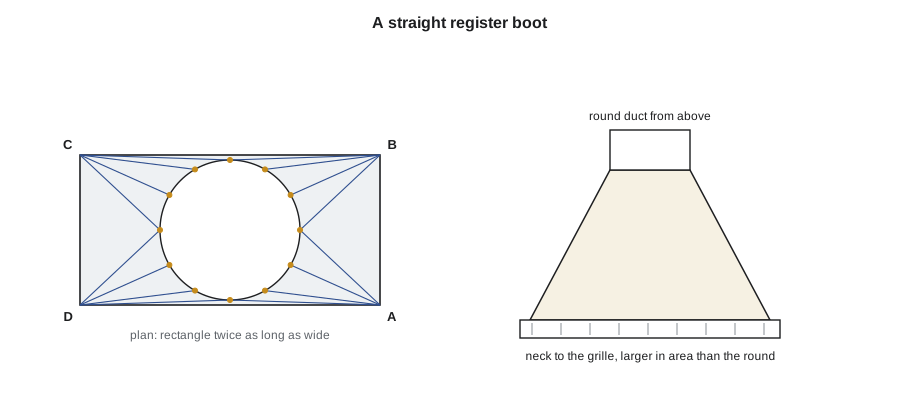
A straight register boot of this kind is a rectangle-to-round transition, the same family as the square-to-round in Lesson 6. Because the rectangle is twice as long as it is wide, the corner fans are no longer alike on all sides, and the flat triangles on the long sides differ from those on the short sides. With the round centerd over the rectangle, the fitting is still symmetrical in both directions, so one quarter of it gives all the lengths.
A rectangle-to-round
The plan shows the rectangle with its corners lettered and the circle divided into 12 equal spaces, numbered from the middle of a long side so that point 1 sits over the middle of side D-A. Each corner fans to its quarter of the circle, four lines per corner as before. The flat triangles on the two long sides run from the side up to the round point over its middle, and those on the two short sides run up to the round point over theirs. Because the round is small compared with the rectangle, the flat triangles on the long sides are wide and low; those on the short sides are narrow.
The script below works out the plan length and true length of each line from corner A to its four round points. The other three corners repeat them in mirror image. It also compares the free area of the rectangle with that of the round, a check that matters for air flow.
# Rectangular-to-round register boot: true lengths and a free-area check
import math
W, Dp, Dr, H = 12, 6, 6, 8          # in     # rectangle length and width, round diameter, height
r = Dr / 2
A, B = (W/2, -Dp/2, 0), (W/2, Dp/2, 0)          # one long-side pair of corners
rp = [(r*math.cos(math.radians(30*k - 90)), r*math.sin(math.radians(30*k - 90)), H) for k in range(7)]
for k in range(4):
    print(f"A-{k+1}: plan {math.hypot(A[0]-rp[k][0], A[1]-rp[k][1]):.2f}, true {math.dist(A, rp[k]):.2f} in")
rect_area = W * Dp
round_area = math.pi * r * r
print(f"rectangle {rect_area:.1f} sq in, round {round_area:.1f} sq in, ratio {rect_area / round_area:.2f}")A-1: plan 6.00, true 10.00 in A-2: plan 4.52, true 9.19 in A-3: plan 3.72, true 8.82 in A-4: plan 4.24, true 9.06 in rectangle 72.0 sq in, round 28.3 sq in, ratio 2.55
The four lines from corner A came out at about 10, 9 3/16, 8 13/16 and 9 1/16 in. The rectangle's area is about 2.5 times the round's, which is normal for a boot: the grille neck is larger than the duct so that the air slows down before it leaves through the grille, reducing noise and spreading the throw. A boot whose rectangle was smaller in area than its round would speed the air up and make the grille whistle.
The half pattern is built from the flat triangle on one long side outward, exactly as in Lesson 6, and the seams go up the middle of the two short-side flat triangles, where the triangles are narrow and the seam line short. The rectangular end is drawn with straight lines and the round end with a batten. On boots this small, Keelson's practice was a one-piece pattern with a single seam on one short side, which was quicker to form; the method of development is the same.
Angled and end boots
Not every boot is straight. Where a duct runs horizontally above a ceiling and must turn down into a grille, the boot often turns through 90 degrees as it changes from round to rectangular: an angle boot or end boot. The round end is then vertical, square to the duct, and the rectangular end horizontal at the grille. The two ends are not parallel, so the fitting is oblique, and each line has its own rise, as Lesson 7 described. The round end must be divided in its own true view, a full circle drawn square to the duct, and the points projected into the plan and elevation.
Angle boots are developed in two parts on most patterns: a back that is often flat or simply curved, and a front that carries the transition. Layout people break the fitting into pieces that are each easy to form, with seams placed where the shape changes. Many residential and light commercial boots are bought from fitting suppliers in standard sizes; the hand method is for the odd sizes and for checking.
Boot tees and shoe taps
A branch taken off the side of a main with a plain straight collar loses a good deal of pressure, because the air has to turn sharply into it. A boot tee, also called a shoe tap or a 45-degree entry tap, gives the air a tapered entry: the branch's collar is extended on its upstream side into a sloping lip, so the opening into the main is longer than the branch and the air turns into it more gradually. Duct design guides show significantly lower losses for tapered and 45-degree entry taps than for straight taps, and many specifications require them on supply branches.
A rectangular-to-round boot tee taking off a rectangular main is a small transition with one end, the opening in the main, a rectangle lying flat in the main's side, and the other end the round branch collar. Its shoe, the sloping upstream face, makes the rectangle longer on the upstream side. It is developed by triangulation from the rectangle's corners to the round's divisions, just like the register boot, but with the round set off toward the downstream end and tilted if the branch leaves at an angle. In practice, most shops use standard boot tees and spin-in fittings from suppliers or from their own plasma table; Kai developed one by hand as an exercise to understand the shape.
Y-branches and breeches
A Y-branch splits one duct into two at an angle, or joins two into one. In round duct, SMW-120 treated it as two laterals, developed by parallel lines from pipes and their intersections. A breeches is a Y in which both legs change shape or direction, such as a rectangular main splitting into two round ducts, or a round duct splitting into two smaller rounds that diverge, as at a two-way fan discharge. Breeches are usually triangulated, because their legs are transitions and their crotch, where the two legs meet, is a line that has to be found first.
The approach is to treat each leg as a separate transition from its share of the main to its own outlet. The crotch line, where the legs meet, is drawn in the plan and elevation along the plane of symmetry between them, and each leg is developed by triangulation from its part of the main's end, along the crotch, to its outlet. The crotch line is then the edge where the two leg patterns are joined, so the two patterns must have exactly matching edges along it. On a symmetrical breeches, the two legs are mirror images.
The crotch is the hardest part of a breeches to make tight and smooth. Air divides there, so a sharp, clean crotch with a splitter or a radius gives the best flow; a rough crotch makes turbulence and noise. Keelson's breeches for the Ashgrove library supply were split by a flat splitter plate along the crotch, which also stiffened the joint.
Conical tees
A conical tee, sometimes called a conical branch or spin-in fitting in its smaller sizes, is a branch that flares out where it meets the main, like a short reducer set into the main's side. It gives a gentler entry than a straight tee for round branches. If its cone is a right cone meeting a round main at right angles, its pattern is a cone cut by a cylinder, from Lesson 4: the line of intersection is found by cutting planes and the cone is developed to it by radial lines. Spin-in fittings for round branches off rectangular duct are flat-based cones and develop like a frustum with a flange. The main's hole is developed from the same intersection.
Planning branch fittings in the shop
Branch fittings are where the shop drawing, the pattern and the field have to agree most closely. A boot or tap in the wrong position or at the wrong angle puts a branch in the wrong place, and fixing it means cutting a new hole in the main. Kai learned three habits from Lin on branch fittings: confirm the branch location on the shop drawing against the architectural ceiling plan, check that the fitting's outlet size matches the grille or diffuser it feeds, and mark the main's center line and the branch's direction on both the fitting and the main before they leave the shop.
Developing a boot tee
A rectangular-to-round boot tee taking a round branch off a rectangular main can be developed with the same tools as the register boot. The opening in the main's side is a rectangle whose upstream edge is pushed out by the shoe, so in the plan the rectangle is longer than the branch diameter on its upstream side and about equal to it on its downstream side. The round branch collar sits over the downstream part of the rectangle. The corners on the downstream side fan to the round with short lines; the corners on the upstream side fan with long, shallow lines, and the flat triangle on the upstream side becomes the sloping shoe. In other words, a boot tee is an offset rectangle-to-round, from Lesson 7, with its round end shifted toward the downstream side. The pattern is built in order from the downstream flat triangle out to a seam on the shoe, and it is checked like any other: the rectangular edge must equal the opening's perimeter, which is also the length of the flange that will be turned to fasten it to the main.
Kai's exercise boot tee for the Ashgrove library branch, a round branch off a rectangular main with a shoe one branch diameter long, took him about an hour by hand, against a few minutes on the plasma table's software. The exercise was worth it, Aggie said, because the next time the table cut a boot tee with its shoe on the wrong side, he would know at a glance.
Common mistakes
MistakeMaking a boot whose rectangle is smaller in area than its round.
InsteadSize the neck larger than the duct, typically two or more times its area, so air slows before the grille.
MistakeTreating an angle boot as if its ends were parallel.
InsteadIts ends are square to each other; give each line its own rise and divide the round in its true view.
MistakeUsing a straight tap where the specification calls for a boot tee.
InsteadUse the tapered entry; it turns the air more gently and loses less pressure.
MistakeDeveloping breeches legs with edges that do not match along the crotch.
InsteadDraw the crotch line first and develop both legs to it, so their edges match.
MistakeSending branch fittings out without location marks.
InsteadMark the main's center line and the branch direction on both parts.
Summary and key terms
- A straight register boot is a rectangle-to-round transition, developed like a square-to-round but with different fans and triangles on long and short sides.
- Boots usually have a neck larger in area than the duct, so the air slows before the grille.
- Angle boots have non-parallel ends, so each line needs its own rise and the round is divided in its true view.
- Boot tees and 45-degree entry taps give the air a gradual turn into a branch and lose less pressure than straight taps.
- Breeches are developed leg by leg to a crotch line found first, so the legs' edges match.
- Conical tees are cones cut by the main, developed by radial lines to the line of intersection.
- Register boot
- A fitting that changes a round duct into the rectangular neck of a grille or register.
- Angle boot
- A boot that turns through an angle as it changes shape, with non-parallel ends.
- Boot tee
- A branch fitting with a sloped shoe on its upstream side, also called a shoe tap.
- Breeches
- A Y-shaped fitting splitting one duct into two, with legs that change shape or direction.
- Crotch
- The line where the two legs of a breeches or Y-branch meet.
- Conical tee
- A round branch that flares where it meets the main.
- Free area
- The open cross-sectional area through which air passes.
Practice problems
Work each problem on paper first, then reveal the answer to check.
A boot has a 10 by 5 in neck and a 5 in round. What is the ratio of neck area to round area?
Show answer
50 over about 19.6, about 2.5.
Why are the seams of a two-piece register boot put on the short sides?
Show answer
The short-side flat triangles are narrow, so the seam lines are short.
What does the shoe on a boot tee do?
Show answer
It lengthens the opening on the upstream side so air turns into the branch gradually.
What must be found first when developing a breeches?
Show answer
The crotch line where the two legs meet.
Lesson quiz · 5 questions
Score 60% or more to complete this lesson.
Create a free account to save your progress, take quizzes and earn a certificate.