
SLS-253 · Lesson 2 of 12 · 25 min
Markup
▶ Video coming soon A video version of this lesson is on the way.
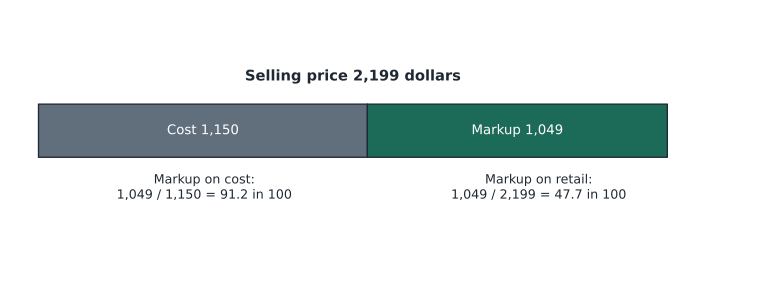
At the second numbers morning, on September 21, 2026, Bev brought a sofa invoice. Juniper & Pine had paid the manufacturer 1,150 dollars for a three-seat sofa in a performance fabric, and the sofa was ticketed on the floor at 2,199 dollars. She asked the group what the store's markup was. Aiden said about 91 in 100. Noura said about 48 in 100. Both were right, and that was the point of the lesson. "Markup is the most common number in retail," Bev said, "and half the arguments about it happen because two people are using different bases."
What markup is
Markup is the difference between what a retailer pays for an item and the price it charges. In dollars, the sofa's markup is 2,199 − 1,150 = 1,049 dollars. That amount has to cover the store's share of rent, wages, delivery, advertising and every other operating cost, plus any markdowns and losses, before any profit is left.
Markup is usually expressed as a percentage, and here the trouble starts. It can be calculated on two different bases.
- Markup on cost divides the markup dollars by the cost. It answers the question: by how much did we raise the price above what we paid?
- Markup on retail divides the markup dollars by the selling price. It answers the question: what share of the selling price is markup?
Most retailers, and almost all retail planning systems, express markup on retail. The reason is practical: sales, expenses, markdowns and profit are all measured as a share of sales, so a markup expressed as a share of the selling price can be compared directly with them. Manufacturers, wholesalers and some small businesses often speak of markup on cost. When someone quotes a markup, ask which base they mean.
Worked problem
Markup on two bases
Juniper & Pine pays 1,150 dollars for a sofa and tickets it at 2,199 dollars. Find the markup in dollars, the markup on cost and the markup on retail.
Show solution
- Markup = 2,199 − 1,150 = 1,049 dollars.
- \[\text{Markup on cost} = \frac{1{,}049}{1{,}150} \approx 0.912\]
- \[\text{Markup on retail} = \frac{1{,}049}{2{,}199} \approx 0.477\]
Answer: The markup is 1,049 dollars: about 91.2 in 100 on cost, or about 47.7 in 100 on retail. Aiden used cost as the base; Noura used retail.
Converting between the two
Because the two percentages describe the same dollars on different bases, one can be converted into the other without knowing the actual prices. If m_c is the markup on cost and m_r is the markup on retail, written as decimals:
Markup on retail is always smaller than markup on cost for the same item, and it can never reach 100 in 100, because the markup can never be larger than the selling price. Markup on cost has no upper limit: an item that costs 5 dollars and sells for 50 has a markup on cost of 900 in 100, but a markup on retail of 90 in 100.
| Markup on cost | Markup on retail | Common name |
|---|---|---|
| 25 in 100 | 20 in 100 | |
| 50 in 100 | about 33.3 in 100 | |
| 75 in 100 | about 42.9 in 100 | |
| 100 in 100 | 50 in 100 | Keystone (price is double the cost) |
| 150 in 100 | 60 in 100 | |
| 200 in 100 | about 66.7 in 100 | Triple keystone in some trades |
The term keystone comes from the traditional practice of doubling the cost to set the price, which gives a markup of 100 in 100 on cost and 50 in 100 on retail. Keystone pricing is still common in furniture, jewelry, gifts and apparel, though many retailers now set markups category by category rather than applying one rule to everything.
Setting a price from a target markup
Buyers usually work the other way round: they know the cost and the markup the department needs, and they want the selling price. With a target markup on retail m_r, the retail price is the cost divided by one minus the markup. A common mistake is to multiply the cost by one plus the markup on retail, which gives the right answer only if the markup is on cost.
Worked problem
Pricing a recliner
A power recliner costs Juniper & Pine 640 dollars. The upholstery department's target initial markup is 52 in 100 on retail. What price gives exactly that markup? The department uses price points ending in 49 or 99. Which point should the buyer choose, and what markup does it give?
Show solution
- \[\text{Retail} = \frac{640}{1 - 0.52} = \frac{640}{0.48} \approx 1{,}333.33\]
- The nearest price points are 1,299 and 1,349 dollars. 1,299 is below the price needed for the target, so the buyer chooses 1,349.
- \[\text{Markup on retail} = \frac{1{,}349 - 640}{1{,}349} = \frac{709}{1{,}349} \approx 0.526\]
- Check the wrong method: 640 × 1.52 = 972.80 dollars, which gives a markup on retail of only 332.80 ÷ 972.80, about 34.2 in 100.
Answer: The exact price would be 1,333.33 dollars; the buyer tickets it at 1,349 dollars, a markup of about 52.6 in 100 on retail. Multiplying the cost by 1.52 would have priced it at 972.80 dollars and fallen far short of the target.
What goes into cost
The cost in a markup calculation should be the full cost of getting the item onto the floor, often called landed cost. It starts with the invoice price, adds inbound freight and any duties or brokerage on imported goods, and subtracts trade discounts and rebates the supplier gives. Furniture often needs assembly or inspection before it can be sold, and some retailers add that workroom cost too. Leaving costs out makes the markup look better than it is.
Imported goods add another layer. A US retailer importing furniture pays any customs duties and tariffs on the goods, which depend on the tariff classification and country of origin and have changed often in recent years, plus customs brokerage fees. Those costs belong in landed cost.
Worked problem
Freight and the appliance markup
A refrigerator has an invoice cost of 1,420 dollars and costs 45 dollars per unit to ship to the store. It is ticketed at 1,899 dollars. Find the markup on retail with and without freight.
Show solution
- Without freight: (1,899 − 1,420) ÷ 1,899 = 479 ÷ 1,899 ≈ 0.252.
- Landed cost = 1,420 + 45 = 1,465 dollars.
- With freight: (1,899 − 1,465) ÷ 1,899 = 434 ÷ 1,899 ≈ 0.229.
Answer: Freight lowers the true markup from about 25.2 to about 22.9 in 100 on retail. On a low-markup category like appliances, ignoring freight overstates the markup noticeably.
Markup on a whole purchase
Retailers rarely look at markup only one item at a time. A buyer placing an order for a department wants to know the markup on the whole purchase, because some items will carry higher markups than others. The markup on a group of items is the total markup dollars divided by the total retail value, which is not the same as the average of the individual markup percentages. Items with larger retail values carry more weight.
Worked problem
Cumulative markup on a décor order
Noura orders three décor items for the fall: 40 lamps at a cost of 38 dollars and a retail price of 89 dollars, 12 accent tables at 210 dollars cost and 449 dollars retail, and 20 area rugs at 120 dollars cost and 279 dollars retail. What is the markup on retail for the whole order?
Show solution
- Total cost = 40 × 38 + 12 × 210 + 20 × 120 = 1,520 + 2,520 + 2,400 = 6,440 dollars.
- Total retail = 40 × 89 + 12 × 449 + 20 × 279 = 3,560 + 5,388 + 5,580 = 14,528 dollars.
- \[\text{Markup on retail} = \frac{14{,}528 - 6{,}440}{14{,}528} = \frac{8{,}088}{14{,}528} \approx 0.557\]
Answer: The order carries a markup of about 55.7 in 100 on retail. The individual items range from about 53.2 in 100 (accent tables) to about 57.3 in 100 (lamps), but the total must be calculated from the dollars, not by averaging the three percentages.
Retailers use the term initial markup for the markup when goods are first ticketed, and cumulative markup for the markup on all goods handled in a period, including the opening inventory and everything received since. Later, after markdowns, shrink and discounts, the markup actually achieved is called maintained markup. Lesson 3 explains how markdowns reduce initial markup to maintained markup, and lesson 4 connects maintained markup to gross margin.
How high should the markup be?
A department's initial markup has to be high enough to cover its operating expenses, the profit the business wants and all the reductions that will happen before the goods are sold: markdowns, employee discounts and shrink. Retail planners use a standard formula for the required initial markup, with every item expressed either in dollars or as a share of planned net sales.
Reductions appear on the bottom as well as the top because the goods are first ticketed at prices that include the reductions still to come. A store that expects to mark down 8 in 100 of its sales has to ticket more than 100 dollars of merchandise for every 100 dollars it eventually collects.
Worked problem
The markup a department needs
For spring 2027, the case goods department plans operating expenses of 35 in 100 of net sales and a profit of 6 in 100. It expects markdowns, employee discounts and shrink to total 9 in 100 of net sales. What initial markup on retail does it need?
Show solution
- Work in units of net sales: expenses 35, profit 6, reductions 9, net sales 100.
- \[\text{Initial markup} = \frac{35 + 6 + 9}{100 + 9} = \frac{50}{109} \approx 0.459\]
Answer: The department needs an initial markup of about 45.9 in 100 on retail. A buyer who tickets the goods at a lower markup will not reach the profit target unless reductions or expenses also come in lower.
This is a planning figure, not a rule for every item. Some items will be ticketed above it and some below. Opening price points, such as a 499-dollar sofa that brings shoppers into the store, often carry lower markups, and accessories and protection plans carry higher ones. What matters is that the department as a whole reaches its target.
Markup and competition
Markup is set by more than arithmetic. A store cannot charge 2,199 dollars for a sofa that a competitor sells for 1,599 dollars, however much margin it needs. Appliances are a clear example: many models are sold by several retailers in the same city, manufacturers publish advertised price guidance, and shoppers compare prices on their phones in the aisle. That competition keeps appliance markups low, around 20 to 25 in 100 on retail at Juniper & Pine. Furniture made exclusively for the store, mattresses sold under the store's own label and décor that customers cannot easily compare carry much higher markups. Lesson 11 returns to how stores set prices when competition and arithmetic point in different directions.
Carl Jensen summed up the appliance problem for Aiden after the session. "You can sell a 1,900-dollar fridge and make less for the store than the person who sold three lamps and a rug," he said. "That's why the delivery fee, the haul-away and the protection plan matter so much in my department."
Common mistakes
MistakeQuoting a markup without saying whether it is on cost or on retail.
InsteadState the base every time; most retailers use retail.
MistakePricing by multiplying cost by one plus the markup on retail.
InsteadDivide cost by one minus the markup on retail.
MistakeLeaving freight, duties or workroom costs out of cost.
InsteadUse landed cost, net of supplier discounts.
MistakeAveraging the markup percentages of several items.
InsteadAdd the markup dollars and divide by the total retail value.
MistakeSetting the initial markup without allowing for markdowns and shrink.
InsteadInclude planned reductions in the initial markup calculation.
Summary and key terms
- Markup is the difference between selling price and cost.
- Markup on cost divides it by cost; markup on retail divides it by the selling price, and is the base most retailers use.
- To convert, m_r = m_c ÷ (1 + m_c) and m_c = m_r ÷ (1 − m_r); keystone is 100 in 100 on cost or 50 in 100 on retail.
- To price from a target markup on retail, divide cost by one minus the markup.
- Cost should be landed cost, including freight and duties and net of supplier discounts.
- The markup on a group of items is total markup dollars divided by total retail, not an average of percentages.
- Initial markup is the markup when goods are first ticketed; maintained markup is what is left after reductions.
- The initial markup a department needs equals expenses plus profit plus reductions, divided by net sales plus reductions.
- Competition limits markup in categories that shoppers can compare easily, such as appliances.
- Markup
- Selling price minus cost.
- Markup on cost
- Markup divided by cost.
- Markup on retail
- Markup divided by selling price.
- Keystone
- A price that is double the cost: 100 in 100 on cost, 50 in 100 on retail.
- Landed cost
- Invoice cost plus freight, duties and similar costs, less supplier discounts.
- Initial markup
- The markup when goods are first ticketed.
- Cumulative markup
- The markup on all goods handled in a period, including opening inventory and receipts.
- Maintained markup
- The markup actually achieved after markdowns, shrink and discounts.
Practice problems
Work each problem on paper first, then reveal the answer to check.
A lamp costs 30 dollars and sells for 75 dollars. What are its markups on cost and on retail?
Show answer
Markup = 45 dollars; on cost 45 ÷ 30 = 1.50 (150 in 100); on retail 45 ÷ 75 = 0.60 (60 in 100).
A bed frame costs 420 dollars. At a markup of 48 in 100 on retail, what price should it carry?
Show answer
420 ÷ 0.52 ≈ 807.69 dollars.
A department plans expenses of 32, profit of 5 and reductions of 7, all in 100 of net sales. What initial markup does it need?
Show answer
(32 + 5 + 7) ÷ (100 + 7) = 44 ÷ 107 ≈ 0.411, or about 41.1 in 100.
Lesson quiz · 5 questions
Score 60% or more to complete this lesson.
Create a free account to save your progress, take quizzes and earn a certificate.