
SLS-253 · Lesson 11 of 12 · 20 min
Pricing strategy in stores
▶ Video coming soon A video version of this lesson is on the way.
On Thursday, November 12, 2026, Bev, Carl and Tessa met with Noura to settle prices for the spring assortment. Lesson 2 had shown how to set a price from a cost and a target markup. Carl started by pointing out that he had never sold a single appliance at a price set that way. "The manufacturer tells us the advertised price, three other stores in town sell the same model, and the customer has all of their prices on a phone," he said. "Markup is what's left over." Noura's furniture, much of it made for Juniper & Pine alone, was the opposite case: no shopper could find the same sofa across the street. Bev wanted both of them to leave with a clear view of how a store sets prices when arithmetic, competition and customers pull in different directions.
Three starting points for a price
Retailers usually begin from one of three places, and good pricing considers all three.
- Cost-based pricing starts from what the item costs and adds the markup the department needs, as lesson 2 showed. It guarantees the margin if the item sells at that price, but it ignores what customers will pay and what competitors charge.
- Competition-based pricing starts from what other stores charge for the same or a similar item. It is essential for products that shoppers can compare easily, such as appliances, mattresses from national brands and electronics.
- Value-based pricing starts from what the item is worth to the customer: its quality, design, features, service and the store's reputation. It suits exclusive products, store brands and goods that come with service such as delivery, set-up and warranties.
Juniper & Pine uses all three. Appliances are priced mainly against competitors and manufacturer guidance. Store-label mattresses and exclusive furniture are priced on value, with cost-based markup as a floor. Décor sits in between: some items are easy to compare and some are unique.
Price points and price endings
Retailers rarely charge whatever price the arithmetic produces. They choose from a set of price points, such as prices ending in 99 or 49, and they space their price lines so that customers can see the difference between them. Lesson 2's recliner, priced at 1,333.33 dollars by the arithmetic, was ticketed at 1,349 dollars for this reason.
Prices ending in 9, sometimes called charm prices, are one of the most studied practices in retail. Field experiments, including a well-known study of mail-order catalog prices by Eric Anderson and Duncan Simester published in 2003, found that ending a price in 9 raised demand compared with nearby prices ending in other digits. The usual explanation is that shoppers read prices from left to right and pay most attention to the first digit, so 1,799 feels closer to 1,700 than to 1,800. The effect is not universal. It seems weaker when customers already know the price well or when the store wants to signal quality, which is one reason luxury retailers often use round prices. Juniper & Pine uses prices ending in 99 for most goods and round prices for a few premium lines.
Everyday low prices and high-low pricing
Stores choose between two broad pricing strategies.
- Everyday low pricing (EDLP) keeps prices steady at a level close to competitors' sale prices, with few promotions. It builds trust, simplifies operations and avoids the cost of frequent markdowns, but it gives the store fewer reasons to advertise and fewer "events" to bring shoppers in.
- High-low pricing sets regular prices higher and runs frequent promotions with substantial discounts. It creates urgency and excitement and lets the store reach both full-price and bargain-seeking customers, but it trains some customers to wait for the sale and makes the regular price less credible.
Most furniture and appliance retailers use a mix. Juniper & Pine follows something close to EDLP on core furniture and mattresses, with a few planned promotional weekends a year (Labor Day, the holiday season and a spring event), and follows the manufacturers' promotional calendar on appliances. Lesson 3 showed what the Labor Day sale cost. The question for each promotion is whether it earns more than it costs, using the break-even volume from lesson 4.
Price elasticity: how much will a price change move sales?
The effect of a price change on unit sales is measured by price elasticity of demand: the percentage change in quantity divided by the percentage change in price. An elasticity of −2 means a 1 in 100 cut in price raises unit sales by about 2 in 100. Demand is called elastic when the elasticity is more negative than −1, so that a price cut raises total revenue, and inelastic when it is between 0 and −1.
Revenue is not the same as margin. Even when a price cut raises revenue, it can lower gross margin, because every extra unit costs the store money. Retail pricing decisions should be judged on margin dollars.
Worked problem
A spring price test on a sofa
In a four-week test in spring 2026, Noura lowered the price of a better-line sofa from 1,799 dollars to 1,649 dollars. Weekly sales rose from an average of 10 to 12 units. The sofa costs 940 dollars. Estimate the price elasticity, and compare weekly gross margin before and during the test.
Show solution
- Percentage change in price = (1,649 − 1,799) ÷ 1,799 ≈ −0.0834, a cut of about 8.3 in 100.
- Percentage change in quantity = (12 − 10) ÷ 10 = 0.20, a rise of 20 in 100.
- \[\text{Elasticity} \approx \frac{0.20}{-0.0834} \approx -2.4\]
- Weekly margin before = (1,799 − 940) × 10 = 8,590 dollars.
- Weekly margin during = (1,649 − 940) × 12 = 8,508 dollars.
Answer: Demand was elastic, at about −2.4, so revenue rose, from 17,990 to 19,788 dollars a week. But weekly gross margin fell slightly, from 8,590 to 8,508 dollars. The lower price sold more sofas without making more money, and it used more stock and delivery capacity, so Noura returned the price to 1,799 dollars.
Elasticity estimates from store tests are rough. A four-week test is short, other things change at the same time (weather, advertising, a competitor's sale), and customers who buy during a price cut may simply have bought earlier than they would have. Treat a single test as evidence, not proof.
Pricing against competitors
For comparable goods, a store must know what competitors charge. Juniper & Pine checks the advertised prices of its top 50 appliance models every week, and its key furniture and mattress competitors' flyers and websites every month. It does not try to be the lowest on everything. It aims to match the market on the items shoppers compare most, the known-value items, and to earn its margin on service, delivery, exclusive products and the goods customers cannot compare.
Its price-match policy, described in the negotiation course, puts that strategy into practice: the store matches an identical model, in stock at a local competitor, at the competitor's current advertised price, and excludes open-box items, clearance, financing offers and online marketplace sellers. The policy reassures customers that they will not overpay on comparable goods, while keeping the cost limited, because only a small share of customers ask.
Manufacturers often publish a suggested retail price and, for many appliances and branded mattresses, a minimum advertised price (MAP) policy, which sets the lowest price a retailer may advertise if it wants to keep receiving promotional support. In the US, a manufacturer may generally announce such a policy and decline to deal with retailers that do not follow it, if it acts on its own. Agreements between a manufacturer and a retailer on minimum resale prices are judged under the federal rule of reason since the Supreme Court's 2007 Leegin decision, though some states treat them more strictly. Retailers remain free to set their own selling price, even where an advertising policy limits the price they show in ads.
Bundles and package prices
A bundle is a group of products sold together at a single price, usually lower than the sum of the separate prices. Juniper & Pine offers a package price when a customer buys four or more major appliances, 5 in 100 below the total of the separate prices. Bundles can raise the average sale and help win the customer's whole kitchen rather than one or two appliances. They also give away margin on items the customer might have bought at full price anyway. Whether a bundle pays depends on what the customer would have bought without it.
Worked problem
The four-appliance package
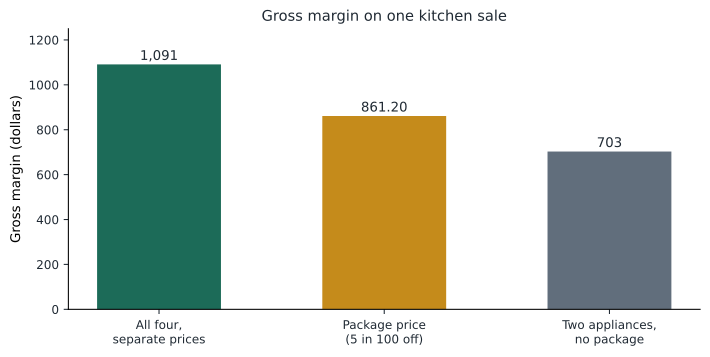
A customer is shopping for a kitchen. The separate prices are a refrigerator 1,899 dollars, a range 1,099 dollars, a dishwasher 899 dollars and a microwave 699 dollars. The store's costs are 1,465, 830, 690 and 520 dollars. The package price is 5 in 100 below the separate total. Compare the store's gross margin if the customer buys all four separately, buys the package, or (without the package) buys only the refrigerator and range.
Show solution
- Separate total = 1,899 + 1,099 + 899 + 699 = 4,596 dollars; total cost = 1,465 + 830 + 690 + 520 = 3,505 dollars.
- All four at separate prices: margin = 4,596 − 3,505 = 1,091 dollars.
- Package price = 4,596 × 0.95 = 4,366.20 dollars; margin = 4,366.20 − 3,505 = 861.20 dollars.
- Refrigerator and range only: margin = (1,899 − 1,465) + (1,099 − 830) = 434 + 269 = 703 dollars.
Answer: If the package wins the whole kitchen from a customer who would otherwise have bought two appliances here, it earns 861.20 dollars instead of 703, a gain of 158.20 dollars. If the customer would have bought all four anyway, the package gives away 229.80 dollars. The package is worth offering to customers deciding where to buy the rest of the kitchen, not to every customer automatically.
Showing prices honestly
Pricing strategy has legal limits. The FTC Act prohibits deceptive pricing, and the FTC's 2025 rule on unfair or deceptive fees requires the total price, including mandatory fees, to be shown up front for live-event tickets and short-term lodging. That rule does not cover furniture stores, but advertising a price that cannot actually be obtained because of hidden mandatory charges can still be deceptive under the FTC Act and state law. Juniper & Pine shows its delivery fee separately because delivery is optional: customers can pick up their purchase. Sales tax is shown separately, as is normal in the US. Lesson 3 covered the rules on former prices and sale claims.
| Pricing tool | What it does | Main risk |
|---|---|---|
| Cost-based markup | Guarantees margin on each sale | Ignores competition and value |
| Price matching | Reassures customers on comparable goods | Costs margin if applied loosely |
| Charm prices (ending in 9) | Can lift demand for many goods | May undercut a quality image |
| High-low promotions | Creates events and urgency | Trains customers to wait for sales |
| Bundles and packages | Wins larger and more complete sales | Gives margin to customers who would buy anyway |
| Price lines | Makes choice clear | Too many lines confuse customers |
What the group decided
By the end of the meeting, the spring price plan had four parts. Core furniture would stay on steady prices ending in 99, with one spring promotional weekend in April. The better sofa would stay at 1,799 dollars, given the elasticity test. Appliances would follow manufacturer guidance and the weekly competitor check, with the package price offered when a customer was weighing where to buy the rest of a kitchen. And the store would add a premium store-label mattress at a round price, 2,500 dollars, to test whether a quality signal sold better than 2,499. "We'll know by June," Bev said. "That's the point of testing."
Common mistakes
MistakeSetting prices from cost alone.
InsteadCheck competitors' prices and the value to the customer as well.
MistakeJudging a price change by revenue.
InsteadCompare gross margin dollars before and after.
MistakeTreating one short price test as proof.
InsteadLook for confirming evidence and account for other changes.
MistakeOffering bundle discounts to every customer.
InsteadUse them when they win items the customer would otherwise buy elsewhere.
MistakeAdvertising a price that hides mandatory charges.
InsteadInclude fixed mandatory fees in the advertised price, or make the service truly optional.
Summary and key terms
- Retail prices start from cost, competition and value, and good pricing considers all three.
- Stores choose prices from set price points; prices ending in 9 often lift demand, though not in every case.
- Everyday low pricing keeps prices steady; high-low pricing uses frequent promotions.
- Price elasticity is the percentage change in quantity divided by the percentage change in price; a price cut can raise revenue while lowering margin, so decisions should be judged on margin dollars.
- Stores match the market on known-value items and earn margin on exclusive goods and service. Minimum advertised price policies are generally lawful when manufacturers adopt them unilaterally; resale price agreements fall under the rule of reason federally. Bundles pay when they win sales that would otherwise be lost.
- Advertised prices must not hide mandatory charges.
- Price point
- A specific price level a store uses, often ending in 99 or 49.
- Charm price
- A price ending in 9, just below a round number.
- Everyday low pricing
- A strategy of steady low prices with few promotions.
- High-low pricing
- A strategy of higher regular prices with frequent promotions.
- Price elasticity of demand
- The percentage change in quantity sold divided by the percentage change in price.
- Known-value item
- A product whose price shoppers know and compare.
- Minimum advertised price
- The lowest price a manufacturer allows a retailer to advertise under its policy.
- Bundle
- Several products sold together at a single price.
Practice problems
Work each problem on paper first, then reveal the answer to check.
A price falls by 10 in 100 and unit sales rise by 15 in 100. What is the price elasticity?
Show answer
15 ÷ (−10) = −1.5.
A rug costs 150 dollars. At 349 dollars it sells 20 a month; at 299 dollars, 24 a month. Which price earns more gross margin?
Show answer
349: (349 − 150) × 20 = 3,980; 299: (299 − 150) × 24 = 3,576. The 349-dollar price earns more.
Two items sell separately for 600 and 400 dollars and cost 360 and 240 dollars. A bundle is priced 10 in 100 below the separate total. What is the bundle's gross margin?
Show answer
Bundle price = 900; cost = 600; margin = 300 dollars, against 400 dollars at separate prices.
Lesson quiz · 5 questions
Score 60% or more to complete this lesson.
Create a free account to save your progress, take quizzes and earn a certificate.