
SLS-253 · Lesson 1 of 12 · 20 min
Why retail math matters
▶ Video coming soon A video version of this lesson is on the way.
On the second Monday of September 2026, at eight in the morning, Bev Halvorsen unlocked the staff room at Juniper & Pine Home an hour before the store opened. Aiden Laroque had been a sales associate for two weeks. Bev had invited him, along with Noura Saleh from visual merchandising, Marcus Dube from operations and Tessa Yellowbird from e-commerce, to the first of what she called her numbers mornings. Every Monday until early November, the group would spend an hour on the arithmetic that decides whether a store makes money. "Most people on a sales floor think their job ends when the customer pays," Bev said, writing three numbers on the whiteboard. "It doesn't. Every price you quote, every discount you give and every chair you leave sitting in a corner shows up in these numbers. If you can read them, you can make better decisions than people who have been here twice as long."
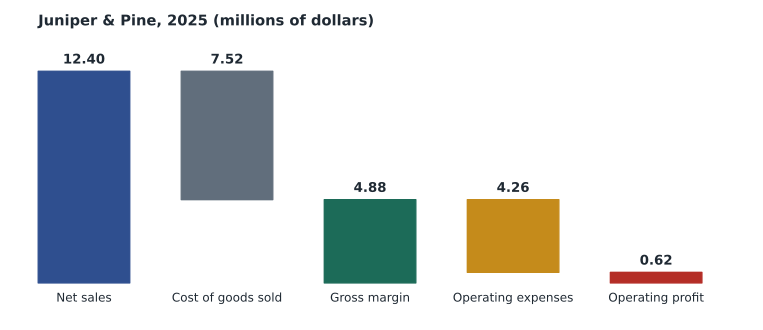
The three numbers were last year's results for the whole store: net sales of 12.4 million dollars, gross margin of 4.88 million dollars and operating profit of about 0.62 million dollars. Aiden did the subtraction in his head and frowned. The store had sold 12.4 million dollars' worth of furniture, mattresses, appliances and décor, but kept only about 620,000 dollars of it as profit. "Five cents on the dollar," Bev said. "That's normal for a store like ours. It also means a small mistake on price or stock can wipe out a large part of the year."
This course follows Bev's numbers mornings through the fall of 2026. It covers the measures retailers buy and sell by: markup and markdowns, gross margin, sell-through, stock turn and weeks of supply, gross margin return on inventory investment, sales per square foot, open-to-buy and assortment planning. It ends with a case study in which Juniper & Pine plans its spring 2027 season for sofas and sectionals. That plan is written in November 2026, so everything after that date is a forecast, not a result.
What a store sells and what it keeps
A retailer buys merchandise from manufacturers and wholesalers and sells it to consumers at a higher price. The difference between what the store pays for an item and what it sells the item for has to cover every other cost of running the business: wages and commissions, rent, utilities, delivery trucks, advertising, payment fees, insurance and the computer systems. Whatever is left after all of that is profit.
Retailers use a standard set of terms to describe this, and the course uses them throughout.
- Gross sales are the total value of goods sold at the prices customers paid, before returns.
- Net sales are gross sales minus customer returns and allowances. When retailers say "sales" without a qualifier, they usually mean net sales.
- Cost of goods sold (COGS) is what the store paid for the merchandise it sold, including inbound freight and minus any supplier discounts. Some retailers also include shrink, the value of stock lost to theft, damage and errors, and workroom costs such as assembly or repairs.
- Gross margin (also called gross profit) is net sales minus cost of goods sold. It is the money left to pay the store's operating expenses.
- Operating expenses are the costs of running the store that are not part of the merchandise: payroll, occupancy, delivery, marketing, technology and so on.
- Operating profit is gross margin minus operating expenses.
The same quantities are often expressed as a share of net sales. A gross margin of 4.88 million dollars on net sales of 12.4 million dollars is a gross margin rate of about 39.4 in 100. In conversation, retailers often drop the word "rate" and say the store "runs a 39 margin".
Worked problem
Reading the store's profit and loss statement
Juniper & Pine's 2025 results were: gross sales of 12.71 million dollars, returns and allowances of 0.31 million dollars, cost of goods sold of 7.52 million dollars and operating expenses of 4.26 million dollars. Find net sales, gross margin, the gross margin rate, operating profit and the operating profit rate.
Show solution
- Net sales = 12.71 − 0.31 = 12.40 million dollars.
- Gross margin = 12.40 − 7.52 = 4.88 million dollars.
- \[\text{Gross margin rate} = \frac{4.88}{12.40} \approx 0.394\]
- Operating profit = 4.88 − 4.26 = 0.62 million dollars.
- \[\text{Operating profit rate} = \frac{0.62}{12.40} = 0.05\]
Answer: Net sales were 12.40 million dollars, gross margin 4.88 million dollars (about 39.4 in 100 of sales), and operating profit 0.62 million dollars, or 5 in 100 of sales.
Why five cents on the dollar is fragile
A thin operating profit makes a store very sensitive to small changes. Suppose Juniper & Pine had given away an extra 2 in 100 of its sales in unplanned discounts in 2025. That is 0.02 × 12.4 million = 248,000 dollars, and it would have come straight out of gross margin, because the cost of the goods would not have changed. Operating profit would have fallen from 620,000 dollars to 372,000 dollars, a drop of 40 in 100. A change that sounds tiny on the sales floor becomes a large change at the bottom of the statement.
The same logic works in the other direction. If the store had sold the same merchandise but avoided 248,000 dollars of markdowns by buying more carefully, profit would have risen by 40 in 100. This is why retailers spend so much effort on the measures in this course. Most of them are ways of catching small leaks before they become large ones.
| Change in 2025 | Effect on gross margin | Operating profit | Change in profit |
|---|---|---|---|
| No change | 4.88 million | 0.62 million | — |
| Extra discounts of 2 in 100 of sales | −0.248 million | 0.372 million | Falls 40 in 100 |
| Shrink 0.5 in 100 of sales higher | −0.062 million | 0.558 million | Falls 10 in 100 |
| Gross margin rate 1 point higher on the same sales | +0.124 million | 0.744 million | Rises 20 in 100 |
The measures retailers watch
Retail math is not one formula but a family of related measures. Each answers a different question, and a good buyer or store manager uses several together. The rest of this course takes them one at a time.
| Measure | Question it answers | Lesson |
|---|---|---|
| Markup | How far above cost is the selling price? | 2 |
| Markdown | How much price was given up after the item was ticketed? | 3 |
| Gross margin | How much of each sales dollar is left after the cost of the goods? | 4 |
| Sell-through | How much of what we bought have we sold? | 5 |
| Stock turn and weeks of supply | How quickly does inventory sell, and how long will current stock last? | 6 |
| GMROI | How much gross margin does each dollar invested in inventory earn? | 7 |
| Sales per square foot | How productive is the floor space? | 8 |
| Open-to-buy | How much more can we order without overstocking? | 9 |
| Assortment breadth and depth | How many different items, and how many of each? | 10 |
Some measures belong mostly to the sales floor. Associates are measured on average transaction value (sales divided by the number of transactions), units per transaction, conversion (the share of shoppers who buy) and attachment rates for protection plans and accessories. Those measures were covered in earlier courses and are covered again in Retail Selling and Clienteling. This course looks at the measures one level up, the ones buyers and managers use to decide what to stock, how to price it and how much of it to carry.
Prices, sales and sales tax
One complication appears on every receipt. In Sioux Falls, sales are subject to the South Dakota state sales tax of 4.2 in 100 and the city's municipal sales tax of 2 in 100, for a combined 6.2 in 100. The state rate is temporary: it was cut from 4.5 in 100 in July 2023, and the reduction is set to end on June 30, 2027, when the combined Sioux Falls rate returns to 6.5 in 100. Juniper & Pine collects the tax on behalf of the state and the city and sends it on. The tax is not part of the store's sales. When this course talks about sales, markup or margin, it always means amounts before tax.
Worked problem
Separating the tax from the sale
Aiden sells a dining set ticketed at 1,899 dollars. What does the customer pay, and how much of that is Juniper & Pine's sale?
Show solution
- Sales tax = 1,899 × 0.062 = 117.738, which rounds to 117.74 dollars.
- The customer pays 1,899 + 117.74 = 2,016.74 dollars.
Answer: The customer pays 2,016.74 dollars. Only 1,899 dollars is the store's sale; the 117.74 dollars of tax belongs to the state and the city.
Mixing up tax and sales is a common source of errors. An associate who quotes an "out the door" price to a customer and then calculates a discount on that number will give away tax as well as margin. A manager who reads a daily sales report that includes tax will overstate the store's sales. Retail systems keep the two apart, and so should anyone who works with the numbers.
Retail method and cost method
Retailers keep track of inventory in two ways. Under the cost method, each item on hand is valued at what the store paid for it. Under the retail method, inventory is valued at its current selling price, and a cost value is estimated by applying the department's cost-to-retail ratio. Department stores and many large retailers use the retail method because it is easy to count a store at the prices on the tickets. Furniture and appliance stores with fewer, more expensive items often use the cost method, because each item can be tracked individually.
The distinction matters because several measures in this course can be calculated either way, and the answers differ. Stock turn calculated on sales at retail divided by inventory at retail is not the same as turn calculated on cost of goods sold divided by inventory at cost, unless the markup stays constant. Whenever you compare a number with a target or with another store, check which method was used.
Why associates should care
Aiden asked the question most new associates ask. "I don't set the prices or order the stock. Why do I need this?" Bev gave three answers. First, associates make pricing decisions every day: which price-match requests to accept, which floor models to suggest, whether to offer the package price on four appliances or the separate prices on three. Each decision changes margin. Second, associates see the merchandise and the customers before anyone in the office does. An associate who notices that a sofa color is not selling, or that customers keep asking for a size the store does not carry, can tell a buyer before the season is half over. That information is valuable only if the associate can explain it in the buyer's language: sell-through, weeks of supply, margin. Third, most people who become store managers, buyers or district managers started on the sales floor. The ones who understood the numbers early got there sooner.
Carl Jensen, who had sold appliances at the store for nine years, put it more bluntly when Aiden mentioned the session later that morning. "The buyers will listen to you if you bring them numbers," he said. "If you bring them a feeling, they'll thank you and forget it."
A word about precision
Retail math is mostly simple arithmetic, but the arithmetic has traps. Percentages are calculated on different bases: markup can be expressed as a share of cost or a share of retail price; a markdown can be expressed as a share of the original price or of net sales. Averages can mislead when items with very different prices are combined. Rounding early can produce errors that grow when the numbers are multiplied. The worked examples in this course show every step, state the base of every percentage and round only at the end. Following the same habits will save you from most of the mistakes that cause trouble in practice.
Common mistakes
MistakeTreating sales tax as part of the store's sales.
InsteadCalculate markup, margin and discounts on prices before tax.
MistakeThinking a small discount has a small effect on profit.
InsteadCompare the dollars given up with operating profit, not with sales.
MistakeComparing a turn or margin figure without checking how it was calculated.
InsteadConfirm whether the cost or retail method was used and what was included in cost of goods sold.
MistakeLeaving the numbers to the buyers.
InsteadWatch what sells and what doesn't, and report it in the buyer's terms.
MistakeRounding at every step.
InsteadKeep full figures until the final answer.
Summary and key terms
- Retailers buy merchandise and sell it at a higher price; the difference must cover every operating cost before any profit is left.
- Net sales are gross sales minus returns and allowances.
- Gross margin is net sales minus cost of goods sold, and the gross margin rate is gross margin divided by net sales.
- Operating profit is gross margin minus operating expenses.
- Juniper & Pine's 2025 net sales were 12.4 million dollars, gross margin 4.88 million dollars and operating profit 0.62 million dollars, or 5 in 100 of sales.
- A thin operating profit makes small changes in discounts, shrink or margin very important. The combined Sioux Falls sales tax of 6.2 in 100 is collected for the government and is not part of the store's sales.
- Inventory can be valued by the cost method or the retail method, and measures calculated each way are not directly comparable.
- Associates affect margin every day and can give buyers useful information if they use the buyers' measures.
- Net sales
- Gross sales minus customer returns and allowances.
- Cost of goods sold
- What the store paid for the merchandise it sold, including inbound freight, less supplier discounts.
- Gross margin
- Net sales minus cost of goods sold.
- Gross margin rate
- Gross margin as a share of net sales.
- Operating profit
- Gross margin minus operating expenses.
- Shrink
- Inventory lost to theft, damage, administrative error or vendor fraud.
- Retail method
- Valuing inventory at selling prices and estimating cost with a cost-to-retail ratio.
- Cost method
- Valuing inventory at what the store paid for each item.
Practice problems
Work each problem on paper first, then reveal the answer to check.
A store has net sales of 2.5 million dollars and cost of goods sold of 1.45 million dollars. What is its gross margin rate?
Show answer
Gross margin = 2.5 − 1.45 = 1.05 million dollars; 1.05 ÷ 2.5 = 0.42, or 42 in 100.
If the same store has operating expenses of 0.95 million dollars, what is its operating profit as a share of sales?
Show answer
1.05 − 0.95 = 0.10 million dollars; 0.10 ÷ 2.5 = 0.04, or 4 in 100.
A mattress is ticketed at 1,200 dollars in Sioux Falls. What is the total tax?
Show answer
1,200 × 0.062 = 74.40 dollars.
Lesson quiz · 5 questions
Score 60% or more to complete this lesson.
Create a free account to save your progress, take quizzes and earn a certificate.