
SLS-253 · Lesson 10 of 12 · 21 min
Assortment planning
▶ Video coming soon A video version of this lesson is on the way.
On Tuesday, November 10, 2026, Noura held a working session in the upholstery gallery after closing. The open-to-buy plan from lesson 9 told her how much she could spend on sofas and sectionals for spring 2027. It did not tell her what to buy. She had spread supplier catalogs and fabric swatches across two sectionals, and she had invited Aiden and Carl because they talked to customers every day. "Lesson nine gives me dollars," she said. "Tonight we turn the dollars into sofas: which styles, which colors, how many of each."
What an assortment is
A store's assortment is the set of products it offers in a category: the styles, sizes, colors, fabrics, configurations and price levels a customer can choose from. Assortment planning is the process of deciding that set for a season, within the limits of the budget, the floor space and what suppliers can deliver. It sits between the merchandise plan, which works in dollars, and the purchase orders, which list individual items.
Retailers describe an assortment along two dimensions.
- Breadth (also called width or variety) is the number of different product lines, styles or categories offered. A store with ten sofa styles has a broader assortment than one with four.
- Depth is the number of choices within each line, such as colors, fabrics, sizes or configurations, and the number of units of each choice held in stock. A store with each sofa in six colors, several of each in the warehouse, has a deeper assortment than one that offers two colors and keeps one of each.
The individual items a store tracks are stock-keeping units (SKUs): one SKU for each distinct combination of style, color, size and configuration. A gray Style A sofa and a gray Style A sectional are two SKUs; so are a gray and an oatmeal Style A sofa.
Worked problem
Counting SKUs
Noura's draft spring assortment has five upholstery styles. Style A comes in 3 colors, each as a sofa or a sectional. Style B comes in 4 colors as a sofa only. Style C comes in 2 colors as a sofa or a sectional. Style D comes in 2 colors as a sofa only. Style E comes in 3 colors as a sofa only. How many SKUs is that?
Show solution
- Style A: 3 × 2 = 6.
- Style B: 4 × 1 = 4.
- Style C: 2 × 2 = 4.
- Style D: 2 × 1 = 2.
- Style E: 3 × 1 = 3.
- Total = 6 + 4 + 4 + 2 + 3 = 19 SKUs.
Answer: The draft assortment has 5 styles (its breadth) and 19 SKUs. Each SKU needs a floor model or swatch, some stock and a place in the reorder plan.
Broad, deep, narrow and shallow
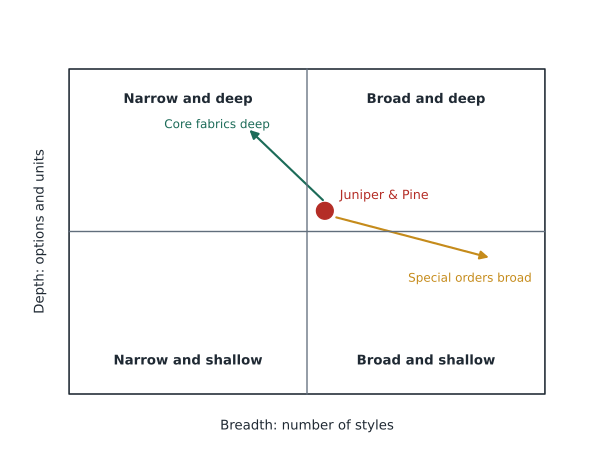
Every store chooses a balance between breadth and depth, because the budget, the space and the customer's patience are all limited. The four combinations suit different strategies.
| Assortment | Description | Suits | Risk |
|---|---|---|---|
| Broad and deep | Many styles, each in many options and quantities | Large destination stores | Very high inventory and space costs |
| Broad and shallow | Many styles, few options or units of each | Stores where variety and discovery matter | Frequent stockouts of popular items |
| Narrow and deep | Few styles, each in many options and quantities | Specialists and stores built on availability | Little choice for customers who want something different |
| Narrow and shallow | Few styles, few options | Small stores and showrooms | Customers may not find what they want |
Juniper & Pine positions itself between the extremes. It carries enough styles that a customer can find something that suits their room, but it keeps a deep stock only of the colors and configurations that sell reliably, and offers the rest by special order. Carl described the logic from the floor: "People want to see choice. Then most of them buy gray or oatmeal."
Core, fashion and test
Not every item in an assortment plays the same role. Buyers usually group items into three kinds and plan each differently.
- Core items (also called basics or staples) sell steadily season after season. At Juniper & Pine, the gray and oatmeal performance-fabric sectionals are core. Core items are bought deep, reordered automatically and rarely marked down.
- Fashion or seasonal items follow trends or seasons and have a limited life. A bold color of the year or a holiday accent chair is fashion. They are bought carefully, sold through within the season and cleared at the end.
- Test items are new styles or colors bought in small quantities to see whether customers want them. If they sell, they are reordered; if not, the loss is small.
The mustard chairs and the forest-green sectional were both fashion purchases treated as if they were core. Each was bought in a quantity that only a proven seller would justify. The lesson Noura drew for spring 2027 was simple: new colors enter as tests, and only become core once their sell-through has earned it.
Allocating units with sell-through history
Once the styles are chosen, the buyer must decide how many units of each to buy. A common starting point is each option's share of past sales, adjusted for what the buyer expects to change. The fall 2026 sectionals from lesson 5 give Noura her history.
Worked problem
Splitting 60 spring sectionals by color
Noura plans to buy 60 Style A and Style B sectionals for spring. In the first eight weeks of fall, the sectionals sold 18 gray, 13 oatmeal, 4 navy and 2 forest green, out of 37. Calculate each color's share of sales and what 60 units would look like if allocated by those shares. Then adjust the plan to drop forest green and test a new terracotta color at the supplier's minimum of 6 units.
Show solution
- Shares: gray 18 ÷ 37 ≈ 0.486; oatmeal 13 ÷ 37 ≈ 0.351; navy 4 ÷ 37 ≈ 0.108; forest green 2 ÷ 37 ≈ 0.054.
- Allocation by share: gray 60 × 0.486 ≈ 29.2; oatmeal ≈ 21.1; navy ≈ 6.5; forest green ≈ 3.2.
- Adjustments: drop forest green; give terracotta the supplier minimum of 6; keep navy at 7, because it sold better after being moved to the main aisle.
- That uses 13 units, leaving 47 for the core colors: gray 27 and oatmeal 20, close to their 58 to 42 share of the two colors' combined sales.
- Check: 27 + 20 + 7 + 6 = 60.
Answer: Noura's draft buy is 27 gray, 20 oatmeal, 7 navy and 6 terracotta. The core colors take nearly 80 in 100 of the units; the test color is limited to the smallest quantity the supplier will make.
History is a starting point, not an answer. Past sales show what customers bought from what was offered; they do not show what customers would have bought if something else had been available. That is why associates' observations matter. Aiden told Noura that several customers had asked for a sectional with a chaise on the right side, which the store carried only on the left. Carl added that families with dogs kept asking whether fabrics were scratch-resistant. Noura added a right-chaise configuration of Style A in gray as a test, and asked suppliers to label their performance fabrics clearly.
Price lines: good, better, best
A well-planned assortment also covers the price levels the store's customers expect. Many retailers organize each category into price lines, a small number of distinct price levels, often described as good, better and best. A good line offers an entry price, a better line the price most customers choose, and a best line the top of the range. Price lines make shopping easier, because customers can see what each step up buys them, and they make associates' jobs easier, because the differences can be explained.
Worked problem
The average price of the sofa assortment
Juniper & Pine's spring sofa price lines are 999 dollars (good), 1,799 dollars (better) and 2,799 dollars (best). Noura expects unit sales to split 30, 45 and 25 in 100 among them. What average selling price does that imply? What would it be if the split moved to 25, 45 and 30 in 100?
Show solution
- Average = 0.30 × 999 + 0.45 × 1,799 + 0.25 × 2,799 = 299.70 + 809.55 + 699.75 = 1,809 dollars.
- With the new split: 0.25 × 999 + 0.45 × 1,799 + 0.30 × 2,799 = 249.75 + 809.55 + 839.70 = 1,899 dollars.
Answer: The planned mix gives an average price of 1,809 dollars. Shifting just 5 in 100 of unit sales from good to best raises the average by 90 dollars. Lesson 11 looks at how price lines are set.
Space, display and supplier limits
An assortment has to fit the store. Every SKU on the floor needs space, and a furniture store needs a lot of it: a sectional display, with room for customers to walk around it and sit, takes about 120 square feet; a sofa about 70. Noura's spring plan displays 6 sectionals and 14 sofas, which needs about 6 × 120 + 14 × 70 = 1,700 square feet of the upholstery gallery's 9,000 square feet, leaving room for chairs, recliners, ottomans and aisles. Adding styles means taking space from something else, which is the trade-off lesson 8 measured.
Suppliers set limits too. Many require a minimum order quantity for each color or fabric, a minimum dollar value per order, or a set lead time for production. Some offer fabric programs, where the store displays one frame and customers choose from a book of fabrics, with each sofa made to order in six to ten weeks. Those programs let a store offer great breadth without stocking it, at the cost of making customers wait.
| Constraint | Effect on the assortment | How Juniper & Pine handles it |
|---|---|---|
| Open-to-buy budget | Caps the total units and dollars | Core deep, tests shallow, 30 in 100 held back for reorders |
| Floor space | Caps the number of displays | About 20 upholstery displays at a time; rotate fashion items |
| Supplier minimums | Sets the smallest test quantity | Test new colors at the minimum, often 6 units |
| Lead times | Limits how quickly winners can be reordered | Reorder core colors early; use fabric programs for special orders |
| Warehouse capacity | Limits depth | Hold no more than about 8 weeks of supply on core SKUs |
Editing the assortment
Assortments tend to grow. Buyers add new items each season, but it is easy to forget to remove old ones, and the store ends up with too many SKUs, each with too little stock. Assortment editing (sometimes called SKU rationalization) removes items that duplicate others, sell slowly or earn a poor return. The measures from earlier lessons make the choice clearer: low sell-through, many weeks of supply and a low GMROI together identify the items that are using inventory and space without earning much.
Noura applied that test to the fall assortment and cut two items: a recliner that duplicated another at nearly the same price, and a loveseat that had sold four units all year. The space and budget freed went to the right-chaise test and to deeper stock of gray.
Common mistakes
MistakeConfusing breadth with depth.
InsteadBreadth is how many different lines; depth is how many choices and units within each.
MistakeBuying fashion and test items as deeply as core items.
InsteadTest new styles in small quantities; buy deep only on proven sellers.
MistakeAllocating units purely by last season's sales.
InsteadAdjust for what changed and for what customers asked for but could not buy.
MistakeAdding SKUs without removing any.
InsteadEdit the assortment each season using sell-through, weeks of supply and GMROI.
MistakePlanning an assortment that does not fit the floor or the supplier's minimums.
InsteadCheck space, minimum order quantities and lead times before finalizing.
Summary and key terms
- An assortment is the set of products a store offers in a category; assortment planning turns the merchandise plan's dollars into styles, options and units.
- Breadth is the number of different lines or styles; depth is the number of options and units within each.
- Each distinct combination of style, color, size and configuration is a SKU.
- Stores balance breadth and depth against budget, space and customer needs.
- Core items are bought deep, fashion items carefully, and test items in small quantities.
- Past sell-through shares give a starting point for allocating units, adjusted for change and for what customers asked for.
- Good, better and best price lines organize choice, and the mix among them sets the average price.
- Space, supplier minimums, lead times and warehouse capacity constrain the plan.
- Assortment editing removes slow, duplicate and low-return items.
- Assortment
- The set of products a store offers in a category.
- Breadth
- The number of different lines, styles or categories offered.
- Depth
- The number of choices and units within each line.
- SKU
- Stock-keeping unit: one distinct combination of style, color, size and configuration.
- Core item
- A steady seller bought deep and reordered regularly.
- Price lines
- A small number of distinct price levels within a category, such as good, better and best.
- Minimum order quantity
- The smallest amount a supplier will make or ship of an item.
- Assortment editing
- Removing slow, duplicate or low-return items from an assortment.
Practice problems
Work each problem on paper first, then reveal the answer to check.
A chair comes in 4 fabrics and 2 leg finishes. How many SKUs is that?
Show answer
4 × 2 = 8 SKUs.
A buyer plans 40 units of a sofa. Last season, color X sold 60 in 100 of units and color Y 40 in 100. How might the 40 be split?
Show answer
40 × 0.60 = 24 of X and 40 × 0.40 = 16 of Y, before any adjustments.
Price lines are 499, 899 and 1,499 dollars with a unit mix of 40, 40 and 20 in 100. What is the average price?
Show answer
0.40 × 499 + 0.40 × 899 + 0.20 × 1,499 = 199.60 + 359.60 + 299.80 = 859 dollars.
Lesson quiz · 5 questions
Score 60% or more to complete this lesson.
Create a free account to save your progress, take quizzes and earn a certificate.