
SLS-252 · Lesson 9 of 12 · 20 min
Returns and exchanges
▶ Video coming soon A video version of this lesson is on the way.
On Monday, November 9, 2026, a customer brought back a dining chair. She had bought six of them in October, and one had a wobbly leg. A week earlier, another customer had tried to return a sectional, delivered in September, that he said he no longer needed; it had a red wine stain on one cushion and the sale had been made 52 days before. And on the same Monday, a man asked for a cash refund on a floor lamp that still had its Juniper & Pine price tag but no receipt, saying it had been a gift. At the next morning's session, on November 10, Marcus put all three on the whiteboard. "Three returns," he said. "One we fix right away, one we decline politely, and one we handle very carefully. The policy tells you which is which, and the procedure tells you how."
Why returns matter
Returns are part of retail. Customers change their minds, measure wrong, receive damaged goods or find that a product does not work for them, and a fair returns policy gives shoppers the confidence to buy. But returns are also expensive. Every return costs staff time, often a second delivery or pickup, inspection and repackaging, and frequently a loss of value, because a returned sofa or mattress usually cannot be sold as new. Returns are also the most common route for retail fraud, both by customers and by employees.
In 2025, Juniper & Pine took back 0.31 million dollars of merchandise, about 2.4 in 100 of its gross sales of 12.71 million dollars. Furniture and mattress stores typically have lower return rates than online apparel sellers, because furniture is bought after seeing and trying it, but each furniture return is large and costly to handle.
Policy and the law
A store's returns policy is mostly its own choice, but it sits inside the law.
In the United States, a store generally has no legal duty to accept the return of goods that are not defective, if it does not promise to. But goods sold by a merchant carry an implied warranty under the Uniform Commercial Code that they are fit for ordinary use, unless properly disclaimed, and written warranties are governed by the federal Magnuson-Moss Warranty Act; a defective item must be dealt with under those warranties regardless of the returns policy. The FTC's Cooling-Off Rule gives buyers three business days to cancel many sales made at their home or at a temporary location. A store's returns policy must be clearly disclosed and honored, and some states require stores to post it.
Juniper & Pine's policy, printed on every receipt and posted at the counter, is summarized below.
| Kind of purchase | Juniper & Pine policy |
|---|---|
| Stock furniture and décor | Return or exchange within 30 days of delivery or pickup, unused and in original condition, with the receipt or order number |
| Mattresses | 90-night comfort exchange: one exchange for a different mattress within 90 nights, with a mattress protector used throughout; no refunds on used mattresses |
| Special orders | Cancellable before production starts; not returnable after production unless defective |
| Floor models and clearance | Final sale unless defective |
| Appliances | Unopened within 30 days; opened or installed appliances are handled under the manufacturer's warranty |
| Defective or damaged on delivery | Repair, replacement or refund at any time under the store's and manufacturer's warranties and the law |
| Delivery and services | Delivery fees are refunded only when the return is the store's fault |
Processing a return
Every return at Juniper & Pine follows the same steps, whether it happens at the counter or at a customer's home.
- Find the original sale. Look up the receipt, the order number or the customer record. A return should be tied to the sale it came from.
- Check the policy. Is the item within the time allowed? Is it a kind of item that can be returned? Is it in the condition the policy requires?
- Inspect the item. Look for damage, use, missing parts, stains and odor. Photograph anything that affects its value.
- Decide and explain. Accept, offer an exchange or repair, or decline, and explain the decision in plain language, with the policy in front of the customer.
- Refund to the original payment. Refunds go back to the card or account used to pay. Cash refunds are given only for cash purchases.
- Record the reason and the disposition. Choose a reason code (changed mind, wrong size, damaged in delivery, defective, and so on) and decide where the item goes.
- Get approval where needed. Refunds over 500 dollars, refunds without a receipt and any exception to the policy need a manager.
Refunding to the original payment method is one of the most important controls. It stops a common fraud, in which stolen goods or goods bought with a stolen card are returned for cash.
Where returned goods go
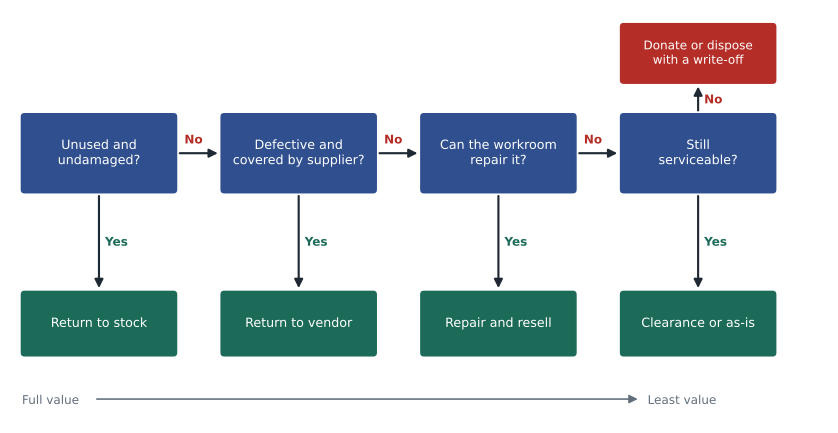
A returned item is not automatically sellable stock. Its disposition, the decision about what happens to it, determines how much value the store recovers.
| Disposition | When it applies | Value recovered |
|---|---|---|
| Return to stock | Unused, undamaged, in original packaging | Full value |
| Return to vendor | Defective, covered by the supplier's warranty or return agreement | Credit from the supplier, often full cost |
| Repair and resell | Minor damage the store's workroom can fix | Most of the value, less repair cost |
| Clearance or as-is | Used or marked but serviceable | Partial value, often 40 to 70 in 100 of retail |
| Donate or dispose | Not sellable, including used mattresses under the store's policy | None; recorded as a write-off |
Worked problem
Value recovered from October returns
In October 2026, Juniper & Pine took back returned merchandise with a retail value of 26,000 dollars. Of that, 14,000 dollars went back to stock, 5,000 dollars went back to vendors for full credit at cost, 4,000 dollars was sold in clearance at 55 in 100 of retail, and 3,000 dollars was written off. Assuming merchandise cost averages 60 in 100 of retail, how much of the returned goods' cost did the store recover?
Show solution
- Cost of all returns = 0.60 × 26,000 = 15,600 dollars.
- Returned to stock: recovered at full cost, 0.60 × 14,000 = 8,400 dollars.
- Returned to vendor: full credit at cost, 0.60 × 5,000 = 3,000 dollars.
- Clearance: sold for 0.55 × 4,000 = 2,200 dollars, against a cost of 0.60 × 4,000 = 2,400 dollars, so 2,200 recovered.
- Written off: 0 recovered of 0.60 × 3,000 = 1,800 dollars.
- Total recovered = 8,400 + 3,000 + 2,200 + 0 = 13,600 dollars.
- \[\text{Recovery rate} = \frac{13{,}600}{15{,}600} \approx 0.872\]
Answer: The store recovered about 13,600 dollars of the 15,600 dollars the returned goods cost, about 87.2 in 100. The 2,000-dollar shortfall, plus the handling and delivery costs not counted here, is the real cost of October's returns.
Every disposition must be recorded. A returned chair that goes back to stock without being entered in the system will appear as an overage at the next count; one that goes to the dumpster without a write-off will become shrink.
Exchanges, including the comfort exchange
An exchange swaps one item for another. When the new item costs more, the customer pays the difference, with tax on the difference; when it costs less, the store refunds the difference to the original payment. Exchanges are usually better for the store than refunds, because the sale is kept.
The 90-night comfort exchange is a common feature of mattress retailing, because a mattress that feels right in the store for ten minutes may not feel right after a few weeks at home. Juniper & Pine allows one exchange within 90 nights, provided the customer used a mattress protector, and the returned mattress cannot be resold as new. The store's records showed that about 6 in 100 of mattresses sold in 2025 were exchanged, and Marcus tracks the rate by model, because a model with a high exchange rate is a buying and selling problem as much as a returns one.
Worked problem
A comfort exchange
In September 2026, a customer bought a store-label queen hybrid for 1,099 dollars. After 40 nights, she exchanged it for a firmer queen at 1,299 dollars. How much does she pay, before tax, and what happens to the returned mattress?
Show solution
- Price difference = 1,299 − 1,099 = 200 dollars.
- She pays 200 dollars plus tax on the 200 dollars.
- The returned mattress cannot be resold as new. Under Juniper & Pine's policy it is not resold at all, and goes to a mattress recycling program.
Answer: The customer pays 200 dollars plus tax. The returned mattress, which cost the store 410 dollars, is written off and recycled, so the comfort exchange cost the store that amount plus handling, offset by the extra 200 dollars of sales on the firmer model.
Return fraud and abuse
Return fraud takes several forms. Some are crimes; others are abuse of a generous policy. Retail surveys in 2025 reported that return and refund fraud remained a significant source of loss.
| Form | What it is | Control at Juniper & Pine |
|---|---|---|
| Returning stolen goods | Taking an item from the floor and returning it for a refund | Refunds tied to a sale; no cash refunds without a cash receipt |
| Receipt fraud | Using a found, copied or altered receipt | Look up the sale in the system rather than trusting paper |
| Wardrobing or renting | Using an item and returning it, such as furniture borrowed to stage a home for sale | Inspection for use; time limits; tracking repeat returners |
| Price switching | Returning a cheaper item in the packaging of a more expensive one | Inspect contents and serial numbers |
| Employee refund fraud | Processing fake returns and pocketing the money or putting it on a personal card | Manager approval, refund exception reports, refunds to original payment |
Returns without a receipt are the highest-risk category. Juniper & Pine allows them only with a manager's approval and photo identification, gives store credit rather than a refund, values the item at its lowest selling price in the last 90 days, and limits how many a customer can make in a year. The floor lamp from November 9 was one of these: the system showed that lamp had not been sold for two months, the person had made two other no-receipt returns in October, and Marcus declined the return. He was polite and did not accuse the man of anything; he simply explained the policy.
Not every unusual return is fraud. Most customers who return things are honest, and a good returns experience brings them back. The goal of return controls is to make fraud difficult without making honest customers feel suspected.
Learning from returns
Return reasons are useful information. A sofa returned three times for "color not as expected" may need a better fabric sample. A dresser often returned as "damaged on delivery" may need better packaging or a different carrier. A rising number of "wrong size" returns may mean associates need to measure doorways and rooms more carefully, a skill the floor school had covered. Marcus sends a monthly returns report to Bev, the buyers and Noura, sorted by reason and by item.
The wobbly chair from November 9 turned out to be the first of four returns of the same model with the same fault. Marcus sent the photos to the supplier, which confirmed a problem with one production batch and issued a full credit and replacement legs for every chair sold from that batch. The returns report caught a supplier problem before most customers had noticed it.
Common mistakes
MistakeGiving a cash refund for an item paid by card.
InsteadRefund to the original payment method.
MistakePutting a returned item straight back on the floor.
InsteadInspect it, record its disposition, and only restock what is truly in sellable condition.
MistakeTelling a customer with a defective item that it is past the returns period, so nothing can be done.
InsteadDefects are covered by warranties and the law regardless of the returns policy.
MistakeAccusing a customer of fraud when a return looks suspicious.
InsteadApply the policy politely and consistently, and let the manager decide.
MistakeIgnoring return reasons.
InsteadTrack reasons by item and share them with buyers and suppliers.
Summary and key terms
- Returns build customer confidence but cost staff time, deliveries and lost value, and they are the most common route for retail fraud.
- A store generally need not accept returns of non-defective goods unless it promises to, but defective goods are covered by warranties and the law, some sales away from the store carry cancellation rights, and the stated policy must be clearly disclosed and honored.
- Juniper & Pine allows 30-day returns on stock items, a 90-night comfort exchange on mattresses, and treats special orders, floor models and clearance as final unless defective.
- Each return is tied to its original sale, checked against policy, inspected, decided, refunded to the original payment, coded and approved where needed.
- Disposition decides how much value is recovered and must always be recorded.
- Exchanges keep the sale.
- Return fraud includes returning stolen goods, receipt fraud, wardrobing, price switching and employee refund fraud, controlled by system lookups, inspection, approvals and limits on no-receipt returns.
- Return reasons reveal product, packaging and selling problems.
- Returns policy
- The store's rules for accepting returns and exchanges.
- Statutory warranty
- A warranty given by law, such as acceptable quality, that cannot be excluded for consumers.
- Disposition
- The decision about what happens to a returned item.
- Return to vendor
- Sending a returned item back to the supplier for credit.
- Comfort exchange
- A mattress exchange allowed within a set number of nights.
- Wardrobing
- Using an item and returning it as if new.
- Receipt fraud
- Returning goods with a found, copied or altered receipt.
- Recovery rate
- The share of returned goods' cost the store gets back.
Practice problems
Work each problem on paper first, then reveal the answer to check.
A customer exchanges a 799-dollar chair for a 649-dollar chair. What happens to the difference?
Show answer
The store refunds 150 dollars, plus the tax on it, to the original payment method.
Why are refunds given to the original payment method?
Show answer
It stops stolen goods or goods bought with stolen cards from being turned into cash.
Returns with a retail value of 10,000 dollars, at a cost of 60 in 100, recover 5,400 dollars. What is the recovery rate?
Show answer
Cost = 6,000 dollars; 5,400 ÷ 6,000 = 0.90, or 90 in 100.
Lesson quiz · 5 questions
Score 60% or more to complete this lesson.
Create a free account to save your progress, take quizzes and earn a certificate.