
SLS-252 · Lesson 4 of 12 · 26 min
Replenishment
▶ Video coming soon A video version of this lesson is on the way.
At the October 6 session, Marcus put two numbers on the whiteboard. The store-label queen hybrid, Juniper & Pine's best-selling mattress, had sold 19 units the week before and the warehouse held 4. The branded queen from the second supplier had sold 3 and the warehouse held 21. "One of these is about to run out and the other is taking up space," he said. "Replenishment is deciding, for every item, how much to order and when, so we have enough to sell and not much more." Aiden pointed out that the store-label queen came from a supplier who delivered in a week, while the branded one took six. "Exactly," Marcus said. "That's why the same rule can't work for both."
What replenishment is
Replenishment is the process of putting stock back after it sells. It happens at two levels in a store. Store replenishment orders more stock from suppliers or a distribution center. Floor replenishment moves stock from the back room to the sales floor so that displays and shelves stay full. Both answer the same two questions: when should we reorder, and how much?
Not every item is replenished. Fashion and seasonal goods, such as the fall sectionals in colorways that may not be repeated, are usually bought once for a season and managed with sell-through and markdowns, as Bev's numbers mornings showed. Basic or staple items, which sell steadily all year, are replenished continuously. At Juniper & Pine, staples include the core mattress range, bed frames, pillows and protectors, the best-selling sofa and dining chair frames, appliances, and décor basics such as candles and frames. These are the items where running out costs sales every day.
The cost of running out and of carrying too much
Running out of a staple loses sales and sometimes customers. A shopper who wanted the store-label queen and finds it out of stock may wait for the next truck, may switch to a more expensive mattress, or may buy elsewhere. Carrying too much ties up money, uses warehouse space, and raises the risk of damage, aging and markdowns. The cost of holding inventory, including money tied up, space, insurance, handling, damage and obsolescence, is often estimated at 20 to 30 in 100 of the inventory's cost per year, although the right figure depends on the business.
Worked problem
What a stockout cost
In the week of September 28, 2026, the store-label queen was out of stock for three days. In-stock weeks, the store sells about 18 of them a week, about 2.6 a day, at 1,099 dollars each with a gross margin of 50 in 100. Bev estimates that half the customers who wanted one bought a different mattress and half walked away. What was the likely lost gross margin?
Show solution
- Expected demand in 3 days ≈ 3 × 2.6 = 7.8 mattresses, about 8.
- Customers lost ≈ half of 8 = 4.
- Lost gross margin ≈ 4 × 1,099 × 0.50 ≈ 2,198 dollars.
Answer: The three-day stockout probably cost about 2,200 dollars of gross margin, plus some goodwill. Even customers who switched may have bought a mattress they liked less.
Reorder points
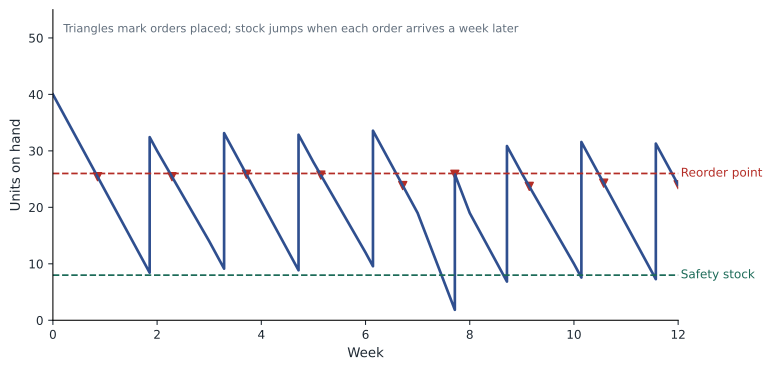
The simplest replenishment rule is the reorder point: when the stock on hand plus stock on order falls to a set level, order more. The reorder point has to cover the sales expected while the new order is on its way, the lead time, plus a cushion of safety stock for weeks when sales are higher than usual or the delivery is late.
Worked problem
Reorder points for two queen mattresses
The store-label queen sells an average of 18 a week, comes from Supplier A with a lead time of 1 week, and carries a safety stock of 8. The branded queen sells an average of 3 a week, comes from Supplier B with a lead time of 6 weeks, and carries a safety stock of 5. Find each reorder point.
Show solution
- \[\text{Store-label queen: } 18 \times 1 + 8 = 26\]
- \[\text{Branded queen: } 3 \times 6 + 5 = 23\]
Answer: The store-label queen should be reordered when stock on hand plus on order falls to 26; the branded queen when it falls to 23. The branded queen sells one-sixth as fast but needs almost as high a reorder point because its lead time is six times longer.
Note that the reorder point uses stock on hand plus stock already on order. If the store has 4 store-label queens in the warehouse and 24 on a truck arriving Thursday, it has 28 available and does not need another order yet. Counting only what is on hand leads to double orders.
How much safety stock?
Safety stock protects against uncertainty: demand that varies from week to week and deliveries that arrive late. More uncertainty, or a longer lead time, needs more safety stock. The higher the service level the store wants, meaning the share of order cycles without a stockout, the more safety stock it needs, and the cost rises steeply as the target approaches 100 in 100.
A common formula, used by many inventory systems, assumes demand varies in a roughly normal pattern from period to period. Safety stock equals a service factor z times the standard deviation of demand per period, times the square root of the lead time in periods.
| Target service level (order cycles without a stockout) | Service factor z |
|---|---|
| 90 in 100 | 1.28 |
| 95 in 100 | 1.65 |
| 98 in 100 | 2.05 |
| 99 in 100 | 2.33 |
Worked problem
Safety stock for the store-label queen
Weekly sales of the store-label queen vary with a standard deviation of about 5 units. The lead time is 1 week. Bev wants a 95 in 100 service level. How much safety stock is needed, and how much for 99 in 100?
Show solution
- \[\text{At 95 in 100: } 1.65 \times 5 \times \sqrt{1} = 8.25 \approx 8\]
- \[\text{At 99 in 100: } 2.33 \times 5 \times \sqrt{1} = 11.65 \approx 12\]
Answer: A 95 in 100 service level needs about 8 units of safety stock, the figure used above; 99 in 100 needs about 12. Moving from 95 to 99 in 100 adds about 4 mattresses, roughly 1,640 dollars at the 410-dollar cost, held all year to avoid a stockout in about one week a year less.
The formula is a starting point, not a law. Demand for furniture is lumpy, with big swings around sale weekends, and lead times can vary as much as demand. Marcus and the buyer review safety stocks before every major sale and after every stockout.
Periodic review and order-up-to levels
Many stores do not watch every item continuously. Instead they review stock on a fixed schedule, such as every Monday, and order enough to bring each item up to a target level. This is called a periodic review system, and the target is the order-up-to level or maximum. It suits suppliers that deliver on a set day and lets the store combine items into one order.
Worked problem
Monday décor order
Juniper & Pine orders its best-selling pillar candle every Monday from a décor supplier with a 2-week lead time. It sells an average of 30 a week, and the safety stock is 25. On Monday, October 12, the store had 41 on hand and 30 on order. How many should Noura order?
Show solution
- Review period = 1 week; lead time = 2 weeks.
- \[\text{Order-up-to level} = 30 \times (1 + 2) + 25 = 115\]
- Available now = 41 on hand + 30 on order = 71.
- Order quantity = 115 − 71 = 44.
Answer: Noura should order 44 candles, rounded up to 48 because they come in cases of 12. The order brings available stock to 119, enough to cover three weeks of sales plus safety stock.
Many systems combine the two approaches into a min/max rule: when stock falls to the minimum (the reorder point), order enough to bring it to the maximum. Order quantities are then rounded to the supplier's case or pallet size and checked against any minimum order the supplier requires.
Floor replenishment
Stock in the warehouse does not sell unless the floor is full. Floor replenishment keeps displays and shelves at their presentation minimum, the smallest quantity that still looks full and gives shoppers a choice. For décor, Noura's team sets a presentation minimum and a shelf capacity for each item. When the floor drops below the minimum, the item goes on the morning fill list, and warehouse staff bring out enough to reach capacity.
In a furniture showroom, floor replenishment mostly means keeping floor samples in place and in good condition, and making sure the warehouse holds stock of what is displayed. A customer who falls in love with a sofa on the floor expects to be able to buy it. If the display sample is the last one, it should be tagged "order only" so that associates quote the right delivery date.
Replenishment and online orders
Buying online and picking up in store depends on accurate stock records. When a customer orders online, Juniper & Pine's website checks the store's perpetual inventory and promises pickup the next day. If the record says there are two in stock and there are none, the store breaks a promise it made automatically. Tessa Yellowbird manages the website, and she asked Marcus in October to hold back a safety buffer of one unit on fast-selling décor items, so the website shows them as available only when the record shows at least two. The buffer cost a few online sales, but it cut failed pickups by more than half in the first month.
Worked problem
In-stock rate for core items
On a check on October 19, 2026, Juniper & Pine had 240 core items that should always be in stock. Of these, 226 had at least one unit available to sell. What was the in-stock rate?
Show solution
- \[\text{In-stock rate} = \frac{226}{240} \approx 0.942\]
Answer: The in-stock rate was about 94.2 in 100, just below the 95 in 100 target. Ten of the 14 items out of stock were from the supplier with the six-week lead time, which pointed to its safety stocks rather than to the store's ordering.
Automatic replenishment
Most retail systems can calculate reorder points and suggest orders automatically, using sales history. Automatic replenishment saves time and is usually more consistent than ordering by eye, but it is only as good as its inputs. A wrong on-hand record produces a wrong order. A promotion that doubled sales last March will make the system order too much this March unless someone marks it as a promotion. A new item has no history at all. Marcus's rule is that the system proposes and a person reviews, especially for expensive items and before big sale events.
Replenishing before a sale event
Sale events break ordinary replenishment rules, because demand jumps for a few days. Before Black Friday on November 27, 2026, the buyer and Marcus reviewed every item in the flyer. For each one they estimated the extra units the event would sell, checked the supplier's lead time and placed orders early enough to arrive by the Tuesday before the event, leaving two days to receive, ticket and stage the goods. They also lowered the reorder points of the same items for the two weeks after the event, so the automatic system would not order heavily into the post-holiday slowdown. Advertised items carry an extra obligation: a store that advertises an item and does not have reasonable stock of it risks a complaint under bait-and-switch rules, so Juniper & Pine offers rain checks when an advertised item sells out.
Common mistakes
MistakeUsing the same reorder rule for items with very different lead times.
InsteadSet each reorder point from the item's own demand and lead time.
MistakeCounting only stock on hand when deciding to reorder.
InsteadUse stock on hand plus stock on order.
MistakeSetting safety stock at the same number of units for every item.
InsteadSize safety stock to demand variability, lead time and the service level wanted.
MistakeLeaving the warehouse full while the floor display is empty.
InsteadKeep floor stock at its presentation minimum with a daily fill list.
MistakeLetting automatic orders run without review.
InsteadReview system suggestions, especially around promotions and for new items.
Summary and key terms
- Replenishment puts stock back after it sells, both by ordering from suppliers and by moving stock from the warehouse to the floor.
- Staple items are replenished continuously; seasonal goods are usually bought once and managed with sell-through.
- Running out loses sales and customers; carrying too much ties up money and space, with holding costs often estimated at 20 to 30 in 100 of cost a year.
- The reorder point is average demand times lead time plus safety stock, measured against stock on hand plus on order.
- Safety stock covers variable demand and delivery, and a common formula is z times the standard deviation of demand times the square root of lead time.
- Periodic review orders up to a target level of demand over the review period plus lead time, plus safety stock; min/max rules combine the two approaches.
- Floor stock is kept at a presentation minimum, online promises depend on accurate records, and automatic orders need a person to review them.
- Replenishment
- Putting stock back after it sells, by reordering or by moving stock to the floor.
- Staple item
- An item that sells steadily all year and is replenished continuously.
- Lead time
- The time from placing an order to receiving the goods.
- Reorder point
- The stock level at which a new order is placed.
- Safety stock
- Extra stock held to cover demand or delivery that is worse than average.
- Service level
- The share of order cycles that end without a stockout.
- Order-up-to level
- The target stock level a periodic review order restores.
- Presentation minimum
- The smallest floor quantity that still looks full and gives shoppers a choice.
Practice problems
Work each problem on paper first, then reveal the answer to check.
An item sells 12 a week, has a lead time of 3 weeks and a safety stock of 10. What is its reorder point?
Show answer
12 × 3 + 10 = 46.
Weekly demand has a standard deviation of 4 and the lead time is 4 weeks. What safety stock gives a 95 in 100 service level?
Show answer
1.65 × 4 × √4 = 1.65 × 4 × 2 = 13.2, about 13.
An item is reviewed weekly, has a 1-week lead time, sells 20 a week and carries safety stock of 10. With 18 on hand and none on order, how many should be ordered?
Show answer
Order-up-to level = 20 × 2 + 10 = 50; order 50 − 18 = 32.
Lesson quiz · 5 questions
Score 60% or more to complete this lesson.
Create a free account to save your progress, take quizzes and earn a certificate.