
SLS-252 · Lesson 3 of 12 · 22 min
Inventory counts and accuracy
▶ Video coming soon A video version of this lesson is on the way.
On September 29, 2026, Marcus gave Aiden a handheld scanner and a printout for one bay of décor overstock in the warehouse: location W5-B2, which the system said held 14 table lamps, 9 ceramic vases, 22 throw blankets and 6 framed mirrors. Aiden counted 14 lamps, 9 vases and 6 mirrors, but only 19 blankets. Then he found three more blankets in the next bay, W5-B3, which the system said was empty. "So we didn't lose three blankets," Aiden said. "We lost track of them." Marcus nodded. "That's most of what counting finds. The question is whether you fix the record, or fix the reason the record was wrong."
Why records drift
Every store keeps a perpetual inventory: a running record, kept by the point-of-sale and inventory systems, of how many units of each item should be on hand. Each receipt adds to it, each sale subtracts from it, and each return, transfer or write-off adjusts it. In principle, the record always matches the shelf. In practice, it drifts, because every transaction depends on someone recording it correctly.
| Cause of a record error | Example at Juniper & Pine | What the record shows |
|---|---|---|
| Receiving error | Two queen mattresses recorded that never arrived | Too many on hand |
| Wrong item scanned at sale | A navy cushion rung up as the gray one beside it | Too few navy, too many gray |
| Unrecorded move | Blankets moved to the next bay without updating the location | Right total, wrong place |
| Unrecorded damage | A cracked vase thrown away without a write-off | Too many on hand |
| Return not processed | A returned chair left in the returns cage for a week | Too few on hand |
| Theft | A lamp taken from the floor | Too many on hand |
Most of these errors are not theft. They are process errors, and many of them cancel out at the store level while causing real problems at the item level. A store can show the right number of cushions in total and still have the wrong number of navy and gray, which is exactly the problem when a customer wants navy.
The full physical count
A physical inventory, or full count, counts every item in the store at one time and compares the total with the perpetual records. It is how a store measures its shrink for the year, and auditors and lenders often require it. Juniper & Pine does a full count on the last weekend of January, after holiday returns have been processed and before spring goods arrive. The count for 2025 took place on January 24 and 25, 2026, with the store closed early on the Saturday.
A full count is a project, and the quality of the result depends on preparation.
- Prepare the store. Finish receiving, process every return, record every transfer and write-off, and tidy every location so each item is in one place. Goods that do not belong to the store, such as customer orders already paid for or consignment items, are segregated and labeled.
- Freeze the records. Stop receiving and transfers during the count and record the time of the last sale, so the count can be compared with a fixed record.
- Map and tag. Divide the store into numbered count areas and assign each one to a team of two, with one person counting and one recording or scanning.
- Count blind. Counters should not see the quantity the system expects. A counter who knows the answer tends to find it.
- Check and recount. Supervisors recount a sample of areas and every area with a large variance.
- Reconcile. Investigate large differences before accepting the count, then adjust the records and calculate shrink.
Many retailers hire an outside inventory service for the full count, because trained counters with scanners are faster and more consistent than store staff on overtime. Juniper & Pine uses its own staff for the warehouse and an outside service for the sales floor.
Cycle counting
A full count once a year tells a store how much it lost, but by then the records have been wrong for months. Cycle counting counts a small part of the inventory every day or week, so that every item is counted several times a year and errors are found and fixed while they are still recent. Cycle counts do not replace the annual count at most retailers, but they make it far less painful.
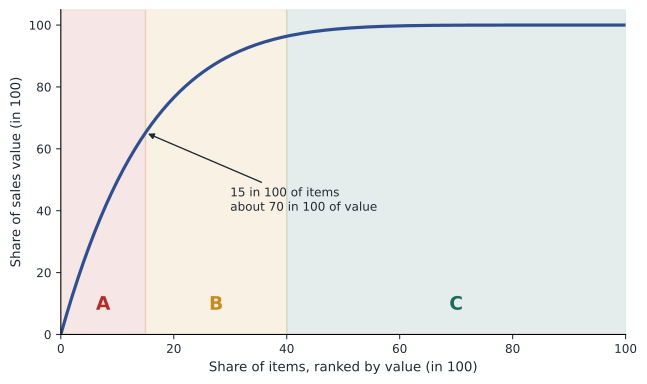
The usual way to plan cycle counts is ABC classification. Items are ranked by value, often annual sales or annual cost of goods sold, and split into three groups. A items are the small number of items that account for most of the value; they are counted most often. B items are counted less often, and C items, the many low-value items, least often. The idea comes from the observation that a small share of items usually accounts for most of the value, sometimes called the 80/20 rule.
| Class | Share of items | Share of sales value | Count frequency at Juniper & Pine |
|---|---|---|---|
| A | About 15 in 100 | About 70 in 100 | Monthly |
| B | About 25 in 100 | About 20 in 100 | Quarterly |
| C | About 60 in 100 | About 10 in 100 | Twice a year |
Worked problem
Planning a cycle-count schedule
Juniper & Pine stocks 1,200 items (SKUs). Using the ABC split in the table, how many counts a year does the plan require, and about how many items must be counted each week?
Show solution
- A items: 15 in 100 of 1,200 = 180 items, counted 12 times a year = 2,160 counts.
- B items: 25 in 100 of 1,200 = 300 items, counted 4 times a year = 1,200 counts.
- C items: 60 in 100 of 1,200 = 720 items, counted 2 times a year = 1,440 counts.
- Total = 2,160 + 1,200 + 1,440 = 4,800 counts a year.
- \[\text{Counts per week} = \frac{4{,}800}{52} \approx 92\]
Answer: The plan needs about 4,800 item counts a year, roughly 92 a week. At about two minutes an item, that is about three hours of counting a week, which Marcus splits across early mornings before the store opens.
Some counts are triggered by events rather than the calendar. Juniper & Pine counts an item immediately when the system shows a negative quantity, when a sale is made but the item cannot be found, when a customer order is short at picking, or when the quantity falls to zero, which is when there is least to count.
Inventory record accuracy
The most common measure of how well the records match reality is inventory record accuracy (IRA): the share of counted locations or items whose recorded quantity matches the physical count, within an agreed tolerance. A tolerance allows for very small differences on low-value items where an exact match is not worth chasing. At Juniper & Pine, the tolerance is zero for A items and for anything over 100 dollars, and one unit for low-cost C items such as candles.
Worked problem
Inventory record accuracy for October
In October 2026, Juniper & Pine completed 410 cycle counts. Of these, 371 matched the record exactly, 18 were C items off by one unit, and 21 had larger differences or were A items with any difference. What was the inventory record accuracy?
Show solution
- Counts within tolerance = 371 exact + 18 C items within one unit = 389.
- \[\text{IRA} = \frac{389}{410} \approx 0.949\]
Answer: Inventory record accuracy was about 94.9 in 100, below the store's target of 97 in 100. The 21 counts outside tolerance went to Marcus for root-cause review.
Accuracy is different from the dollar value of the difference. Twenty-one items out of tolerance might add up to a few hundred dollars, or to many thousands if one of them is a missing refrigerator. Retailers usually track both: IRA shows how reliable the records are, and the net and gross dollar variance shows what the errors are worth. Net variance lets overages and shortages cancel; gross variance adds their absolute values, so it shows the total size of the errors.
Worked problem
Net and gross variance
A count of four décor items found these differences from the record: lamps −2 at 89 dollars each, cushions +3 at 39 dollars each, vases −1 at 59 dollars, rugs +1 at 279 dollars. Find the net and gross variance at retail.
Show solution
- Lamps: −2 × 89 = −178 dollars.
- Cushions: +3 × 39 = +117 dollars.
- Vases: −1 × 59 = −59 dollars.
- Rugs: +1 × 279 = +279 dollars.
- Net variance = −178 + 117 − 59 + 279 = +159 dollars.
- Gross variance = 178 + 117 + 59 + 279 = 633 dollars.
Answer: The net variance is an overage of 159 dollars, which looks harmless, but the gross variance is 633 dollars. The records were wrong on every item; the errors simply offset each other.
Fixing the cause, not just the count
When a count is wrong, the easy response is to adjust the record and move on. The useful response is to find out why. Marcus asks three questions about every count outside tolerance. When was this item last counted correctly? What transactions happened since then: receipts, sales, returns, transfers, write-offs? And which of those transactions is most likely to be wrong? Often the answer is a receipt entered against the wrong item, or a sale scanned as a similar item. Sometimes it is a process gap, such as damaged goods being thrown away without a write-off.
Aiden's three missing blankets were a typical case. The transaction history showed that a receiver had moved a carton of blankets to make room on September 18 but had not recorded the move, because the move screen on the handheld scanner needed a manager's sign-in. Marcus changed the permission so any trained receiver could record moves. Over the next month, location errors in the décor overstock fell from 9 to 2.
Some adjustments need approval. Juniper & Pine requires a manager to approve any single adjustment over 250 dollars at retail, and Marcus reviews every adjustment report weekly. Adjustments are one of the ways employee theft can be hidden, because a stolen item can be made to disappear from the records with a quick change. Separating the person who counts from the person who approves the adjustment is a basic control.
Counting in a furniture store
Furniture and appliances bring their own counting problems. A sectional may be three or four cartons that are sold as one item, so the count has to check that every piece of the set is present. Floor models are sold and replaced, and a floor model that has been sold but not yet delivered still sits on the floor. Special orders that have arrived but not been delivered belong to customers. Repair and damage areas hold goods waiting for a decision. Juniper & Pine labels each of these with colored tags, so a counter knows instantly whether an item is sellable stock, sold, a customer's special order, or damaged.
Getting ready for the January 2027 count
Marcus's plan for the next full count, set for the last weekend of January 2027, used what the cycle counts had taught. Every warehouse location would be relabeled and checked against the system in the first two weeks of January, so that counters would not waste time on unlabeled bays. All customer special orders and sold-but-not-delivered floor models would carry red tags by January 22. Holiday returns would be processed and given a disposition by January 20, because a cage full of unprocessed returns is one of the most common reasons a count goes wrong. The outside inventory service would count the sales floor on Saturday evening after closing, and the warehouse team would count the back of house on Sunday morning. And no adjustment would be posted until every area with a variance over 500 dollars had been recounted. "A count is only as good as the week before it," Marcus said. Aiden was on the list of counters for the warehouse.
Common mistakes
MistakeAdjusting the record whenever a count disagrees, without asking why.
InsteadFind the transaction that went wrong and fix the cause.
MistakeLetting counters see the expected quantity.
InsteadCount blind, so the count measures what is there.
MistakeReporting only the net variance.
InsteadReport gross variance too, because offsetting errors still mean wrong records.
MistakeCounting everything equally often.
InsteadUse ABC classification: count high-value items most often.
MistakeLetting the person who counts also approve the adjustment.
InsteadSeparate counting from approval, and review adjustment reports weekly.
Summary and key terms
- A perpetual inventory is the running record of what should be on hand, and it drifts because every receipt, sale, move, return and write-off must be recorded correctly.
- Most record errors come from process mistakes rather than theft.
- A full physical count compares everything with the records once or twice a year and measures shrink; it needs preparation, frozen records, mapped areas, blind counts, recounts and reconciliation.
- Cycle counting counts part of the inventory every week, so errors are found while they are recent, and ABC classification counts high-value items most often.
- Inventory record accuracy is the share of counts within tolerance.
- Net variance lets errors offset; gross variance shows their total size.
- Every count outside tolerance should be traced to its cause, and adjustments need approval separate from counting.
- Furniture stores must also track multi-carton sets, floor models, special orders and damaged goods.
- Perpetual inventory
- A running record of units on hand, updated by every transaction.
- Physical inventory
- A count of every item at one time, compared with the records.
- Blind count
- A count made without seeing the quantity the system expects.
- Cycle counting
- Counting a small part of the inventory regularly throughout the year.
- ABC classification
- Ranking items by value into A, B and C groups to set how often each is counted.
- Inventory record accuracy
- The share of counts whose recorded quantity matches the physical count within tolerance.
- Net variance
- The total difference between records and counts, with overages and shortages offsetting.
- Gross variance
- The sum of the absolute values of all differences.
Practice problems
Work each problem on paper first, then reveal the answer to check.
A store completes 300 cycle counts and 282 are within tolerance. What is its inventory record accuracy?
Show answer
282 ÷ 300 = 0.94, or 94 in 100.
A count finds chairs −1 at 249 dollars and stools +2 at 89 dollars. What are the net and gross variances?
Show answer
Net = −249 + 178 = −71 dollars; gross = 249 + 178 = 427 dollars.
Why are A items counted more often than C items?
Show answer
They carry most of the sales value, so their errors cost the most and affect the most sales.
Lesson quiz · 5 questions
Score 60% or more to complete this lesson.
Create a free account to save your progress, take quizzes and earn a certificate.