
SLS-252 · Lesson 2 of 12 · 22 min
Receiving and stocking
▶ Video coming soon A video version of this lesson is on the way.
The second back-room session, on September 22, 2026, started at the dock. A 53-foot trailer from Juniper & Pine's mattress supplier had backed in at 7:00 a.m., and two receivers were already unloading it with a pallet jack. Marcus handed Aiden a clipboard with the packing slip and asked him to do one thing: before anything was signed, find out whether the truck held what the store had ordered, in the condition it had been ordered. Twenty minutes later Aiden had found two problems. The truck carried 22 queen mattresses rather than the 24 on the packing slip, and one king carton had a forklift puncture in its side. "Good," Marcus said. "Now we write both on the delivery receipt before the driver leaves. After that, they're our problem, not the carrier's."
Why receiving matters
Receiving is the process of accepting merchandise from a supplier or carrier, checking it, recording it and moving it into stock. It is the point where responsibility for the goods usually passes to the store, so it is also the point where errors are cheapest to catch. A short shipment that is noted before the driver signs out becomes a claim against the supplier or carrier. The same shortage found a week later becomes an argument, and often becomes shrink.
Receiving errors spread. If the store records 24 mattresses when 22 arrived, the inventory system will show two mattresses that do not exist. A salesperson may sell one of them, a delivery may be scheduled, and the shortfall surfaces only when the warehouse cannot find it on delivery day. The customer is disappointed, the delivery slot is wasted, and the eventual count shows a loss that nobody can explain. Retail loss surveys have long counted process and paperwork errors as one of the main sources of shrink, alongside theft, and receiving is where many of those errors start.
The documents
Three documents are at the center of receiving. The purchase order (PO) is the store's order to the supplier: what items, how many, at what cost and by when. The packing slip or bill of lading arrives with the goods and lists what the supplier says it shipped. The invoice is the supplier's bill. Many suppliers also send an advance ship notice (ASN) electronically before the truck arrives, listing the cartons and their contents.
The store should pay only for what it ordered and actually received in good condition. Checking that the purchase order, the receiving record and the invoice agree before paying is called a three-way match. At Juniper & Pine, the receiver records what actually arrived; the accounts payable clerk at the owners' office matches that record against the purchase order and the invoice, and holds payment on any line that does not agree.
| Document | Who creates it | What it says | What the store checks |
|---|---|---|---|
| Purchase order | The store (buyer) | What the store ordered, quantity, cost, delivery date | That the goods were ordered at all |
| Advance ship notice | The supplier, electronically | What is coming and in which cartons | That the truck matches the notice |
| Packing slip or bill of lading | The supplier or carrier | What was shipped and how many pieces | Carton count and condition at the dock |
| Receiving record | The store (receiver) | What actually arrived and its condition | Quantities by item, damage, substitutions |
| Invoice | The supplier | What the store is being billed | That it matches the purchase order and the receiving record |
Receiving step by step
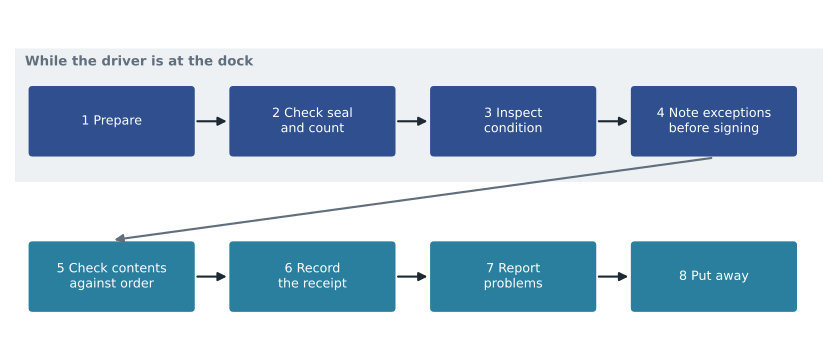
Juniper & Pine's receiving procedure has eight steps. The order matters: the most important checks happen before the driver leaves, because that is when the store can still note problems on the carrier's paperwork.
- Prepare. Check the receiving schedule and pull up the purchase order or advance ship notice before the truck arrives, so the receiver knows what to expect. Clear the dock and stage enough floor space.
- Check the seal and the carton count. Before unloading, confirm that the trailer seal number matches the paperwork, if the load was sealed. Count cartons or pieces as they come off the truck and compare the total with the bill of lading.
- Inspect the condition. Look at every carton for punctures, crushed corners, water stains and retaping. Furniture cartons that rattle or feel wrong are opened on the spot.
- Note exceptions before signing. Write shortages, overages and visible damage on the delivery receipt, with the carton or item number, and have the driver initial the note if the carrier allows. A clean signature tells the carrier everything arrived in good order.
- Check the contents against the order. After the driver leaves, open or scan cartons and compare item numbers, colors, sizes and quantities with the purchase order. Watch for substitutions: a gray sofa where navy was ordered is not a match.
- Record the receipt. Enter what actually arrived in the inventory system the same day, so the stock becomes available to sell and the record matches reality.
- Report problems. Send damage photos and shortage notes to the buyer, who files claims with the supplier or carrier. Concealed damage, found only when a carton is opened, must be reported quickly; carriers and suppliers set short time limits.
- Put away. Move goods to their labeled locations or to the floor, and record the location if the system tracks it.
Worked problem
Recording the mattress delivery
The purchase order for the September 22 truck listed 24 queen and 12 king mattresses, all the store-label hybrid model, at a cost of 410 dollars for each queen and 520 dollars for each king. The truck held 22 queens and 12 kings, and one king carton was punctured, with a torn cover inside. What should the receiving record show, and how much should the store expect to pay on the invoice?
Show solution
- Queens: ordered 24, received 22, short 2.
- Kings: ordered 12, received 12, of which 1 is damaged and set aside for a claim.
- Good stock to record: 22 queens and 11 kings, plus 1 king in a damaged-goods location.
- Value of goods received in good condition = 22 × 410 + 11 × 520 = 9,020 + 5,720 = 14,740 dollars.
- Value of the full order = 24 × 410 + 12 × 520 = 9,840 + 6,240 = 16,080 dollars.
- Difference = 16,080 − 14,740 = 1,340 dollars: 2 queens short (820 dollars) and 1 damaged king (520 dollars).
Answer: The record should show 22 queens and 11 good kings, with 1 damaged king held for a claim. The store should pay 14,740 dollars until the shortage and the damage are resolved, not the 16,080 dollars on the original order.
Receiving delivery orders and special orders
Furniture stores receive two kinds of merchandise. Stock is bought to sell to anyone, like the queen mattresses. Special orders are made for a specific customer, such as a sofa in a fabric the customer chose. A special order arrives already sold, so it should be matched to the customer's order as it is received, inspected especially carefully, tagged with the customer's name and order number, and staged for delivery or pickup. A special-order sofa that is put away as ordinary stock can be sold to someone else, leaving the original customer waiting for a second one.
Customer deliveries depend on receiving too. Juniper & Pine's delivery redesign, piloted from October 5, gives customers a two-hour delivery window chosen at the time of sale. That promise works only if the sold item is actually in the warehouse, in good condition, when the route is built at 4 p.m. the day before. Hamid, who leads the delivery crew, put it bluntly at one session: "A two-hour window means nothing if the dresser is still in a box on the dock."
Stocking and put-away
Once goods are received, they need a home. Put-away is moving merchandise from the dock to a storage location or the sales floor. A good put-away system lets anyone find any item quickly, uses space well, and keeps goods safe from damage.
- Labeled locations. Every rack bay, shelf and floor zone has a location code, such as W2-B3 for warehouse aisle 2, bay 3. The system records which items are in each location. An item without a recorded location is effectively lost, even if it is in the building.
- First in, first out. Older stock should be sold or picked before newer stock of the same item, so it does not age or get damaged. This is usually called FIFO.
- Heavy items low. Appliances, dressers and mattresses are stored at floor level or on the lowest beam of the racking. Light, bulky goods such as cushions and lamp shades can go higher.
- Protect finishes. Upholstery stays wrapped and off the floor, wood case goods stay boxed or blanketed, and nothing is stacked on top of glass or marble.
- Separate the exceptions. Damaged goods, customer returns waiting for inspection, special orders and goods on hold each have their own marked area, so they are not mistaken for sellable stock.
Space is limited, so Marcus tracks how full the warehouse is. When it passes about 90 in 100 of its usable positions, receivers start double-handling goods, moving one pallet to reach another, which slows work and raises the risk of damage.
Worked problem
How full is the warehouse?
Juniper & Pine's warehouse has 180 pallet positions. On October 13, 2026, the location report showed 151 positions in use, and the fall upholstery reorder (12 gray and 10 oatmeal sectionals, each taking one position) was due to arrive that week. How full would the warehouse be after it arrived?
Show solution
- Positions after the delivery = 151 + 12 + 10 = 173.
- \[\text{Utilization} = \frac{173}{180} \approx 0.961\]
Answer: The warehouse would be about 96 in 100 full, above the 90 in 100 point where work slows. Marcus scheduled two days of deliveries from stock before the truck arrived and moved slow décor overstock to the mezzanine.
Moving stock to the floor
Stock moves from the warehouse to the sales floor when a display sells or a shelf needs filling. Every move should be recorded if the system tracks locations, and every item that goes onto the floor should carry the right ticket. Floor models in a furniture store are a special case: when the last floor model of a sofa sells, the store needs another sample on the floor, and the visual merchandising team (Noura Saleh's team at Juniper & Pine) decides what replaces it.
Damage also happens in transit inside the building. A dresser dragged across concrete, a mattress stood on its end beside a sharp rack upright, or a stack of chairs on an unsecured cart will all lose value. The warehouse at Juniper & Pine uses dollies and furniture blankets for every move, and staff are trained to lift as a team for anything over about 23 kilograms (50 pounds), a practice lesson 10 returns to.
Measuring receiving
Three measures tell Marcus whether receiving is working. Receiving accuracy is the share of received lines entered with the correct item and quantity, checked by recounting a sample. Dock-to-stock time is how long it takes from the truck arriving to the goods being available to sell. Supplier fill rate is the share of ordered units the supplier actually delivers. Each one points to a different fix: training for accuracy, staffing or layout for dock-to-stock time, and conversations with the supplier for fill rate.
Worked problem
Supplier fill rate in September
In September 2026, Juniper & Pine ordered 412 units from its store-label mattress supplier and received 396 units in good condition. What was the supplier's fill rate?
Show solution
- \[\text{Fill rate} = \frac{396}{412} \approx 0.961\]
Answer: The fill rate was about 96.1 in 100. The buyer raised the two short shipments with the supplier's account manager, because a fill rate below the 98 in 100 the supplier had promised meant the store was running short of its best-selling queen.
Common mistakes
MistakeSigning the delivery receipt before counting and inspecting.
InsteadCount and inspect first, and note every shortage and visible damage on the receipt before signing.
MistakeRecording what the packing slip says rather than what arrived.
InsteadRecord only what was actually received, in good condition, on the day it arrived.
MistakePutting a special order away as ordinary stock.
InsteadTag special orders with the customer's name and order number and stage them for delivery.
MistakeLeaving goods in a location the system does not know about.
InsteadRecord every location, or the item is effectively lost.
MistakePaying the invoice for the full order when some goods were short or damaged.
InsteadMatch the purchase order, receiving record and invoice, and pay only for what was received in good condition.
Summary and key terms
- Receiving accepts, checks, records and puts away merchandise, and it is the cheapest point to catch errors.
- The purchase order says what was ordered, the packing slip or bill of lading what was shipped, the receiving record what arrived, and the invoice what the supplier bills; a three-way match checks they agree before payment.
- Count cartons and inspect them before the driver leaves, and note shortages and damage on the delivery receipt before signing.
- Then check contents against the order, record the receipt the same day, report problems quickly, and put goods away in recorded locations.
- Special orders are tagged to the customer and staged for delivery.
- Good stocking uses labeled locations, first in first out, heavy items low and separate areas for damaged, returned and held goods.
- Receiving accuracy, dock-to-stock time and supplier fill rate show whether receiving is working.
- Receiving
- Accepting, checking, recording and putting away merchandise from a supplier or carrier.
- Purchase order
- The store's order to a supplier, stating items, quantities, costs and dates.
- Packing slip
- The supplier's list of what was shipped.
- Advance ship notice
- An electronic notice from the supplier of what is about to arrive.
- Three-way match
- Checking that the purchase order, receiving record and invoice agree before paying.
- Concealed damage
- Damage found only when a carton is opened after delivery.
- Put-away
- Moving received goods to a storage location or the sales floor.
- Supplier fill rate
- The share of ordered units a supplier actually delivers.
Practice problems
Work each problem on paper first, then reveal the answer to check.
A purchase order lists 30 lamps at 38 dollars each. The truck brings 28, and one is broken. How many lamps should be recorded as good stock, and what is their value at cost?
Show answer
27 lamps; 27 × 38 = 1,026 dollars.
Why should exceptions be written on the delivery receipt before the driver leaves?
Show answer
A clean signature tells the carrier everything arrived in good order, making a later claim much harder.
A warehouse has 200 positions and 176 are in use. How full is it?
Show answer
176 ÷ 200 = 0.88, or 88 in 100.
Lesson quiz · 5 questions
Score 60% or more to complete this lesson.
Create a free account to save your progress, take quizzes and earn a certificate.