
SLS-251 · Lesson 7 of 12 · 21 min
Lighting, color and sound
▶ Video coming soon A video version of this lesson is on the way.
In September 2026 Juniper & Pine replaced the last 40 halogen spotlights in its mattress gallery with LED fixtures. The decision was made to save energy, but the first comment Noura heard was about something else. Carl Jensen, who has sold mattresses at the store for nine years, said the gallery suddenly felt "like a hotel instead of a warehouse". The new fixtures were warmer in color, cast softer shadows and lit the beds rather than the aisles. On the Tuesday merch walk of November 3, Noura used the gallery to teach Aiden how light, color and sound shape how shoppers feel, how long they stay and what they notice.
Shoppers experience a store through all their senses. Researchers in environmental psychology, starting with Albert Mehrabian and James Russell in the 1970s, proposed that surroundings affect how pleasant and how stimulating people find a place, and that these feelings influence whether they stay or leave. Mary Jo Bitner later called the designed physical setting of a business its servicescape. Many studies since have linked lighting, color, music and even scent to shoppers' moods and behavior. The findings are real but uneven: many come from a single store or a laboratory, effects are often small, and some famous results have not been repeated. This lesson presents the main tools and the evidence, and treats each as something to test in your own store.
Layers of light
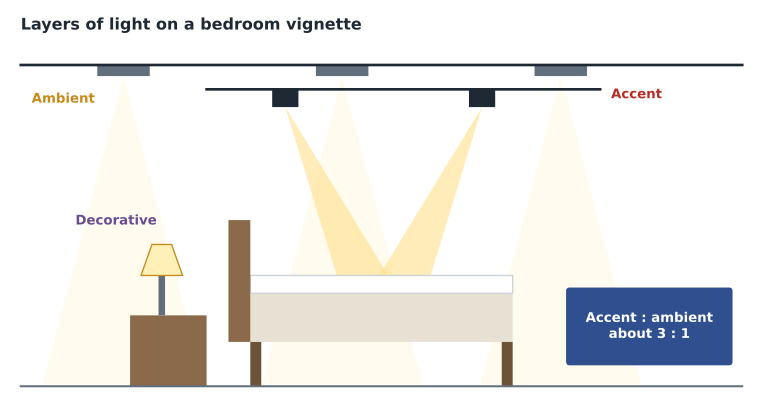
Retail lighting is usually designed in layers, each with a different job.
| Layer | Job | Example at Juniper & Pine |
|---|---|---|
| Ambient (general) | Lets people see and move safely; sets the overall brightness | Ceiling fixtures over the whole floor |
| Accent | Draws the eye to products and displays | Adjustable track spotlights on vignettes, beds and feature tables |
| Task | Lights work areas | Lights over the sales desk, the pick-up counter and the stockroom |
| Decorative | Adds character; often the product itself | Table lamps and pendant lights on display, switched on |
| Daylight | Natural light from windows and skylights | The front windows and a row of skylights over décor |
Accent lighting does most of the merchandising work. The eye goes to the brightest thing in view, so the products a merchandiser most wants noticed should be lit more brightly than their surroundings. The difference between accent and ambient light is often described as a ratio. A ratio of about 2 to 1 is barely noticeable; around 3 to 1 or 5 to 1 makes a product stand out clearly; 10 to 1 or more is dramatic, as in a jewelry case or a museum. Too many brightly lit spots in one area cancel each other out, because nothing stands out when everything does.
Worked problem
Is the feature bed lit strongly enough?
Noura measured light levels in the mattress gallery with a light meter. The general light level in the aisles was about 50 foot-candles. On the feature bed at the gallery entrance, the new accent lights gave about 150 foot-candles. On a bed in the back row, which had no accent light, the level was about 45 foot-candles. What were the accent ratios?
Show solution
- Feature bed compared with the aisle:
- \[150 \div 50 = 3\]
- Back-row bed compared with the aisle:
- \[45 \div 50 = 0.9\]
Answer: The feature bed has a ratio of about 3 to 1, enough to stand out. The back-row bed is slightly darker than the aisle, which makes it look like the unwanted end of the range. Noura re-aimed two spare track heads to give the back row about 90 foot-candles, a ratio of about 1.8 to 1, so it would look cared for without competing with the feature bed.
Glare, shadows and safety
Good lighting is also comfortable and safe. Spotlights aimed too low shine into shoppers' eyes as they walk toward a display, and bright reflections on glossy tables and stainless steel can make labels unreadable. Noura checks every re-aimed track head by walking the main aisle in both directions and looking for any light that shines into her eyes. Deep shadows on steps, platform edges and the transition from aisle to department floor are trip hazards, especially for older shoppers and people with low vision, so platforms at Juniper & Pine have a lit or contrasting edge. Emergency lighting and exit signs are part of the building's life-safety systems and must never be covered by displays, decorations or banners, a point Marcus checks after every reset.
Color temperature and color rendering
Light has a color, measured as color temperature in kelvins (K). Low values, around 2,700 to 3,000 K, look warm and yellowish, like a lamp in a living room. Around 4,000 K looks neutral. Values of 5,000 K and above look cool and bluish, like daylight on a cloudy day. Home stores usually use warm to neutral light, because it makes rooms feel welcoming and resembles light at home, where customers will use the products. Appliances, with their stainless steel and white finishes, often look better under neutral light. Juniper & Pine uses 3,000 K in its furniture and mattress areas and 3,500 to 4,000 K in appliances.
Equally important is color rendering: how accurately light shows the true colors of objects. It is measured with the color rendering index (CRI), on a scale up to 100. Cheap lighting with a low CRI can make a blue sofa look gray or a wood finish look muddy, which leads to returns when the customer sees the product at home. For fabrics, finishes and paint colors, merchandisers look for a CRI of 90 or higher. The halogen spotlights in the gallery rendered color well but used a great deal of energy and ran hot; the LED replacements were chosen with a high CRI so that the change saved energy without making fabrics look worse.
Worked problem
What did the LED change save?
The 40 halogen spotlights used 50 watts each. Each LED replacement uses 7 watts. The lights run about 12 hours a day, 363 days a year. Using an illustrative electricity price of 0.15 dollars per kilowatt-hour, how much energy and money does the change save in a year?
Show solution
- Watts saved per fixture:
- \[50 - 7 = 43\ \text{W}\]
- Total watts saved:
- \[40 \times 43 = 1{,}720\ \text{W} = 1.72\ \text{kW}\]
- Energy saved in a year:
- \[1.72 \times 12 \times 363 \approx 7{,}492\ \text{kWh}\]
- Money saved at 0.15 dollars per kilowatt-hour:
- \[7{,}492 \times 0.15 \approx 1{,}124\ \text{dollars}\]
Answer: The change saves about 7,500 kilowatt-hours a year, worth roughly 1,100 dollars at the illustrative price, before counting the lower cooling load from cooler-running lights and the fewer bulb replacements. The actual saving depends on the store's electricity rate.
Color in the store
Color in a store comes from the walls, floors, fixtures, signs and, above all, the products. Merchandisers think about it at three scales. At the scale of the store, a consistent palette of wall and fixture colors, usually neutral, lets the products be the strongest colors in view. At the scale of a department, accent walls and floor finishes can mark areas and set a mood: Juniper & Pine's mattress gallery has deep blue-gray walls that feel calm, while décor has white walls that make colorful products pop. At the scale of a display, color blocking and contrast, described in lesson 5, organize the products.
Popular articles often claim that particular colors cause particular feelings or behavior: red excites and makes people hungry, blue calms, green feels natural. Research shows that colors do have associations and can influence impressions, but the effects depend heavily on culture, context, the shade and saturation, and the product. A claim such as "red increases sales" is too simple to rely on. What is well supported is the practical effect of contrast: products stand out against backgrounds that differ from them.
Sound
Music is one of the easiest parts of the environment to change and one of the most studied. In a frequently cited 1982 study, Ronald Milliman found that shoppers in one American supermarket moved more slowly and spent more when the background music was slow than when it was fast. In a 1997 study in an English wine shop, Adrian North, David Hargreaves and Jennifer McKendrick found that French wine outsold German wine when French music played, and the reverse when German music played, although few shoppers said they had noticed the music. These studies were small and limited to particular stores, and later research shows that the effects of music depend on whether it fits the store, the product and the shoppers. The general lessons that hold up are that music should suit the store and its customers, that tempo and volume affect the pace and mood of shopping, and that music that does not fit can drive people away.
At Juniper & Pine the background music is soft and moderate in tempo, mostly instrumental and acoustic, and kept at a volume low enough that associates and customers can talk easily. During the holiday season it shifts to seasonal music, which Noura limits in the weeks before December because staff and regular customers tire of it quickly. Announcements over the speakers are kept to a minimum.
Playing recorded music in a store is a public performance, which generally requires licenses from the performing rights organizations, such as ASCAP, BMI, SESAC and GMR. Federal law exempts some small stores, but a store the size of Juniper & Pine is not exempt. The store uses a commercial background-music service whose subscription includes the licenses for business use. A personal streaming account is licensed only for personal listening, not for playing in a store.
Sound also includes noise. Hard floors and high ceilings make large stores echo, and noise from a busy sales desk or a delivery bay can carry across the floor. Rugs, upholstered furniture and acoustic panels absorb sound, which is one reason the furniture departments are quieter than appliances. A quiet area where customers can sit and talk about a big decision is valuable in a home store; Juniper & Pine set one up beside the mattress gallery in 2025.
Scent and temperature
Some retailers add scent to their stores, and research has linked pleasant, fitting scents to more positive impressions and longer visits in some settings. Scent also has costs: some shoppers and staff have allergies, asthma or sensitivity to fragrances, and a scent that seems pleasant to one person is overwhelming to another. Juniper & Pine does not add scent, but it does make sure the store does not smell of anything unpleasant, such as packaging, cleaning products or the delivery bay. Comfortable temperature matters too: a store that is too warm in winter, when shoppers are wearing coats, or too cold in summer shortens visits.
Putting it together
Lighting, color and sound work together, and the aim is a consistent experience that suits the products and the people who buy them. Noura judges the gallery by standing in it for five minutes and asking whether she would be happy to lie on a bed there while someone watched. Since the lighting change, the answer has been yes. Whether the new lighting also sells more mattresses is a question for lesson 11, which looks at how to measure changes like this one.
Common mistakes
MistakeLight the whole store as brightly as possible.
InsteadUse layers. Products stand out when accent light is brighter than the surroundings, not when everything is bright.
MistakeAny LED is as good as any other.
InsteadCheck color temperature and color rendering. A low-CRI light can make fabrics look wrong and cause returns.
MistakeRed walls will increase sales.
InsteadColor effects depend on culture, context and product. Rely on contrast, which is well supported.
MistakeAny music will do, and a personal streaming account is fine.
InsteadChoose music that fits the store, keep it at a talking volume, and use properly licensed business music.
MistakeA pleasant scent can only help.
InsteadScent can bother people with allergies or sensitivities. Test carefully, or simply keep the store free of bad smells.
Summary and key terms
- Shoppers respond to the whole sensory environment, though research findings vary in strength and should be tested locally.
- Retail lighting uses ambient, accent, task, decorative and natural layers; accent light about three to five times the general level makes products stand out.
- Warm to neutral color temperatures suit home stores, and a color rendering index of 90 or more shows fabrics and finishes accurately.
- Use a neutral palette so products carry the color, and rely on contrast rather than simple claims about color psychology.
- Music should fit the store and allow conversation, and it must be licensed for business use.
- Noise, scent and temperature also shape how long people stay and how they feel.
- Servicescape
- The designed physical setting in which a business serves its customers.
- Accent lighting
- Directed light that makes particular products or displays stand out.
- Accent ratio
- The light level on a featured product divided by the general light level around it.
- Color temperature
- The warmth or coolness of light, measured in kelvins.
- Color rendering index (CRI)
- A measure, up to 100, of how accurately light shows the true colors of objects.
Practice problems
Work each problem on paper first, then reveal the answer to check.
A display is lit at 120 foot-candles in an area with a general level of 40 foot-candles. What is the accent ratio?
Show answer
3 to 1.
Why might a home store use 3,000 K lighting in furniture and 4,000 K in appliances?
Show answer
Warm light makes rooms feel welcoming like a home; neutral light suits stainless steel and white appliance finishes.
Ten 35-watt lights are replaced with 6-watt LEDs and run 10 hours a day for 360 days. How many kilowatt-hours are saved?
Show answer
29 watts saved each, 290 watts in all, 0.29 kW times 3,600 hours is 1,044 kWh.
What do the Milliman and North studies suggest, and what are their limits?
Show answer
That music tempo and style can influence shoppers' pace and choices; but they were small studies in single stores, and effects depend on fit.
Lesson quiz · 5 questions
Score 60% or more to complete this lesson.
Create a free account to save your progress, take quizzes and earn a certificate.