
SLS-251 · Lesson 3 of 12 · 21 min
Fixtures and capacity
▶ Video coming soon A video version of this lesson is on the way.
On Tuesday, October 13, Noura took Aiden to the décor wall to count. Not shoppers this time, but products. "Every fixture is a promise," she said. "It promises the shopper that the product will be there, and it promises the store that the space will earn its keep. Today we find out whether the throw-blanket fixture keeps its promises." By the end of the hour they had found that the fixture held 48 blankets, sold about 30 a week, and was refilled only on Mondays and Thursdays, which meant that by Saturday afternoon the most popular color was usually gone.
A fixture is any piece of store equipment that holds or shows merchandise: shelving, tables, platforms, racks, bins, wall systems, display cases. Choosing the right fixture and filling it with the right amount of stock is one of the most practical parts of visual merchandising. This lesson covers the main fixture types, how to work out how much a fixture holds, how capacity relates to sales and replenishment, and the safety limits every fixture must respect.
Types of fixtures
| Fixture | Best for | Notes |
|---|---|---|
| Gondola (double-sided shelving unit) | Small and medium goods in quantity: décor, lamps, small appliances | Adjustable shelves; ends of the run are called end caps |
| Wall system (slatwall, pegboard, standards and brackets) | Using wall height for product and display | Shows product from across the floor; good for the back and perimeter |
| Table and nesting tables | Feature displays, gifts, folded textiles | Low height keeps sightlines open; nesting sets create levels |
| Platform or riser | Large items: sofas, beds, dining sets | Raises a vignette so it is seen from the aisle |
| Bin or dump table | Low-priced, impulse or clearance items | Signals value; looks untidy if not maintained |
| Case or cabinet | Small, valuable or fragile items | Improves security but reduces touching |
| Appliance row (floor bays) | Refrigerators, ranges, washers, side by side for comparison | Needs power and water hook-ups for demonstration models |
The fixture shapes the message. A neat glass cabinet says "special and valuable". A crowded bin says "bargain". A styled table with a few pieces says "this is how you could use it at home". Using a bin for premium cushions, or a cabinet for clearance mugs, sends the wrong signal before any shopper reads a price.
Facings, depth and capacity
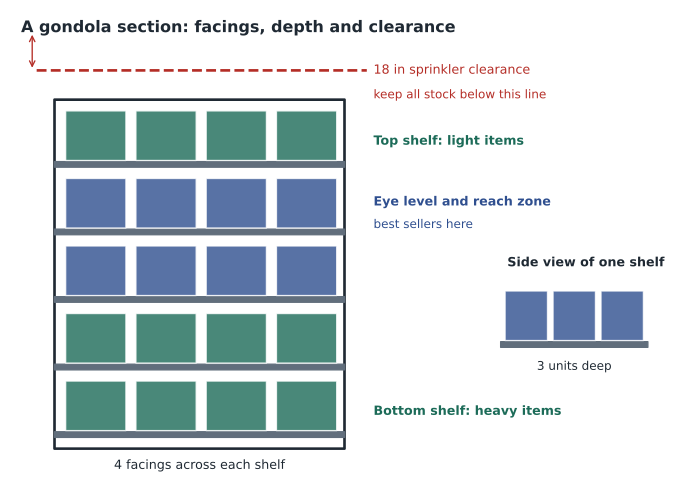
The basic unit of shelf space is the facing: one product, or one stack of identical products, seen from the front. A shelf with four facings of a candle shows four candles side by side. Behind each facing there may be more units, which is the fixture's depth. The capacity of a fixture is how many units it holds when full:
Most of the time products are not stacked, so units high is 1. Facings across a shelf come from the shelf width divided by the product width, rounded down, and units deep come from the shelf depth divided by the product depth, also rounded down. Rounding down matters: a product that is 13 inches wide does not fit four times on a 48-inch shelf, even though 48 divided by 13 is close to 4.
Worked problem
Capacity of a gondola section
A gondola section is 48 inches wide and has 5 shelves, each 18 inches deep. A boxed table lamp is 12 inches wide and 6 inches deep, and the lamps are not stacked. How many lamps does the section hold when full?
Show solution
- Facings per shelf:
- \[48 \div 12 = 4\]
- Units deep per facing:
- \[18 \div 6 = 3\]
- Capacity:
- \[4 \times 3 \times 1 \times 5 = 60\]
Answer: The section holds 60 lamps: 4 facings across, 3 deep, on 5 shelves. If the shelves were 16 inches deep instead, the lamps would fit only 2 deep (16 divided by 6 is 2.67, rounded down), and capacity would fall to 40.
Capacity and sales: keeping the promise
A fixture that is too small for the rate of sale runs empty between deliveries, and shoppers see gaps, which are lost sales and make the store look neglected. A fixture that is far too big ties up money in stock, hides other products and often looks cluttered. The right capacity depends on three things: how fast the product sells, how often it is refilled, and a safety margin for busy days.
Worked problem
Is the throw-blanket fixture big enough?
The throw-blanket fixture holds 48 blankets. Sales average 30 a week, but about half of the week's sales happen on Friday, Saturday and Sunday. Staff refill the fixture on Mondays and Thursdays from the stockroom. Thursday's refill must last until Monday morning. Noura wants a safety stock of 8 blankets for an unusually busy weekend. Is the fixture big enough, and if not, what could be changed?
Show solution
- Sales from Thursday's refill to Monday's, about half the week plus Thursday afternoon. Noura estimates 18 blankets for Thursday evening through Sunday.
- Stock needed after the Thursday refill:
- \[18 + 8 = 26\]
- The fixture holds 48, so total capacity is enough. But there are 6 colors, each with 8 spaces:
- \[48 \div 6 = 8\ \text{per color}\]
- The top two colors sell about 5 each from Thursday to Sunday, and the best seller, a soft gray, sells about 9, which is more than its 8 spaces before any safety stock.
Answer: The fixture holds enough blankets in total but gives every color the same space. The best seller runs out on weekends while slower colors sit full. Noura gave the gray 14 spaces and the two slowest colors 5 each, which kept the total at 48. She also added a Saturday-morning check. The next lesson on planograms shows how to allocate facings by sales.
The blanket example shows why capacity should be planned product by product, not just fixture by fixture. Giving every item the same space is easy and looks tidy on day one, but it guarantees that the best sellers run out first.
Height zones
Shoppers do not look at all heights equally. Visual merchandisers divide shelving and walls into rough zones.
| Zone | Approximate height | Use |
|---|---|---|
| Stretch zone | Above about 6 ft | Light, bulky items, visual displays, back-up stock where allowed |
| Eye level | About 4 to 5.5 ft | Best sellers, new products, highest-margin items |
| Reach zone | About 2.5 to 4 ft | Strong sellers, items customers pick up and compare |
| Stoop zone | Below about 2.5 ft | Heavy items, bulk packs, items for children (who see this zone at eye level) |
The saying "eye level is buy level" is a rule of thumb from industry practice and research on attention, and studies of supermarket shelves generally find that products at middle heights get more attention than those at the top or bottom. The size of the effect varies by category and store, so it is best treated as a reason to put the products you most want noticed in the middle, not as a promise of a particular sales increase. Height zones also have to respect accessibility: lesson 10 explains why products on high shelves need staff help nearby, and why heavy items belong low for safety as well as convenience.
Safety limits on fixtures
Fixtures must be safe for shoppers and staff, and must not interfere with the building's fire protection.
The most important limit is the sprinkler clearance. Sprinkler heads need open space below them to spray water across the area. NFPA 13, the sprinkler standard that the International Fire Code references, requires stored goods to stay at least 18 inches below the sprinkler deflectors. In practice, stores mark a clearance line on walls and tall fixtures and train staff never to stack product above it. Shelving against a wall that is not directly under a sprinkler can sometimes extend higher, but that decision belongs to the fire inspector or the store's fire-protection contractor, not to the merchandiser.
Other limits are about stability and loads. Fixtures must be used within the weight ratings the manufacturer gives for each shelf and bracket. Tall fixtures must be anchored to the wall or floor as the manufacturer specifies. Heavy items go on low shelves, both so they cannot fall on someone and so staff and customers do not lift them from above shoulder height. Displays of furniture that could tip, such as tall bookcases and dressers, are anchored on the floor just as the store tells customers to anchor them at home, which SLS-250 covered at the counter.
Glass shelves, sharp edges and protruding hooks need particular care. Pegboard hooks at eye height should have safety caps or be the type that folds, because a bare hook at face height is a real injury risk, especially for children and for anyone with low vision. Marcus checks fixtures for loose brackets, overloaded shelves and missing anchors on his monthly walk.
Flexibility
A fixture that can change is worth more than one that cannot. Adjustable shelf heights, tables on lockable casters, modular platforms that join in different shapes and wall systems that accept shelves, hooks and faceouts all let the store change displays without buying new equipment. Juniper & Pine switched its décor floor to rolling nesting tables in 2023, and Noura estimates that it cut the time for a seasonal reset of that area roughly in half. Lesson 9 returns to resets.
Measuring shelf space
Retailers often measure shelf space in linear feet: the total length of shelf edge available for a category. A gondola section 4 feet wide with 5 shelves gives 20 linear feet of shelf; a run of eight such sections on both sides of a gondola gives 320. Linear measure lets a merchandiser compare categories quickly. When Noura reviewed décor in October, candles had 60 linear feet and picture frames 80, although candles sold almost twice as many units a week. That did not prove frames had too much space, since frames are wider and slower by nature, but it was a reason to look closely at the next planogram.
A fixture checklist
Before a fixture goes on the floor or is refilled for a new display, Noura runs through a short checklist with whoever is setting it up:
| Check | Question to ask |
|---|---|
| Message | Does this type of fixture suit the product's price and image? |
| Capacity | Will it hold enough stock to last until the next refill, product by product? |
| Height | Are best sellers at eye level and heavy items low? |
| Clearance | Is all stock below the sprinkler line, and are exits, extinguishers and signs clear? |
| Stability | Is it within its load rating, anchored if tall, with no bare hooks at face height? |
| Access | Is the aisle beside it still wide enough, and can a shopper reach or ask for every item? |
The checklist takes two minutes. Noura says it has saved her from every kind of mistake she made in her first year: a display that emptied in a weekend, a glass shelf loaded past its rating, and a holiday stack that came within a hand's width of a sprinkler head.
Capacity also changes with the seasons. A fixture that holds two days of throw blankets in October may hold less than one day in early December, when sales triple. Noura reviews the capacity of her busiest fixtures before every holiday reset, and either adds a second fixture for the peak weeks or increases refills to three or four times a day. Planning for the peak, rather than the average, is what keeps the best sellers on the floor when the most shoppers are looking for them.
Common mistakes
MistakeDivide the fixture equally among products.
InsteadPlan space product by product. Best sellers need more facings or they run out first.
MistakeRound facings to the nearest whole number.
InsteadAlways round down. A product that does not fit fully does not fit.
MistakeUse the top of tall shelving for overflow stock.
InsteadStock must stay below the sprinkler clearance line, and heavy items belong low.
MistakeAny fixture can show any product.
InsteadThe fixture sends a message. A bin says bargain; a case says valuable. Match the fixture to the product.
MistakeA shelf that has not collapsed is within its rating.
InsteadUse the manufacturer's load ratings and anchor tall fixtures as specified.
Summary and key terms
- Fixtures hold and show merchandise, and their type tells shoppers something about the product.
- Capacity is facings times units deep times units high times shelves, with facings and depth rounded down.
- Stock needed equals daily sales times days between refills plus safety stock; plan it for each product, not just each fixture.
- Eye level and the reach zone get the most attention; heavy items go low.
- Stock must stay below the sprinkler clearance, and fixtures must be used within their load ratings and anchored as specified.
- Flexible fixtures make displays and resets faster and cheaper.
- Fixture
- Store equipment that holds or shows merchandise, such as shelving, tables and platforms.
- Facing
- One product, or stack of identical products, seen from the front of a shelf.
- Capacity
- The number of units a fixture or shelf holds when full.
- End cap
- The display at the end of a run of shelving, facing the aisle.
- Safety stock
- Extra stock kept to cover sales that are higher than expected.
- Sprinkler clearance
- The open space that must be kept between stored goods and the sprinkler heads above them.
Practice problems
Work each problem on paper first, then reveal the answer to check.
A shelf is 36 inches wide and 16 inches deep. A box is 8 inches wide and 5 inches deep. How many boxes fit on the shelf, unstacked?
Show answer
36 divided by 8 is 4.5, rounded down to 4 facings; 16 divided by 5 is 3.2, rounded down to 3 deep; 4 times 3 is 12 boxes.
A candle sells 6 a day and is refilled every 3 days, with a safety stock of 6. How much stock should the fixture hold after a refill?
Show answer
6 times 3 is 18, plus 6 is 24 candles.
Why should a premium product usually not go in a bin?
Show answer
A bin signals bargain or clearance and can make the product look cheap.
Who decides whether wall shelving may extend above the sprinkler clearance line?
Show answer
The fire inspector or the store's fire-protection contractor, not the merchandiser.
Lesson quiz · 5 questions
Score 60% or more to complete this lesson.
Create a free account to save your progress, take quizzes and earn a certificate.