
SLS-251 · Lesson 10 of 12 · 19 min
Accessible store design
▶ Video coming soon A video version of this lesson is on the way.
In late September, a customer who uses a power wheelchair came into Juniper & Pine to look at lift recliners for herself. She got as far as the recliner row and stopped: the aisle beside it had been narrowed by a recliner left with its leg rest extended, and there was no way through. An associate moved the chair, but by then she had seen enough to leave a note at the sales desk. "Your main aisle is lovely," it said. "Your side aisles are an obstacle course." Bev pinned the note to the staff-room wall. On Tuesday, October 13, Noura and Aiden spent the merch walk doing what the customer had done for them: walking every aisle with a tape measure, looking for places where a person using a wheelchair, a walker, a stroller or a cane would be stopped.
Accessible design means that people with disabilities can enter the store, move through it, find and reach products, get help and pay, with as much independence as other shoppers. It is a legal duty, and it is also good business: about one in four adults in Canada and the US report a disability, many more shoppers are older or have temporary injuries, and parents push strollers through the same aisles. A store that works for a person using a wheelchair usually works better for everyone. This lesson covers the laws and standards that apply, the practical dimensions merchandisers need to protect, and the everyday choices that make a store easier to use.
The legal framework
In the US, Title III of the Americans with Disabilities Act (ADA) requires public accommodations, including retail stores, to give people with disabilities full and equal enjoyment of their goods and services. New construction and alterations must meet the 2010 ADA Standards for Accessible Design. Existing stores must remove architectural barriers where doing so is "readily achievable", meaning easily accomplished without much difficulty or expense, and must offer alternatives, such as staff help, where it is not. Stores must also modify policies when needed, for example to allow service animals. The US Department of Justice enforces Title III, and private individuals can sue for barrier removal. South Dakota's own human rights law also prohibits disability discrimination in public accommodations.
Merchandisers rarely design buildings, but they control most of what goes on the floor after the building is finished: displays, fixtures, product placement, signs, seasonal stock and temporary obstacles. That is where most day-to-day accessibility problems in stores come from, so it is also where merchandisers can fix them.
Clear routes and aisles
The most important dimension is the width of the route a shopper uses to move through the store, and it must be kept clear of displays, products and furniture.
The 2010 ADA Standards require an accessible route at least 36 inches wide, which can narrow to 32 inches for short distances of up to 24 inches, such as between two fixtures. Where people need to turn around, the route needs a turning space of a 60-inch circle or a T-shaped space. The Department of Justice's guidance for small businesses makes the same point for shelves and displays: there should be a 36-inch accessible route between them, with a little more space at corners. Juniper & Pine set its own rule after the customer's note: the main aisle stays at its full 8 feet, and no side aisle may be less than 42 inches at any point, including when chairs are reclined or doors on display cabinets are open.
Worked problem
Checking two aisles
The main aisle at the entrance to the mattress gallery is 8 feet wide. A new display platform for the holiday season would stick out 3 feet into it. In the recliner department, a side aisle is 4 feet (48 inches) wide, and one recliner with its leg rest extended reaches 14 inches into the aisle. What clear width remains in each case, and does it meet the ADA's 36 inches and the store's 42-inch rule?
Show solution
- Main aisle with the platform:
- \[8 - 3 = 5\ \text{ft} = 60\ \text{in}\]
- This meets both 36 and 42 inches, and leaves room to pass.
- Side aisle with the reclined chair:
- \[48 - 14 = 34\ \text{in}\]
- This is below both 36 and 42 inches.
Answer: The holiday platform can go in the main aisle, leaving 60 inches clear. The reclined recliner narrows the side aisle to 34 inches, which fails both the ADA minimum and the store's rule, exactly the problem the customer met. The fix is to show recliners upright, with one reclined model placed where its extended leg rest does not enter an aisle.
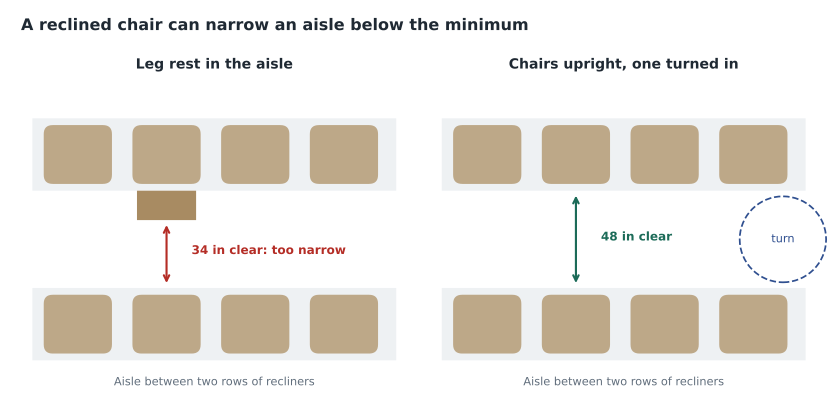
Aiden and Noura's October 13 walk found three pinch points: the reclined chair, a promotional bin left at the end of a gondola in décor, and a mattress foundation display that had crept into the side aisle of the mattress gallery. All three were fixed that morning. Noura now checks every new display against the aisle rule before it is finished, and associates are trained to notice when shoppers or other staff move things into aisles during the day.
Temporary obstacles cause as many problems as permanent ones: delivery carts, boxes waiting to be unpacked, a ladder left during a display change, a floor model moved for a customer to try and not put back. They are hard to design out, so they have to be managed by habit.
Reaching products and counters
Shoppers who use wheelchairs, are of short stature or cannot lift their arms easily need products and controls within reach. The 2010 ADA Standards set reach ranges of 15 to 48 inches above the floor for forward and side reaches without obstructions. The Department of Justice's guidance is that stores do not have to place all merchandise within reach, and that staff help can fill the gap, but self-service shelves must be on an accessible route. Sales and service counters must have a portion no higher than 36 inches and at least 36 inches long. Juniper & Pine's sales desk has a lowered section 34 inches high and 36 inches long, so that a customer using a wheelchair can complete a sale and sign comfortably, and a sign on each tall fixture says "Need something from a high shelf? Ask us."
Seeing, hearing and understanding
Accessibility is not only about wheelchairs. Many shoppers have low vision, are deaf or hard of hearing, have cognitive or learning disabilities, are autistic or find busy places overwhelming. Merchandisers make the store easier for them in several ways, many of them covered in earlier lessons.
| Need | What helps | Covered in |
|---|---|---|
| Low vision | Strong contrast on signs and tags, large plain type, even lighting without glare, contrasting edges on platforms and steps | Lessons 6 and 7 |
| Deaf or hard of hearing | Clear written information on tags and signs, pen and paper or a tablet at the desk, staff who face the customer when speaking | Lesson 6; SLS-250 |
| Cognitive and learning disabilities | Simple wayfinding, consistent tag layouts, plain-language signs, patient staff | Lessons 2 and 6 |
| Sensory sensitivity | Moderate music volume, few flashing screens, a quiet seating area | Lesson 7 |
| Fatigue and mobility | Places to sit along the route, carts, delivery and carry-out help | Lesson 2 |
| Service animals | Policies that welcome them, and staff who know the rules | Store policy |
Furniture stores have one natural advantage: there are chairs and sofas everywhere. Juniper & Pine tells associates to invite tired shoppers to sit, and keeps one comfortable chair near each department entrance free of tags and stock, so it is clearly for resting rather than for sale.
Accessible displays and vignettes
Displays themselves can be designed to include more shoppers. A vignette that can only be seen from one narrow side, or a bed that can only be reached by stepping up onto a platform, leaves some people out. Juniper & Pine's guidelines for new displays ask Noura to check four things. Can the main product be reached and tried from an accessible route, for example a bed with at least one side open to an aisle wide enough for a wheelchair to pull alongside? Are the product tags at a consistent height that a seated person can read? Are platform edges a contrasting color so they can be seen? And is there something within reach to touch, such as a fabric swatch book, when the product itself is raised or behind other items?
Trying products matters more in a home store than in many others, because a recliner, mattress or lift chair has to suit the person's body. The mattress gallery keeps one bed in each comfort range at a lower height, with a clear approach on one side, so that shoppers who transfer from a wheelchair can try it. The idea came from Carl, who had watched customers struggle with high beds on platforms for years.
Training and everyday habits
Most accessibility depends on what staff do day to day, which makes training as important as design. New associates at Juniper & Pine learn a few habits in their first week: speak directly to the customer, not to a companion; offer help but do not take hold of a person's wheelchair or arm without being asked; keep aisles clear as you work; know where the lowered counter, the quiet seating area and the swatch books are; and know the store's policy on service animals. Associates also learn to offer delivery, assembly and carry-out help as a normal part of the sale, not as a favor.
The habits are simple, but they only stick when managers model them. Bev clears a cart out of an aisle when she sees one, without comment, and Noura measures the narrowest point of every new display in front of whoever helped her build it. Aiden noticed that within a few weeks of the customer's note, associates had started doing the same without being asked.
An accessibility walk
The simplest audit is the one Noura and Aiden did: walk the store as a person with a particular need would, and note every barrier. Some stores invite people with disabilities to do the walk with them, which finds problems that staff without disabilities miss. Noura has since added an accessibility walk to the morning after every reset, using a short checklist: aisle widths at the narrowest points, clear turning spaces at the ends of aisles, nothing at face height that a person with low vision could walk into, the lowered counter clear of displays and brochures, the "ask us" signs in place and the quiet seating area free of stock.
The customer who wrote the note came back in November. Bev made sure she was greeted and walked her through the recliner department, now with its upright chairs and clear aisles. She bought a lift chair, and asked for her compliments to be passed to "whoever fixed the aisles". Noura put the second note beside the first.
Accessibility also extends beyond the sales floor. Customers need to reach the store from the parking lot, find accessible parking spaces close to the entrance, get through the doors, use a washroom and, at the end, get their purchase home. Juniper & Pine offers carry-out help to any customer who asks, keeps a wheelchair available at the main entrance, and books deliveries with enough time for installers to help customers who cannot move furniture themselves. None of these is a merchandising task, but merchandisers notice them, because they walk the store from door to door more often than anyone else.
Common mistakes
MistakeAccessibility is the architect's job.
InsteadMerchandisers control displays, fixtures and temporary obstacles, which cause most day-to-day barriers.
MistakeAn aisle that meets the minimum width when built stays accessible.
InsteadDisplays, reclined chairs, bins and carts narrow aisles every day. Check the narrowest point, not the design width.
MistakeEvery product must be within reach of every shopper.
InsteadKeep at least one of each type and essential items within reach, and make staff help easy to ask for.
MistakeAccessibility only means wheelchair access.
InsteadLow vision, hearing, cognitive and sensory needs, fatigue and service animals all matter.
MistakeA store is accessible if no complaints come in.
InsteadMany people simply leave. Walk the store regularly and invite people with disabilities to help.
Summary and key terms
- Accessible design lets people with disabilities enter, move, find and reach products, get help and pay with as much independence as other shoppers.
- In the US, ADA Title III applies to stores, the 2010 ADA Standards set dimensions, and existing stores must remove barriers where readily achievable.
- Protect clear widths along routes: at least 36 inches, with turning spaces, and more in practice, including at the narrowest points.
- Keep essential items within reach, provide a lowered counter section and make staff help easy to request.
- Contrast, plain signs, even lighting, moderate sound, seating and welcoming policies help many other shoppers.
- Walk the store regularly as people with different needs would, especially after resets.
- Accessible route
- A continuous, unobstructed path that people with disabilities can use to move through a building.
- Turning space
- An area large enough for a wheelchair user to turn around.
- Reach range
- The heights within which a seated person can reach products and controls.
- Duty to accommodate
- The legal obligation to adjust services or premises for people with disabilities.
- Readily achievable
- Under the ADA, easily accomplished and able to be carried out without much difficulty or expense.
Practice problems
Work each problem on paper first, then reveal the answer to check.
A side aisle is 54 inches wide. A display sticks out 10 inches. What clear width remains, and does it meet 42 inches?
Show answer
54 minus 10 is 44 inches, which meets 42 inches.
Name two temporary obstacles that often narrow aisles.
Show answer
Delivery carts, boxes, ladders, promotional bins, floor models moved and not returned, or reclined chairs.
What can a store do when products on a high shelf are out of reach?
Show answer
Keep at least one of each type within reach, and post clear signs offering staff help.
Give two design choices that help shoppers with low vision.
Show answer
Strong contrast on signs and tags, large plain type, even lighting without glare, contrasting edges on platforms.
Lesson quiz · 5 questions
Score 60% or more to complete this lesson.
Create a free account to save your progress, take quizzes and earn a certificate.