
SLS-230 · Lesson 7 of 12 · 26 min
Setting quotas
▶ Video coming soon A video version of this lesson is on the way.
Once the fiscal 2027 territories were drawn, Rob Kowalski's third planning session, on Tuesday, November 3, 2026, turned to quotas. Every field account executive would carry a quota, a target for first-year revenue from new business over the year, split by quarter. Quotas would drive commission, recognition and, over time, decisions about who stayed and who was promoted. Rob had seen quota-setting go badly twice in his career: once when quotas were set so high that half the team gave up by the second quarter, and once when they were set so low that the company paid large commissions in a year it barely grew. He wanted Ridgeline's fiscal 2027 quotas to be ambitious, fair and believable.
At Juniper & Pine Home, Bev Halvorsen was setting individual goals for her floor sellers for the holiday season, the busiest weeks of the year. Her goals did not change anyone's commission rate, which was a fixed share of margin, but they shaped recognition, the store's monthly contest and her coaching conversations. This lesson covers the main ways of setting quotas and goals, how to check them, and how to avoid the common traps.
What a good quota does
A quota is a goal and a measuring stick at the same time. As a goal, it tells the seller what the company expects and focuses effort. As a measuring stick, it is the basis for pay and comparison. These two uses pull in different directions. A goal works best when it is challenging but achievable; goal-setting research by Edwin Locke and Gary Latham, summarized over several decades, found that specific, difficult goals usually lead to higher performance than vague or easy ones, as long as people accept them and have the ability to reach them. A measuring stick works best when it is fair, so that two sellers who work equally well in equally good territories earn about the same.
Most sales leaders aim for a quota set where a clear majority of sellers, often around 60 to 70 in 100, reach or exceed it in a normal year. If almost no one reaches quota, sellers stop believing in it and the pay plan stops motivating. If almost everyone does, the quotas were probably too easy. These ranges are rules of thumb from practice rather than research findings, but they give leaders a way to check their numbers after the fact.
Top-down quotas
A top-down quota starts from the company's sales target and divides it among sellers. Rob's starting point was the 3,300,000 dollars of first-year revenue from new field sales in the fiscal 2027 plan. Most companies set the sum of their sellers' quotas somewhat above the company target, a practice called over-assignment, because not every seller will reach quota and some positions will be vacant for part of the year. Rob chose to over-assign by 10 in 100, a common figure, and to allocate the total in proportion to each territory's potential from lesson 6.
Worked problem
Allocating quotas in proportion to potential
The company target is 3,300,000 dollars, over-assigned by 10 in 100. Total territory potential is 19,500,000 dollars. Maya's North territory has potential of 2,950,000 dollars and Kevin's South territory 3,000,000. What are their top-down quotas, rounded to the nearest thousand dollars?
Show solution
- \[\text{Quota pool} = 3{,}300{,}000 \times 1.10 = 3{,}630{,}000 \text{ dollars}\]
- \[\text{North} = 3{,}630{,}000 \times \frac{2{,}950{,}000}{19{,}500{,}000} = 549{,}154 \approx 549{,}000\]
- \[\text{South} = 3{,}630{,}000 \times \frac{3{,}000{,}000}{19{,}500{,}000} = 558{,}462 \approx 558{,}000\]
Answer: Maya's top-down quota is about 549,000 dollars and Kevin's about 558,000. Because the territories were rebalanced, the quotas are close together, which is the point of balancing potential first.
| Territory | Potential (dollars) | Top-down quota (dollars) |
|---|---|---|
| South (Kevin) | 3,000,000 | 558,000 |
| Central (Lisa) | 2,500,000 | 465,000 |
| North (Maya) | 2,950,000 | 549,000 |
| East (Nadia) | 2,500,000 | 465,000 |
| West (Andrew) | 3,000,000 | 558,000 |
| Rural (Sam) | 2,450,000 | 456,000 |
| Downtown (new hire) | 3,100,000 | 577,000 |
| Total | 19,500,000 | 3,628,000 (rounding) |
Top-down quotas connect sellers to the company's goals, but on their own they ignore what each seller knows about their accounts. A territory may have high estimated potential but a large competitor contract that will not end for three years, or a major customer that is about to close a location.
Bottom-up quotas
A bottom-up quota starts from each territory's accounts and pipeline. The seller, with their manager, estimates what they can sell to existing customers, open opportunities and new prospects, usually using conversion rates from the seller's own history. Bottom-up estimates capture local knowledge, and sellers are more likely to accept a quota they helped build. Their weakness is that sellers may understate what they can achieve, knowing that a lower quota is easier to beat, a behavior sometimes called sandbagging.
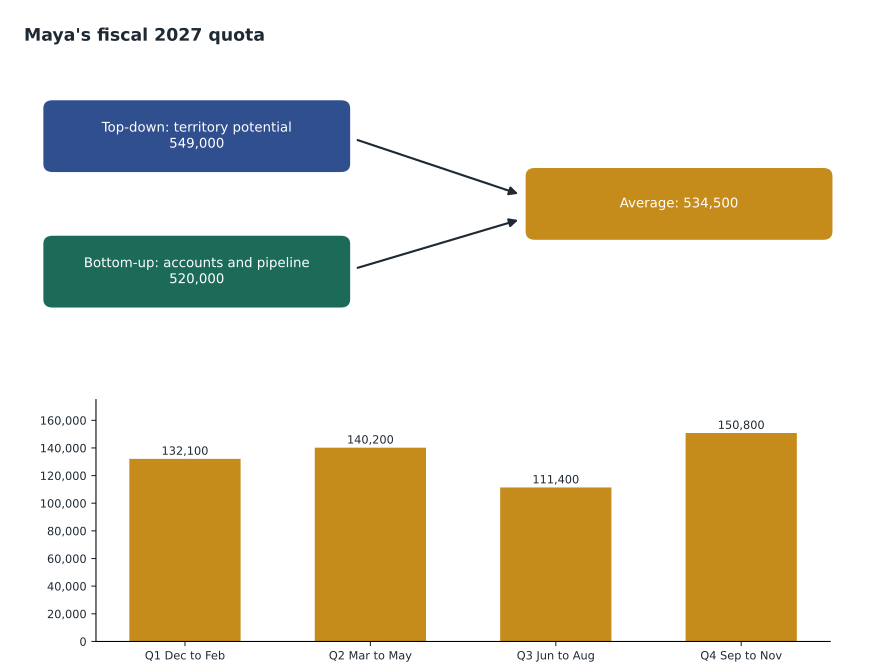
Maya built her bottom-up estimate in the first week of November. She listed her open opportunities, her account plans for existing customers such as Northfield Family Clinic and Keystone Grain Equipment, and the prospecting she expected with her inside-sales pod partner from December. Using conversion rates from her first ten weeks and the team's longer history where hers was too short to rely on, she estimated 520,000 dollars of first-year revenue for fiscal 2027.
Worked problem
Blending top-down and bottom-up
Rob's rule for fiscal 2027 was to start from the average of the top-down and bottom-up figures, then adjust only for written reasons agreed by Darnell and the seller. Maya's top-down quota is 549,000 dollars and her bottom-up estimate is 520,000 dollars. What is her starting quota? If Darnell argues that Maya's estimate understates the inside team's contribution and adds 15,000 dollars, what is her final quota?
Show solution
- \[\text{Starting quota} = \frac{549{,}000 + 520{,}000}{2} = 534{,}500 \text{ dollars}\]
- Darnell's adjustment is written down with its reason: the December pods are expected to add first meetings that Maya's estimate did not include. Rob decided against the adjustment, because the pods had not yet started and there was no evidence for the figure.
- Final quota: 534,500 dollars.
Answer: Maya's fiscal 2027 quota was set at 534,500 dollars, between the two estimates. The rule for written adjustments stopped quotas from being changed by whoever argued hardest, and Rob's refusal to add an untested figure kept the quota believable.
Splitting the year into quarters
Sales are rarely even across the year. Ridgeline's first-year bookings in fiscal 2026 ran about 701,000 dollars in the first quarter (December to February), 744,000 in the second, 591,000 in the third, which includes the summer, and an expected 800,000 in the fourth, when budget-year-end buying pushes orders up. A quota split evenly by quarter would make the summer quarter look like a failure every year and the fourth quarter look easy.
Worked problem
Splitting Maya's quota by season
Ridgeline's fiscal 2026 quarterly bookings were about 701,000, 744,000, 591,000 and 800,000 dollars, for a total of 2,836,000. Split Maya's annual quota of 534,500 dollars in the same proportions, rounding each quarter to the nearest hundred dollars.
Show solution
- \[\text{Q1 share} = \frac{701{,}000}{2{,}836{,}000} = 0.2472; \quad 534{,}500 \times 0.2472 \approx 132{,}100\]
- \[\text{Q2 share} = \frac{744{,}000}{2{,}836{,}000} = 0.2623; \quad 534{,}500 \times 0.2623 \approx 140{,}200\]
- \[\text{Q3 share} = \frac{591{,}000}{2{,}836{,}000} = 0.2084; \quad 534{,}500 \times 0.2084 \approx 111{,}400\]
- \[\text{Q4 share} = \frac{800{,}000}{2{,}836{,}000} = 0.2821; \quad 534{,}500 \times 0.2821 \approx 150{,}800\]
- Check: 132,100 + 140,200 + 111,400 + 150,800 = 534,500.
Answer: Maya's quarterly quotas would be about 132,100, 140,200, 111,400 and 150,800 dollars. One year's pattern can be misleading, so Grace planned to use the average of three years' seasonal shares once the data was cleaned.
Ridgeline also kept quarterly quotas rather than one annual quota. Research by Thomas Steenburgh and Michael Ahearne, published in the Harvard Business Review in 2012, argued from field studies that more frequent targets help keep lower and middle performers engaged, because a poor quarter does not doom the whole year. Their findings came from particular companies and pay plans, but the reasoning matched Rob's experience.
Goals on the sales floor
Bev set floor goals differently, because her sellers' opportunities depended mostly on how many hours they worked and when. She started from the store's sales plan for November, the shifts each seller was scheduled for, and the store's average sales per seller-hour. She then adjusted for experience, because sellers newer than six months would not yet sell as much per hour as experienced ones.
Worked problem
Setting Aiden's November goal
The floor sales plan for November 2026 is 1,207,500 dollars, and commissioned floor sellers are scheduled for 1,350 hours in total. Aiden is scheduled for 140 hours. Bev sets goals for sellers in their first six months at 80 in 100 of the store average per hour. What is Aiden's November goal, to the nearest hundred dollars?
Show solution
- \[\text{Sales per seller-hour} = 1{,}207{,}500 \div 1{,}350 \approx 894.44 \text{ dollars}\]
- \[\text{Full goal for 140 hours} = 140 \times 894.44 \approx 125{,}222 \text{ dollars}\]
- \[\text{Aiden's goal} = 125{,}222 \times 0.80 \approx 100{,}200 \text{ dollars}\]
Answer: Aiden's November goal is about 100,200 dollars of sales. Because the goal is tied to hours, it stays fair even when sellers work different schedules, and the experience adjustment keeps it reachable for a newer seller.
Checking and protecting quotas
Before finalizing quotas, Rob ran three checks. First, did the quotas add up to the over-assigned pool? Second, was each quota reasonable compared with the seller's history and territory, with no seller asked for a jump of more than about a third over their best year without a clear reason? Third, would the expected distribution of attainment look sensible, with most sellers near quota rather than a few far above and many far below?
He also set rules for changing quotas during the year. A quota would be adjusted only for reasons outside the seller's control, such as a territory change, a long medical leave or the loss of a product line, and every adjustment would be written down. Sam Whitehorse's fiscal 2026 quota had not been reduced for his six-week medical leave in July, which had made his third-quarter result look worse than his performance; Rob agreed that under the new rules it would have been reduced.
Finally, Rob warned against the ratchet effect: raising a seller's quota sharply after every good year. If a strong year is always punished with a much higher quota, sellers learn to hold back sales near the end of a good year, pushing them into the next period. Basing quotas on territory potential as well as history, as Ridgeline now did, reduces the temptation.
Quotas for other roles
Not every member of a sales team carries the same kind of quota. Ridgeline's inside sales team, Owen, Jordan, Amira and Tyler, books smaller deals by phone and video and also sets meetings for the field account executives. Giving them a revenue quota alone would have pushed them to keep every deal they could close themselves rather than pass larger ones to the field. Darnell therefore planned for fiscal 2027 to give each inside seller two targets: a revenue quota for their own deals and a target for qualified meetings passed to the field, each worth about half of their variable pay.
Sales leaders also need targets, and they usually take the form of the team's total quota, sometimes with a separate measure such as retention or new-customer revenue. Darnell's own fiscal 2027 target would be the sum of his team's quotas, plus a goal for the share of sellers who reach at least 90 in 100 of their quota. Including that second measure was deliberate: a manager whose target depends only on the team's total can hit it while half the team struggles.
Worked problem
Checking how many sellers can reach quota
A sales plan is often judged by how many sellers it expects to reach quota. Grace's draft fiscal 2027 quotas, compared with each seller's expected results, gave expected attainment of 112, 104, 98, 93, 89 and 81 in 100 for the six account executives in their first full year. How many would reach quota, and what share of the team is that?
Show solution
- \[\text{At or above 100: } 112 \text{ and } 104 \Rightarrow 2 \text{ sellers}\]
- \[\frac{2}{6} \approx 0.33 = 33 \text{ in } 100\]
Answer: Only about a third of the team would reach quota. Many sales leaders aim for a plan where a clear majority of experienced sellers can reach quota with good work, so Darnell and Grace asked Rob whether the top-down target could be lowered slightly or whether the gap should be closed with the new hire's ramp instead.
Common mistakes
MistakeDividing the company target equally among all sellers.
InsteadAllocate by territory potential and check against each territory's accounts and history.
MistakeAccepting a seller's bottom-up estimate without checking it.
InsteadCompare it with the top-down figure and the seller's own conversion history.
MistakeSplitting the annual quota evenly across quarters.
InsteadUse seasonal shares from several years of history.
MistakeRaising quotas sharply after every good year.
InsteadBase quotas on potential as well as history to avoid the ratchet effect.
MistakeChanging quotas during the year whenever a seller asks.
InsteadAdjust only for written reasons outside the seller's control, such as a leave or territory change.
Summary and key terms
- A quota is both a goal and a measuring stick.
- Goal-setting research supports specific, difficult but accepted goals, and many leaders aim for about 60 to 70 in 100 of sellers to reach quota in a normal year.
- Top-down quotas divide the company target, often over-assigned by around 10 in 100, in proportion to territory potential.
- Bottom-up quotas build from each territory's accounts and pipeline but can be sandbagged.
- A blend of the two, adjusted only for written reasons, is common.
- Quotas should follow seasonal patterns, and quarterly quotas can keep more sellers engaged.
- Retail goals are often tied to scheduled hours and sales per hour, adjusted for experience.
- Leaders should check totals, jumps and expected attainment, adjust quotas only for reasons outside the seller's control, and avoid the ratchet effect.
- Quota
- A seller's target for sales or revenue over a period, used for goals and pay.
- Top-down quota
- A quota set by dividing the company target among sellers.
- Bottom-up quota
- A quota built from a territory's accounts, pipeline and conversion rates.
- Over-assignment
- Setting the sum of sellers' quotas above the company target.
- Sandbagging
- Understating what one can sell so as to get an easier target or forecast.
- Ratchet effect
- Raising a seller's quota sharply after each good year, which can lead sellers to hold back sales.
Practice problems
Work each problem on paper first, then reveal the answer to check.
A company target is 2,000,000 dollars, over-assigned by 10 in 100. A territory holds 25 in 100 of total potential. What is its quota?
Show answer
2,000,000 × 1.10 = 2,200,000; 2,200,000 × 0.25 = 550,000 dollars.
Top-down gives 480,000 dollars and bottom-up 440,000. What is the blended starting quota?
Show answer
(480,000 + 440,000) ÷ 2 = 460,000 dollars.
A store plan is 900,000 dollars for 1,200 seller-hours. A new seller works 120 hours at 80 in 100 of the average rate. What is their goal?
Show answer
900,000 ÷ 1,200 = 750 dollars an hour; 120 × 750 × 0.80 = 72,000 dollars.
Lesson quiz · 5 questions
Score 60% or more to complete this lesson.
Create a free account to save your progress, take quizzes and earn a certificate.