
SLS-230 · Lesson 5 of 12 · 20 min
Coaching
▶ Video coming soon A video version of this lesson is on the way.
Andrew Ferguson had been a Ridgeline account executive for four years. In the third quarter of fiscal 2026, June to August, he closed 96,000 dollars of first-year revenue against a quarterly quota of 150,000 dollars, the second-lowest result on the team after Sam Whitehorse, who had been on medical leave for six weeks. Andrew's activity was fine. He booked about 40 first meetings a quarter, as many as anyone. Something was going wrong after those meetings.
Darnell Brooks had a choice. He could tell Andrew to work harder, which would not help, since Andrew was already busy. He could take over Andrew's biggest deals, which would help the quarter but not Andrew. Or he could find out exactly where Andrew's deals were stalling and help him get better at that step. He chose the third, and on Tuesday, September 22, 2026, he began a weekly coaching session with Andrew that ran through the fall. This lesson is about that kind of work: what sales coaching is, how to find what to coach, and how to run coaching conversations that change what a seller does.
What coaching is, and what it is not
Coaching is the ongoing work a manager does to help a seller improve specific skills and behaviors, through observation, questions, feedback and practice. It differs from training, which teaches knowledge or skills to many people at once, usually away from the job. It differs from managing, which includes setting goals, checking results and making decisions. And it differs from mentoring, which is broader career advice, often from someone outside the seller's reporting line. A sales manager does all four, but coaching is the part most often squeezed out by other pressures.
Sales leaders coach in several ways. Skill coaching works on how the seller does something, such as asking discovery questions or handling a price objection, usually by observing a real or recorded call. Deal coaching helps the seller plan the next steps in a specific opportunity. Pipeline coaching looks across all of a seller's opportunities to help them decide where to spend their time. And career coaching helps the seller think about where they want to go. Darnell planned to use all four with Andrew, starting with the skill that the data pointed to.
What the evidence says about coaching
Sales leaders often quote figures for how much coaching improves results, and some of those figures are hard to trace. Research by the Sales Executive Council, a membership research firm, reported around 2009 that sellers who received strong coaching performed noticeably better, with the largest gains among the middle group of performers rather than the stars or the weakest. That research was not published in peer-reviewed journals and its methods are not fully public, so it should be treated as suggestive. Academic reviews of workplace coaching in general, such as meta-analyses by Theeboom, Beersma and van Vianen in 2014 and by Jones, Woods and Guillaume in 2016, found positive average effects on performance and skills, but most of the coaching studied was by professional coaches rather than sales managers, and many studies were small. The fair summary is that well-run coaching tends to help, especially when it is specific and regular, but no one can promise a particular percentage.
Finding what to coach
Good coaching starts with a diagnosis. Andrew's results could have been low for many reasons: too few opportunities, weak discovery, poor proposals, losing at negotiation, or focusing on the wrong accounts. Darnell used the stage conversion rates in Ridgeline's CRM, the measures Grace Liu had taught the team in the fall, to find where Andrew's deals were leaking.
| Stage | Andrew, Q3 | Team median, Q3 |
|---|---|---|
| First meetings held | 40 | 38 |
| First meeting to proposal | 30 in 100 (12 proposals) | 50 in 100 |
| Proposal to win | 40 in 100 (4.8 wins, about 5) | 42 in 100 |
| Average first-year revenue per win | 20,000 dollars | 19,700 dollars |
The table made the problem plain. Andrew booked as many first meetings as anyone and won proposals at about the team's rate, but only 30 in 100 of his first meetings became proposals, against a team median of 50 in 100. His deals were stalling between the first meeting and the proposal, which is where discovery happens. Darnell suspected that Andrew was not uncovering enough about the customer's problem in the first meeting to make a proposal worth writing.
Worked problem
What fixing one stage is worth
Andrew holds 40 first meetings a quarter, converts 30 in 100 to proposals, wins 40 in 100 of proposals and averages 20,000 dollars of first-year revenue per win. If coaching lifts his meeting-to-proposal rate to 45 in 100, with everything else unchanged, what would his quarterly revenue become?
Show solution
- \[\text{Now: } 40 \times 0.30 \times 0.40 \times 20{,}000 = 96{,}000 \text{ dollars}\]
- \[\text{After: } 40 \times 0.45 \times 0.40 \times 20{,}000 = 144{,}000 \text{ dollars}\]
- \[144{,}000 - 96{,}000 = 48{,}000 \text{ dollars more a quarter}\]
Answer: Raising one conversion rate from 30 to 45 in 100 would lift Andrew's quarter from 96,000 to 144,000 dollars, close to his 150,000 dollar quota. It shows why coaching should target the stage where results leak, rather than asking for more activity.
Observing the skill
Data shows where a problem is, but not why. To see why, Darnell needed to watch Andrew work. Over three weeks he joined two of Andrew's first meetings and listened to recordings of two more video calls, which Ridgeline recorded with customers' consent. He used a short observation form so that his notes would be specific rather than impressionistic.
| What to watch | What Darnell saw in Andrew's calls |
|---|---|
| Share of time the customer talked | About a third; Andrew talked most of the time |
| Questions about the customer's problem and its impact | Two or three per call, mostly about current equipment |
| Moment the product was first mentioned | Within the first ten minutes of every call |
| Agreed next step at the end | A promise to send information, without a date |
| Summary of what the customer said | None |
The pattern was clear. Andrew was knowledgeable and friendly, and he moved to products too soon. Customers ended the meeting with brochures but without having said why change mattered to them, so there was no basis for a proposal. These are discovery skills, the subject of an earlier course in this program, and they can be practiced.
Running a coaching conversation
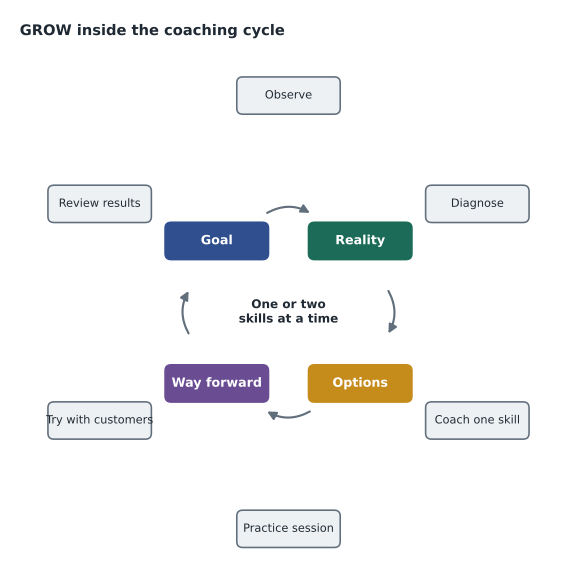
Darnell structured his coaching conversations using the GROW model, a widely used coaching framework associated with John Whitmore. GROW stands for Goal, Reality, Options and Way forward. The manager asks more than tells, so that the seller does most of the thinking and owns the plan. Darnell also kept to one rule from his own early mistakes: coach one or two behaviors at a time. A seller handed ten things to change will change none of them.
| Step | Purpose | Darnell's question to Andrew |
|---|---|---|
| Goal | Agree what the seller wants to achieve | "What would you like your first meetings to produce?" |
| Reality | Look at what is happening now, with evidence | "In the Eastside clinic call, how much did you learn about why they might change?" |
| Options | Explore possible changes | "What could you do in the first ten minutes instead of showing the product?" |
| Way forward | Agree specific actions and how to check them | "What will you try in your next two meetings, and how will we know it worked?" |
Andrew chose two changes: hold back any mention of products for the first fifteen minutes and ask at least three questions about the impact of the customer's problem; and end every meeting with a summary of what he had heard and a dated next step. He and Darnell practiced both in a short role-play, with Darnell playing a hurried practice manager. Practice matters. Research on skill learning, including Anders Ericsson's work on deliberate practice, suggests that people improve most when they rehearse a specific part of a skill with feedback, rather than simply repeating the whole task.
Feedback needs care. Darnell used a simple pattern: describe what he observed, explain the effect, and ask what Andrew thought. "In the dental lab follow-up you mentioned RoomFlow in the fourth minute. After that, the customer asked only about price. What do you make of that?" Specific, observed and connected to a result, feedback like this is far easier to act on than "you need to listen more".
Coaching on the sales floor
Bev Halvorsen coached Aiden Laroque differently, because floor selling happens in short conversations she could watch directly. Her focus in November was add-ons: the protection plans, mattress protectors, delivery and haul-away that customers often wanted but did not think to ask for. Aiden's attachment rate, the share of his mattress sales that included a protector, was 38 in 100 in October, against a store average of 55.
Bev's method was quick and frequent. She watched part of one sale each shift, gave one piece of feedback within a few minutes, and let Aiden try again on the next customer. She noticed that Aiden offered the protector after the customer had already agreed the price, as an extra, which made it sound like a sales pitch. Carl offered it while the customer was lying on the mattress, as part of how to keep it clean and keep the warranty valid. Aiden tried Carl's timing for a week.
Worked problem
The value of a better attachment rate
Aiden sells about 26 mattresses a month. A protector sells for 129 dollars with a gross margin of 60 in 100, and floor sellers earn 8 in 100 of the margin. If Aiden's attachment rate rises from 38 to 55 in 100, how much more margin does the store earn each month, and how much more commission does Aiden earn?
Show solution
- \[\text{Protectors now} = 26 \times 0.38 = 9.88; \quad \text{after} = 26 \times 0.55 = 14.30\]
- \[\text{Extra protectors} = 14.30 - 9.88 = 4.42 \text{ a month}\]
- \[\text{Extra margin} = 4.42 \times 129 \times 0.60 = 342.11 \text{ dollars a month}\]
- \[\text{Extra commission} = 342.11 \times 0.08 = 27.37 \text{ dollars a month}\]
Answer: The store would earn about 342 dollars more margin a month, and Aiden about 27 dollars more commission. The amounts are modest, which is a useful reminder: the protector is worth offering because it helps customers keep their warranty valid, and the coaching works because it makes the offer more helpful rather than more pushy.
Making coaching regular
The biggest barrier to coaching is time. Darnell blocked one hour a week in his calendar for each of his six account executives in the fourth quarter, more for the two newest and less for Kevin Moreau, his strongest seller, who preferred a fortnightly session. That is roughly six hours a week, about 15 in 100 of a 40-hour week, before joint calls. The sessions had a regular shape: review the agreed actions from last week, look at one or two pieces of evidence, coach one behavior, agree what to try next.
By mid-November, Andrew's results were starting to move. Of his ten first meetings since late September with the new approach, five had already produced proposals, compared with three in ten before. Ten meetings is a small sample, and some of the change could be chance or the time of year, so Darnell kept tracking it. But the conversations sounded different on the recordings, and Andrew said the meetings felt more useful to him as well as to the customers.
Common mistakes
MistakeTelling a struggling seller to work harder.
InsteadUse stage data to find where results leak, then observe that step to see why.
MistakeTaking over a seller's deal and calling it coaching.
InsteadHelp the seller plan and practice, and debrief after the call.
MistakeGiving vague feedback such as 'listen more'.
InsteadDescribe what you observed, its effect and ask the seller's view.
MistakeCoaching ten things at once.
InsteadChoose one or two behaviors, practice them and check the result.
MistakeCoaching only when there is time left over.
InsteadBlock regular coaching time in the calendar and keep it.
Summary and key terms
- Coaching is the ongoing work of helping a seller improve specific skills and behaviors through observation, questions, feedback and practice; it differs from training, managing and mentoring.
- Sales leaders do skill, deal, pipeline and career coaching.
- Evidence suggests well-run coaching helps, but popular percentages are hard to verify and academic reviews mostly study professional coaches.
- Coaching should start with a diagnosis from stage conversion data and continue with observation of the skill.
- The GROW model, standing for Goal, Reality, Options and Way forward, structures conversations so the seller does the thinking.
- Feedback should be specific, observed and linked to results, and practice should focus on one or two behaviors.
- On a sales floor, short, frequent coaching on measures such as attachment rate works well.
- Coaching needs regular, protected time.
- Coaching
- Ongoing help from a manager to improve specific skills and behaviors.
- Skill coaching
- Coaching on how a seller performs a task, usually from observing a call.
- Deal coaching
- Coaching that helps a seller plan the next steps in a specific opportunity.
- GROW model
- A coaching framework of Goal, Reality, Options and Way forward.
- Attachment rate
- The share of sales of a main product that include a related add-on.
- Deliberate practice
- Focused rehearsal of a specific part of a skill with feedback.
Practice problems
Work each problem on paper first, then reveal the answer to check.
A seller holds 30 first meetings, converts 40 in 100 to proposals, wins 50 in 100 and averages 10,000 dollars per win. What is the quarterly revenue, and what if conversion rises to 50 in 100?
Show answer
Now: 30 × 0.40 × 0.50 × 10,000 = 60,000 dollars. After: 30 × 0.50 × 0.50 × 10,000 = 75,000 dollars.
Rewrite "you need to listen more" as useful feedback.
Show answer
For example: "In the clinic call you described the product in the third minute, and after that the customer only asked about price. What do you think happened?"
A seller sells 40 units a month and attaches an add-on to 30 in 100. If that rises to 50 in 100, how many more add-ons a month?
Show answer
40 × 0.50 − 40 × 0.30 = 20 − 12 = 8 more.
Lesson quiz · 5 questions
Score 60% or more to complete this lesson.
Create a free account to save your progress, take quizzes and earn a certificate.