
SLS-230 · Lesson 10 of 12 · 22 min
Motivation and recognition
▶ Video coming soon A video version of this lesson is on the way.
Every December, Juniper & Pine Home ran a holiday sales contest for its commissioned floor sellers. The prize was a weekend trip for two, and it went to the seller with the highest sales from Black Friday to December 24. Carl Jensen had won it five of the last nine years. On Thursday, November 5, 2026, after the morning floor school, Bev Halvorsen asked Aiden Laroque and two other newer sellers what they thought of the contest. There was a pause before Aiden answered. "Honestly? Everyone knows Carl wins. It's nice for Carl."
Bev had suspected as much. A contest that one person nearly always wins motivates one person. She decided to redesign it before Black Friday. At Ridgeline, Rob Kowalski was thinking about a related problem: how to keep the team motivated in the first quarter of fiscal 2027, when quotas would reset, territories would change and several sellers would lose accounts they had worked on for years. This lesson covers what research says about motivating salespeople and how both leaders used it.
What motivates salespeople
Sales motivation is often reduced to money, and money matters: sellers choose sales jobs partly because results are rewarded. But research on motivation suggests money is only part of the picture. Two well-established frameworks help explain why.
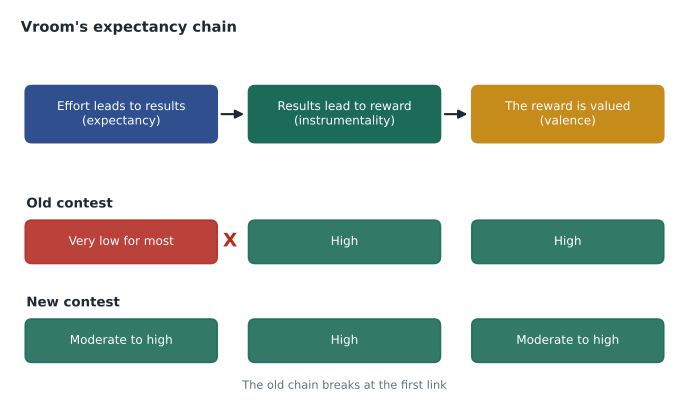
Expectancy theory, developed by Victor Vroom in 1964, holds that people put effort into a task when three things are true together: they believe effort will lead to results (expectancy), they believe results will lead to a reward (instrumentality), and they value the reward (valence). If any one is close to zero, motivation collapses, however large the other two. Aiden's reaction to the contest is a clear case: the prize was valuable, and winning would certainly bring it, but his expectancy of winning was close to zero, so it did not motivate him at all.
Self-determination theory, developed by Edward Deci and Richard Ryan, holds that people are most motivated, and do their best work, when three basic needs are met: autonomy, a sense of choice in how they work; competence, a sense of getting better and being effective; and relatedness, a sense of belonging and being valued by others. The theory is supported by a large body of research across many settings. Some studies, including a 1999 meta-analysis by Deci, Koestner and Ryan, found that tangible rewards offered for doing an interesting task can reduce people's own interest in it, although other researchers, including Judy Cameron and David Pierce, have argued the effect is smaller and more limited than sometimes claimed. For sales leaders the practical lesson is not to avoid rewards, which are part of the job, but to make sure pay and prizes are not the only reasons people have to do good work.
| Need or factor | What weakens it | What strengthens it |
|---|---|---|
| Expectancy | Targets that seem out of reach; contests one person always wins | Reachable goals; several ways to win |
| Instrumentality | Rewards that seem arbitrary or are paid late | Clear rules; prompt, reliable payouts |
| Autonomy | Scripts for everything; micromanaged calendars | Choice in how to reach goals; trust |
| Competence | No feedback; no visible progress | Coaching; measures of improvement; new skills |
| Relatedness | Constant ranking against peers; isolation | Team goals; recognition from peers and customers |
Recognition that works
Recognition is acknowledging someone's work or results, publicly or privately. It costs little, and research and practice both suggest it matters to people's engagement. But recognition only works when it is sincere, specific and timely. "Great month, everyone" in a team email does little. "Aiden, the customer who bought the sectional today told me you were the first person who asked how they actually use their living room" tells the seller exactly what they did well and why it mattered, and does it while the memory is fresh.
Darnell Brooks set himself a simple habit: each Friday, before leaving, he sent at least two short messages recognizing something specific a team member had done that week, and at least one of them had to be about effort or skill rather than a closed deal. Results already bring their own recognition through commission and the sales board. Effort and skill, such as a well-prepared discovery call that did not lead to a sale or patient work on a difficult account, are easy to overlook.
Recognition also has to be fair. If the same few sellers are always praised, the rest notice. Bev kept a simple tally of whom she had recognized each month so she could see whether anyone was being missed.
Designing a better contest
Sales contests, also called spiffs when they are short-term cash incentives on a particular product, can focus effort on a priority, such as a new product or a slow season. Their design determines whether they motivate the whole team or only a few. Steenburgh and Ahearne's 2012 Harvard Business Review article, based on studies of sales pay at several companies, recommended contests with many winners and prizes that people value, because contests that only the top performer can realistically win do little for everyone else.
Bev's redesigned holiday contest had three changes. First, every seller had a personal target, based on their scheduled hours and the store's average sales per hour, adjusted for experience, as in lesson 7. Anyone who beat their own target by 10 in 100 would receive a gift card. Second, the weekend trip would go to the seller with the largest improvement over their own target, not the largest total. Third, there would be a team prize: if the floor as a whole beat the holiday plan, everyone would get an extra paid day off in January.
Worked problem
Comparing the old and new contests
Under the old contest, Aiden estimates his chance of winning the trip at 2 in 100. He values the trip at about 1,200 dollars. Under the new design, he estimates a 50 in 100 chance of beating his target by 10 in 100 and earning a 200 dollar gift card, a 10 in 100 chance of winning the trip for the largest improvement, and a 60 in 100 chance that the team earns the extra day off, which he values at 150 dollars. Using expected value, how do the two contests compare for Aiden?
Show solution
- \[\text{Old contest} = 0.02 \times 1{,}200 = 24 \text{ dollars}\]
- \[\text{New: gift card} = 0.50 \times 200 = 100; \quad \text{trip} = 0.10 \times 1{,}200 = 120; \quad \text{day off} = 0.60 \times 150 = 90\]
- \[\text{New contest} = 100 + 120 + 90 = 310 \text{ dollars}\]
Answer: The new contest is worth about 310 dollars to Aiden in expected value, against about 24 for the old one. The estimates are rough, but the comparison shows why contests with several ways to win engage more of the team: they raise expectancy, the first link in Vroom's chain.
Worked problem
Is the new contest worth its cost?
Bev budgets for the new contest: about seven gift cards of 200 dollars, one trip costing 1,200 dollars, and, if the team target is met, a paid day off for nine sellers at an average of 140 dollars of pay each. She expects the contest to add about 60,000 dollars of holiday sales, at an average gross margin of 40 in 100. Is the contest worth running?
Show solution
- \[\text{Cost} = 7 \times 200 + 1{,}200 + 9 \times 140 = 1{,}400 + 1{,}200 + 1{,}260 = 3{,}860 \text{ dollars}\]
- \[\text{Extra margin} = 60{,}000 \times 0.40 = 24{,}000 \text{ dollars}\]
- The commission on the extra sales, 8 in 100 of 24,000 margin, is 1,920 dollars, which also reduces the store's gain.
- \[\text{Net gain} = 24{,}000 - 1{,}920 - 3{,}860 = 18{,}220 \text{ dollars}\]
Answer: If the contest adds 60,000 dollars of sales, the store gains about 18,000 dollars of margin after prizes and commission. The weakest assumption is the 60,000 dollars of extra sales, which is hard to separate from what would have happened anyway, so Bev planned to compare this year's holiday sales per hour with last year's as a rough check.
Rob chose a different approach for Ridgeline's first quarter of fiscal 2027. Rather than a contest, he planned a modest spiff: 250 dollars for each new RoomFlow subscription sold in December to February, because recurring software revenue was a company priority and sellers tended to neglect it in favor of larger hardware deals. He capped the spiff period at three months so it would not become an expected part of pay, and he made sure it could not be earned on a RoomFlow subscription bundled into a deal at a discount, which would have rewarded giving it away.
Workload, wellbeing and fairness
Motivation is not only about incentives. Sellers who are overloaded, unclear about expectations or treated unfairly lose motivation however good the pay plan is. Sales roles combine targets, rejection and long hours, and research on job burnout, including work by Christina Maslach and colleagues, has linked burnout to excessive workload, lack of control, insufficient reward, lack of community, unfairness and conflicts of values. These match what sales leaders see when good sellers leave.
Rob asked his managers to watch for warning signs in the reset months: a seller who stops raising problems in one-to-ones, who works very long hours without better results, or whose behavior with customers changes. He also asked them to protect time off, especially in December, and to remember that the territory changes in lesson 6 had cost several sellers accounts they cared about. Kevin Moreau, who lost the most potential, received a personal call from Rob thanking him for how he handled the hand-over.
Holiday scheduling at Juniper & Pine also had to follow the law and the store's own policy. South Dakota does not require private employers to give paid holidays or holiday premium pay, so Juniper & Pine's policy of paying time and a half on Thanksgiving and Christmas Eve was a choice the store made, written into its handbook. Bev posted the December schedule three weeks ahead so sellers could plan, and rotated the less popular shifts.
Recognition that costs little
Most recognition does not need a budget. Sellers often value specific, timely thanks from a manager they respect, a mention in front of peers, the chance to lead a training session, first choice of a new account or a day off after a hard quarter. What makes recognition work is that it is specific about what the person did, given soon after they did it, and fair, so that people who do similar work receive similar recognition.
At Ridgeline, Darnell used the Friday team call for two minutes of recognition each week. He named one behavior, not only one result: Lisa Tran's thorough handover notes on two accounts moving to the North territory, Owen's work booking meetings for the field team, or Andrew Ferguson's improved discovery questions on a call Darnell had listened to. Recognizing behaviors that lead to results helped people who had not yet closed a large deal, and it showed the team which behaviors mattered.
Worked problem
Budgeting a year of recognition
Darnell planned a modest recognition budget for fiscal 2027: a team lunch each quarter for the 12 people in Darnell's sales group, counting the six account executives, the four inside sellers, Grace and himself, at about 30 dollars a person, and a monthly 100 dollar award for the best example of putting a customer first, chosen by the team. What is the annual cost, and what is it per person per month?
Show solution
- \[4 \times 12 \times 30 = 1{,}440 \text{ dollars}\]
- \[12 \times 100 = 1{,}200 \text{ dollars}\]
- \[\frac{1{,}440 + 1{,}200}{12 \times 12} = \frac{2{,}640}{144} \approx 18.33 \text{ dollars}\]
Answer: The year costs about 2,640 dollars, or a little over 18 dollars a person a month, far less than a single large contest prize. Because the monthly award is chosen by the team and rewards a behavior rather than a result, it also reaches people whose territories are having a slow quarter.
Common mistakes
MistakeRunning contests that the same top seller always wins.
InsteadGive every seller a reachable way to win, such as beating a personal target or improving the most.
MistakeRelying on money as the only motivator.
InsteadSupport autonomy, competence and relatedness through choice, coaching and team goals.
MistakeGiving vague, general praise.
InsteadRecognize specific actions, promptly, including effort and skill, not only closed deals.
MistakeDesigning spiffs that can be earned by giving products away.
InsteadExclude discounted or bundled sales and limit the spiff period.
MistakeIgnoring workload and fairness during stressful periods.
InsteadWatch for warning signs, protect time off and explain changes personally.
Summary and key terms
- Money matters to sellers, but it is only part of motivation.
- Expectancy theory says effort depends on believing effort leads to results, results lead to rewards, and the rewards are valued; if any link is weak, motivation falls.
- Self-determination theory emphasizes autonomy, competence and relatedness, and some research suggests tangible rewards can reduce interest in interesting tasks, though the size of that effect is debated.
- Recognition works when it is sincere, specific, timely and fairly shared.
- Contests and spiffs should give many people a reachable way to win, focus on priorities and avoid rewarding behavior such as discounting.
- Expected value helps compare contest designs, and a contest's cost should be weighed against the extra margin it plausibly adds.
- Workload, control and fairness affect motivation and burnout, and holiday scheduling must follow employment law and company policy.
- Expectancy theory
- Vroom's theory that motivation depends on expectancy, instrumentality and valence together.
- Self-determination theory
- Deci and Ryan's theory that people are most motivated when autonomy, competence and relatedness are met.
- Recognition
- Acknowledging someone's work or results, publicly or privately.
- Spiff
- A short-term cash incentive for selling a particular product or achieving a specific goal.
- Sales contest
- A competition with prizes for sellers who reach set results over a period.
- Burnout
- A state of exhaustion and reduced effectiveness linked to chronic work stress.
Practice problems
Work each problem on paper first, then reveal the answer to check.
A seller has a 5 in 100 chance of a 1,000 dollar prize. What is the expected value?
Show answer
0.05 × 1,000 = 50 dollars.
A contest costs 2,500 dollars and is expected to add 40,000 dollars of sales at a 35 in 100 margin, with commission of 8 in 100 of margin. What is the net gain?
Show answer
Margin 14,000; commission 1,120; net 14,000 − 1,120 − 2,500 = 10,380 dollars.
Why did Rob cap the RoomFlow spiff at three months?
Show answer
So it would focus effort on a priority without becoming an expected part of pay.
Lesson quiz · 5 questions
Score 60% or more to complete this lesson.
Create a free account to save your progress, take quizzes and earn a certificate.