
SLS-230 · Lesson 6 of 12 · 20 min
Territory design
▶ Video coming soon A video version of this lesson is on the way.
Adding a seventh field account executive meant redrawing Ridgeline's territories, and on Tuesday, October 20, 2026, Grace Liu brought a large printed map of eastern South Dakota to Rob's second planning session. Each of Ridgeline's six current territories was outlined in a different color, with dots for every account and a number for each territory's estimated sales potential. The numbers were uneven. Kevin Moreau's territory, which included most of the city's southwest side and the busiest commercial district, had an estimated potential of about 3.9 million dollars a year. Maya Chen's had about 3.0 million. Sam Whitehorse's, which stretched across several smaller towns, had about 2.4 million but required the most driving.
"Everyone has the same quota," Grace said, "but not the same opportunity." This lesson covers how sales leaders design territories that give each seller a fair chance, match effort to opportunity and keep customers well served, and how to handle the hardest part, moving accounts from one seller to another.
What a territory is and why design matters
A sales territory is the set of customers and prospects assigned to one seller or team, usually defined by geography, by named accounts, by industry or by some combination. Territory design matters for three groups. For the company, poorly designed territories leave potential untouched in some areas and waste effort in others. For sellers, unequal territories mean that pay and recognition depend partly on luck. For customers, a territory that is too large means slow responses and infrequent contact.
Researchers who work on sales force design, notably Andris Zoltners and Sally Lorimer, have argued that territory alignment is an overlooked way to raise productivity, and have reported that many companies' territories are badly out of balance. Gains reported from realignment projects are typically a few percent of sales, which is large for a change that costs little, though such figures come mostly from consulting work and depend on how unbalanced the starting territories were.
Two things to balance: potential and workload
Territory design tries to balance two things at once. Potential is how much a territory could buy, whether from Ridgeline or from anyone, over a year. Workload is how much selling effort the territory needs, including travel. A territory can be high in potential and light in workload, like a dense downtown area full of offices, or low in potential and heavy in workload, like a wide rural area with small customers far apart. A fair design aims to give each seller a similar amount of each, or, if that is impossible, to set quotas that reflect the difference.
Grace estimated potential from Ridgeline's account tiers, built for the territory analysis that Maya had learned earlier in the year: about 18,000 dollars a year for a tier A account, 7,500 for tier B and 1,800 for tier C. She estimated workload from the selling hours each tier needs plus travel time, using the CRM's record of how long field visits took in each area.
| Territory | Seller | Potential (dollars) | Selling and travel hours needed | Share of total potential (in 100) |
|---|---|---|---|---|
| South | Kevin Moreau | 3,900,000 | 1,180 | 20.0 |
| Central | Lisa Tran | 3,400,000 | 1,060 | 17.4 |
| North | Maya Chen | 3,000,000 | 980 | 15.4 |
| East | Nadia Petrov | 3,100,000 | 1,020 | 15.9 |
| West | Andrew Ferguson | 3,700,000 | 1,120 | 19.0 |
| Rural | Sam Whitehorse | 2,400,000 | 1,240 | 12.3 |
| Total | 19,500,000 | 6,600 | 100.0 |
The table showed two problems. Potential ranged from 2.4 to 3.9 million dollars, so the richest territory had about 1.6 times the potential of the poorest. And the rural territory, with the lowest potential, needed the most hours, mostly because of driving. Sam was being asked to hit the same quota as Kevin with less opportunity and more time on the road.
Worked problem
Measuring how unbalanced the territories are
One simple measure of balance compares each territory with the average. With six territories and total potential of 19,500,000 dollars, what is the average potential per territory, and how far are the largest and smallest territories from it? What would the average be with seven territories?
Show solution
- \[\text{Average (six)} = 19{,}500{,}000 \div 6 = 3{,}250{,}000 \text{ dollars}\]
- \[\text{South: } \frac{3{,}900{,}000}{3{,}250{,}000} = 1.20 \quad \text{(20 in 100 above average)}\]
- \[\text{Rural: } \frac{2{,}400{,}000}{3{,}250{,}000} = 0.74 \quad \text{(26 in 100 below average)}\]
- \[\text{Average (seven)} = 19{,}500{,}000 \div 7 \approx 2{,}785{,}700 \text{ dollars}\]
Answer: The South territory is 20 in 100 above average and the rural territory 26 in 100 below it. A common goal in territory design is to bring every territory within about 15 in 100 of the average; Ridgeline's design was outside that range at both ends. With seven territories, the average potential falls to about 2.79 million dollars.
Drawing the new territories
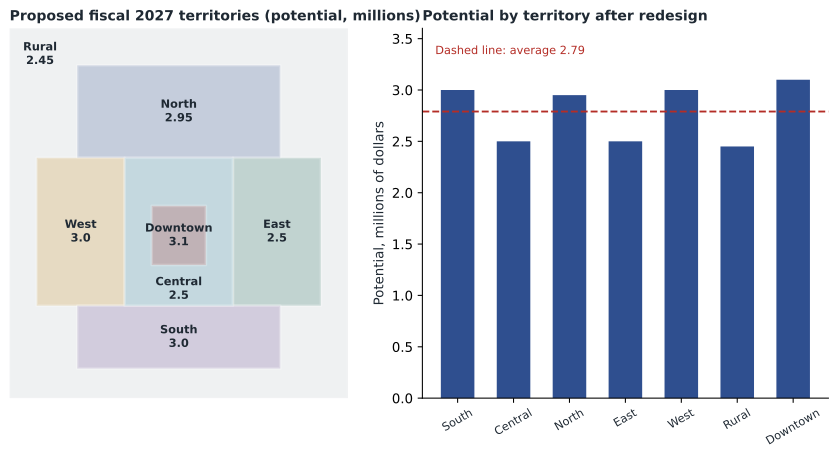
Grace and Darnell redrew the map in three steps. First, they made the downtown commercial district, which had been split between Kevin and Lisa, into a single new territory for the seventh account executive, because it was dense, rich in professional-services firms and easy to cover on foot and by short drives. Second, they moved a cluster of small towns closest to the city from the rural territory into the North territory, which reduced Sam's driving, and gave Sam a group of agricultural-equipment and farm-supply accounts along the highway corridor that had belonged to the East territory and lay on roads he already traveled. Third, they assigned the two segment specialists described in lesson 2, Lisa and Nadia, a smaller geographic area so they would have time for specialist deals across the whole region.
They followed a few common design rules. Territories should be contiguous, meaning each is one connected area rather than scattered pieces, so sellers are not driving past each other's customers. Boundaries should follow natural lines such as highways or postal codes so everyone knows which side an address falls on. And accounts that are part of the same customer, such as several locations of one clinic group, should stay with one seller wherever they are, with exceptions written down.
| Territory | Potential before | Potential after | Change |
|---|---|---|---|
| South (Kevin) | 3,900,000 | 3,000,000 | −900,000 |
| Central (Lisa, clinics specialist) | 3,400,000 | 2,500,000 | −900,000 |
| North (Maya) | 3,000,000 | 2,950,000 | −50,000 (lost two dense blocks, gained nearby towns) |
| East (Nadia, professional services specialist) | 3,100,000 | 2,500,000 | −600,000 |
| West (Andrew) | 3,700,000 | 3,000,000 | −700,000 |
| Rural (Sam) | 2,400,000 | 2,450,000 | +50,000 (lost six nearby towns, gained highway-corridor accounts from East) |
| Downtown (new hire) | — | 3,100,000 | new |
| Total | 19,500,000 | 19,500,000 | 0 |
The new design narrowed the range among the five generalist territories to between 2.45 and 3.1 million dollars. The two specialist territories were deliberately smaller, because Lisa and Nadia would spend part of their time on specialist deals outside them. Their quotas would include credit for those deals, a point lesson 7 returns to.
Worked problem
Checking workload for the rural territory
Before the change, Sam's rural territory needed about 1,240 hours of selling and travel a year, of which Grace estimated 460 were driving. Moving the six towns closest to the city into the North territory removes about 30 accounts and, because those towns lay along Sam's main routes, about 180 hours of driving and 120 hours of selling time. Maya's North territory gains the selling time but only about 60 hours of extra driving, because the towns are closer to her base. What happens to each seller's hours?
Show solution
- \[\text{Sam after} = 1{,}240 - 180 - 120 = 940 \text{ hours}\]
- \[\text{Maya after} = 980 + 120 + 60 = 1{,}160 \text{ hours}\]
- Total hours fall from 1,240 + 980 = 2,220 to 940 + 1,160 = 2,100, a saving of 120 hours of driving across the two territories.
- The highway-corridor accounts Sam gains from the East territory add about 80 hours of selling but almost no driving: 940 + 80 = 1,020 hours.
Answer: Sam's workload falls from 1,240 to about 1,020 hours once his new corridor accounts are included, and Maya's rises from 980 to 1,160 before her other changes. Because Maya also lost two dense blocks to the new downtown territory, which took about 140 hours of her selling time, her final workload is about 1,020 hours, close to the average for the generalist territories. The change cuts total driving, which is time no customer benefits from.
Moving accounts: the human side
Every redesign moves accounts from one seller to another, and the seller losing an account often loses a relationship they built over years, along with future commission. Handled badly, account moves cause resentment, damage customer relationships and lead sellers to hide opportunities so they are not reassigned. Rob set out rules for the fiscal 2027 changes before announcing them:
- Open opportunities that are already at the proposal stage stay with the current seller until they close or are lost, and the seller receives full credit.
- Customers moving to a new seller get a joint introduction, in person or by video, with both sellers present.
- For the first six months, the former seller receives a share of credit, 25 in 100, on any new business from accounts they hand over, so they have a reason to help the transition.
- Every seller loses and gains accounts on the same rules, and the rules are written down and shared with the team before the new map is final.
Kevin lost the most potential, and Darnell met him before anyone else saw the new map. Kevin's reaction was that the change seemed to punish him for building a strong territory. Darnell explained that Kevin's quota would be set on the new territory's potential, so his chance of earning was unchanged, and that several of his largest customers, including two he had won personally, would stay with him as named accounts despite being inside the new downtown area. Kevin accepted the change, though he asked for the named-account exceptions to be put in writing, which they were.
Territories on the sales floor
A retail store's version of a territory is a combination of floor zones, the departments or areas each seller covers on a shift, and the shift schedule itself. At Juniper & Pine, the most valuable territory was not a place but a time: Saturday afternoons, when traffic and sales were highest. Assigning those shifts unfairly would do as much harm as an unbalanced map.
Bev's scheduling rule gave every commissioned floor seller a fair share of high-traffic shifts over each four-week period, rotated by a published pattern, with trades allowed if both sellers and the manager agreed. During the peak season she also assigned floor zones by shift so that appliances, the department with the most technical questions, always had a certified seller on the floor. She tracked sales per hour worked for each seller so that she could see whether results reflected skill or simply the shifts each person had worked.
Reviewing territories over time
Territories drift out of balance even when they start well. A large customer moves its head office, a new housing area fills with small businesses, or a seller builds such strong relationships that their territory's results rise faster than its potential. For that reason Darnell planned to review the potential and workload estimates once a year, using the same method each time, and to change boundaries only when the gap between the largest and smallest territory grew beyond an agreed limit of about 15 in 100 of average potential. Smaller changes would be handled through quotas rather than by moving accounts.
He also agreed some rules with the team so that account moves would feel fair. A seller who had worked an opportunity for more than 60 days would keep it until it closed or was lost, even if the account moved. Commission on moved accounts would be split for the first quarter after the move when both sellers had worked on a deal. And customers would always hear about a change from their current seller first, followed by a joint introduction, rather than from a letter or an email from head office.
These rules cost a little money in shared commission, but they reduce the temptation to hold back deals before a territory change, and they protect customer relationships at the moment when they are most at risk. Sellers are more likely to accept a new map when they believe the rules for moving accounts were set before anyone knew which accounts would move.
Common mistakes
MistakeGiving every seller the same quota on very unequal territories.
InsteadBalance potential and workload, or set quotas that reflect the difference.
MistakeMeasuring territories only by the number of accounts.
InsteadEstimate potential and the hours of selling and travel each territory needs.
MistakeDrawing scattered or overlapping territories.
InsteadKeep territories contiguous, with boundaries everyone can apply.
MistakeMoving accounts without warning or credit rules.
InsteadPublish rules for open deals, joint introductions and transition credit before the map is final.
MistakeIgnoring the time dimension of retail territories.
InsteadRotate high-traffic shifts fairly and compare sellers on sales per hour worked.
Summary and key terms
- A sales territory is the set of customers and prospects assigned to a seller.
- Good design leaves less potential untouched, treats sellers fairly and serves customers well; realignment often yields gains of a few percent of sales for little cost.
- Design balances potential, how much a territory could buy, against workload, the selling and travel time it needs.
- Comparing each territory with the average shows how unbalanced a design is, and many designers aim for every territory within about 15 in 100 of the average.
- Territories should be contiguous, follow clear boundaries and keep multi-site customers together.
- Moving accounts needs written rules for open deals, joint introductions and transition credit.
- In retail, territories include floor zones and shifts, and fair rotation of high-traffic shifts matters.
- Sales territory
- The set of customers and prospects assigned to one seller or team.
- Territory potential
- How much the customers in a territory could buy in a year, from any supplier.
- Workload
- The selling and travel time a territory needs.
- Contiguous territory
- A territory that forms one connected area.
- Named account
- A customer assigned to a seller by name, regardless of territory boundaries.
- Floor zone
- The department or area of a store that a seller covers on a shift.
Practice problems
Work each problem on paper first, then reveal the answer to check.
Five territories have potentials of 2.0, 2.5, 3.0, 3.5 and 4.0 million dollars. What is the average, and how far above it is the largest?
Show answer
The total is 15.0 million and the average 3.0 million; 4.0 ÷ 3.0 ≈ 1.33, or about 33 in 100 above average.
A territory needs 1,200 hours, 500 of them driving. Moving accounts saves 150 hours of driving and 100 of selling. What is the new workload?
Show answer
1,200 − 150 − 100 = 950 hours.
Why did Rob give the former seller 25 in 100 of credit for six months on handed-over accounts?
Show answer
So the seller losing the account has a reason to help the new seller and the customer through the transition.
Lesson quiz · 5 questions
Score 60% or more to complete this lesson.
Create a free account to save your progress, take quizzes and earn a certificate.