
SLS-220 · Lesson 9 of 12 · 22 min
Customer success and account management
▶ Video coming soon A video version of this lesson is on the way.
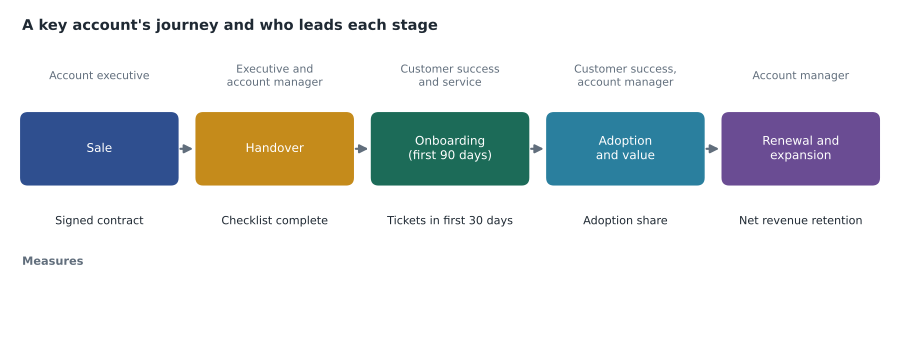
Halverson Law signed with Ridgeline on Thursday, November 5, 2026: three multifunction printers on a 48-month plan, six workstations and installation, for 36,216 dollars in all. Maya won it in her lab week, Rob Kowalski countersigned it, and on the following Monday the account was handed to Farida, because the furniture had to be in place before the firm's December open house. At the handover meeting, Farida asked the question she asked of every new account. "What does Halverson need to be true in six months for this to have been a good decision?" Maya knew the products, the prices and the delivery dates. She had not thought about the six-month question.
That question is the starting point of customer success: the work of making sure customers achieve the outcomes they bought a product or service for. The idea grew up with subscription software, where a customer can stop paying at the end of any term and suppliers learned that keeping customers depends on whether they actually use and benefit from what they bought. It now appears across business-to-business markets, including services like managed print. This lesson covers what customer success involves, how it differs from account management and sales, and how Ridgeline organized it for its key accounts and its RoomFlow software.
Three jobs, one customer
In a key account, several roles at the supplier touch the customer. Their responsibilities overlap, and customers become frustrated when they are unclear.
| Role | Main question | Typical responsibilities | Measured on |
|---|---|---|---|
| Account executive (sales) | Will they buy? | Discovery, proposals, negotiation, closing new business | New bookings |
| Account manager | Will the relationship grow and last? | Account plan, relationships, business reviews, renewals, expansion | Retention and growth |
| Customer success manager | Are they getting the value they expected? | Onboarding, adoption, success plans, health monitoring | Adoption, health, renewal readiness |
| Service and support | Does it work today? | Installation, repairs, help desk, service levels | Response times, fix rates, satisfaction |
Smaller suppliers often combine these roles. At Ridgeline in 2026, Farida did most of the account management and much of the customer success work herself, the service manager ran service and support, and RoomFlow had one consultant, Hannah Ostberg, who set up new customers. Rob's plan for fiscal 2027 added a dedicated customer success specialist for RoomFlow from March. What mattered more than titles, Farida said, was that each customer knew who to call for what, and that Ridgeline's people shared what they learned.
Starting with outcomes
Customers do not buy printers or room-booking software for their own sake. They buy them to reach an outcome: fewer interruptions, lower costs, staff who do not waste time hunting for a room. Customer success starts by writing down the outcomes the customer expects, in measurable terms, and then working backward to what has to happen for them to be reached. A short document that does this is often called a success plan.
| Outcome Halverson expects | Measure | Starting point | Target by May 2027 |
|---|---|---|---|
| Fewer printing interruptions | Printer faults reported per month | About 6 a month on old devices | No more than 1 a month |
| Lower printing cost | Monthly print cost including toner and service | About 488 dollars a month | At or below the contract price |
| Staff time back | Time spent ordering toner and calling for repairs | About 3 hours a month for the office manager | Under 30 minutes a month |
| A good first impression for clients | Furniture in place for the open house | Not applicable | Installed before the December open house |
The success plan made Farida's six-month question concrete. In May 2027 she would be able to show Halverson's managing partner, Ruth Halverson, whether each outcome had been reached. If one had not, she would know before Ruth did.
Onboarding: the first ninety days
Onboarding is the period after a sale in which the customer starts using what it bought: installation, setup, training and the first weeks of use. Many customer success practitioners regard it as the most important period in the relationship, because first impressions shape how the customer judges everything that follows, and because problems that are not fixed early tend to become habits. The evidence for this comes largely from software companies' own data and practitioner surveys rather than independent research, but it matched Ridgeline's experience.
In September and October 2026, Hannah had piloted a standard launch kit for new RoomFlow customers with three accounts, including Halverson Law. The kit included a fifteen-minute setup call with each room's owner, a one-page guide for staff, a short video, booking rules agreed with the customer in advance and a check-in at day 30. The results were clear enough that the kit would become standard from January 2027.
Worked problem
What the launch kit saved
Before the launch kit, a new RoomFlow customer raised an average of 9 support tickets in its first 30 days. With the kit, the three pilot customers averaged 3. Ridgeline estimates that each ticket costs 45 dollars of support time. The kit itself takes about 2.5 hours of Hannah's time per customer, at an internal cost of 52 dollars an hour. Ridgeline expects to onboard 40 new RoomFlow customers in fiscal 2027. What is the net saving in the first 30 days for each customer, and across the year?
Show solution
- Tickets avoided per customer: 9 − 3 = 6.
- Support saving per customer: 6 × 45 = 270 dollars.
- Kit cost per customer: 2.5 × 52 = 130 dollars.
- Net saving per customer: 270 − 130 = 140 dollars.
- Across 40 customers: 40 × 140 = 5,600 dollars.
Answer: The launch kit saves about 140 dollars per customer in the first 30 days, about 5,600 dollars across the year. The larger benefit is harder to count: customers whose first month goes smoothly are more likely to use the system fully and to renew.
Farida added a caution. Three pilot customers is a small sample, and the pilot customers may have been easier than average. The kit's effect should be checked again once more customers have used it. That did not stop Ridgeline adopting it; it meant Ridgeline should keep measuring.
Adoption and time to value
Two measures sit at the heart of customer success. Adoption is how fully the customer uses what it bought: the share of licensed users who are active, the share of rooms booked through the system rather than by email, or the share of printing done on managed devices rather than old desktop printers. Time to value is how long it takes from signing to the customer seeing the first real benefit.
Worked problem
Measuring adoption at the City
The City of Sioux Falls has 16 rooms on RoomFlow in two buildings. In October 2026, 2,540 hours of bookings were made through RoomFlow, and the facilities office estimates that another 410 hours of meetings in those rooms were arranged informally by email or by simply walking in. What share of room use went through RoomFlow? Why does the answer matter for the meeting-room project?
Show solution
- \[\frac{2{,}540}{2{,}540 + 410} = \frac{2{,}540}{2{,}950} = 0.861 \approx 86 \text{ in } 100\]
Answer: About 86 in 100 of room use went through RoomFlow. The rest causes most clashes, because informal bookings are invisible to everyone else. Before the City adds rooms in 2027, raising adoption toward 95 in 100 would make the new rooms easier to manage and make the City's utilization data more accurate.
Low adoption is one of the strongest leading indicators of churn (lesson 8). A customer that pays for something it barely uses will eventually ask why it is paying. High adoption, on the other hand, is usually the precondition for expansion: a customer that uses RoomFlow in all its rooms is a natural candidate for more rooms.
High touch and low touch
A supplier cannot give every customer the same attention. Customer success teams usually segment customers by size and potential into tiers. Key accounts get a high-touch model: a named person, regular meetings, a success plan. Smaller customers get a low-touch or tech-touch model: standard onboarding, help articles, automated check-ins and a pooled support team. The tier should match what the customer is worth and what it needs, which takes us back to the cost-to-serve thinking in lesson 1.
Worked problem
How many accounts can one person manage?
Ridgeline estimates that a high-touch key account needs about 9 hours a month of account management and customer success time, and a mid-tier growth account about 2.5 hours a month. An account manager has about 110 hours a month available for this work after travel, administration and internal meetings. Farida is responsible for 5 key accounts. How many growth accounts can she also support?
Show solution
- Time for key accounts: 5 × 9 = 45 hours a month.
- Time left: 110 − 45 = 65 hours a month.
- \[\frac{65}{2.5} = 26\]
Answer: Farida can support about 26 growth accounts alongside her 5 key accounts. If Ridgeline adds key accounts to her list, the growth accounts must move to someone else or to a lower-touch model, or service will slip.
The handover from sales
The moment a new customer moves from the account executive who sold to it to the people who will look after it is one of the riskiest in the relationship. Customers dislike repeating themselves, and promises made during the sale can be lost. Ridgeline's handover checklist required the account executive to hand over five things in a joint meeting with the customer present or, at least, in writing before it.
- What the customer bought, including every special term, promise and exception agreed during the sale.
- Why the customer bought: the problem, its cost, the outcomes expected and the people who cared most.
- Who is who: the relationship map, with notes on each person's priorities and concerns.
- Open questions and risks: anything not yet resolved, any doubts the customer expressed.
- The first milestones: installation dates, training, the first review.
For Halverson, the handover surfaced one item that could have gone wrong. During the sale, Maya had told Ruth Halverson that the furniture would be installed after hours so that clients would not see the work. The promise was in her notes but not in the order. Farida added it to the installation request that afternoon.
Sharing what customer success learns
Customer success staff see things that sales and account management do not: which features customers struggle with, which training works, where the product falls short of its promises. That knowledge is valuable in three directions. It should go back to the product and service teams, so that problems are fixed. It should go to the account manager, so that the account plan reflects reality. And it should go to sales, so that new customers are told the truth about what to expect, which reduces disappointment later.
In 2026, Hannah's pilot had found that RoomFlow's room displays confused staff when a booking ran over into the next one. She passed it to RoomFlow's developers and to the sales team, and Ridgeline's demonstrations from November showed how the display handled overruns, rather than leaving customers to discover it.
Common mistakes
MistakeTreating the sale as the end of the work.
InsteadStart a success plan at signing, built on the outcomes the customer expects.
MistakeMeasuring only whether products were delivered.
InsteadMeasure adoption and time to value, which show whether the customer is benefiting.
MistakeGiving every customer the same level of attention.
InsteadMatch high-touch and low-touch models to the account's value and needs.
MistakeLosing promises made during the sale at handover.
InsteadUse a handover checklist covering every term, promise, person and risk.
MistakeKeeping what customer success learns inside one team.
InsteadShare it with product, account management and sales.
Summary and key terms
- Customer success is the work of making sure customers achieve the outcomes they bought a product or service for.
- It overlaps with sales, account management and service, and customers need to know who does what.
- A success plan records the outcomes the customer expects, with measures, starting points and targets.
- Onboarding, the first weeks after a sale, shapes how the customer judges what follows.
- Adoption measures how fully the customer uses what it bought, and time to value measures how quickly it benefits; low adoption is a leading indicator of churn and high adoption a precondition for expansion.
- High-touch and low-touch models match attention to account value.
- The handover from sales should pass on every promise, reason, person, risk and milestone.
- What customer success learns should be shared with product, account management and sales.
- Customer success
- The work of making sure customers achieve the outcomes they bought a product or service for.
- Success plan
- A document recording the outcomes a customer expects, with measures, starting points and targets.
- Onboarding
- The period after a sale in which the customer installs, sets up, learns and starts using what it bought.
- Adoption
- How fully a customer uses what it bought, such as the share of licensed users who are active.
- Time to value
- The time from signing to the customer seeing the first real benefit.
- High-touch model
- A service model with a named person, regular meetings and a success plan, used for key accounts.
Practice problems
Work each problem on paper first, then reveal the answer to check.
A customer has 50 licenses and 38 active users. What is adoption?
Show answer
38 ÷ 50 = 0.76, or 76 in 100.
An account manager has 100 hours a month, serves 4 key accounts at 10 hours each and growth accounts at 3 hours each. How many growth accounts can they support?
Show answer
100 − 40 = 60 hours; 60 ÷ 3 = 20 growth accounts.
What did Farida's handover check catch at Halverson Law, and why did it matter?
Show answer
Maya's promise to install the furniture after hours was in her notes but not on the order; missing it would have broken a promise to the managing partner in the first week.
Lesson quiz · 5 questions
Score 60% or more to complete this lesson.
Create a free account to save your progress, take quizzes and earn a certificate.