
SLS-220 · Lesson 1 of 12 · 27 min
What makes an account key
▶ Video coming soon A video version of this lesson is on the way.
On the first Monday of October 2026, after the weekly sales meeting had broken up, Farida Haddad stayed behind in Ridgeline's boardroom with a printout of the customer list. It ran to eleven pages. Maya Chen, five weeks into her job as an account executive, sat across from her with a coffee and a notebook. Darnell Brooks had asked Farida to spend Monday afternoons that fall teaching Maya how Ridgeline looks after its largest customers, because Maya's first wins would soon need looking after and because the biggest opportunity in the building, Prairie Valley School District, might soon become a customer.
Farida slid the printout across the table. "Ridgeline has about 430 active customers," she said. "Every one of them matters, but they do not all matter in the same way, and we cannot treat them all the same. If I gave every customer the attention I give the City, I would need forty of me. If I gave the City the attention I give a two-person accounting office, we would lose it within a year. Key account management starts with deciding which accounts deserve the difference."
This course is about that difference. A key account is a customer that a supplier has chosen to manage in a special way because of its present or future importance. Key account management (KAM) is the planned, long-term approach a supplier uses to keep, grow and work closely with those customers. It includes account planning, mapping relationships across both organizations, understanding the customer's business, regular business reviews, growing the account through cross-selling and upselling, managing renewals, spotting churn risk early, working with customer success staff and partners, and coordinating customers that buy across many sites. Each of those topics has its own lesson. This first lesson asks the question that comes before all of them: which accounts are key, and why?
The course follows Maya and Farida through October and early November 2026, as Ridgeline prepares for its new fiscal year, which begins on December 1. Rob Kowalski, Ridgeline's vice-president of sales, has announced that from that date the company will name a small set of key accounts, give each one a written account plan and an executive sponsor, and review them every quarter. Several of Maya's own customers are candidates, and so are some of Farida's long-standing ones. Everything that happens after mid-November 2026 in these lessons is a plan, not an event: the renewals, reviews and expansions that the plans describe are still ahead.
Key accounts, large accounts and important accounts
The phrase key account is sometimes used to mean simply a big customer, but size alone does not make an account key. Farida's first rule was that an account becomes key because the supplier decides to treat it differently, and that the decision should rest on a clear view of what the account is worth and what it would take to serve it well. Researchers who have studied KAM, notably Malcolm McDonald, Tony Millman and Beth Rogers at the Cranfield School of Management in the 1990s, describe key accounts as customers that a supplier identifies as being of strategic importance, not just of high current revenue. A large customer that buys on price alone, changes suppliers every few years and wants nothing beyond a low invoice may be better served by efficient transactional selling than by an expensive account team.
In practice, suppliers use several terms for the same idea. Some say strategic accounts, some say major accounts, some say global or national accounts when the customer buys across many regions. The Strategic Account Management Association (SAMA), a professional association whose members are mainly large business-to-business suppliers, uses strategic account management for the discipline. In this course, key account, strategic account and major account all mean an account the supplier has deliberately chosen to manage with a dedicated plan and team.
| Type of account | What it typically needs | How Ridgeline serves it |
|---|---|---|
| Transactional | Fast quotes, reliable delivery, easy reordering | Inside sales team, online reordering, standard terms |
| Growth | Help to buy more as it grows; regular contact | Account executive, annual check-in, targeted offers |
| Maintenance | Steady service on a stable contract | Service desk, renewal reminders, light-touch reviews |
| Key | Planning together, senior relationships, tailored service | Account manager and team, written plan, quarterly business review, executive sponsor |
Why suppliers single out a few customers
The economic reason for key account management is concentration. In most business-to-business companies a small share of customers produces a large share of revenue and an even larger share of profit. The pattern is often called the Pareto principle or the 80/20 rule, after the economist Vilfredo Pareto's observation about the distribution of land ownership, though the exact proportions vary widely from company to company and 80/20 is a rule of thumb, not a law. What matters for a supplier is its own data, which Grace Liu, Ridgeline's sales operations analyst, had pulled from the CRM for Farida that morning.
Worked problem
How concentrated is Ridgeline's revenue?
In fiscal 2026 (December 1, 2025 to November 30, 2026, with November estimated), Ridgeline's revenue from its 430 active customers is forecast at 16.8 million dollars. The 20 largest customers account for 6.9 million dollars of it, and the next 80 customers for a further 5.4 million dollars. What share of revenue comes from the top 20 customers, and from the top 100? What share of customers are they?
Show solution
- Top 20 share of revenue:
- \[\frac{6.9}{16.8} = 0.411 \approx 41 \text{ in } 100\]
- Top 100 revenue is 6.9 + 5.4 = 12.3 million dollars.
- \[\frac{12.3}{16.8} = 0.732 \approx 73 \text{ in } 100\]
- Share of customers: 20 ÷ 430 is about 4.7 in 100, and 100 ÷ 430 is about 23 in 100.
Answer: About 5 in 100 of customers bring in about 41 in 100 of revenue, and about 23 in 100 of customers bring in about 73 in 100. Ridgeline's pattern is less extreme than 80/20, but concentrated enough that losing a handful of large customers would hurt badly.
Concentration cuts both ways. It means a few customers deserve more attention, and it also means the company is exposed if one of them leaves. Farida pointed to a name near the top of the list: the City of Sioux Falls facilities office, a customer since 2019 that would spend about 318,000 dollars with Ridgeline in fiscal 2026 on managed print across eleven city buildings, office furniture and meeting-room technology. "If the City walked away, we would lose nearly two in every hundred dollars we bring in, from one relationship," she said. "That is reason enough to plan it carefully."
There are other reasons beyond revenue. Key customers often buy a wider range of products, which gives the supplier a deeper understanding of how its offerings work together. They may be reference customers whose names help win others; Prairie Valley would be the first school division or district of its size on Ridgeline's list. They may push the supplier to improve, by demanding better service or new features. And because their buying decisions are complex and involve many people, they reward a supplier that invests in relationships, while punishing one that treats them like any other order.
The cost of serving a key account
Special treatment is not free. A key account may have a dedicated account manager, a service technician who knows its sites, an executive sponsor who meets its leaders, custom reporting, quarterly business reviews and sometimes better prices. Each of those costs time and money. Cost to serve is the total cost of selling to, delivering to and supporting a customer, beyond the cost of the products themselves. A large account with a high cost to serve can be less profitable than a smaller account that rarely needs anything.
Worked problem
Comparing two accounts by profit, not revenue
Ridgeline estimates fiscal 2026 figures for two customers. The City: revenue 318,000 dollars, gross margin 30 in 100, cost to serve (account management, service calls, reporting, delivery and installation) 46,000 dollars. A regional insurance brokerage with twelve offices: revenue 210,000 dollars, gross margin 34 in 100, cost to serve 52,000 dollars. Which account contributes more after the cost to serve?
Show solution
- City gross margin: 318,000 × 0.30 = 95,400 dollars.
- City contribution: 95,400 − 46,000 = 49,400 dollars.
- Brokerage gross margin: 210,000 × 0.34 = 71,400 dollars.
- Brokerage contribution: 71,400 − 52,000 = 19,400 dollars.
- Contribution as a share of revenue: City 49,400 ÷ 318,000 ≈ 15.5 in 100; brokerage 19,400 ÷ 210,000 ≈ 9.2 in 100.
Answer: The City contributes about 49,400 dollars after the cost to serve, the brokerage about 19,400 dollars. The brokerage's higher margin is eaten up by the cost of serving twelve scattered offices, which is a question for its account plan, not a reason to drop it.
Farida's point was not that the brokerage was a bad customer. It was that revenue alone is a poor guide to where account management effort should go. Suppliers that track cost to serve can see which accounts need a different service model, such as fewer site visits and more remote support, before they decide which accounts to invest in. Lesson 11 returns to cost to serve for customers with many sites.
Choosing key accounts: attractiveness and strength
Most structured approaches to choosing key accounts look at two questions. The first is how attractive the account is to the supplier: how much it could buy, how fast it is growing, how profitable it is likely to be, and how well its needs match what the supplier does well. The second is how strong the supplier's position is with the account: how much of the customer's business it already has, how good the relationships are, and how the customer rates it against competitors. McDonald and his colleagues popularized a matrix built on these two dimensions, often called the key account selection matrix or directional policy matrix, and many companies use a version of it.
Each dimension is scored against a few weighted criteria. The criteria and weights are a supplier's own choice, and choosing them is a useful conversation in itself. Ridgeline's sales leadership agreed on the following for fiscal 2027, after Grace showed them which characteristics its most profitable long-term customers shared.
| Account attractiveness criterion | Weight | What a high score means |
|---|---|---|
| Potential spend in Ridgeline's categories | 35 | Large total spend on print, furniture and workplace technology |
| Growth | 20 | Expanding staff, sites or services |
| Likely profitability | 20 | Healthy margins and a manageable cost to serve |
| Fit with Ridgeline's strengths | 15 | Needs that combine products and service, close to Ridgeline's service area |
| Strategic value | 10 | Reference value, entry to a new sector, learning |
Worked problem
Scoring an account's attractiveness
Farida scores Prairie Valley School District on each attractiveness criterion out of 10: potential spend 9, growth 5, profitability 6, fit 8, strategic value 9. What is the weighted attractiveness score out of 10?
Show solution
- Multiply each score by its weight and add:
- \[9(35) + 5(20) + 6(20) + 8(15) + 9(10) = 315 + 100 + 120 + 120 + 90 = 745\]
- Divide by the total weight of 100:
- \[\frac{745}{100} = 7.45\]
Answer: Prairie Valley's attractiveness score is about 7.5 out of 10: very large potential spend and high strategic value, with moderate growth and profitability.
The strength side is scored the same way, using criteria such as Ridgeline's current share of the account's spending, the quality and breadth of relationships, the customer's satisfaction and Ridgeline's advantage over competitors. Plotting both scores places each account in one of four boxes.
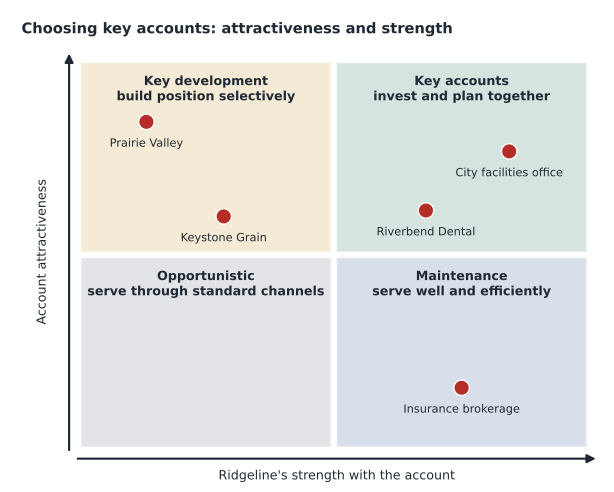
| Box | Attractiveness | Ridgeline's strength | Typical approach |
|---|---|---|---|
| Key accounts | High | High | Invest: dedicated team, joint planning, executive sponsor |
| Key development accounts | High | Low | Invest selectively to build position; decide which ones are worth it |
| Maintenance accounts | Low | High | Serve well and efficiently; protect margins |
| Opportunistic accounts | Low | Low | Serve through standard channels and inside sales |
Prairie Valley sat in the top left. It was highly attractive, but in early October Ridgeline had no contract with it at all: the request for proposals for managed print had closed on October 9 and the decision was still weeks away. "An account can be key before it is a customer," Farida said. "That is what the top-left box is for. Darnell has been working Prairie Valley for more than a year. If we win, the account plan is ready on the first day." On November 10 the division's procurement office told Ridgeline it had been selected, at about 66,000 dollars a year, subject to board approval on November 17 and a signed contract.
How many key accounts?
A supplier can only manage a few accounts this way. Each needs a capable account manager, time from senior people and service resources. If everything is key, nothing is. Rob set a firm limit for Ridgeline's first year: eight named key accounts and up to four key development accounts, with Farida and one other account manager sharing them, each supported by the account executive who had won the business. The limit forced choices. Several large customers that mostly reordered supplies on standard terms were placed in the maintenance box and moved to a lighter service model with a named contact on the inside sales team.
Choosing key accounts is also a decision about what to say no to. Farida warned Maya against two temptations. The first is the account that is loud rather than valuable: a customer that demands a lot of attention, is unhappy whatever the supplier does and is never going to buy much more. The second is the account that is flattering: a famous name that would look good on Ridgeline's website but has no real need for what Ridgeline sells. Both can absorb effort that would earn far more elsewhere.
How key account relationships develop
Key account relationships are not born mature. Tony Millman and Kevin Wilson, writing in the mid-1990s, described a series of stages that supplier-customer relationships tend to move through, later developed with McDonald and Rogers. In the earliest stage, sometimes called pre-KAM, the supplier has identified the customer as a possible key account but has little or no business. In early KAM, there is some business, usually through a single main contact on each side, often a salesperson and a buyer. In mid-KAM, contacts multiply across functions and trust grows. In partnership KAM, the two organizations share information, plan together and treat each other as strategic. A few relationships reach a synergistic stage in which the two organizations work almost as one on shared goals. The model also describes uncoupling, when a relationship winds down, whether because of a broken promise, a change of strategy or a change of people.
| Stage | Typical contact pattern | Ridgeline example in fall 2026 |
|---|---|---|
| Pre-KAM | Seller exploring; no or little business | Prairie Valley before November 10 |
| Early KAM | Single main contact on each side | Keystone Grain Equipment: Maya and Dale Petrie |
| Mid-KAM | Several contacts across functions | Riverbend Dental Group: account, service and billing contacts |
| Partnership KAM | Shared information and joint planning | The City facilities office: shared five-year workplace plan |
| Synergistic KAM | Joint goals and close integration | None at Ridgeline yet |
| Uncoupling | Relationship winding down | A former customer that moved to a national supplier in 2024 |
The stages are a way of thinking, not a law of nature. Later researchers have pointed out that many relationships never move beyond the early or middle stages, that some customers do not want a partnership with any supplier, and that the evidence for the model comes mostly from case studies and interviews rather than large controlled studies. Farida used it as a mirror: "Ask where the relationship really is, not where we wish it were. Then plan the next step, not the last one."
What changes when an account becomes key
Naming an account key should change how the supplier works with it in visible ways. At Ridgeline, from December 1, 2026, each key account would get the following.
- A named account manager, accountable for the whole relationship and its results, working with the account executive who won it.
- A written account plan, reviewed every quarter, with objectives, a relationship map, risks and an action list (lesson 2).
- An executive sponsor: a Ridgeline leader, usually Rob or the operations director, who builds a relationship with a senior person at the customer.
- Business reviews with the customer, at least twice a year and usually quarterly (lesson 5).
- A service plan with named technicians and agreed response times, tracked and reported.
- A seat at Ridgeline's monthly key account meeting, where problems get escalated and resources assigned.
None of this is visible from a price list. What a customer notices is that the supplier seems to understand its business, remembers what was promised, sees problems coming, and brings ideas rather than just quotes. That, Farida said, is the job.
Common mistakes
MistakeCalling every large customer a key account.
InsteadChoose key accounts on attractiveness and strength, and limit the number to what the team can serve well.
MistakeJudging accounts by revenue alone.
InsteadLook at profitability after the cost to serve, growth and strategic value as well.
MistakeTreating a key account like any other customer once it is named.
InsteadGive it a plan, a team, an executive sponsor and regular business reviews.
MistakeAssuming a relationship is a partnership because the customer is large.
InsteadAssess the real stage of the relationship and plan the next step from there.
MistakeInvesting heavily in a flattering or demanding account with little potential.
InsteadUse the selection criteria to decide, and say no to accounts that will not repay the effort.
Summary and key terms
- A key account is a customer a supplier has chosen to manage specially because of its present or future importance.
- Key account management is a planned, long-term approach to keeping, growing and working closely with those customers.
- Revenue is usually concentrated in a small share of customers, which makes a few accounts worth special attention and also exposes the supplier if one leaves.
- Profitability after the cost to serve is a better guide than revenue alone.
- Many suppliers choose key accounts by scoring account attractiveness and their own strength with each account, then placing accounts on a two-by-two matrix.
- An account can be key before it is a customer.
- A supplier can manage only a limited number of key accounts well.
- Relationships tend to develop through stages from early contact to partnership, though many never reach the later stages and the evidence comes mainly from case studies.
- Naming an account key should bring a named account manager, a written plan, an executive sponsor, regular business reviews and a service plan.
- Key account
- A customer a supplier has chosen to manage with a dedicated plan and team because of its present or future importance.
- Key account management (KAM)
- A planned, long-term approach to keeping, growing and working closely with key accounts.
- Cost to serve
- The total cost of selling to, delivering to and supporting a customer, beyond the cost of the products.
- Account attractiveness
- How valuable an account could be to the supplier, based on potential spend, growth, profitability, fit and strategic value.
- Key account selection matrix
- A two-by-two grid of account attractiveness against supplier strength, used to decide where to invest.
- Executive sponsor
- A senior leader at the supplier who builds a relationship with a senior person at a key account.
Practice problems
Work each problem on paper first, then reveal the answer to check.
A customer brings in 250,000 dollars a year at a 28 in 100 gross margin and costs 58,000 dollars to serve. What does it contribute after the cost to serve?
Show answer
250,000 × 0.28 = 70,000 dollars of gross margin; 70,000 − 58,000 = 12,000 dollars, or about 4.8 in 100 of revenue.
Why might a large customer that buys on price alone not be a good key account?
Show answer
It may not value or pay for the extra service, it may switch suppliers often, and the cost of an account team may exceed what the relationship returns.
In which box of the selection matrix would you place a highly attractive prospect where you have no business yet, and what would you do?
Show answer
Key development: invest selectively to build position, for example by meeting more stakeholders and preparing an account plan in case you win.
Lesson quiz · 5 questions
Score 60% or more to complete this lesson.
Create a free account to save your progress, take quizzes and earn a certificate.