
SLS-220 · Lesson 3 of 12 · 19 min
Relationship mapping
▶ Video coming soon A video version of this lesson is on the way.
On the Monday after the request for proposals closed, Farida drew two columns of boxes on the boardroom whiteboard. On the left she wrote the names of the people at Prairie Valley School District whom Ridgeline had met. On the right she wrote the Ridgeline people who knew each of them. Then she drew lines between the boxes. Almost every line ran to the same box on the right: Darnell Brooks. "This is what a single thread looks like," she said. "Darnell has done more than a year of good work here. But if Darnell were sick for a month, or if the division's business manager retired, we would be starting over."
A relationship map is a picture of the people in a customer's organization who matter to a supplier's business, showing their roles, their influence on decisions, their attitude toward the supplier and how strong the supplier's relationship with each of them is. A good map also shows which person on the supplier's side owns each relationship. In key account management, the map is one of the most useful tools in the account plan, because large accounts are won, kept and lost through people.
SLS-110 introduced the buying center, the group of people involved in an organizational purchase, and SLS-211 showed how Maya mapped stakeholders during discovery. This lesson goes further: how to map an account that is already a customer, or about to become one, so that the relationship survives changes in people on both sides.
From a single thread to many
McDonald, Millman and Rogers described two shapes that supplier-customer relationships often take. In the bow-tie shape, the two organizations touch at a single knot: one salesperson talks to one buyer, and everyone else on each side works through those two people. The bow-tie is simple and common in the early stages of a relationship, but fragile: if either person leaves, the relationship can unravel. In the diamond shape, people on each side work directly with their counterparts: the supplier's service manager with the customer's operations staff, its finance team with the customer's accounts payable, its senior leaders with the customer's senior leaders, and the account manager coordinating the whole.
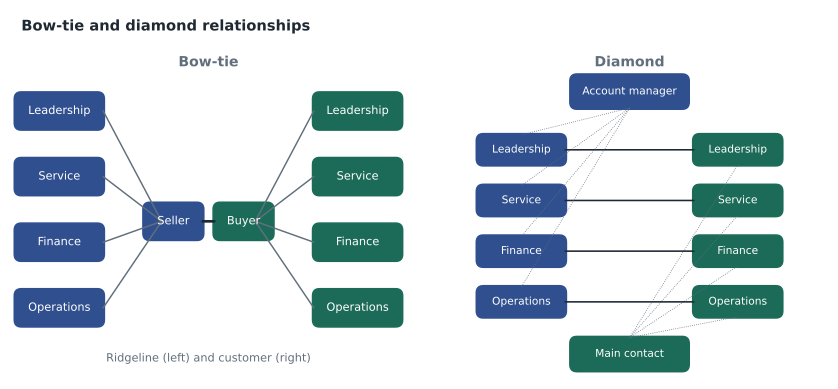
The diamond is not automatically better. It costs more, because more people spend time on the account, and it needs coordination so that the customer does not hear five different stories. But for a key account it spreads risk and gives the supplier a richer understanding of the customer. Farida's goal for Prairie Valley was a diamond within the first year of the contract.
What to record about each person
A useful map records the same few things about each person. Too little and the map is just an organization chart; too much and it becomes gossip. Ridgeline's template asked for six items.
| Item | Question it answers | Example scale |
|---|---|---|
| Role | What do they do, and what is their part in decisions about us? | Decider, influencer, user, buyer, gatekeeper, technical evaluator |
| Influence | How much does their view affect decisions that matter to us? | High, medium, low |
| Attitude to Ridgeline | Do they support us, oppose us or not care yet? | Champion, supporter, neutral, skeptic, opponent |
| Relationship strength | How well does someone at Ridgeline know them? | 0 none, 1 met, 2 regular contact, 3 trusted |
| Their priorities | What do they care about, in their own words? | Free text with source and date |
| Ridgeline owner | Who at Ridgeline is responsible for this relationship? | A named person |
Influence and formal authority are not the same thing. An organization chart shows who reports to whom; a relationship map shows whose view counts. At Prairie Valley the superintendent of business administration would sign the recommendation to the board, but the business manager, Patricia Klassen, had shaped the request for proposals and would run the contract day to day. The IT manager, Ken Fehr, had a veto in practice, because no device would go on the division's network without his approval. And one high-school principal on the division's technology committee, Sarah Nakamura, had argued for managed print for two years and was the clearest champion Ridgeline had.
Mapping Prairie Valley
Farida and Maya built the map together from Darnell's notes, the CRM and the discovery notes Maya had taken in September. They were careful about one rule that applied while the competition was open: the request for proposals limited supplier contact to the procurement officer, Colleen Sawatzky, until the award. The map was built from what Ridgeline already knew; it was not an excuse for new calls.
| Person | Role in the contract | Influence | Attitude | Strength | Ridgeline owner |
|---|---|---|---|---|---|
| Assistant superintendent for business services | Decider; recommends to the board | High | Neutral | 1 | Darnell |
| Patricia Klassen, business manager | Contract owner; daily user of reports | High | Supporter | 2 | Darnell |
| Ken Fehr, IT manager | Technical evaluator; network approval | High | Skeptic | 1 | None |
| Colleen Sawatzky, procurement officer | Runs the competition and the contract terms | Medium | Neutral | 2 | Darnell |
| Sarah Nakamura, high-school principal | Technology committee member; champion | Medium | Champion | 2 | Maya |
| A high-school administrative assistant | Heavy user; loyal to the old local supplier | Low | Skeptic | 1 | Maya |
The map showed three problems at once. First, only two people at Prairie Valley had a relationship with Ridgeline rated 2 or higher, and both of those relationships ran through Darnell. Second, the person with the most practical power over the installation, Ken Fehr, was a skeptic whom nobody at Ridgeline owned. Third, Ken was retiring in the spring of 2027, and the division had not yet hired his successor, so the most important technical relationship would soon have to be built twice.
Worked problem
Measuring relationship coverage
Farida uses a simple coverage measure: for each high-influence stakeholder, multiply relationship strength (0 to 3) by 1 if the person has a named Ridgeline owner and by 0.5 if not, then divide the total by the maximum possible score. Prairie Valley has three high-influence stakeholders: the superintendent (strength 1, owned), Patricia Klassen (strength 2, owned) and Ken Fehr (strength 1, not owned). What is the coverage score?
Show solution
- Superintendent: 1 × 1 = 1.
- Patricia Klassen: 2 × 1 = 2.
- Ken Fehr: 1 × 0.5 = 0.5.
- Total: 1 + 2 + 0.5 = 3.5.
- Maximum: three people at strength 3, all owned, gives 3 × 3 = 9.
- \[\frac{3.5}{9} = 0.389 \approx 39 \text{ in } 100\]
Answer: Coverage is about 39 in 100. The number itself matters less than what it points to: the two biggest gains would come from giving Ken Fehr a Ridgeline owner and from moving the superintendent relationship from 1 to 2.
A score like this is a prompt for discussion, not a scientific measurement. The ratings are judgments, and two people can rate the same relationship differently. Farida found the score useful because it made the gaps visible on one line of the plan on a page and showed whether they were closing from quarter to quarter.
Matching people on both sides
Once the gaps are clear, the next step is to decide who at the supplier should own each relationship. A common approach is to match people by level and function: an executive sponsor with a senior leader, a service manager with an operations manager, a technical specialist with a technical evaluator. The account manager does not have to own every relationship, but needs to know about every one.
| Prairie Valley stakeholder | Proposed Ridgeline owner | First step (after the award) |
|---|---|---|
| Assistant superintendent for business services | Rob Kowalski, executive sponsor | Introductory meeting after the contract is signed |
| Patricia Klassen | Farida, as account manager, with Darnell during the handover | Joint implementation planning |
| Ken Fehr | Ridgeline's network and security specialist | Technical session on device security and network setup |
| Ken Fehr's successor (not yet hired) | Same specialist | Offer an orientation once appointed |
| Sarah Nakamura | Maya | Invite her school to be first in the installation schedule |
| School administrative staff | Ridgeline's installation lead | Short training at each school during installation |
Darnell would stay involved for the first months after the award, so that the people at Prairie Valley who trusted him saw a deliberate handover rather than a disappearance. Many customers dislike the moment when the person who sold to them hands them off to someone they have never met; a joint meeting and a clear explanation of who does what reduce the shock.
Champions, skeptics and opponents
A champion is a person inside the customer who wants the supplier to succeed and works to make that happen: explaining internal politics, carrying the supplier's message into meetings it cannot attend and warning of trouble. Champions are valuable, but they are not employees of the supplier. A champion has their own job and reputation to protect, and they will support the supplier only as long as doing so serves their goals and the organization's.
Skeptics and opponents deserve as much attention. Ken Fehr's skepticism had a reason: a previous supplier had installed printers that broadcast unnecessary traffic on the school network and stored copies of scanned documents on an internal drive with weak security. "He is not against us," Farida said. "He is against the last supplier. Our job is to show him we take his network as seriously as he does." A skeptic who is listened to and whose concerns are met can become one of the strongest supporters, because they have tested the supplier hardest.
An opponent who simply prefers another supplier may never change their mind. The map should still record them, because surprises are worse than opposition. The high-school administrative assistant who had worked with the old local supplier for eleven years was not a decision maker, but her view would shape what other staff said about the installation. Maya planned to ask her to help test the new devices at her school.
Reading the informal network
Not all influence shows on paper. People listen to colleagues they trust, to those who have been in the organization a long time, and to whoever controls information. Questions that help reveal the informal network include: "Who else will want to be comfortable with this?", "Who did you check with before you raised it?" and "Whose opinion would change your mind?" Watching who is copied on emails and who speaks first in meetings also helps.
Farida warned Maya against guessing at people's motives or recording speculation. A note such as "Patricia wants this contract to show the board she can cut costs" is a guess about someone's private ambitions, and if it were ever read by the customer it would damage trust. A note such as "Patricia said in the September 9 meeting that cost control is one of her goals for this year" records what was said, when and where.
When people change
Key account relationships are often damaged not by poor service but by changes in people. A new manager at the customer may have a favorite supplier from a previous job. A champion may be promoted out of the area that buys. A trusted account manager at the supplier may leave. The map is the early-warning system for these changes, and the account plan should treat known changes as risks with actions attached.
- When a customer contact is about to leave, ask them for introductions to their successor and colleagues before they go, and record what they know about the account's history.
- When a new person arrives, treat them as a new relationship, not an old one: learn their priorities rather than assuming they share their predecessor's.
- When the supplier's account manager changes, plan a joint handover meeting and brief the new person fully from the plan and the CRM.
At Riverbend Dental Group, another of Farida's accounts, the clinic had appointed a new director, Dr. Felix Nwosu, in September 2026. He had never met anyone from Ridgeline, and Riverbend's managed print contract was due for renewal in February 2027. Farida rated the relationship 0 and moved "introductory meeting with Dr. Nwosu" to the top of the Riverbend action list. Lesson 8 returns to Riverbend as an example of churn risk.
Common mistakes
MistakeMapping only the people who are easy to reach.
InsteadMap everyone who influences decisions, including skeptics and people nobody at the supplier knows yet.
MistakeRelying on one strong relationship.
InsteadBuild relationships across levels and functions so the account survives a change of people on either side.
MistakeConfusing the organization chart with influence.
InsteadRecord who actually shapes decisions, not only who signs.
MistakeRecording guesses about people's private motives.
InsteadRecord what people said, with the date and context, and keep notes professional.
MistakeContacting stakeholders during a competition when the rules forbid it.
InsteadFollow the procurement rules; build the map from what you already know until contact is allowed.
Summary and key terms
- A relationship map shows the people who matter in a customer organization, their roles, influence and attitude to the supplier, how strong the supplier's relationship with each is and who at the supplier owns it.
- A bow-tie relationship runs through a single contact on each side and is fragile; a diamond relationship connects people across functions and levels and spreads risk.
- Influence differs from formal authority.
- A coverage measure can make gaps visible, though the ratings are judgments.
- Relationship owners are usually matched by level and function, with the account manager coordinating.
- Champions help but have their own interests; skeptics often have reasons that can be addressed.
- Notes should record what people said, not guesses about their motives.
- Changes of people on either side are a major risk and should be planned for in the account plan.
- Relationship map
- A picture of the people who matter in a customer organization, their influence and attitude, and the supplier's relationship with each.
- Bow-tie relationship
- A relationship in which the two organizations connect mainly through one salesperson and one buyer.
- Diamond relationship
- A relationship in which people in several functions on each side work directly with their counterparts.
- Champion
- A person inside the customer who wants the supplier to succeed and works to help it.
- Relationship owner
- The person at the supplier responsible for a particular stakeholder relationship.
- Single-threaded
- Describes an account whose relationship depends on one contact on one or both sides.
Practice problems
Work each problem on paper first, then reveal the answer to check.
An account has two high-influence stakeholders: one at strength 3 and owned, one at strength 1 and not owned. Using Farida's coverage measure, what is the score?
Show answer
3 × 1 = 3; 1 × 0.5 = 0.5; total 3.5 out of a maximum of 6, or about 58 in 100.
Your champion at a customer is being promoted to a different department. What should you do?
Show answer
Congratulate them, ask for introductions to their successor and colleagues, capture what they know about the account and update the map and plan.
Rewrite this note so it is professional: "Ken hates printers and probably wants to keep the old supplier."
Show answer
For example: "Ken said on October 2 that the previous supplier's devices caused network problems and stored scans insecurely; he wants proof that ours will not."
Lesson quiz · 5 questions
Score 60% or more to complete this lesson.
Create a free account to save your progress, take quizzes and earn a certificate.