
SLS-220 · Lesson 5 of 12 · 20 min
Business reviews with customers
▶ Video coming soon A video version of this lesson is on the way.
On Thursday, October 22, 2026, Farida took Maya with her to the City of Sioux Falls facilities office for a quarterly business review. The meeting was in a plain room on the third floor of the main civic building, with a projector, a jug of water and five people from the City: the facilities director Andrea Lindgren, the facilities manager who ran day-to-day operations, a buildings supervisor, a finance analyst and a procurement officer. Ridgeline brought three: Farida, Maya and the service manager. The meeting lasted 75 minutes. Ridgeline spoke for less than half of it.
Afterwards, in the car, Maya said she had expected more selling. "There was some," Farida said. "We agreed to scope the meeting-room project for two buildings. But we earned that by spending the first forty minutes on their numbers and their problems. A business review is the customer's meeting about whether we are doing our job. If it turns into a sales pitch, they stop coming."
A business review is a regular, structured meeting between a supplier and a key account to look back at results, check progress on the customer's goals, resolve issues and agree what comes next. When held every three months it is often called a quarterly business review (QBR); some accounts need one twice a year, others monthly. This lesson covers why reviews matter, how Farida prepared and ran the City's October review, and how she planned the review for Riverbend Dental Group ahead of its February 2027 renewal.
Why business reviews matter
Business reviews do several jobs at once. They show the customer, with evidence, what the supplier has delivered. They surface problems before those problems become reasons to leave. They give senior people on both sides a reason to meet regularly. They keep the account plan honest, because the supplier has to report against what it promised. And they create a natural place to discuss new needs, because the conversation is already about the customer's goals.
There is a further reason that matters at renewal time. Customers forget good service quickly and remember bad service for a long time. A record of quarterly reviews, each showing results against agreed targets, is the supplier's best evidence when a competitor arrives with a lower price. Farida called the reviews "the renewal, paid in installments".
Business review or sales meeting?
| Business review | Sales meeting | |
|---|---|---|
| Whose agenda | Shared; built around the customer's goals | The seller's |
| Main content | Results, issues, progress on goals, plans | A proposal or offer |
| Who talks most | Both sides; often the customer | Often the seller |
| Evidence | Data on service, usage and outcomes | Product information and case studies |
| New business | Raised only where it serves the customer's goals | The main purpose |
| Ends with | Agreed actions on both sides, with owners and dates | A close or next step for the deal |
Preparing the review
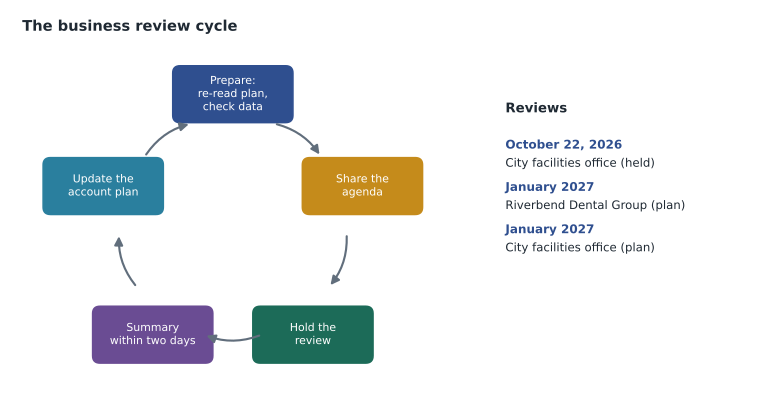
Farida prepared every review the same way, starting two weeks before the meeting. She was strict about the order of the steps, because the content of the meeting had to come from the customer's priorities and the data, not from what Ridgeline wanted to sell.
- Re-read the account plan and the notes from the last review, and list every action agreed there, on both sides.
- Ask the customer's main contact what they want to cover, and who should attend.
- Pull the data: service performance, usage, spending, invoices, issues, and progress on the customer's goals.
- Check every number with the person responsible, and reconcile anything that does not match the customer's own records.
- Write a short agenda and send it a week ahead, with a one-page summary of the data.
- Agree internally who will present what, and what Ridgeline will and will not commit to in the meeting.
The step that most often goes wrong, she said, is checking the numbers. If the supplier's service report says response times averaged three hours and the customer's own log says five, the meeting will be about the disagreement. She had once lost twenty minutes of a review because Ridgeline's report counted response time from when a call was logged, while the City's facilities manager counted it from when the printer failed. Since then, the definitions were written on the first page of every report.
The data: service, usage and value
Business reviews rest on a few kinds of data. Service data shows whether the supplier met its commitments. Usage data shows how the customer uses what it bought, which reveals both waste and opportunity. Value data connects the supplier's work to the customer's goals, in money, time or risk.
Worked problem
Checking service performance against the agreement
The City's managed print agreement requires Ridgeline to respond to service calls within four business hours on at least 95 in 100 of calls each quarter. In Ridgeline's fiscal third quarter (June to August 2026), the City logged 312 service calls. Ridgeline responded within four business hours on 297 of them. Did Ridgeline meet the target? How many more on-time responses would have been needed if only 290 had been on time?
Show solution
- \[\frac{297}{312} = 0.9519 \approx 95.2 \text{ in } 100\]
- 95.2 is above 95, so the target was met, narrowly.
- The target requires at least 0.95 × 312 = 296.4, so 297 on-time responses are needed.
- With only 290 on time, Ridgeline would have needed 297 − 290 = 7 more.
Answer: Ridgeline met the target at about 95.2 in 100. The margin was one call, so the review should say so plainly and explain what Ridgeline is doing to improve rather than presenting the result as comfortable.
Farida showed the result exactly that way: met, narrowly, with the two causes of most late responses. The causes were road construction in late August that had slowed technicians traveling between buildings and two days when one technician was off sick. Her proposed fix was a second trained technician for the City's buildings during the winter months, from December. The facilities manager, who had his own log, nodded at the numbers. "Thank you for not dressing it up," he said.
Worked problem
Showing value in the customer's terms
When Ridgeline took over the City's printing in 2019, the City had 141 devices across eleven buildings. By 2026 it had 96, with the same staff. Ridgeline's data show average monthly print volume of 410,000 pages. The City's 2019 cost per page, including leases, toner, service and staff time spent ordering supplies, was 4.1 cents. In fiscal 2026 it was 3.2 cents. How much is the City saving per year at today's volume, compared with the 2019 cost per page?
Show solution
- Annual pages: 410,000 × 12 = 4,920,000.
- Cost at the 2019 rate: 4,920,000 × 0.041 = 201,720 dollars.
- Cost at the 2026 rate: 4,920,000 × 0.032 = 157,440 dollars.
- Saving: 201,720 − 157,440 = 44,280 dollars a year.
Answer: At today's volume the City is saving about 44,300 dollars a year compared with what it would pay at the 2019 cost per page. The review should also say what the figure leaves out, such as price increases in the market since 2019, so that the finance analyst trusts it.
Value figures are where suppliers are most tempted to exaggerate, and where customers are most skeptical. Farida's rules were to use the customer's own data where possible, to show the calculation, to state the assumptions, and never to claim credit for something the customer did itself. The reduction from 141 devices to 96 had been a joint decision, and her slide said so.
Running the meeting
Ridgeline's standard review agenda had six parts. The first and last were the most important.
| Part | Purpose | Time in a 75-minute review |
|---|---|---|
| 1. The customer's priorities | Hear what has changed for them since the last review | 10 minutes |
| 2. Actions from last time | Report on every action agreed, on both sides | 10 minutes |
| 3. Results | Service, usage and value data against targets | 20 minutes |
| 4. Issues | Problems either side wants to raise, and how they will be fixed | 15 minutes |
| 5. Looking ahead | The customer's plans, and where Ridgeline might help | 15 minutes |
| 6. Agreed actions | Owners, dates and what done looks like | 5 minutes |
Farida opened the City review by asking Andrea Lindgren what had changed since July. The answer took twelve minutes and was the most useful part of the meeting: council had asked the facilities office to find further savings in the 2027 budget; the plan to move staff out of two leased offices was moving faster than expected; and two buildings had been chosen to receive the displaced staff. Each of those facts went into the account plan that afternoon.
When the conversation reached part 5, the link from the City's priorities to Ridgeline's products was obvious without any pitch. The two receiving buildings would need more meeting rooms, booked through a system, with video equipment for staff who would now be spread across sites. Andrea asked Ridgeline to scope it. Farida wrote down the request word for word, agreed a date for a site walk, and moved on. She did not produce a price.
Handling bad news in a review
Every key account has problems, and a business review is the right place to deal with them, because both sides have the right people in the room. The supplier should raise its own failures before the customer does. In the City's case, Ridgeline had sent the wrong toner to one building twice in September. Farida put the error on the issues slide herself, with its cause (a part number change the supplier's system had missed) and the fix (an automatic check now in place). The customer had planned to raise it; finding it already on the agenda changed the tone of the conversation.
When the customer raises an issue the supplier did not know about, the best response is to listen, ask questions, record it, avoid arguing in the meeting and commit to a date for a full answer. Promises made in the room to calm someone down are a common source of later trouble.
After the review
Within two business days, Farida sent a short summary: what was discussed, the decisions, and the actions with owners and dates, on both sides. She logged it in the CRM and updated the account plan. Agreed actions from the City review included the site walk for the meeting-room project (Ridgeline, November), the City's list of rooms in the two receiving buildings (City, by November 20) and the second winter technician (Ridgeline, from December 1).
The summary is not a formality. It is the record the next review will start from, and the evidence at renewal time that the supplier did what it said it would.
Planning a review before a renewal
Riverbend Dental Group's managed print contract, about 14,000 dollars a year at 1,180 dollars a month, was due for renewal in February 2027. Riverbend had a new clinic director, Dr. Felix Nwosu, who had started in September and had never met Ridgeline. Farida planned a business review for the first half of January, before any renewal discussion, with three aims: introduce Ridgeline to Dr. Nwosu, show the year's results honestly, and learn his priorities.
Her draft agenda gave the first fifteen minutes to Dr. Nwosu's goals for the clinic. The results section would include Riverbend's service record, including the months in which Ridgeline had missed its response targets and the credits it had paid under the agreement, as SLS-130 described. Renewal terms were deliberately not on the agenda. "If he trusts the review, the renewal will be a short conversation," Farida said. "If he does not, a renewal proposal in the same meeting would only make it worse."
Common mistakes
MistakeTurning a business review into a sales presentation.
InsteadBuild the agenda around the customer's priorities and results; raise new business only where it serves their goals.
MistakePresenting numbers that do not match the customer's own records.
InsteadAgree definitions and check every figure with the customer's data before the meeting.
MistakeHiding missed targets or waiting for the customer to raise problems.
InsteadReport results honestly and raise your own failures with their cause and fix.
MistakeMaking promises in the meeting to calm an unhappy customer.
InsteadListen, record the issue and commit to a date for a full answer.
MistakeHolding the first serious review just before renewal.
InsteadHold reviews regularly so the renewal rests on a record of results.
Summary and key terms
- A business review is a regular, structured meeting between a supplier and a key account to look back at results, check progress on the customer's goals, resolve issues and agree next steps.
- Reviews show evidence of what was delivered, surface problems early, connect senior people and keep the account plan honest.
- They differ from sales meetings: the agenda is shared and built around the customer, and new business arises only where it serves the customer's goals.
- Preparation includes re-reading the plan, asking the customer what to cover, pulling and checking data and sending an agenda.
- Data covers service, usage and value, with definitions agreed and calculations shown.
- The supplier should raise its own failures first.
- A written summary with actions on both sides should follow within two business days.
- A review before a renewal should build trust, not present renewal terms.
- Business review
- A regular, structured meeting between a supplier and a key account about results, issues, goals and next steps.
- Quarterly business review (QBR)
- A business review held every three months.
- Service level
- An agreed standard for service, such as responding to calls within four business hours.
- Cost per page
- Total printing cost divided by the number of pages printed, used to compare printing costs over time.
- Review summary
- A short written record of a business review's discussion, decisions and actions, sent soon after the meeting.
- Agreed action
- A task decided in a review, with an owner, a due date and a test of completion.
Practice problems
Work each problem on paper first, then reveal the answer to check.
A customer logged 180 service calls in a quarter, and you responded on time to 169. The target is 95 in 100. Did you meet it?
Show answer
169 ÷ 180 ≈ 93.9 in 100, so no; you needed at least 0.95 × 180 = 171 on-time responses, two more than you had.
A customer prints 200,000 pages a month. Its cost per page fell from 5.0 to 4.2 cents. What is the annual saving at today's volume?
Show answer
200,000 × 12 = 2,400,000 pages; 2,400,000 × 0.008 = 19,200 dollars a year.
Why did Farida leave renewal terms off the agenda for Riverbend's January review?
Show answer
The new director had never met Ridgeline; the review needed to build trust and learn his priorities first, and a renewal pitch would undermine that.
Lesson quiz · 5 questions
Score 60% or more to complete this lesson.
Create a free account to save your progress, take quizzes and earn a certificate.