
SLS-140 · Lesson 11 of 12 · 19 min
Privacy and security of customer data
▶ Video coming soon A video version of this lesson is on the way.
In early November, an account executive at another company in Sioux Falls made the local news for the wrong reason. He had exported his employer's customer list, including names, phone numbers, home addresses of some small-business owners and notes about their financial situations, to a spreadsheet on a personal laptop before leaving to join a competitor. The laptop was stolen from his car. Rob Kowalski forwarded the story to the whole Ridgeline sales team with one line: "Read this, then read Grace's note." Grace's note was a one-page reminder of five rules: customer data stays in company systems; export only what you need, when you need it, and delete it afterward; never use personal email or storage for customer information; lock your devices and use multi-factor sign-in; and report anything that looks wrong straight away.
Customer data is one of the most valuable things a sales team holds, and one of the most sensitive. CRMs, engagement platforms, recording tools and AI assistants all collect and process personal information about real people: names, contact details, job titles, conversations, preferences and, in retail, home addresses and purchase histories. This lesson explains the privacy laws that govern that information in Canada and the United States, the security practices that protect it, and what sellers should do day to day. SLS-150 Sales Law and Ethics covers privacy law in more depth; this lesson focuses on the CRM and the tools around it.
What counts as personal information
Personal information is information about an identifiable individual. In a sales context it includes the obvious (names, email addresses, phone numbers, home addresses) and the less obvious: notes about what a person said, call recordings, the record that someone opened an email, purchase histories, IP addresses and device identifiers. Business contact information, such as a person's name, title and work email, is still about an individual, but privacy laws often treat it differently when it is used only to communicate with that person about their work. Retail customer data, which is about people in their private lives, is generally treated with more care.
The privacy law framework
In the United States, there is no general federal privacy law covering all businesses. Instead, privacy is governed by a mix of federal laws for particular sectors and kinds of data (such as health, financial and children's information), the Federal Trade Commission's power to act against unfair or deceptive practices, including weak data security and broken privacy promises, and state laws. By October 2026, twenty-four states had passed comprehensive consumer privacy laws, starting with California. South Dakota has not passed one, but it does have a data breach notification law, and Ridgeline's customers in Minnesota and Iowa are covered by those states' privacy laws. Many state laws exempt information about people acting in a business or employment role, but California's does not, and the rules differ from state to state, so companies selling across state lines need to check each one.
Despite the differences, privacy laws in both countries rest on similar ideas, often called fair information principles. The table below states them in plain terms.
| Principle | What it means | In the CRM |
|---|---|---|
| Accountability | Someone in the company is responsible for privacy | Ridgeline's privacy officer, with Grace as the sales contact |
| Purpose | Collect information for clear, stated reasons | Record what is needed to serve and sell to the customer, not everything possible |
| Consent | Obtain the consent the law requires for collection, use and messages | Consent fields for communication (lesson 7); recording consent (lesson 8) |
| Limiting collection | Collect only what is needed | No notes about health, family or finances unless truly needed for the sale |
| Limiting use and retention | Use information only for its purposes and keep it only as long as needed | Retention rules for old leads, recordings and inactive contacts |
| Accuracy | Keep information correct and current | Data hygiene (lesson 6) |
| Safeguards | Protect information with security suited to its sensitivity | Access controls, multi-factor sign-in, careful exports |
| Openness and access | Be open about practices; let people see and correct their information | Respond to requests for access, correction and deletion within legal deadlines |
People can ask companies what information they hold about them, and in many cases ask for it to be corrected or deleted. Under PIPEDA, organizations generally must respond to an access request within 30 days, and several US state laws give consumers similar rights. This is one reason lesson 5 recommended writing every CRM note as if the customer might read it: in some situations, they can.
Breaches
A privacy breach happens when personal information is lost, stolen, accessed or disclosed without authorization: a stolen laptop, an email sent to the wrong person, a spreadsheet shared publicly, a hacked account. Both countries require companies to notify people in many cases.
Every US state has a data breach notification law, and the details differ. South Dakota's law requires a business to notify affected residents within 60 days of discovering a breach of certain personal information, with notice to the state Attorney General for larger breaches; other states set different deadlines and thresholds, and breaches affecting customers in several states must meet each state's rules. The FTC can also act against companies whose poor security practices lead to breaches.
For a seller, the practical rule is simple: report a suspected breach immediately to the person the company has named, such as a manager, the privacy officer or IT. Do not try to fix it quietly. The legal clock for notification usually starts when the company discovers the breach, and the company cannot assess the risk if it does not know.
Security practices
Most breaches involving sales teams do not start with sophisticated hacking. They start with ordinary mistakes: a weak or reused password, a phishing email, a lost phone, a file shared with "anyone with the link", a customer list exported to a personal device. Good security practice addresses those everyday risks.
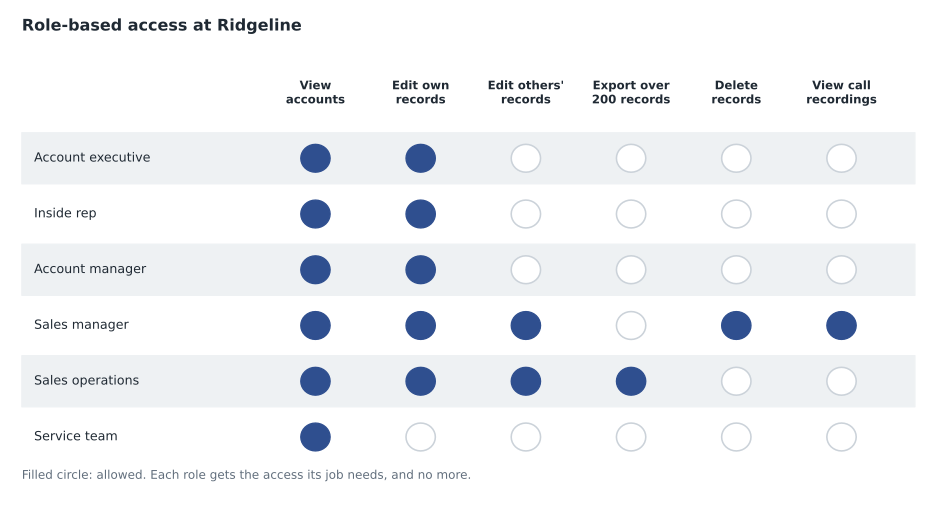
Access control decides who can see and change what. CRMs use roles and permissions so that each user sees what their job needs. The principle of least privilege means giving people the minimum access they need, not the maximum that might be convenient. At Ridgeline, account executives can see all accounts but can edit only their own; only sales operations can export more than 200 records at a time; and only managers can delete records.
Multi-factor authentication (MFA) requires a second proof of identity, such as a code from an app or a security key, as well as a password. It blocks most attacks that rely on stolen passwords, and most CRM vendors now require or strongly encourage it.
Phishing awareness matters because sales teams are prime targets. Sellers receive messages from strangers all day, and attackers pose as customers, colleagues or software vendors to get people to click a link or share a login. A message that creates urgency, asks for credentials or payment details, or comes from an address that is almost but not quite right deserves suspicion. When in doubt, contact the person through a known phone number.
Device and sharing habits close the remaining gaps: lock screens, keep devices updated, use the company's file storage rather than personal drives, share files with named people rather than with "anyone with the link", and be careful on public Wi-Fi and in public places where screens can be read.
Exports deserve special care, as the news story showed. Every export is a copy of customer data outside the system's protections. Ridgeline's rule is to export only the fields needed, store the file only in company storage, and delete it as soon as the job is done. Sales operations reviews export logs monthly.
Worked problem
Counting the exposure in an export
A seller exports a list of 1,250 contacts with 9 fields each to prepare a mailing. Only 4 fields (name, company, email and province or state) are needed. How many individual pieces of personal information were exported, how many were needed, and what fraction was unnecessary?
Show solution
- Pieces exported: 1,250 contacts times 9 fields.
- \[1250 \times 9 = 11250\]
- Pieces needed: 1,250 contacts times 4 fields.
- \[1250 \times 4 = 5000\]
- Unnecessary pieces.
- \[11250 - 5000 = 6250\]
- Fraction unnecessary.
- \[6250 \div 11250 \approx 0.56\]
Answer: About 56 in 100 of the exported pieces of information, 6,250 in all, were not needed. Exporting only the four needed fields would have cut the exposure by more than half if the file had been lost.
Vendors, AI tools and where data lives
When a company uses cloud software, its customer data is stored and processed by the vendor, often in data centers in several countries. Privacy laws generally hold the company responsible for protecting that data even when a vendor handles it, so companies review vendors' security, sign agreements that set out how data is handled, and tell customers in their privacy policies that service providers may process data, sometimes outside the country. Some customers, such as school districts, health clinics and governments, ask suppliers where their data is stored and may require it to stay in the country. When Prairie Valley asked Ridgeline whether RoomFlow's booking data was stored in the United States, Grace had a clear answer ready because she had checked during the vendor review.
The same questions apply to AI features, as lesson 10 explained: what data the assistant reads, where it is processed, whether the vendor uses it to train models, and who can see the outputs. Pasting customer information into an unapproved AI tool is, in privacy terms, disclosing it to a third party the company has not vetted.
Privacy and security in retail
Retail customer data is especially sensitive because it is about people's homes and lives: delivery addresses, phone numbers, purchase histories, financing applications. Juniper & Pine's rules for associates include asking customers for permission before creating a profile, explaining briefly what the store will use it for, never reading a customer's full details aloud on the sales floor, keeping financing applications only in the lender's secure system, and never photographing customer documents with a personal phone. When Aiden helped a customer who asked the store to delete her profile after a move, he passed the request to Bev, who forwarded it to the head office privacy contact the same day. The request was completed within two weeks, and the customer received written confirmation.
Retention and deletion
Keeping customer data forever is not safe or, in many cases, lawful. Privacy principles in both countries call for keeping personal information only as long as it is needed for its purpose. Ridgeline's retention rules, set with its lawyer, delete or anonymize unqualified leads after 24 months with no activity, delete call recordings after 12 months unless they are needed for a dispute, and mark contacts inactive when they leave a customer, then delete their personal details after a further period unless there is a reason to keep them. Financial records such as invoices and contracts are kept for the periods tax and contract law require, which are longer.
Retention rules are usually automated in the CRM and recording tools, but sellers play a part: they should not keep their own copies of recordings, exports or customer documents outside the systems where the rules run, because those copies are never deleted on schedule.
Common mistakes
MistakeBusiness contact information is never personal information.
InsteadIt is information about an individual; privacy laws often treat it differently when used for work communication, but not always, and retail data is fully personal.
MistakeExporting customer data to a personal device is fine if the seller is careful.
InsteadCustomer data should stay in company systems; exports should be minimal, stored in company storage and deleted promptly.
MistakeA small privacy breach can be fixed quietly.
InsteadReport suspected breaches immediately; the company may have legal duties to notify, and must keep records.
MistakeIf a vendor stores the data, the vendor is responsible for protecting it.
InsteadThe company remains responsible and must choose and manage vendors carefully.
MistakeMulti-factor sign-in is an unnecessary hassle.
InsteadIt blocks most attacks based on stolen passwords, the most common way accounts are compromised.
Summary and key terms
- CRMs and sales tools hold personal information, including notes, recordings and activity records, not only contact details.
- Canada relies on PIPEDA in provinces without their own laws, with Quebec's Law 25 the strictest provincial regime; the United States relies on sector laws, the FTC and a growing number of state laws.
- Fair information principles, including purpose, consent, limited collection, accuracy, safeguards and access, guide CRM practice in both countries.
- Breaches must often be reported and individuals notified; sellers should report suspected breaches immediately.
- Least-privilege access, multi-factor sign-in, phishing awareness, careful sharing and minimal exports prevent most everyday breaches.
- Companies remain responsible for data processed by vendors and AI tools, and customers may ask where their data is stored.
- Personal information
- Information about an identifiable individual.
- FTC Act, Section 5
- The federal power the FTC uses against unfair or deceptive practices, including weak data security.
- Privacy breach
- Loss of, or unauthorized access to or disclosure of, personal information.
- Least privilege
- Giving each user only the access their job needs.
- Multi-factor authentication
- Signing in with a password plus a second proof of identity.
- Phishing
- A fraudulent message designed to trick someone into revealing information or clicking a harmful link.
- Data residency
- Where data is physically stored and processed.
Practice problems
Work each problem on paper first, then reveal the answer to check.
Does South Dakota have a comprehensive consumer privacy law?
Show answer
No, but it has a data breach notification law, and customers in states such as Minnesota and Iowa are covered by those states' privacy laws.
What should a seller do first if they think a laptop with customer data has been lost?
Show answer
Report it immediately to the person the company has named, such as a manager, privacy officer or IT.
An export has 800 contacts and 10 fields; only 3 fields are needed. How many unnecessary pieces of information were exported?
Show answer
800 times 7 is 5,600.
Explain least privilege in one sentence.
Show answer
Each user gets only the access their job needs, and no more.
Lesson quiz · 5 questions
Score 60% or more to complete this lesson.
Create a free account to save your progress, take quizzes and earn a certificate.