
ROB-440 · Lesson 11 of 12 · 29 min
Cost justification and deployment
Every industrial robot project must answer a business question before it answers an engineering one: is it worth the money? A cell that is technically elegant but never pays back, or one that pays back on paper but takes a year longer than planned to reach full production, is a failure in the eyes of the people who funded it. This lesson covers the economics and the project management of industrial automation: what a robot cell really costs, which benefits can be counted, how payback, net present value and internal rate of return are calculated, how tax rules and incentives change the numbers, how projects move from a request for quotation through factory and site acceptance to full production, and how the workforce is brought along.
What a robot cell costs
Newcomers often equate the cost of automation with the price of the robot. In reality the robot arm and controller are frequently a third or less of the total project cost for a complete cell, and sometimes much less for complex tooling or vision. The rest goes to end effectors, fixtures, feeders and conveyors, safeguarding, controls and electrical work, engineering and programming, installation and commissioning, training, documentation and project management. Ongoing costs include maintenance, spare parts, energy, compressed air, software licenses and support contracts, and the people who operate and maintain the cell.
| Cost element | Typical share of a machine tending cell | Notes |
|---|---|---|
| Robot arm, controller and options | 25 to 35 percent | Safety-rated functions, vision and software options add cost |
| End effector and tooling | 10 to 20 percent | Higher with many part variants or tool changers |
| Fixtures, feeders and conveyors | 10 to 20 percent | Part presentation can dominate for loose parts |
| Safeguarding | 5 to 10 percent | Fencing, interlocks, light curtains, scanners and safety controller |
| Controls, electrical and HMI | 5 to 10 percent | PLC, panels, wiring and networks |
| Engineering, programming, simulation | 10 to 20 percent | Larger for first-of-a-kind applications |
| Installation, commissioning, training | 5 to 15 percent | Includes travel, site work and run-off |
Hidden costs catch many first-time buyers: modifying the building for floor loading, power or compressed air; changes to the part design or supplier packaging to make automation feasible; lost production during installation; scrap and slow cycles during ramp-up; and the time of internal engineers and managers. A realistic budget includes a contingency, often 10 to 15 percent for well-understood applications and more for novel ones.
Counting the benefits
The most commonly counted benefit is labor savings: if a cell replaces work previously done by people on two or three shifts, the saving is the fully loaded cost of those hours, including wages, benefits and payroll taxes, minus the cost of any staff who now operate and maintain the cell. Other benefits are often just as large but harder to quantify: higher throughput from consistent cycle times and running through breaks; better and more consistent quality, reducing scrap, rework and warranty claims; reduced injuries from heavy lifting, repetitive motion or hazardous environments, with lower compensation costs; reduced floor space; and the ability to meet demand when staff cannot be hired at all. Strategic benefits, such as keeping production in a high-cost country rather than moving it offshore, rarely appear in a spreadsheet but often drive decisions.
Worked problem
Annual savings from a palletizing cell
A palletizing cell replaces one worker per shift on two shifts, 235 working days a year. Fully loaded labor costs $34 per hour for 8-hour shifts. The cell needs 0.2 of a maintenance technician's time at $45 per hour fully loaded for 2,000 hours a year, plus $6,000 a year in parts, energy and service. Injury-related costs averaged $9,000 a year for the manual task. What are the annual net savings?
Show solution
- Labor replaced: \( 2 \times 8 \times 235 \times 34 = \$127\,840 \).
- Added maintenance labor: \( 0.2 \times 2000 \times 45 = \$18\,000 \).
- Operating costs: \( \$6\,000 \).
- Avoided injury costs: \( \$9\,000 \).
- Net: \( 127\,840 - 18\,000 - 6\,000 + 9\,000 = \$112\,840 \) per year.
Answer: About $113,000 a year, before tax. Workers whose jobs are automated are often redeployed rather than laid off, in which case the saving appears as avoided hiring rather than reduced payroll.
Payback, ROI, NPV and IRR
Simple payback is the initial investment divided by annual net savings. It is easy to understand and widely used as a screening rule; many manufacturers have historically wanted automation to pay back within about two to three years, though acceptable periods vary with company strategy and interest rates. Payback ignores the time value of money and everything that happens after the payback date. Return on investment (ROI) expresses the gain relative to cost, but definitions vary, so always ask how it was calculated.
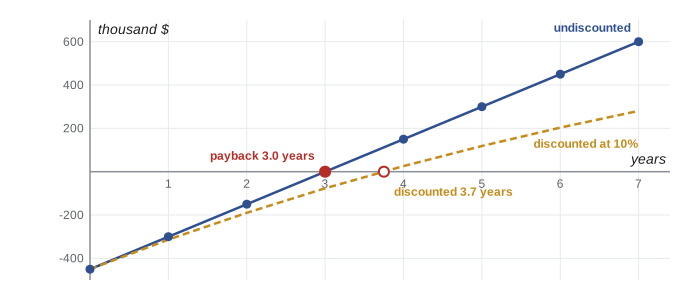
Net present value (NPV) discounts every future cash flow back to today at a rate that reflects the company's cost of capital and the project's risk, then subtracts the investment. A positive NPV means the project earns more than that required rate. The internal rate of return (IRR) is the discount rate at which NPV equals zero.
Worked problem
NPV of a robot cell
A cell costs $450,000 installed and saves $150,000 a year for 7 years, with no salvage value. The company uses a 10 percent discount rate. Find the simple payback and the pre-tax NPV.
Show solution
- Simple payback: \( 450\,000 / 150\,000 = 3.0 \) years.
- Present value factor for 7 years at 10 percent: \( \frac{1 - 1.1^{-7}}{0.1} \approx 4.868 \).
- Present value of savings: \( 150\,000 \times 4.868 \approx \$730\,300 \).
- NPV: \( 730\,300 - 450\,000 \approx \$280\,300 \).
Answer: Payback 3 years and a pre-tax NPV of about $280,000, so the project is attractive at a 10 percent hurdle rate, before considering taxes and risks.
Taxes, depreciation and incentives
Taxes change the numbers because savings are taxable income, while the cost of equipment can be recovered through depreciation. Under the Modified Accelerated Cost Recovery System (MACRS), most general manufacturing equipment, including industrial robots in typical uses, is seven-year property. The One Big Beautiful Bill Act, signed in July 2025, permanently restored 100 percent bonus depreciation for qualifying property acquired and placed in service after 19 January 2025, so a robot cell can generally be deducted in full in its first year. Section 179 expensing offers a similar first-year deduction with limits; for 2026 the limit is reported as $2,560,000, phasing out once qualifying purchases exceed $4,090,000. States have their own rules, and some do not follow federal bonus depreciation. Research credits under section 41 may apply to development work, and states and localities offer job-creation and investment incentives. Because rules and dates change, confirm current treatment with IRS guidance and a tax adviser.
# After-tax NPV in the US: 100% bonus depreciation vs 7-year MACRS (half-year convention)
cost, saving, years, r, tax = 450_000, 150_000, 7, 0.10, 0.25    # illustrative federal plus state rate
macrs7 = [0.1429, 0.2449, 0.1749, 0.1249, 0.0893, 0.0892, 0.0893, 0.0446]
def npv(dep):
    n = max(years, len(dep))
    cf = [-cost] + [(saving if t < years else 0) * (1 - tax) + (dep[t] if t < len(dep) else 0) * tax for t in range(n)]
    return sum(c / (1 + r) ** t for t, c in enumerate(cf))
bonus = [cost]
print(f"after-tax NPV, 100% bonus depreciation: ${npv(bonus):,.0f}")
print(f"after-tax NPV, 7-year MACRS: ${npv([cost * p for p in macrs7]):,.0f}")after-tax NPV, 100% bonus depreciation: $199,970 after-tax NPV, 7-year MACRS: $178,860
The comparison shows why first-year write-offs matter: the total deduction is the same, but receiving it sooner increases its present value. They matter most for capital-intensive projects and for companies that are profitable enough to use the deductions. Leasing and robots-as-a-service arrangements, in which the user pays a monthly fee that may include maintenance and upgrades, convert capital spending into operating expense and can suit smaller manufacturers or uncertain demand, though the total cost over the robot's life is usually higher.
Sensitivity and risk
Every financial model rests on assumptions: cycle time, OEE, labor rates, product volumes, product life and ramp-up time. Sensitivity analysis varies each assumption to see which ones matter most. In robot projects, the most dangerous assumptions are usually OEE, because a cell running at 65 percent instead of a planned 85 percent delivers about a quarter less output, and product volume, because a product that is discontinued after two years takes the business case with it unless the cell can be redeployed. Flexible cells with quick changeover and reprogrammable tooling reduce that risk, which is one of the strongest arguments for robots over dedicated machines.
# Sensitivity of pre-tax NPV to OEE and to product life
def npv(cost, saving, years, r=0.10):
    return -cost + sum(saving / (1 + r) ** t for t in range(1, years + 1))
def money(v):
    return ("-" if v < 0 else "") + f"${abs(v):,.0f}"
base_saving_at_85 = 150_000
for oee in (0.65, 0.75, 0.85):
    s = base_saving_at_85 * oee / 0.85          # savings scale with output
    print(f"OEE {oee:.0%}: NPV over 7 years = {money(npv(450_000, s, 7))}")
for life in (2, 3, 5, 7):
print(f"product life {life} years at 85% OEE: NPV = {money(npv(450_000, base_saving_at_85, life))}")OEE 65%: NPV over 7 years = $108,436 OEE 75%: NPV over 7 years = $194,350 OEE 85%: NPV over 7 years = $280,263 product life 2 years at 85% OEE: NPV = -$189,669 product life 3 years at 85% OEE: NPV = -$76,972 product life 5 years at 85% OEE: NPV = $118,618 product life 7 years at 85% OEE: NPV = $280,263
From request for quotation to production
Most manufacturers buy robot cells from system integrators, who design, build, program and install them using robots and components from various suppliers. A typical project moves through recognizable stages. The customer writes the user requirement specification described in Lesson 2 and issues a request for quotation, often with sample parts. Integrators propose concepts, sometimes with simulations, and prices. After selection, the integrator produces a detailed design and functional specification for review. The cell is built and tested at the integrator's facility in a factory acceptance test (FAT), where the customer verifies cycle time, quality and functions with real parts before shipment. The cell is then installed and commissioned at the plant, and a site acceptance test (SAT) confirms performance in the real environment. Finally, a production run-off at rate, perhaps over several shifts, confirms that the cell meets agreed OEE or throughput targets before final payment.
| Stage | Main deliverables | Common pitfalls |
|---|---|---|
| Requirements and RFQ | URS, sample parts, volumes, acceptance criteria | Vague requirements, unrepresentative samples |
| Concept and quotation | Layouts, simulations, cycle estimates, price | Comparing quotes with different scopes |
| Detailed design | FDS, electrical and mechanical drawings, risk assessment | Late changes to parts or scope |
| Build and FAT | Assembled cell, FAT report | Testing with too few parts or ideal parts only |
| Installation and SAT | Installed cell, SAT report, training | Utilities not ready, site differences |
| Run-off and handover | Production at rate, documentation, spare parts list | Unclear acceptance criteria, untrained staff |
Worked problem
Defining a run-off criterion
A contract requires the cell to produce at least 95 percent of its rated output of 110 parts per hour, with no more than 1 percent rejects, over a continuous 24-hour run-off excluding stops caused by the customer's upstream equipment. During the run-off, upstream starvation stopped the cell for 1.5 hours, and the cell produced 2,320 parts, of which 2,301 were good. Does it pass?
Show solution
- Eligible time: \( 24 - 1.5 = 22.5 \) h.
- Required output: \( 0.95 \times 110 \times 22.5 \approx 2351 \) parts.
- Produced: 2,320 parts, below the requirement by about 31 parts.
- Reject rate: \( 19 / 2320 \approx 0.8 \) percent, which meets the quality criterion.
Answer: It fails the output criterion while passing on quality, so the integrator must improve throughput and repeat the run-off. Clear, measurable criteria like these avoid disputes.
People and change
Automation changes jobs. Some tasks disappear, others are created: operators who supervise several cells, technicians who maintain robots and controls, programmers and engineers. Successful companies involve workers early, explain why automation is happening, and invest in training so that existing staff can fill the new roles. Where workplaces are unionized, collective agreements may require notice and consultation on technological change, and in Canada some labor relations statutes contain specific technological change provisions. Ergonomic improvement is often a genuine benefit that workers value: robots are well suited to the heavy, repetitive and awkward tasks that cause musculoskeletal injuries.
Skills shortages cut both ways. Many plants buy robots because they cannot hire enough production workers, and then struggle to find technicians who can maintain them. Community colleges and technical institutes in both countries offer robotics and automation programs, robot manufacturers offer certification courses, and apprenticeship pathways for industrial electricians and millwrights increasingly include automation content. A deployment plan should name who will operate, maintain and program the cell, what training each person needs, and how knowledge will be kept when individuals leave.
Finally, the first robot cell in a plant is as much an organizational learning project as an engineering one. Choosing a simple, high-value first application, with a capable integrator and strong internal ownership, builds confidence and skills for later projects. Ambitious first projects that run late and underperform can set a plant's automation program back by years.
Common mistakes
MistakeBudgeting only for the robot.
InsteadInclude tooling, part presentation, guarding, controls, engineering, installation, training and contingency.
MistakeUsing simple payback as the only criterion.
InsteadUse NPV and IRR with realistic assumptions, and test sensitivity to OEE and product life.
MistakeAssuming first-year write-offs always apply.
InsteadCheck current tax rules, dates and eligibility with qualified advisers.
MistakeAccepting a cell without measurable acceptance criteria.
InsteadDefine FAT, SAT and run-off criteria for rate, quality and duration in the contract.
MistakeTreating workforce change as an afterthought.
InsteadInvolve workers early, plan training and roles, and respect consultation obligations.
Summary and key terms
- The robot is often a third or less of total cell cost; tooling, presentation, guarding, controls and engineering make up the rest.
- Benefits include labor, throughput, quality, safety, floor space and the ability to produce when staff are scarce.
- Simple payback screens projects; NPV and IRR account for the time value of money.
- In the United States, 100 percent bonus depreciation was made permanent in 2025 for property acquired after 19 January 2025, alongside Section 179 expensing.
- Sensitivity to OEE and product life is critical; flexible cells reduce volume risk.
- Projects move from URS and RFQ through design, FAT, SAT and run-off with defined acceptance criteria.
- Training, worker involvement and realistic first projects determine long-term automation success.
- Simple payback
- Investment divided by annual net savings.
- Net present value (NPV)
- The sum of discounted future cash flows minus the initial investment.
- Internal rate of return (IRR)
- The discount rate at which NPV is zero.
- Tax depreciation
- Deducting the cost of equipment over time for tax purposes; in the United States, the Modified Accelerated Cost Recovery System (MACRS).
- System integrator
- A company that designs, builds and installs automation systems from components.
- Factory acceptance test (FAT)
- Testing a cell at the integrator's facility before shipment.
- Site acceptance test (SAT)
- Testing a cell after installation at the customer's plant.
- Run-off
- A production run at rate to confirm the cell meets contractual targets.
- Robots-as-a-service
- Paying a recurring fee for robot use, often including maintenance.
Practice problems
Work each problem on paper first, then reveal the answer to check.
Investment $300,000, net savings $120,000 a year: simple payback?
Show answer
2.5 years.
Present value of $100,000 received in 2 years at 8 percent?
Show answer
\( 100\,000/1.1664 \approx \$85\,700 \).
Why does a first-year write-off increase NPV if total deductions are unchanged?
Show answer
Tax savings arrive sooner, so their present value is higher.
Name three hidden costs of a robot project.
Show answer
Building changes, part or packaging redesign, production lost during installation, ramp-up scrap, internal staff time.
Planned OEE 85 percent, actual 68 percent: output shortfall?
Show answer
About 20 percent.
What is the difference between FAT and SAT?
Show answer
FAT is at the integrator before shipment; SAT is at the customer's plant after installation.
Why might leasing suit a small manufacturer?
Show answer
Lower up-front cost and predictable payments, possibly including maintenance.
Give one way to reduce product-life risk.
Show answer
Design flexible, reprogrammable cells that can be redeployed to new products.
Lesson quiz · 5 questions
Score 60% or more to complete this lesson.
Create a free account to save your progress, take quizzes and earn a certificate.