
RCDD-116 · Lesson 9 of 12 · 23 min
Specifications and bills of materials
▶ Video coming soon A video version of this lesson is on the way.
Three bids come in for Harbourview's structured cabling, and they are far apart: the highest is almost half again the lowest. Roz asks Daniel to find out why before the owner chooses. He spends a day with the bids and finds that the lowest bidder priced a cheaper cable that the specification does not allow, assumed no fiber testing beyond Tier 1, and excluded labels for pathways and firestops. The specification was clear on all three points; the bidder had not read it. The owner asks the bidder to confirm its price against the specification as written, and the price rises to the middle of the range. Daniel learns that a specification is only as useful as it is clear, complete and enforced.
What a specification does
A specification is the written part of the construction documents. It states the quality of materials and workmanship, the standards that apply, the products or performance required, the submittals the contractor must provide, how the work will be tested and accepted, and how warranties will be delivered. Drawings show where and how much; specifications show what and how well. When the two conflict, the contract usually says which governs, often with the specification taking precedence for quality and the drawings for quantity and location, but the designer's aim is to avoid conflicts entirely.
The specification is also a legal document. It forms part of the construction contract, and the contractor is bound by it. Vague words such as best quality, as required or to the satisfaction of the engineer give the designer little to enforce and the contractor little to price. Clear, specific requirements protect the owner and give every bidder the same basis for pricing.
MasterFormat and Division 27
In North America, building specifications are organized using MasterFormat, published jointly by the Construction Specifications Institute and Construction Specifications Canada. MasterFormat assigns every type of work a division and a six-digit section number. Communications work falls in Division 27, with related work in Division 26 for electrical, Division 28 for electronic safety and security, and Division 01 for general requirements that apply to the whole project. Many US owners and agencies keep their own master specifications organized by MasterFormat.
| Section | Typical title |
|---|---|
| 27 05 26 | Grounding and bonding for communications systems |
| 27 05 28 | Pathways for communications systems |
| 27 05 53 | Identification for communications systems |
| 27 08 00 | Commissioning of communications |
| 27 11 00 | Communications equipment room fittings |
| 27 13 00 | Communications backbone cabling |
| 27 15 00 | Communications horizontal cabling |
A cabling project may use some or all of these sections, or combine them into fewer sections on a small project. What matters is that every requirement appears once, in the right place, and that each section refers to related sections rather than repeating them. Requirements for firestopping, for example, usually belong in Division 07 under thermal and moisture protection, and the communications sections refer to it.
The three-part format
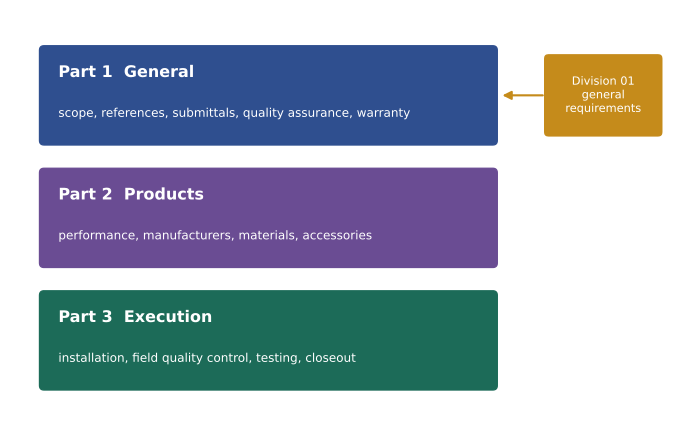
Within each section, MasterFormat's companion standard, SectionFormat, organizes the content into three parts. Part 1, General, covers the scope of the section, references to standards, definitions, submittals, quality assurance requirements such as installer certification, delivery and storage, and warranty. Part 2, Products, covers the materials and equipment: their performance, manufacturers, models and accessories. Part 3, Execution, covers installation, field quality control such as testing, cleaning, protection and closeout requirements. A reader who knows the format can find any requirement quickly, and so can the bidder pricing it.
Ways to specify products
There are four broad ways to specify what the contractor must provide, and most cabling specifications mix them.
- Performance specifications state what the product must achieve, such as Category 6A permanent link performance to ANSI/TIA-568.2, and leave the choice of product to the contractor.
- Descriptive specifications describe the product's characteristics in detail, such as conductor size, jacket rating and color, without naming a manufacturer.
- Reference standard specifications require compliance with a published standard, such as listing for a particular flame rating.
- Proprietary specifications name specific manufacturers and products, either as the only acceptable choice or as a basis of design with equals allowed.
Proprietary specifications are common in structured cabling because manufacturers warrant complete systems, as lesson 3 explained. A specification might name two or three approved manufacturer systems and require the contractor to use one of them throughout. Public owners often must allow competition, so they may require at least two named manufacturers or an or-equal clause that lets the contractor propose a substitute. The designer must then define how equals are judged and approved, usually through a substitution request with full product data submitted before bids close.
Submittals
Submittals are the documents the contractor provides for the designer's review before and during construction. They let the designer confirm that the contractor understands the requirements and that the products and methods proposed comply. Typical cabling submittals include product data sheets for every component, the manufacturer's certification of the installer, shop drawings of rack layouts and pathway routes, samples of labels, the proposed test plan with tester models and calibration certificates, and the proposed labeling scheme. The specification should list each submittal, when it is due and what it must contain.
Reviewing submittals is a major part of construction administration, covered in lesson 11. The specification sets it up by being specific. A requirement that submittals show compliance with the specification is weak; a requirement that each product data sheet be marked to show the exact model, color, rating and options proposed is strong.
Writing clear requirements
Good specification language is short, specific and in the imperative mood. Install cable in tray is better than the contractor shall be required to install cable in tray. Each requirement should be stated once. Words such as approximately, adequate or as necessary should be replaced with numbers wherever possible. And every requirement should be enforceable: if the designer cannot check it, the contractor will not price it.
| Weak | Strong |
|---|---|
| Provide adequate slack in each room. | Provide a service loop of 3 m for each horizontal cable in the telecommunications room. |
| Test all cabling to industry standards. | Certify every horizontal link as a Category 6A permanent link to ANSI/TIA-568.2 with a tester meeting ANSI/TIA-1152. |
| Label everything appropriately. | Label every cable, panel port, outlet, pathway and firestop to the identifier scheme in section 27 05 53. |
| Use high quality fiber. | Provide OS2 singlemode fiber to ANSI/TIA-568.3, in a cable listed for the space where it is installed. |
Bills of materials
A bill of materials lists every product and quantity needed to build the design. It serves several purposes. During design it supports the cost estimate. In bidding it may be issued for information to help bidders, though contractors usually prepare their own quantities. During construction it helps the designer check that the right products arrive in the right amounts. And at closeout it supports the inventory of spare parts. A bill of materials is derived from the drawings and schedules, so it should be generated from the same data wherever possible to avoid errors.
Most items are counted directly: outlets, faceplates, jacks, panels, racks, managers, enclosures. Cable is estimated from routed lengths. A common approach takes the average routed length from the pathway layout, adds slack for the room and the outlet and an allowance for waste, and multiplies by the number of cables. Cable is then rounded up to the nearest box or reel.
Quality assurance requirements
Part 1 of a cabling section usually includes quality assurance requirements that control who may do the work. Common requirements include that the contractor hold current certification from the manufacturer of the specified system; that a stated share of the installers on site hold manufacturer training certificates; that a project manager or lead technician hold a recognized industry credential; and that the contractor show experience on projects of similar size and type. These requirements help the owner get a contractor who can deliver the warranty, but they also limit competition, so public owners must balance them against their procurement rules.
Quality assurance requirements are only useful if they are checked. The specification should require proof, such as copies of certificates and a list of reference projects, as a submittal before work starts. Daniel checks the certificates for Harbourview against the manufacturer's online directory, and finds that one listed technician's certificate has lapsed. The contractor replaces the technician before he works on the project.
Testing and closeout in Part 3
Part 3 of each cabling section sets out the field quality control and closeout requirements that lessons 1 to 5 described: which tests are performed, to which limits and with which equipment; how results are submitted and in what format; what labels and records are required; what documentation is delivered at closeout; and what training is given. These requirements are where the specification protects the owner's long-term interests, and they deserve as much care as the product requirements in Part 2. A specification that names excellent products but says nothing about testing or documentation will often deliver excellent products with no proof of performance and no usable records.
Daniel's specifications for Harbourview put the testing requirements in the horizontal and backbone cabling sections, and the documentation and labeling requirements in the identification section, with each section referring to the others. When the contractor prices the job, it can find the testing scope in one place, and when Daniel reviews the test results, he can cite the clause that each result must meet.
Allowances, alternates and unit prices
Specifications can also shape how the work is priced. An allowance is a fixed sum included in the contract for work not yet fully defined, such as cabling for a tenant area whose layout is unknown; the actual cost is adjusted against it later. An alternate asks bidders to price an option, such as Category 8 cabling in the data room or extra spare outlets, so that the owner can decide after bids arrive whether to include it. Unit prices ask bidders to price a single item, such as one additional link of a stated length, so that changes during construction can be priced quickly and fairly. Lesson 11 shows how unit prices make change pricing easier.
Worked problem
Estimating cable quantity
The third floor at Harbourview has 570 horizontal cables. The average routed length from the pathway layout is 46 meters. Each cable gets 3 meters of slack in the room and 0.3 meters at the outlet, plus a waste allowance of one tenth. Cable comes in boxes of 305 meters. How many boxes are needed?
Show solution
- Length per cable before waste: 46 + 3 + 0.3 = 49.3 meters.
- With waste: 49.3 × 1.1 = 54.23 meters.
- Total cable: 570 × 54.23 = 30,911 meters.
- Boxes: 30,911 / 305 = 101.3, so 102 boxes.
Answer: 102 boxes of 305 meters. Contractors often check this against how many whole cable runs fit in each box, which can push the count higher.
Worked problem
Runs per box
Using the same cables, how many whole runs of 54.23 meters can be pulled from one 305-meter box, and how many boxes does that imply?
Show solution
- Runs per box: 305 / 54.23 = 5.6, so 5 whole runs.
- Boxes: 570 / 5 = 114 boxes.
Answer: 114 boxes. The leftover length in each box can be used for shorter runs, so the real number falls between 102 and 114, depending on how runs are grouped.
Linking the specification, drawings and bill of materials
The three documents must agree. Every product on the drawings must be specified, every product in the specification must appear in the bill of materials, and every quantity in the bill must match the drawings and schedules. Daniel's final check before issuing the Harbourview documents is to compare the outlet schedule, the bill of materials and the drawing counts with a spreadsheet, and to search the specification for every product type on the drawings. He finds a floor box shown on the drawings with no matching product in the specification and adds it before issue, saving a question during bidding.
Common mistakes
MistakeUsing vague words such as adequate or as required.
InsteadState requirements as numbers or specific references.
MistakeRepeating the same requirement in several sections.
InsteadState each requirement once and refer to it elsewhere.
MistakeAllowing equals without a process for judging them.
InsteadDefine how substitutions are requested, judged and approved.
MistakeEstimating cable from straight-line distances.
InsteadUse routed lengths plus slack and waste.
MistakeLetting drawings, specifications and bills of materials drift apart.
InsteadCheck that every product and quantity agrees across all three.
Summary and key terms
- Specifications state the quality, standards, products, submittals, testing and warranties for the work.
- MasterFormat organizes specifications into divisions and sections; communications work is Division 27.
- Each section has three parts: General, Products and Execution.
- Products may be specified by performance, description, reference standard or proprietary name.
- Submittals let the designer confirm compliance before and during construction.
- A bill of materials lists every product and quantity and must agree with the drawings and specification.
- MasterFormat
- The North American system for organizing specifications by division and section.
- SectionFormat
- The three-part organization of each specification section.
- Performance specification
- A requirement stated as what a product must achieve.
- Proprietary specification
- A requirement that names specific manufacturers or products.
- Submittal
- A document the contractor provides for the designer's review.
- Bill of materials
- A list of every product and quantity needed to build the design.
Practice problems
Work each problem on paper first, then reveal the answer to check.
Which MasterFormat division covers communications?
Show answer
Division 27.
What are the three parts of a specification section?
Show answer
General, Products and Execution.
Rewrite 'provide adequate slack' as a strong requirement.
Show answer
Provide a 3 m service loop for each cable in the room.
A floor needs 400 cables at 50 m each with no waste. How many 305 m boxes?
Show answer
66.
Why do cabling specifications often name manufacturers?
Show answer
Because extended warranties cover complete systems from one manufacturer.
Where do firestopping requirements usually belong?
Show answer
In Division 07.
Lesson quiz · 5 questions
Score 60% or more to complete this lesson.
Create a free account to save your progress, take quizzes and earn a certificate.